To improve the reliability of optical transmission systems, failures need to be addressed in their predictive stages. In this study, we proposed a method to locate and identify anomalies by utilizing receiver-side quality data. The proposed method can locate and identify seven out of seven anomalies simulated in experiment.
We propose novel methodology to identify and localize soft-failures using performance metrics monitored at repeater nodes in addition to signal quality monitored at transponders and show feasibility in experiments using commercial equipment and field-deployed fibers.
NTT Network Innovation Center is developing technologies and systems for the practical implementation of an optical transmission network, the key element for implementing the All-Photonics Network (APN), which in turn will support IOWN (the Innovative Optical and Wireless Network).With our nextgeneration optical transmission network, which is an advance release of the APN, we are working to increase speed and capacity to handle growing communication traffic as well as provide open optical interfaces for connecting various systems and devices without photoelectric conversion to enhance the added value provided by optical networks and develop operations and maintenance technologies for these networks.
The rapid increase in Internet traffic is expected due to the spread of network services such as 5G (fifth-generation mobile communication), Internet of Things, and cloud.To economically expand the capacity in the core network of the NTT Group, NTT Network Innovation Center developed the Beyond 100G Optical Cross Connect (B100G-OXC) system, which enables beyond 100-Gbit/s per wavelength optical transmission.This article gives an overview of this system.
A silent failure is a kind of failure that existing optical devices or equipment cannot detect although the failure actually happens. This failure makes it more difficult for maintenance operators to identify the fault point, which potentially deteriorates the reliability of the network. To address this issue, we propose a unique silent failure localization method using characteristic information obtained from the optical devices and equipment. As an example of the silent failures, a wavelength selective switch (WSS) failure is studied, and we propose a detection and localization scheme based on the method to use in a WSS failure scenario. Results of a field experiment revealed that the proposed scheme properly localize the fault point with an accuracy of within 4%.
The core network is the backbone of society's telecommunications infrastructure, and it therefore requires rapid failure localization in order to handle diverse types of failures.This article introduces a failure localization method being studied by NTT Network Service Systems Laboratories in collaboration with an NTT Group company.
An optical transport network is composed of optical transport systems deployed in thousands of office-buildings. As a common infrastructure to accommodate diversified communication services with drastic traffic growth, it is necessary not only to continuously convey the growing traffic but also to achieve high end-to-end communication quality and availability and provide flexible controllability in cooperation with service layer networks. To achieve high-speed and large-capacity transport systems cost-effectively, system configuration, applied devices, and the manufacturing process have recently begun to change, and the cause of failure or performance degradation has become more complex and diversified. The drastic traffic growth and pattern change of service networks increase the frequency and scale of transport-capacity increase and transport-network reconfiguration in cooperation with service networks. Therefore, drastic traffic growth affects both optical-transport-system configuration and its operational cycles. In this paper, we give an overview of the operational problems emerging in current nationwide optical transport networks, and based on trends analysis for system configuration and network-control schemes, we propose a vision of the future nationwide optical-transport-network architecture expressed using five target features.
We propose algorithms that uses fast graph mining for resolving the network topology to a locally regulated area defined as a component of network topology. Though the IP backbone network should be reconfigured periodically in accordance with environmental changes, reconfiguration results in heavy workload, such as routing re-designs or testing these re-designs for network operators. If a network can be reconfigured within the component, however, we can drastically reduce the operation workload for network reconfiguration. For finding the components from the network topology, we should solve the subgraph isomorphism problem, which is NP-hard. We propose the heuristic graph mining algorithm that reduces the size of search space by considering network operating conditions. We visualize the results of components analysis, and show that the computation finishes within the practical time.
This paper proposes a recommendation-based bandwidth calendaring system for packet transport networks. The system provides a user-portal interface with which users can directly reserve packet transport resources. In this regard, the system recommends multi-grade (e.g., multi-price) reservation plans. By adjusting grades of plans in accordance with network resource utilization, this system provides not only reservation flexibility for users but also efficient utilization of network resources. For recommending multi-grade plans, pre-computation of resource allocation is required for every time slot. Because the number of time slots is huge, we also propose an algorithm for fast computation of resource allocation based on time-slot aggregation. Our evaluation suggests that our algorithm can produce a sub-optimal solution within quasi-real time for a large-scale network. We also show that our recommendation-based system can increase the service-provider-revenue in peaky traffic demand environments.
Router virtualization is becoming more common as a method that uses network (NW) equipment effectively and robustly similar to server virtualization. Edge routers, which are gateways of core NWs, should be virtualized because they have many functions and resources just as servers do. To virtualize edge routers, a metro NW, which is a wide area layer-2 NW connecting each user's residential gateway to edge routers, must trace dynamic edge router re-allocation by changing the route of each Ethernet flow. Therefore, we propose a scalable centralized control architecture of a virtual layer-2 switch on a metro NW to trace virtual router reallocation and use metro NW equipment effectively. The proposed scalable control architecture improves the centralized route control performance by processing in parallel on a flow-by-flow basis taking into account route information even in the worst case where edge routers fail. In addition, the architecture can equalize the load among parallel processes dynamically by using two proposed load re-allocation methods to increase the route control performance stably while minimizing the amount of resources for the control. We evaluate the scalability of the proposed architecture through theoretical analysis and experiments on a prototype and show that the proposed architecture increases the number of flows accommodated in a metro NW. Moreover, we evaluate the load re-allocation methods through simulation and show that they can evenly distribute the load among parallel processes. Finally, we show that the proposed architecture can be applied to not only large-scale metro NWs but also to data center NWs, which have recently become an important type of large-scale layer-2 NW.
We report a flow burst conversion system for efficient flow aggregation corresponding to virtual machine migration in future metro networks. Experimental results show the routes of flows were changed at high speed via optical TDM paths while accommodating 100k flows.
Power consumption of network (NW) equipment has been rapidly increasing; therefore it is necessary to build a resource-efficient NW. Router virtualization, which involves dynamically re-allocating virtual routers to physical resources as server virtualization, is becoming more common as a method of using NW equipment effectively and robustly. Edge routers which are gateways of core NWs should be virtualized because they have many functions and resources just as servers do. A metro NW is a wide area layer-2 aggregation NW that connects each user's residential gateway to edge routers. To achieve edge router virtualization, the metro NW must trace dynamic edge router re-allocation by changing the route of each Ethernet flow. Therefore, we previously proposed a virtual layer-2 switch architecture with scale-out control that can improve route control performance to trace dynamic virtual router re-allocation to use metro NW equipment effectively and robustly. The routes are controlled in parallel flow-by-flow on this architecture. When edge router failure occurs, the controller must change the routes of all flows passing through the failed edge router. On the other hand, load imbalance of this route change occurs among parallel processes. If we can distribute this load evenly, we can decrease resources for the controller deployed in advance. Therefore, in this paper we propose two re-allocation methods for allocating flows to parallel processes according to the virtual router re-allocation. We evaluated the methods through simulation and showed that they can evenly distribute load among parallel processes not only in large-scale metro NWs, but also in data center NWs, which have recently become an important type of large-scale layer-2 NW.
Power consumption of network equipment has been rapidly increasing, so it is therefore necessary to build a resource efficient network (NW). Router virtualization, which involves dynamically reallocating virtual routers to physical resources as a server virtualization, is becoming more common as a way to use network equipment effectively and robustly. Especially, edge router which is gateway of core network should be virtualized, because edge routers have many functions and resources just as servers do. A metro NW is wide area layer-2 aggregation NW that connects each user's residential gateway to edge routers. To achieve edge router virtualization, the metro NW must trace the dynamic edge router reallocation by changing a route of each Ethernet flow. Furthermore, access/metro NWs occupy a large proportion of the total NW power consumption, so logically centralized control architecture suits to the metro NW to change routes flexibly because it can use resources effectively by avoiding resource deployment in many locations. However, it is not scalable. When many Ethernet flows need to be accommodated in a metro NW, it can not change routes of the flows quickly enough. Therefore, we propose a virtual wide area layer-2 switch architecture with scale-out control that can improve the route control performance even in a worst case edge router node failure by processing in parallel flow-by-flow, by considering route information, and by rebalancing the load between parallel processes dynamically. We evaluated the proposed architecture through theoretical analysis and experiments with prototype. The results showed that the proposed architecture can increase the number of flows accommodated in a metro NW.
Many functions for various network services (e.g. IP telephone, ISP connection and IP-VPN) are deployed on a broadband network, especially at the boundary between an access network and core network in the broadband network. The network service must be identified from each packet and the packet must be processed appropriately for that service. IP traffic in the broadband network is increasing sharply, so traffic distribution based on service identification may bottleneck when many different network services are provided in the network. Therefore, we propose an offload method for traffic distribution based on service identification to service processing parts, which process the packets for each network service appropriately. This method does not require additional functions in user terminals, and it more scalable than the method in which all traffic undergoes the service identification process. However, control of the proposed method is slightly more complex, so we established a control procedure and checked it in combination with user terminals. In addition, we evaluated by theoretical analysis the scalability of traffic distribution with offload compared to the method without offload. The results showed that the proposed offload method can increase the scalability of traffic distribution based on service identification.
We propose a capacitive averaging technique applied to a double-tail latched comparator without a preamplifier for an offset reduction technique. Capacitive averaging can be introduced by considering the first stage of the double-tail latched comparator as a capacitive loaded amplifier. This makes it possible to reduce the offset voltage while preventing an increase in power dissipation. A positive feedback technique is also used for the first stage, which maximizes the effectiveness of the capacitive averaging. The capacitive averaging mechanism and the relationship between the offset reduction and the linearity of the amplifier is discussed in detail. Simulation results for a 90-nm CMOS process show that the proposed technique can reduce the offset voltage by 1/3.5 (3mV) at a power dissipation of only 45µW.
Internet protocol (IP) networks need admission control mechanism to provide full-fledged multimedia services. Therefore we previously proposed an admission control scheme called the "tentative accommodating and congestion confirming strategy (TACCS)". The basic idea of TACCS is to tentatively accommodate incoming flows and then, after a certain period, determine whether accommodating them has created congestion. In this scheme, the ingress nodes of a domain make flow- accommodation decisions based on packet-loss event information. The information is assumed to be advertised from congestion detection agents (CDAs) located in the domain. However, adding CDA functionality to core nodes is a barrier to deploy TACCS and limits its scalability. Thus, we furthermore developed an enhanced version called "edge-based TACCS" that performs admission control on the basis of only cooperation between edge nodes- it does not depend on CDAs in the core network. In this paper, we compared the operation of the edge-based version with that of the core-node-supported TACCS and investigated a problem: some flows, which should be rejected in the core- node-supported version, could be wrongly accommodated in the edge-based TACCS. Theoretical analysis of this "rejection failure" problem showed that it does not significantly degrade flow quality, meaning that edge-based TACCS is feasible.
 Rie Hayashi合作论文数5
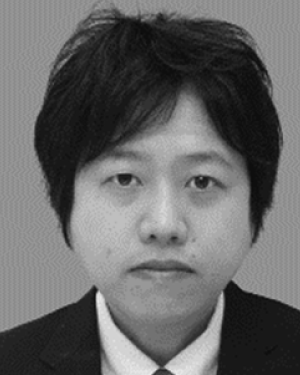 Shohei Kamamura合作论文数NTT Corporation5Hideki Maeda合作论文数4
 Hiroshi Yamamoto合作论文数4
 Kenichi Higuchi (樋口健一)合作论文数Department of Electrical Engineering, Faculty of Science and Technology, Tokyo University of Science4
 Yoshihiko Uematsu合作论文数Dept. of Mech. and Systems Eng. 1-1, Gifu Univ.4
 Masaru Katayama合作论文数4Aki Fukuda合作论文数NTT Corp, NTT Network Serv Syst Labs, 9-11 Midori Cho 3 Chome, Musashino, Tokyo 1808585, Japan3
 Kenta Yasukawa合作论文数3Akira Misawa合作论文数3Daisaku Shimazaki合作论文数2Katsutoshi Koda合作论文数2Takeshi Seki合作论文数2Takeshi Kawasaki合作论文数2Takashi Kubo合作论文数2
 Hiroki Kawahara合作论文数Osaka Univ.;c;Osaka Univ.2
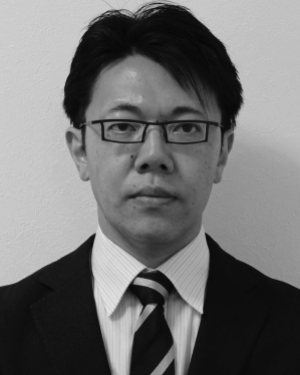 Kyota Hattori合作论文数2Kurimoto, T.合作论文数2Kouichi Genda合作论文数2Katsunori Yamaoka合作论文数2
 Ken-Ichi Baba合作论文数Osaka University, Japan
2Suda Sachio合作论文数1Hideaki Iwata合作论文数1mai arita合作论文数1Kouhei Watanabe合作论文数1hiroaki ogawa合作论文数1Yutaka Fukuchi合作论文数1Ogawa, H.合作论文数1Takahiro Kobayashi合作论文数1Masahiro Nakagawa合作论文数1Shinichiro Chaki合作论文数1
Ken-Ichi Baba合作论文数Osaka University, Japan
2Suda Sachio合作论文数1Hideaki Iwata合作论文数1mai arita合作论文数1Kouhei Watanabe合作论文数1hiroaki ogawa合作论文数1Yutaka Fukuchi合作论文数1Ogawa, H.合作论文数1Takahiro Kobayashi合作论文数1Masahiro Nakagawa合作论文数1Shinichiro Chaki合作论文数1 Kenichi Ohhata合作论文数1
 Kentaro Ogawa合作论文数1
 Fumikazu Inuzuka合作论文数1Takashi Miyamura合作论文数NTT Network Service Systems Laboratories1




