Drivers' drowsiness is one of the main causes of car accidents or near-missed accidents. This has been proven by many studies that established links between driver's drowsiness and road accidents. The objective of this study was to analyze the EEG changes in fatigued subjects while performing a simulated driving task. After a night of sleep deprivation, eight subjects were given a dose of caffeine to reduce drowsiness. During about 50 min of continuous driving, car movements and subject behaviors were recorded on video cameras, and 8 channels of EEG were also recorded. Three basic indices, three ratio indices, and two burst indices were calculated from preprocessed EEG signals. EEG alpha,beta, beta/alpha and (alpha+theta)/beta indices showed significant differences between driving periods. In the comparison of road type, EEG alpha,beta, beta/alpha and (alpha+ theta)/beta indices of the straight section of the driving task were significantly different from those of the curved section. This study also analyzed EEG changes before and after car accidents, showing that beta and (alpha+ theta)/beta were related to the mental alertness level. In the analysis of burst activity, theta burst activity, which was not significant in the mean power analysis, was significantly different between driving sessions.
Analysis of finger motion is an important aspect of hand motion analysis. Studies on finger motion have been relatively few due to the lack of suitable measurement devices. With the advances of sensor technology, devices such as CyberGlove(TM) now have the capability of measuring finger articulation angles in real time. The objective of this study was to analyze repetitive finger flexion and extension with the measurement data from the CyberGlove(TM) System.To investigate the dynamic characteristics of the finger movement, the dynamic equations of motion from robot arm dynamics was adopted and modified. Hand anthropometric data such as the mass of finger segment, length of finger segment, and thickness of joint were measured for eight male subjects. CyberGlove(TM) was used to measure joint angles of each finger during repetitive flexion and extension. Two kinds of flexion and extension motion were studied. A barehand finger flexion and extension wearing the CyberGlove(TM) was studied first. A keyboard-typing task was studied as the simulation of the real task.Results from the two experiments with repetitive finger flexion and extension showed that the dynamic characteristics of the finger motion should be included in the consideration of the loads on the hand during manual task. The result also showed that, unlike the assumptions employed by many studies, finger motion is significantly different between different fingers and joints. When compared with the simulation result from literature, our result showed that the proximal interphalangeal and distal interphalangeal movement for the index finger corresponded well with the simulation results while other joints did not. This study also showed that the dynamic equations of motion can be used to calculate angular moments of the finger joints.Relevance to industryMost of the workers are still using manual tools to carry out tasks. In order to design and evaluate manual tasks and tools, dynamic modeling of hand motion is of importance. This study deals with 2-D dynamic model for finger motion that is an important aspect of hand motion analysis. (C) 2002 Elsevier Science B.V. All rights reserved.
The purpose of this study was to investigate the relationship between self-reported musculoskeletal symptoms and related factors among VDT operators working in banks. The subjects were 950 female bank tellers. This study was the first nation-wide survey on WMSDs carried out to specify the prevalence of WMSDs and to identify demographic and task-related factors associated with work related musculoskeletal disorders (WMSDs) symptoms. The resulting prevalence rates were much higher than similar studies conducted in other countries, in the more than severe' category for the Likert scale, subjects reported 51.4% for the shoulder, 38.3% for the lower back, 38.3% for the neck, 31.2% fbr the upper back, 21.7% for the wrist, and 13.6% for the fingers. The demographic characteristics affecting the WMSD symptoms were marital status, number of children and daily time spent on housework. Task-related factors affecting the symptoms were VDT working experience daily working time, daily VDT use, VDT use time without rest, daily workload, and the amount of rest breaks. Multiple logistics regression showed that daily working time, daily VDT use time, and VDT working experience were significant variables accounting for the symptoms.
The purpose of this study was to evaluate the manual workload on repetitive wrist and finger motions. To evaluate the manual workload, angular displacement of the joint, EMG of the muscle and subjective rating were studied. A screw-driving task was used for the wrist motion experiment. A keyboard-typing task was used for the finger motion experiment. Repetition rates of 0.5, 1, 2 motions per second were used with each task. As a result, manual workload increased with increasing repetitiveness. Peak spectral magnitude and frequency components corresponded closely with joint angular displacement amplitudes and repetition rates. Results of the correlation analysis showed that there were significant correlations among EMG, frequency-weighted filtering and subjective measurement. Both EMG and frequency-weighted filtering showed consistent workload estimation with increasing task frequency. Subjective ratings showed a slight over-estimation of the workload as the task frequency is increased.
 Myung Hwan Yun合作论文数Department of Industrial Engineering, Seoul National University6
 Tae Young Park合作论文数2
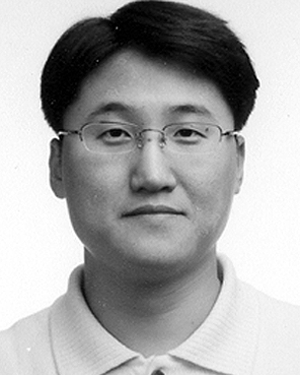 wooyoung jang合作论文数1
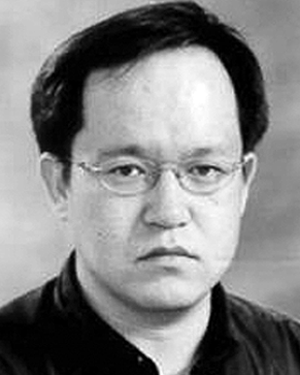 hongsig kim合作论文数1kyungho kim合作论文数1Mun Sung Han合作论文数1Chul Woo Kim合作论文数1Min K. Chung合作论文数1Yun Geun Lee合作论文数1Ochae Kwon合作论文数1
 Youngbo Suh合作论文数Korea Institute for Defense Analyses1Sang Hyuk Lim合作论文数1




