There is growing interest in understanding geographic patterns of medical device-related adverse events (AEs). A spatial scan method combined with the likelihood ratio test (LRT) for spatial-cluster signal detection over the geographical region is universally used. The spatial scan method used a moving window to scan the entire study region and collected some candidate sub-regions from which the spatial-cluster signal(s) will be found. However, it has some challenges, especially in computation. First, the computational cost increased when the number of sub-regions increased. Second, the computational cost may increase if a large spatial-cluster pattern is present and a flexible-shaped window is used. To reduce the computational cost, we propose a Bayesian nonparametric method that combines the ideas of Markov random field (MRF) to leverage geographical information to find potential signal clusters. Then, the LRT is applied for the detection of spatial cluster signals. The proposed method provides an ability to capture both locally spatially contiguous clusters and globally discontiguous clusters, and is manifested to be effective and tractable using hypothetical Left Ventricular Assist Device (LVAD) data as an illustration.
Although basketball is a dynamic process sport, played between two sides of five players each, learning some static information is essential for professional players, coaches, and team managers. In order to have a deep understanding of field goal attempts among different players, we propose a zero‐inflated Poisson model with clustered regression coefficients to learn the shooting habits of different players over the court and the heterogeneity among them. Specifically, the zero‐inflated model captures a large portion of the court with zero field goal attempts, and the mixture of finite mixtures model captures the heterogeneity among different players based on clustered regression coefficients and inflated probabilities. Both theoretical and empirical justification through simulation studies validate our proposed method. We apply our proposed model to data from the National Basketball Association (NBA), for learning players' shooting habits and heterogeneity among different players over the 2017–2018 regular season. This illustrates our model as a way of providing insights from different aspects.
Investigating relationships between response variables and covariates in areas such as environmental science, geoscience, and public health is an important endeavor. Based on a Bayesian mixture of finite mixtures model, we present a novel spatially clustered coefficients regression model for count value data. The proposed method detects the spatial homogeneity of the Poisson regression coefficients. A Markov random field constrained mixture of finite mixtures prior provides a regularized estimator of the number of clusters of regression coefficients with geographical neighborhood information. As a by-product, we also provide the theoretical properties of our proposed method when the Markov random field is exchangeable. An efficient Markov chain Monte Carlo algorithm is developed by using the multivariate log gamma distribution as a base distribution. Simulation studies are carried out to examine the empirical performance of the proposed method. Additionally, we analyze Georgia's premature death data as an illustration of the effectiveness of our approach. The supplementary materials are provided on GitHub at https://github.com/pengzhaostat/MLG_MFM.
Accurate spatial information of farmland in small farms is very important to provide operable information to farmers, managers and decision makers. However, small farms have small area, irregular shape, and use a variety of planting crops, which makes their boundaries blurred, and the standard edge detection algorithm cannot accurately segment the farmland boundary. Therefore, the automatic delimitation of fields in small farms is a challenging task. Aiming at the above problems, this paper proposes an example segmentation method of Mask R-CNN based on dual attention mechanism feature pyramid network (DAFPN) to describe small farms. DAFPN is composed of two attention modules: spatial attention module (SPA) and channel attention module (CHA) to enhance its feature extraction ability. Spatial attention module (SPA) generates spatial attention map by using the spatial relationship of features, and generates information to be emphasized or suppressed in spatial location; The channel attention module (CHA) learns an adaptive channel merging method based on the attention mechanism. Our proposed DAFPN can be easily inserted into the existing FPN model. We have conducted extensive experimental analysis on very high resolution (VHR) satellite images based on the Mask R-CNN deep learning framework of DAFPN. The standard COCO dataset evaluation index and F1-score evaluation strategy are used to compare the algorithm. AP50, AP75 and F1-score reach 82.86%, 55.51% and 70.90% respectively, which is 8.7%, 8.31% and 6.87% higher than Mask R-CNN respectively. Our results highlight the ability of Mask R-CNN based on DAFPN to accurately depict small farms in VHR satellite images, which lays a foundation for the automatic segmentation of small farms.
Understanding shooting patterns among different players is a fundamental problem in basketball game analyses. In this paper, we quantify the shooting pattern via the field goal attempts and percentages over twelve non-overlapping regions around the front court. A joint Bayesian nonparametric mixture model is developed to find latent clusters of players based on their shooting patterns. We apply our proposed model to learn the heterogeneity among selected players from the National Basketball Association (NBA) games over the 2018–2019 regular season and 2019–2020 bubble season. Thirteen clusters are identified for 2018–2019 regular season and seven clusters are identified for 2019–2020 bubble season. We further examine the shooting patterns of players in these clusters and discuss their relation to players’ other available information. The results shed new insights on the effect of NBA COVID bubble and may provide useful guidance for player’s shot selection and team’s in-game and recruiting strategy planning.
Hard foreign objects such as bricks, wood, metal materials, and plastics in orchard soil can affect the operational safety of garden machinery. Ground-Penetrating Radar (GPR) is widely used for the detection of hard foreign objects in soil due to its advantages of non-destructive detection (NDT), easy portability, and high efficiency. At present, the degree of automatic identification applied in soil-oriented foreign object detection based on GPR falls short of the industry’s expectations. To further enhance the accuracy and efficiency of soil-oriented foreign object detection, we combined GPR and intelligent technology to conduct research on three aspects: acquiring real-time GPR images, using the YOLOv5 algorithm for real-time target detection and the coordinate positioning of GPR images, and the construction of a detection system based on ground-penetrating radar and the YOLOv5 algorithm that automatically detects target characteristic curves in ground-penetrating radar images. In addition, taking five groups of test results of detecting different diameters of rebar inside the soil as an example, the obtained average error of detecting the depth of rebar using the detection system is within 0.02 m, and the error of detecting rebar along the measuring line direction from the location of the starting point of GPR detection is within 0.08 m. The experimental results show that the detection system is important for identifying and positioning foreign objects inside the soil.
Bayesian spatial modeling of heavy-tailed distributions has become increasingly popular in various areas of science in recent decades. We propose a Weibull regression model with spatial random effects for analyzing extreme economic loss. Model estimation is facilitated by a computationally efficient Bayesian sampling algorithm utilizing the multivariate Log-Gamma distribution. Simulation studies are carried out to demonstrate better empirical performances of the proposed model than the generalized linear mixed effects model. An earthquake data obtained from Yunnan Seismological Bureau, China is analyzed. Logarithm of the Pseudo-marginal likelihood values are obtained to select the optimal model, and Value-at-risk, expected shortfall, and tail-value-at-risk based on posterior predictive distribution of the optimal model are calculated under different confidence levels.
In this paper, we propose a Susceptible-Infected-Removal (SIR) model with time fused coefficients. In particular, our proposed model discovers the underlying time homogeneity pattern for the SIR model's transmission rate and removal rate via Bayesian shrinkage priors. MCMC sampling for the proposed method is facilitated by the nimble package in R. Extensive simulation studies are carried out to examine the empirical performance of the proposed methods. We further apply the proposed methodology to analyze different levels of COVID-19 data in the United States.
We propose a method of spatial prediction using count data that can be reasonably modeled assuming the Conway-Maxwell Poisson distribution (COM-Poisson). The COM-Poisson model is a two parameter generalization of the Poisson distribution that allows for the flexibility needed to model count data that are either over or under-dispersed. The computationally limiting factor of the COM-Poisson distribution is that the likelihood function contains multiple intractable normalizing constants and is not always feasible when using Markov Chain Monte Carlo (MCMC) techniques. Thus, we develop a prior distribution of the parameters associated with the COM-Poisson that avoids the intractable normalizing constant. Also, allowing for spatial random effects induces additional variability that makes it unclear if a spatially correlated Conway-Maxwell Poisson random variable is over or under-dispersed. We propose a computationally efficient hierarchical Bayesian model that addresses these issues. In particular, in our model, the parameters associated with the COM-Poisson do not include spatial random effects (leading to additional variability that changes the dispersion properties of the data), and are then spatially smoothed in subsequent levels of the Bayesian hierarchical model. Furthermore, the spatially smoothed parameters have a simple regression interpretation that facilitates computation. We demonstrate the applicability of our approach using simulated examples, and a motivating application using 2016 US presidential election voting data in the state of Florida obtained from the Florida Division of Elections.
It is increasingly understood that the assumption of stationarity is unrealistic for many spatial processes. In this article, we combine dimension expansion with a spectral method to model big non-stationary spatial fields in a computationally efficient manner. Specifically, we use Mejía and Rodríguez-Iturbe’s (1974) spectral simulation approach to simulate a spatial process with a covariogram at locations that have an expanded dimension. We introduce Bayesian hierarchical modeling to dimension expansion, which originally has only been modeled using a method of moments approach. We consider a novel scheme to re-weight levels in a Bayesian spatial hierarchical model that allows one to use non-stationary spectral simulation within a collapsed Gibbs sampler. Our method is both full rank and non-stationary, and can be applied to big spatial data because it does not involve storing and inverting large covariance matrices. We demonstrate the wide applicability of our approach through simulation studies, and an application using ozone data obtained from the National Aeronautics and Space Administration (NASA).
In this paper, we develop a group learning approach to analyze the underlying heterogeneity structure of shot selection among professional basketball players in the NBA. We propose a mixture of finite mixtures (MFM) model to capture the heterogeneity of shot selection among different players based on the Log Gaussian Cox process (LGCP). Our proposed method can simultaneously estimate the number of groups and group configurations. An efficient Markov Chain Monte Carlo (MCMC) algorithm is developed for our proposed model. Simulation studies have been conducted to demonstrate its performance. Finally, our proposed learning approach is further illustrated in analyzing shot charts of selected players in the NBA's 2017–2018 regular season.
Tian et al. (2021) proposed the Susceptible-Unidentified infectious-Self-healing without being confirmed-Confirmed cases (SIHC) model that divides the population into four compartments as opposed to three, which is assumed by the popular Susceptible-Infectious-Recovered model (SIR; Kermack and McKendrick, 1927).Specifically, the authors divided the infectious compartment into those who exhibit symptoms, and asymptomatic carriers.Instead of using a recovered/removed compartment, the authors assumed that individuals in the infectious compartment eventually end up confirmed and hospitalized or quarantined, or self-healed without being confirmed.This novel segregation is of practical value as it matches the current practices in fighting COVID-19.In the rest of this discussion, we comment on the approach that the authors have proposed, and suggest some possible extension of the work for future research.
Generalized linear models are routinely used in many environment statistics problems such as earthquake magnitudes prediction. Hu et al. proposed Pareto regression with spatial random effects for earthquake magnitudes. In this paper, we propose Bayesian spatial variable selection for Pareto regression based on Bradley et al. and Hu et al. to tackle variable selection issue in generalized linear regression models with spatial random effects. A Bayesian hierarchical latent multivariate log gamma model framework is applied to account for spatial random effects to capture spatial dependence. We use two Bayesian model assessment criteria for variable selection including Conditional Predictive Ordinate (CPO) and Deviance Information Criterion (DIC). Furthermore, we show that these two Bayesian criteria have analytic connections with conditional AIC under the linear mixed model setting. We examine empirical performance of the proposed method via a simulation study and further demonstrate the applicability of the proposed method in an analysis of the earthquake data obtained from the United States Geological Survey (USGS).
 Guanyu Hu合作论文数Univ Connecticut, Dept Stat, Storrs, CT 06269 USA9
 Yishu Xue合作论文数Univ Connecticut, Dept Stat, Storrs, CT 06269 USA5
 Yuqing Pan合作论文数Microsoft2
 Jonathan Bradley合作论文数2
 Zuoxi Zhao (赵祚喜)合作论文数College of Engineering, South China Agricultural University2
 Dipak Dey合作论文数University of Connecticut Department of Statistics2Shuyuan Luo合作论文数1
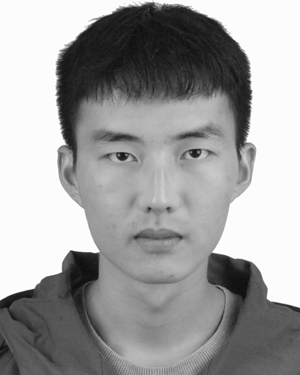 Yuan Huang合作论文数1
 Peng Zhao合作论文数Department of Applied Economics and Statistics, University of Delaware1Eliot Wong-Toi合作论文数1Borui Xiang合作论文数1Lijiang Geng合作论文数1
 Qingyang Liu合作论文数School of Mechanical Engineering, University of Leeds1
 Zhi Qiu合作论文数1
 Weining Shen合作论文数Department of Statistics, University of California, Irvine1
 Ming-Hui Chen合作论文数Department of Statistics, College of Liberal Arts and Sciences, University of Connecticut1




