The field of knowledge level modelling has achieved great success when applied to various domains, yet has thus far largely neglected the generic areas of planning, scheduling and resource allocation. In this paper we outline the development and use of a knowledge level modelling approach within the domain of planning for Search and Rescue. Existing problem solving models for planning are almost exclusively derived from the analysis of systems. We argue that this makes their suitability for directly assisting knowledge acquisition debatable. Our approach makes a clear distinction between domain derived knowledge level models and those derived from systems. We describe how the combination of these two types of model can achieve definite benefits within the course of KBS development.
This paper explains how ontologies can be used in order to assist process oriented knowledge acquisition (KA). It explains what ontologies are and how they can be applied within the context of process oriented KA tasks such as Business Process Reengineering (BPR) initiatives and the construction of company Intranets or knowledge repositories. In particular it explains the rationale behind the development of an ontology based methodology that accompanies the "Process Knowledge Editor" KA tool. The work described is part of the SPEDE project which aims to create a Structured Process Elicitation and Demonstration Environment.
Knowledge Management (KM) is crucial to organizational survival, yet is a difficult task requiring large expenditure of resources. Information Technology solutions, such as email, document management and intranets, are proving very useful in certain areas. However, many important problems still exist, providing opportunities for new techniques and tools more oriented towards knowledge. We refer to this as Knowledge Technology. A framework has been developed which has allowed opportunities for Knowledge Technology to be identified in support of five key KM activities: personalization, creation/innovation, codification, discovery and capture/monitor. In developing Knowledge Technology for these areas, methods from knowledge engineering are being explored. Our main work in this area has involved the application and evaluation of existing knowledge for a large intranet system. This, and other case studies, have provided important lessons and insights which have led to ongoing research in ontologies, generic models and process modelling methods. We believe that the evidence presented here shows that knowledge engineering has much to offer KM and can be the basis on which to move towards a Knowledge Technology.
There is an increasing adoption of knowledge-level modelling within expert system development. However, it has had less impact in the generic areas of planning, scheduling and resource allocation. In this paper, we outline the development of a knowledge-level modelling approach within the domain of planning for search and rescue (SAR). Existing problem solving models for planning are almost exclusively derived from an analysis of the functional architectures of classic AI planners such as TWEAK and NONLIN. We argue that this makes their suitability for directly assisting knowledge acquisition questionable. Our approach makes a clear distinction between domain-derived knowledge-level models and those derived from computational architectures. We describe how the combination of these two types of models can achieve clear benefits within the course of KBS development. The paper includes extensive descriptions of the SAR domain, which illustrate the practical knowledge engineering problems that our approach attempts to address.
The field of Business Process Re-Engineering (BPR) aimed at enabling the large scale re-design of processes within organisations. BPR initiatives are by nature highly knowledge intensive activities. In this paper we argue that the knowledge based nature of BPR has not previously received sufficient recognition. We explain how BPR initiatives can be assisted through the use of techniques and tools that have their origins within the knowledge engineering community. In particular, we demonstrate the incorporation of knowledge acquisition (KA) techniques and the use of ontologies within a toolset that supports BPR. This toolset, named the Structured Process Elicitation and Demonstration Environment (SPEDE) has been developed to support both the acquisition and management of knowledge during BPR. SPEDE is currently being applied and validated within the aerospace and automotive industries.
The increased use of intelligent decision support systems has created a demand for efficient acquisition, implementation and maintenance of the knowledge required by such systems. The field of knowledge level modelling has developed as a means to this end. This has led to the construction of methodologies for KBS development that facilitate a generic approach to knowledge acquisition. Such generic approaches have achieved great success when applied to various domains, yet have thus far largely neglected the generic areas of planning, scheduling and resource allocation. In this paper we outline the development of such a generic approach within the domain of planning for Search and Rescue. Our generic approach makes a distinction between domain derived knowledge level models and those derived from systems. We describe how the combination of these two types of model can achieve definite benefits within the course of KBS development. Acknowledgements: Thanks to RCC Edinburgh for their co-operation and support, in particular Squadron Leader W. Gault. The work described has been done under contract to the Defence Research Agency Flight Systems Division, Farnborough.
 Nigel Shadbolt合作论文数Jesus College, University of Oxford;Department of Computer Science, University of Oxford12
 Nick Milton合作论文数Corresponding author. Tel.: +441159135815;fax: +441159061304.2
 Howard Beck合作论文数1n milton合作论文数1
 John Kingston合作论文数Nottingham Trent Univ1
 Austin Tate合作论文数School of Informatics, University of Edinburgh;Artificial Intelligence and its Applications Institute, School of Informatics, University of Edinburgh1
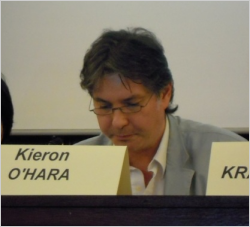 Kieron O'Hara合作论文数University of Southampton1
 Paul Howard Riley合作论文数1Mark Hammersley合作论文数1




