SNOMED CT is a complex ontology; sophisticated browsers are required to make it understandable and useful. We identified 23 SNOMED CT browsers that have been developed, and inspected 17. We enumerate and provide test criteria for a ‘master list’ of 143 browsing features supported by at least one inspected browser; future work will determine which of these features are implemented by individual browsers. Only 5 features were common to all 17 browsers; 89 were found in less than one third of browsers. We recommend that a core set of browsing features be defined and harmonized across browsers, particularly for text-to-concept search operations.
Electronic patient records are typically optimised for delivering care to a single patient. They omit significant information that the care team can infer whilst including much of only transient value. They are secondarily an indelible legal record, comprised of heterogeneous documents reflecting local institutional processes as much as, or more than, the course of the patient’s illness. By contrast, the CLEF Chronicle is a unified, formal and parsimonious representation of how a patient’s illness and treatments unfold through time. Its primary goal is efficient querying of aggregated patient data for clinical research, but it also supports summarisation of individual patients and resolution of co-references amongst clinical documents. It is implemented as a semantic network compliant with a generic temporal object model whose specifics are derived from external sources of clinical knowledge organised around ontologies. We describe the reconstruction of patient chronicles from clinical records and the subsequent definition and execution of sophisticated clinical queries across populations of chronicles. We also outline how clinical simulations are used to test and refine the object model. Finally, we discuss a range of engineering and theoretical challenges raised by our work.
Summary Objective: To review the literature concerning the quality assurance of medical ontologies. Methods: scholar.google.com was searched using the search strings (+ontology +”quality assurance”) and (+ontology +”evaluation/evaluating”). Relevant publications were selected by manual review. Other work already familiar to the author, or suggested by other researchers contacted by the author, were included. The papers were analysed for common themes. Results: Four broad properties of an ontology were identified that may be quality-assured: philosophical validity, compliance with meta-ontological commitments, ‘content correctness’, and fitness for purpose. Each published methodology addressed only a subset of these properties. ‘Content’ may be divided into domain knowledge content, and metadata describing either the provenance of domain knowledge content, or relationships between it and lexical information (e.g. for display and retrieval). ‘Correctness’ (whether of domain knowledge content or metadata) may also be further subdivided into truth, completeness, parsimony and internal consistency. Conclusions: Understanding of how to assure the quality of ontologies, or evaluate their fitness for specific purposes, is improving but remains poor. A combination of methodologies is required, but tools to support a comprehensive quality assurance programme remain lacking.Perfect quality of an ontology is not provable and may not be desirable: an ontology compliant with all current philosophical theories, following necessary ontological commitments, and with entirely ‘correct’ content, may be too complex to be directly usable or useful.The extent to which an ontology’s fitness for purpose is predicted or influenced by its other properties remains to be determined. Field studies of ontologies in use, including interrater effects, are required.
The CCAM French coding system of clinical procedures was developed between 1994 and 2004 using, in parallel, a traditional domain expert's consensus method on one hand, and advanced methodologies of ontology driven semantic representation and multilingual generation on the other hand. These advanced methodologies were applied under the framework of an European Union collaborative research project named GALEN and produced a new generation of biomedical terminology. Following the interest in several countries and in WHO, the GALEN network has tested the application of the ontology driven tools to the existing reduced Australian ICHI coding system for interventions presently under investigation by WHO to check its ability and appropriateness to become the reference international coding system for procedures. The initial results are presented and discussed in terms of feasibility and quality assurance for sharing and maintaining consistent medical knowledge and allowing diversity in linguistic expressiveness of end users.
Summary Objective: To revie wt he literature concernin gt he quality assurance of medical ontologies. Methods: scholar.google.com wa ss earched usin gt he search strings (+ontology +"quality assurance") an d (+ontology +"evaluation/evaluating"). Relevan t publication sw er es elected by manual review. Other work already familiar to the author ,o rs uggested by other researcher sc ontacted by the author ,w er ei n- cluded. Th ep apers wer ea nalyse df or common themes. Results: Four broad propertie so fa no ntology wer e identified tha tm ay be quality-assured: philosophical validity, compliance with meta-ontological commit- ments ,' content correctness', an df itnes sf or purpose . Each publishe dm ethodology addresse do nl yas ubse t of these properties. 'Content' may be divide di nto domai nk nowledge content, an dm etadata describing either the provenanc eo fd omain knowledge content, or relationships between it an dl exica li nformation (e.g. fo rd isplay an dr etrieval). 'Correctness' (whether of domain knowledge conten to rm etadata) may also be further subdivided into truth, completeness, parsimon ya nd internal consistency. Conclusions: Understandin go fh ow to assure the qualit yo fo ntologies, or evaluate thei rf itnes sf or specific purposes, is improvin gb ut remain sp oor. Ac ombination of methodologie si sr equired, but tools to support ac omprehensive qualit ya ssurance programm er emain lacking. Perfec tq uality of an ontology is no tp rovable an dm ay no tb ed esirable :a no ntology complian tw it ha ll current philosophical theories, followin gn ecessary ontological commitments, an dw it he ntirely 'correct 'c ontent, may be to oc omple xt ob ed irectly usable or useful. The extent to which an ontology's fitnes sf or purpose is predicted or influenced by its other propertie s remain st ob ed etermined .F ield studie so fo ntologie s in use ,i ncludin gi nterrater effects ,a re required.
Electronic patient records are typically optimised for delivering care to a single patient. They omit significant information that the care team can infer whilst including much of only transient value. They are secondarily an indelible legal record, comprised of heterogeneous documents reflecting local institutional processes as much as, or more than, the course of the patient's illness.By contrast, the CLEF Chronicle is a unified, formal and parsimonious representation of how a patient's illness and treatments unfold through time. Its primary goal is efficient querying of aggregated patient data for clinical research, but it also supports summarisation of individual patients and resolution of co-references amongst clinical documents. It is implemented as a semantic network compliant with a generic temporal object model whose specifics are derived from external sources of clinical knowledge organised around ontologies.We describe the reconstruction of patient chronicles from clinical records and the subsequent definition and execution of sophisticated clinical queries across populations of chronicles. We also outline how clinical simulations are used to test and refine the chronicle representation. Finally, we discuss a range of engineering and theoretical challenges raised by our work.
The convergence of need between improved clinical care and post genomics research presents a unique challenge to restructuring information flow so that it benefits both without compromising patient safety or confidentiality. The CLEF project aims to link-up heath care with bioinformatics to build a collaborative research platform that enables a more effective biomedical research. In that, it addresses various barriers and issues, including privacy both by policy and by technical means, towards establishing its eventual system. It makes extensive use of language technology for information extraction and presentation, and its shared repository is based around coherent chronicles of patients' histories that go beyond traditional health record structure. It makes use of a collaborative research workbench that encompasses several technologies and uses many tools providing a rich platform for clinical researcher.
GALEN seeks to provide re-usable terminology resources for clinical systems. The heart of GALEN is the Common Reference Model (CRM) formulated in a specialised description logic. The CRM is based on a set of principles that have evolved over the period of the project and illustrate key issues to be addressed by any large medical ontology. The principles on which the CRM is based are discussed followed by a more detailed look at the actual mechanisms employed. Finally the structure is compared with other biomedical ontologies in use or proposed.
SNOMED((R)) CT is emerging as a reference terminology for the entire health care process. It claims to be founded on logic-based modeling principles. In this work we analyze a special encoding scheme for SNOMED disease and procedure entities, the so-called relationship groups which had been devised in order to avoid ambiguities in entity definitions. We show that these artifacts may represent hidden mereological relations. We also report discrepancies encountered between the defined semantics of many SNOMED((R)) CT entity terms and their intuitive meaning, and inconsistencies detected between the definition of some complex composed entities and the definition of their top-level parents. As a result we formulate recommendations for improvements of SNOMED((R)) CT.
The issues of confidentiality and privacy have become increasingly important as Grid technology is being adopted in public sectors such as healthcare. This paper discusses the importance of protecting the confidentiality and privacy of patient health/medical records, and the challenges exhibited in enforcing this protection in a Grid environment. It proposes a novel algorithm to allow traceable/linkable identity privacy in dealing with de-identified medical records. Using the algorithm, de-identified health records associated to the same patient but generated by different healthcare providers are given different pseudonyms. However, these pseudonymised records of the same patient can still be linked by a trusted entity such as the NHS trust or HealthGrid manager. The paper has also recommended a security architecture that integrates the proposed algorithm with other data security measures needed to achieve the desired security and privacy in the HealthGrid context.
Bridging levels of "granularity" and "scale" are frequently cited as key problems for biomedical informatics. However, detailed accounts of what is meant by these terms are sparse in the literature. We argue for distinguishing two notions: "size range," which deals with physical size, and "collectivity," which deals with aggregations of individuals into collections, which have emergent properties and effects. We further distinguish these notions from "specialisation," "degree of detail," "density," and "connectivity." We argue that the notion of "collectivity"--molecules in water, cells in tissues, people in crowds, stars in galaxies--has been neglected but is a key to representing biological notions, that it is a pervasive notion across size ranges--micro, macro, cosmological, etc.--and that it provides an account of a number of troublesome issues including the most important cases of when the biomedical notion of parthood is, or is not, best represented by a transitive relation. Although examples are taken from biomedicine, we believe these notions to have wider application.
Previous papers have argued for the existence of three different models in many clinical information systems--for the medical record, for inference in guidelines, and for concepts and re-usable facts. This paper presents a principled approach to deciding which information belongs in each model based on the nature of the queries or inference to be performed: necessary or contingent, open or closed world, algorithmic vs heuristic. It then discusses an important class of systems--"ontologically indexed knowledge bases"--and issues of metadata within this framework.
A great deal of data in functional genomics studies needs to be annotated with low-resolution anatomical terms. For example, gene expression assays based on manually dissected samples (microarray, SAGE, etc.) need high-level anatomical terms to describe sample origin. First-pass annotation in high-throughput assays (e.g. large-scale in situ gene expression screens or phenotype screens) and bibliographic applications, such as selection of keywords, would also benefit from a minimum set of standard anatomical terms. Although only simple terms are required, the researcher faces serious practical problems of inconsistency and confusion, given the different aims and the range of complexity of existing anatomy ontologies. A Standards and Ontologies for Functional Genomics (SOFG) group therefore initiated discussions between several of the major anatomical ontologies for higher vertebrates. As we report here, one result of these discussions is a simple, accessible, controlled vocabulary of gross anatomical terms, the SOFG Anatomy Entry List (SAEL). The SAEL is available from and is intended as a resource for biologists, curators, bioinformaticians and developers of software supporting functional genomics. It can be used directly for annotation in the contexts described above. Importantly, each term is linked to the corresponding term in each of the major anatomy ontologies. Where the simple list does not provide enough detail or sophistication, therefore, the researcher can use the SAEL to choose the appropriate ontology and move directly to the relevant term as an entry point. The SAEL links will also be used to support computational access to the respective ontologies. Copyright © 2004 John Wiley & Sons, Ltd.
A great deal of data in functional genomics studies needs to be annotated with low-resolution anatomical terms. For example, gene expression assays based on manually dissected samples (microarray, SAGE, etc.) need high-level anatomical terms to describe sample origin. First-pass annotation in high-throughput assays (e.g. large-scale in situ gene expression screens or phenotype screens) and bibliographic applications, such as selection of keywords, would also benefit from a minimum set of standard anatomical terms. Although only simple terms are required, the researcher faces serious practical problems of inconsistency and confusion, given the different aims and the range of complexity of existing anatomy ontologies. A Standards and Ontologies for Functional Genomics (SOFG) group therefore initiated discussions between several of the major anatomical ontologies for higher vertebrates. As we report here, one result of these discussions is a simple, accessible, controlled vocabulary of gross anatomical terms, the SOFG Anatomy Entry List (SAEL). The SAEL is available from http://www.sofg.org and is intended as a resource for biologists, curators, bioinformaticians and developers of software supporting functional genomics. It can be used directly for annotation in the contexts described above. Importantly, each term is linked to the corresponding term in each of the major anatomy ontologies. Where the simple list does not provide enough detail or sophistication, therefore, the researcher can use the SAEL to choose the appropriate ontology and move directly to the relevant term as an entry point. The SAEL links will also be used to support computational access to the respective ontologies.
Understanding the logical meaning of any description logic or similar formalism is difficult for most people, and OWL-DL is no exception. This paper presents the most common difficulties encountered by newcomers to the language, that have been observed during the course of more than a dozen workshops, tutorials and modules about OWL-DL and it’s predecessor languages. It emphasises understanding the exact meaning of OWL expressions – proving that understanding by paraphrasing them in pedantic but explicit language. It addresses, specifically, the confusion which OWL’s open world assumption presents to users accustomed to closed world systems such as databases, logic programming and frame languages. Our experience has had a major influence in formulating the requirements for a new set of user interfaces for OWL the first of which are now available as prototypes. A summary of the guidelines and paraphrases and examples of the new interface are provided. The example ontologies are available online.
CLEF (Co-operative Clinical E-Science Framework) is an MRC sponsored project in the E-Science programme that aims to establish methodologies and a technical infrastructure for the next generation of integrated clinical and bioscience research. It is developing methods for managing and using pseudonymised repositories of the long-term patient histories which can be linked to genetic, genomic information or used to support patient care. CLEF concentrates on removing key barriers to managing such repositories - ethical issues, information capture, integration of disparate sources into coherent chronicles of events, user-oriented mechanisms for querying and displaying the information, and compiling the required knowledge resources. This paper describes the overall information flow and technical approach designed to meet these aims within a Grid framework.
 Alan Rector合作论文数Department of Medical Informatics, School of Computer Science, University of Manchester26
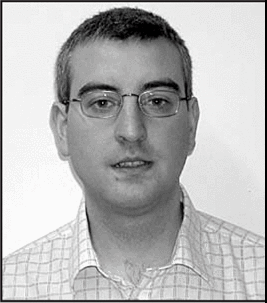 Chris Wroe合作论文数Department of Computer Science;University of Manchester;Department of Computer Science, University of Manchester6
 Adel Taweel合作论文数King's College London5
 Dipak Kalra合作论文数4
 Werner Ceusters合作论文数Department of Biomedical Informatics, Jacobs School of Medicine & Biomedical Sciences, University at Buffalo, The State University of New York4
 E Van Der Haring合作论文数3
 Stuart Aitken合作论文数3
 Christian J. Stoeckert Jr合作论文数Institute for Biomedical Informatics, Perelman School of Medicine, University of Pennsylvania3
 Cornelius Rosse合作论文数Department of Biological Structure, University of Washington/Department of Biomedical Informatics and Medical Education, University of Washington3
 Albert Burger合作论文数and Medical Research Council, Heriot-Watt University3Duncan Davidson合作论文数3Terry F. Hayamizu合作论文数3P Zanstra合作论文数3
 Martin Ringwald合作论文数The Jackson Laboratory3
 Rob Gaizauskas合作论文数Department of Computer Science, Faculty of Engineering, The University of Sheffield3
 Helen Parkinson合作论文数European Molecular Biology Laboratory, European Bioinformatics Institute3Richard Power合作论文数Information Technology Research Institute;University of Brighton3Peter Singleton合作论文数3
 Angus Roberts合作论文数Department of Biostatistics & Health Informatics, School of Mental Health & Psychological Sciences, Institute of Psychiatry, Psychology & Neuroscience, King’s College London2
 Jonathan Bard合作论文数Department of Physiology, Anatomy and Genetics, Balliol College, University of Oxford;Bioinformatics & Development, University of Edinburgh2
 Stefan Schulz合作论文数Friedrich-Schiller-Universität Jena;7TM Antibodies2David Ingram合作论文数2Jean Marie Rodrigues合作论文数2Colin Puleston合作论文数2W. D. Solomon合作论文数2
 Donia Scott合作论文数Department of Informatics, University of Sussex2Robert Baud合作论文数Medical Informatics Division, Hôpitaux Universitaires de Genève2Richard Baldock合作论文数e-Science Institute2Jo Milan合作论文数2Hai Wang合作论文数1A R Mori合作论文数1Lucienne Clavel合作论文数1
 Huib Ten Napel合作论文数1
 Qi Shi合作论文数Department of Computer Science, School of Computer Science and Mathematics, Liverpool John Moores University1M Carlsson合作论文数1p singleton合作论文数1H Ahlfeldt合作论文数1j milan合作论文数1
 David M Ingram合作论文数Mechanical Engineering, School of Engineering, The University of Edinburgh1
 Robert Stevens合作论文数Department of Computer Science, School of Computer Science, University of Manchester1Stephan Schulz合作论文数1
 Matthew Horridge合作论文数University of Manchester1
 Anand Kumar合作论文数Laboratory of Medical Informatics, University of Pavia1
 Barry Smith合作论文数Department of Philosophy, University at Buffalo;Department of Biomedical Informatics, University at Buffalo;Department of Computer Science and Engineering, University at Buffalo;National Center for Ontological Research, University at Buffalo1
 Thomas Bittner合作论文数Institute for Formal Ontology and Medical Information Science;University of Leipzig;Institute for Formal Ontology and Medical Information Science, University of Leipzig1
 Peter David Johnson合作论文数1Jim Rice合作论文数1James Cimino合作论文数Columbia University1
 Udo Hahn合作论文数Language & Information Engineering Lab, Friedrich Schiller University of Jena1




