This paper highlights that combining laser interference lithography and electrochemical etching is a cost-effective, efficient method to realize periodic nanopore arrays in silicon with lattice pitch as small as 300 nm on centimeter-scale substrates. The fabrication of wide-area and high aspect ratio 2D pore arrays with 250 nm diameter and 5 μm depth is demonstrated. All the steps of the process have been optimized to achieve vertical sidewalls with 50 nm thickness, providing pore arrays with aspect ratio of 100 on n-type silicon substrates over an area of 2 × 2 cm2. These results constitute a technological advance in the realization of ordered pore arrays in silicon with very small lattice parameters, with impact in biotechnology, energy harvesting, or sensors.
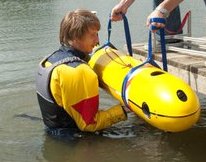
The small flight-style Delphin AUV is designed to evaluate the performance of a long range survey AUV with the additional capability to hover and manoeuvre at slow speed. Delphin’s hull form is based on a scaled version of Autosub6000, and in addition to the main thruster and control surfaces at the rear of the vehicle, Delphin is equipped with four rim driven tunnel thrusters. In order to reduce the development cycle time, Delphin was designed to use commercial-off-the-shelf (COTS) sensors and thrusters interfaced to a standard PC motherboard running the control software within the MS Windows environment. To further simplify the development, the autonomy system uses the State-Flow Toolbox within the Matlab/Simulink environment. While the autonomy software is running, image processing routines are used for obstacle avoidance and target tracking, within the commercial Scorpion Vision software. This runs as a parallel thread and passes results to Matlab via the TCP/IP communication protocol. The COTS based development approach has proved effective. However, a powerful PC is required to effectively run Matlab and Simulink, and, due to the nature of the Windows environment, it is impossible to run the control in hard real-time. The autonomy system will be recoded to run under the Matlab Windows Real-Time Windows Target in the near future. Experimental results are used to demonstrating the performance and current capabilities of the vehicle are presented.
 pascal kleimann合作论文数1
 Guillaume Laffite合作论文数1Alan R. Palmer合作论文数1
 Stephen Turnock合作论文数School of Engineering, Faculty of Engineering and Physical Sciences, University of Southampton1
 Alexander B. Phillips合作论文数School of Engineering Sciences, University of Southampton1
 Cecile Jamois合作论文数1
 Suleiman M. Sharkh合作论文数University of Southampton1
 Regis Orobtchouk合作论文数Institut des Nanotechnologies de Lyon (INL),, Université de Lyon1M. E. Furlong合作论文数1




