A collisionless plasma is modeled by the Vlasov-Poisson system. Solutions in three space dimensions that have smooth, compactly supported initial data with spherical symmetry are considered. An improved field estimate is presented that is based on decay estimates obtained by Illner and Rein. Then some estimates are presented that ensure only particles with sufficiently small velocity can be found within a certain (time dependent) ball.
A collisionless plasma is modeled by the Vlasov-Poisson system. Smooth solutions are considered in three spatial dimensions with compactly supported initial data. The main theorem of this work is a small data result that improves an earlier theorem of Bardos and Degond in that it does not require the derivatives of the initial data to be small. Another theorem is presented here that gives a sufficient condition that ensures that the charge density decays as t(-3), which is the rate which occurs when asymptotically all particles disperse freely.
The motion of a collisionless plasma is described by the Vlasov-Poisson system. A space-time identity for one-dimensional plasmas with two species of charge is here generalized to higher dimensions with spherical symmetry. Some estimates on large time behavior are obtained.
A collisionless plasma is modeled by the Vlasov-Poisson system. Solutions in three space dimensions that have smooth, compactly supported initial data with cylindrical symmetry are considered. Using an identity of Rein and Illner (alt. Perthame) it is shown that almost every characteristic of the Vlasov equation (i.e. almost every particle) "escapes" to infinity for large time.
Motivated by the problem of shocks in a collisionless plasma, we consider the steady Vlasov-Maxwell system in one space dimension. In the case of a cold plasma, the problem reduces to a set of ordinary differential equations. It is assumed that the upstream state of the plasma is given. The downstream state is investigated using the conservation laws and numerical simulation. It is found that when the masses of positive and negative ions differ, that the downstream behavior can differ from the upstream behavior.
Motivated by the problem of shocks in a collisionless plasma, we consider the steady Vlasov--Maxwell system in one space dimension. It is assumed that the electromagnetic fields and the particle densities approach a homogeneous state as $x \rightarrow - \infty$ (upstream). It is shown that the solution must be constant in $x$ if a certain condition holds. When another condition (exclusive of the first) holds, it is shown that the equations obtained by linearization about the upstream state possess a growing exponential (in $x$) solution.
The motion of a collisionless plasma - a high-temperature, low-density, ionized gas - is described by the Vlasov-Maxwell (VM) system. These equations are considered in one space dimension and two momentum dimensions without the assumption of relativistic velocity corrections. The main results are bounds on the spatial and velocity supports of the particle distribution function and uniform estimates on derivatives of this function away from the critical velocity $| v_1 | = 1$. Additionally, for initial particle distributions that are even in the second velocity argument $v_2$, the global-in-time existence of solutions is shown.
We study the "one and one-half" dimensional Vlasov-Maxwell-Fokker-Planck system and obtain the first results concerning well-posedness of solutions. Specifically, we prove the global-in-time existence and uniqueness in the large of classical solutions to the Cauchy problem and a gain in regularity of the distribution function in its momentum argument.
The Vlasov equation may be used to model the dynamics of a collisionless plasma. We consider a situation where the plasma has unbounded support and the charge density does not decay as | x |→ ∞. The electric field is computed from the screened Poisson equation, whose fundamental solution decays exponentially as | x |→ ∞ and hence gives a convergent integral despite the lack of decay of the charge density. The limit as the screening is removed is studied in one space dimension. It is shown that if some assumptions on the initial conditions hold, then the limit in question exists (but is not uniform) and the problem satisfied by the limit is identified.
We consider the Cauchy problem for the Vlasov–Maxwell–Fokker–Planck system in the plane. It is shown that for smooth initial data, as long as the electromagnetic fields remain bounded, then their derivatives do also. Glassey and Strauss have shown this to hold for the relativistic Vlasov–Maxwell system in three dimensions, but the method here is totally different. In the work of Glassey and Strauss, the relativistic nature of the particle transport played an essential role. In this work, the transport is nonrelativistic, and smoothing from the Fokker–Planck operator is exploited. Copyright © 2015 John Wiley & Sons, Ltd.
Motivated by the problem of shocks in a collisionless plasma, we consider the steady Vlasov--Maxwell system in one space dimension. It is assumed that the electromagnetic fields approach constant values and the particle densities approach homogeneous states both upwind $(x \rightarrow -\infty)$ and downwind $(x \rightarrow + \infty)$. Then under some other assumptions (including that all particles come from upwind and eventually go downwind) it is shown that the upstream and downstream behavior must be the same, ruling out shock solutions.
The solar wind interacting with a magnetized obstacle is modeled with the Vlasov equation. The domain considered is a disk in the plane. Inflowing boundary conditions are given for the particle density. A magnetic field is prescribed, and the electric field is computed self consistently with potential zero on the boundary. Taking the boundary condition for the particle density to be sufficiently small, it is shown that there is a natural smooth steady solution. The speed of the inflowing plasma and the magnetic field are not size restricted.
The solar wind interacting with a magnetized obstacle is modelled with the steady Vlasov-Poisson system in the plane. The system is linearized for the (given) magnetic field of the obstacle being small. The main focus is on the rate of decay of the spatial charge density “downwind” of the obstacle. A special case that admits an explicit solution is presented. It is also shown that when the background particle distribution is compactly supported in velocity, that the spatial charge density cannot, in general, decay faster than x 1 − 1 2 x^{-\frac {1}{2}}_1 , where x 1 x_1 is the downwind distance.
A collisionless plasma is modeled by the Vlasov-Poisson system in three space dimensions. A fixed background of positive charge, which is independent of time and space, is assumed. The situation in which mobile negative ions balance the positive charge as vertical bar x vertical bar -> infinity is considered. Hence, the total positive charge and the total negative charge are both infinite. It is shown, in three spatial dimensions, that smooth solutions may be continued as long as the velocity support remains finite. Also, in the case of spherical symmetry, a bound on velocity support is obtained and hence solutions exist globally in time.
We represent three generations of students: Bob Glassey, Walter's student finishing at Brown in 1972, Jack Schaeffer, Bob's student finishing at Indiana University in 1983, and Steve Pankavich, Jack's student finishing at Carnegie Mellon in 2005. We have all thrived professionally from our association with Walter and are delighted to dedicate this note to him on the occasion of his 70th birthday. The problem we study concerns the asymptotic behavior of solutions to Vlasov equations, an area to which Walter has contributed greatly.
Batt showed that solutions of the Vlasov-Poisson system remain smooth as long as the particle speeds remain finite. Pfaffelmoser was the first to establish a bound on the particle speeds, completing the existence proof. Horst greatly improved this bound on the particle speeds. This article improves it further. Copyright (C) 2010 John Wiley & Sons, Ltd.
When particle speeds are large the motion of a collisionless plasma is modeled by the relativistic Vlasov Maxwell system. Large time behavior of solutions which depend on one position variable and two momentum variables is considered. In the case of a single species of charge it is shown that there are solutions for which the charge density does not decay in time. This is in marked contrast to results for the non-relativistic Vlasov Poisson system in one space dimension. The case when two oppositely charged species are present and the net total charge is zero is also considered. In this case, it is shown that the support in the first component of momentum can grow at most like t to the three-fourths power.
Many semi-Lagrangian schemes for solving the Vlasov equation use a second order time splitting method proposed by Cheng and Knorr. In this paper a fourth order time splitting method is proposed. This is combined with cubic spline interpolation (in $x$ and $v$), and a rigorous $\ell_2$ error bound is obtained for the linear Vlasov equation in arbitrary space dimension. Also, this method and that of Cheng and Knorr are implemented and compared for a test case in one space dimension.
The motion of a collisionless plasma - a high-temperature, low-density, ionized gas - is described by the Vlasov-Maxwell system. In the presence of large velocities, relativistic corrections are meaningful, and when symmetry of the particle densities is assumed this formally becomes the relativistic Vlasov-Poisson system. These equations are considered in one space dimension and two momentum dimensions in both the monocharged (i.e., single species of ion) and neutral cases. The behavior of solutions to these systems is studied for large times, yielding estimates on the growth of particle momenta and a lower bound, uniform-in-time, on norms of the charge density. We also present similar results in the same dimensional settings for the classical Vlasov-Poisson system, which excludes relativistic effects.
The motion of a collisionless plasma is described by the Vlasov-Poisson system, or in the presence of large velocities, the relativistic Vlasov-Poisson system. Both systems are considered in one space and one momentum dimension, with two species of oppositely charged particles. A new identity is derived for both systems and is used to study the behavior of solutions for large times.
 Robert Glassey合作论文数15
 Stephen Pankavich合作论文数Department of Mathematics;Indiana University;Department of Mathematics, Indiana University6Rt Glassey合作论文数3
 Alan Rendall合作论文数Institute for Mathematics, Johannes Gutenberg-Universitat Mainz2
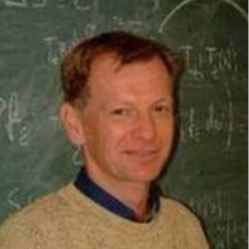 Gerhard Rein合作论文数Mathematisches Institut, Fakultät für Mathematik, Physik und Informatik, Universität Bayreuth2
 Robert (Bob) Glassey合作论文数Math Department, Indiana University2Keming Wang合作论文数1
 David R. Owen合作论文数Mathematical Sciences, Mellon College of Science, Carnegie Mellon University1
 Yuxi Zheng合作论文数Department of Mathematics, Pennsylvania State University1
 Hyung Ju Hwang合作论文数Department of Mathematics, Pohang University of Science and Technology1
 Irene Fonseca合作论文数Department of Mathematical Sciences, Mellon College of Science, Carnegie Mellon University;Center for Nonlinear Analysis, Carnegie Mellon University1
 Misha Shvartsman合作论文数1




