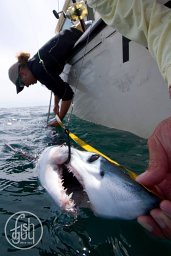
Many shark populations are in decline around the world, with severe ecological and economic consequences. Fisheries management and marine protected areas (MPAs) have both been heralded as solutions. However, the effectiveness of MPAs alone is questionable, particularly for globally threatened sharks and rays (‘elasmobranchs’), with little known about how fisheries management and MPAs interact to conserve these species. Here we use a dedicated global survey of coral reef elasmobranchs to assess 66 fully protected areas embedded within a range of fisheries management regimes across 36 countries. We show that conservation benefits were primarily for reef-associated sharks, which were twice as abundant in fully protected areas compared with areas open to fishing. Conservation benefits were greatest in large protected areas that incorporate distinct reefs. However, the same benefits were not evident for rays or wide-ranging sharks that are both economically and ecologically important while also threatened with extinction. We show that conservation benefits from fully protected areas are close to doubled when embedded within areas of effective fisheries management, highlighting the importance of a mixed management approach of both effective fisheries management and well-designed fully protected areas to conserve tropical elasmobranch assemblages globally. A survey of sharks and rays on coral reefs within 66 marine protected areas across 36 countries showcases that the conservation benefits of full MPA protection to sharks almost double when accompanied by effective fisheries management.
A global survey of coral reefs reveals that overfishing is driving resident shark species toward extinction, causing diversity deficits in reef elasmobranch (shark and ray) assemblages. Our specieslevel analysis revealed global declines of 60 to 73% for five common resident reef shark species and that individual shark species were not detected at 34 to 47% of surveyed reefs. As reefs become more shark-depleted, rays begin to dominate assemblages. Shark-dominated assemblages persist in wealthy nations with strong governance and in highly protected areas, whereas poverty, weak governance, and a lack of shark management are associated with depauperate assemblages mainly composed of rays. Without action to address these diversity deficits, loss of ecological function and ecosystem services will increasingly affect human communities.
Severe thermal stress events occurring on the backdrop of globally warming oceans can result in mass coral mortality. Tracking the ability of a reef community to return to pre-disturbance composition is important to inform the likelihood of recovery or the need for active management to conserve these ecosystems. Here, we quantified annual, temporal changes in the benthic communities for the three years following mass coral mortality at Jarvis Island—an uninhabited island in the Pacific Remote Islands Marine National Monument. While Jarvis experienced catastrophic coral mortality in 2015 due to heat stress resulting from the 2015/16 El Niño, significant annual shifts were documented in the benthic community in the three years post-disturbance. Macroalgal and turf dominance of the benthos was temporary—likely reflecting the high biomass of herbivorous reef fishes post-bleaching—giving way to calcifiers such as crustose coralline algae and Halimeda, which may facilitate rather than impede coral recovery. By 2018, indications of recovery were detectable in the coral community itself as juvenile densities increased and stress-tolerant genera, such as Pavona, exceeded their pre-disturbance densities. However, densities of Montipora and Pocillopora remain low, suggesting recovery will be slow for these formerly dominant taxa. Collectively, the assemblage and taxon-specific shifts observed in the benthic and coral community support cautious optimism for the potential recovery of Jarvis Island’s coral reefs to their pre-disturbance state. Continued monitoring will be essential to assess whether reassembly is achieved before further climate-related disturbance events affect this reef system.
Our changing climate poses growing challenges for effective management of marine life, ocean ecosystems, and human communities. Which species are most vulnerable to climate change, and where should management focus efforts to reduce these risks? To address these questions, the National Oceanic and Atmospheric Administration (NOAA) Fisheries Climate Science Strategy called for vulnerability assessments in each of NOAA’s ocean regions. The Pacific Islands Vulnerability Assessment (PIVA) project assessed the susceptibility of 83 marine species to the impacts of climate change projected to 2055. In a standard Rapid Vulnerability Assessment framework, this project applied expert knowledge, literature review, and climate projection models to synthesize the best available science towards answering these questions. Here we: (1) provide a relative climate vulnerability ranking across species; (2) identify key attributes and factors that drive vulnerability; and (3) identify critical data gaps in understanding climate change impacts to marine life. The invertebrate group was ranked most vulnerable and pelagic and coastal groups not associated with coral reefs were ranked least vulnerable. Sea surface temperature, ocean acidification, and oxygen concentration were the main exposure drivers of vulnerability. Early Life History Survival and Settlement Requirements was the most data deficient of the sensitivity attributes considered in the assessment. The sensitivity of many coral reef fishes ranged between Low and Moderate, which is likely underestimated given that reef species depend on a biogenic habitat that is extremely threatened by climate change. The standard assessment methodology originally developed in the Northeast US, did not capture the additional complexity of the Pacific region, such as the diversity, varied horizontal and vertical distributions, extent of coral reef habitats, the degree of dependence on vulnerable habitat, and wide range of taxa, including data-poor species. Within these limitations, this project identified research needs to sustain marine life in a changing climate.
Baited remote underwater stereo‐video systems (stereo‐BRUVs) are a popular tool to sample demersal fish assemblages and gather data on their relative abundance and body size structure in a robust, cost‐effective and non‐invasive manner. Given the rapid uptake of the method, subtle differences have emerged in the way stereo‐BRUVs are deployed and how the resulting imagery is annotated. These disparities limit the interoperability of datasets obtained across studies, preventing broadscale insights into the dynamics of ecological systems. We provide the first globally accepted guide for using stereo‐BRUVs to survey demersal fish assemblages and associated benthic habitats. Information on stereo‐BRUVs design, camera settings, field operations and image annotation are outlined. Additionally, we provide links to protocols for data validation, archiving and sharing. Globally, the use of stereo‐BRUVs is spreading rapidly. We provide a standardized protocol that will reduce methodological variation among researchers and encourage the use of Findable, Accessible, Interoperable and Reusable workflows to increase the ability to synthesize global datasets and answer a broad suite of ecological questions.
Artificial reefs act as high-rugosity habitats and are often deployed to enhance fishing; however, the effects of man-made features on fish communities can be unpredictable and are poorly understood in deeper waters. In this study, we used a submersible to describe a deep-water artificial reef complex (93-245 m) off of Ewa Beach, Oahu, Hawaii, USA, and evaluated possible conservation and/or fisheries-related contributions. Sixty-eight species were recorded, with larger features supporting greater diversity of species. Species composition changed strongly with depth and a faunal break was detected from 113-137 m. While the features supported diverse fish communities, they were not similar to those on natural substrates, and were numerically dominated by only two species, Lutjanis kasmira and Chromis verater. Depth-generalist and endemic species were present at levels comparable to natural substrates, but were less abundant and species-rich than at biogenic Leptoseris reefs at similar depths. While the non-native L. kasmira was highly abundant, its presence and abundance were not associated with discernable changes in the fish community, and was not present deeper than 120 m. Finally, five species of commercially- and recreationally-important 'Deep 7' fisheries species were also observed, but the artificial reef complex was mostly too shallow to provide meaningful benefits.
An Amendment to this paper has been published and can be accessed via a link at the top of the paper.
As agencies shift from single-species management to ecosystem-based fisheries management, ecosystem models are gaining interest for understanding species dynamics in relation to oceanographic and ecological processes and human marine uses. However, information on community structure or distribution of many species that occupy deep (>30 m) waters is largely unavailable. We amassed a total of 24 686 fish observations of 523 species/taxa for the 30-410 m depth areas surrounding the main Hawaiian Islands (MHI). We also obtained estimates of geomorphological variables, including substrate type, slope, rugosity, and ridge-like features. Using these 2 data sources, we (1) identified distinct fish communities along the 30-410 m depth gradient, and (2) generated relative biomass maps for fish functional groups. We showed that the mesophotic zone ranges between 30 and 129 m, with a fish faunal break at 60 m. Beyond this zone, 4 subphotic zones were identified: upper rariphotic (130-169 m), mid-rariphotic (170-239 m), lower rariphotic (240-319 m), and upper bathyal (320-410 m). We assigned fish species to functional groups partly based on identified depth ranges and fitted general additive models (GAMs) integrating geomorphological covariates to the functional group relative biomass estimates to determine the environmental variables that best predict the probability of encounter and relative biomass of each fish functional group. Finally, GAM predictions were employed to map functional group relative biomass distributions. These distribution maps showed a high relative biomass of many groups in the center of the MHI chain. This study contributes to a better understanding of fish community structure around the MHI and will inform ecosystem model parameterization.
Coral reef research programs in Hawaii primarily use diver-based underwater visual censuses in <= 30 m depths to assess roving predator populations between the Main (MHI) and Northwestern Hawaiian Islands (NWHI). As a probable consequence of survey biases, results from some methods imply remarkably top-heavy trophic pyramids that potentially inflate the scale of differences between remote and populated regions. Other limitations include the absence of predator information in >30 m depths. To better understand regional differences, we compared shallow-water roving predator abundances and estimated predator length-frequencies between 2 diver-based visual assessment methods (stationary point count ['SPC'] and towed-diver) and 2 video sampling techniques (unbaited and baited remote underwater stereo-video systems: RUVS and BRUVS). We also surveyed 30-100 m ('mesophotic') roving predators using RUVS and BRUVS. As with diver-based assessments, RUVS and BRUVS sampled considerably more roving predators in the NWHI versus the MHI, with patterns remaining consistent between methods. However, the NWHI:MHI scales of difference for RUVS and BRUVS tended to be substantially lower than for diver surveys. The largest discrepancies were recorded for the giant trevally Caranx ignobilis, where NWHI:MHI abundance ratios varied by >2 orders of magnitude between diver SPC and all other methods. Although our results corroborate substantially higher roving predator densities in the NWHI, this study demonstrates that the application of different methods can result in strikingly dissimilar predator estimates. Continued assessments among survey techniques, coupled with the inclusion of mesophotic surveys, remain vital to improving understanding of predator populations, providing information that is properly aligned with management and conservation needs.
Large-bodied coral reef roving predators (sharks, jacks, snappers) are largely considered to be depleted around human population centers. In the Hawaiian Archipelago, supporting evidence is primarily derived from underwater visual censuses in shallow waters (≤30 m). However, while many roving predators are present or potentially more abundant in deeper strata (30–100 m+), distributional information remains sparse. To partially fill that knowledge gap, we conducted surveys in the remote Northwestern Hawaiian Islands (NWHI) and populated Main Hawaiian Islands (MHI) from 2012–2014 using baited remote underwater stereo-video. Surveys between 0–100 m found considerable roving predator community dissimilarities between regions, marked conspicuous changes in species abundances with increasing depth, and largely corroborated patterns documented during shallow water underwater visual censuses, with up to an order of magnitude more jacks and five times more sharks sampled in the NWHI compared to the MHI. Additionally, several species were significantly more abundant and larger in mesophotic versus shallow depths, which remains particularly suggestive of deep-water refugia effects in the MHI. Stereo-video extends the depth range of current roving predator surveys in a more robust manner than was previously available, and appears to be well-suited for large-scale roving predator work in the Hawaiian Archipelago.
Mesophotic coral ecosystem (MCE) research has increased considerably in recent years, as MCEs may provide partial insulation from the effects of climate change, localized anthropogenic stressors, and may dampen fishing pressures for target species depleted in shallower waters. However, few studies have examined coral reef fish assemblages and functional groups across shallow water to mesophotic depth gradients. In the Main Hawaiian Islands, we investigated coral reef fish communities between 0 and 100 m using baited remote underwater stereo-video. While significant community shifts were detected when transitioning from shallow water to mesophotic depths, relative abundance and species richness remained highest between 0 – 30 m. Mobile invertivores and generalist macropiscivores were exceptions, recording higher abundance and richness values in deeper waters. Depth, habitat complexity, and percent cover of unconsolidated sediment and macroalgae were the main reef fish community drivers in multivariate regression and distance-based linear models. Finally, several target species were more abundant and/or larger in deeper waters, suggesting stock assessment and resource management strategies are incomplete without the incorporation of mesophotic portions of stocks.
Visual survey by divers using open-circuit (OC) SCUBA is the most widely used approach to survey coral reef fishes. Therefore, it is important to quantify sources of bias in OC surveys, such as the possibility that avoidance of OC divers by fishes can lead to undercounting in areas where targeted species have come to associate divers with a risk of being speared. One potential way to reduce diver avoidance is to utilize closed circuit rebreathers (CCRs), which do not produce the noise and bubbles that are a major source of disturbance associated with OC diving. For this study, we conducted 66 paired OC and CCR fish surveys in the Main Hawaiian Islands at locations with relatively high, moderate, and light fishing pressure. We found no significant differences in biomass estimates between OC and CCR surveys when data were pooled across all sites, however there were differences at the most heavily fished location, Oahu. There, biomass estimates from OC divers were significantly lower for several targeted fish groups, including surgeonfishes, targeted wrasses, and snappers, as well as for all targeted fishes combined, with mean OC biomass between 32 and 68% of mean CCR biomass. There were no clear differences between OC and CCR biomass estimates for these groups at sites with moderate or low fishing pressure, or at any location for other targeted fish groups, including groupers, parrotfishes, and goatfishes. Bias associated with avoidance of OC divers at heavily fished locations could be substantially reduced, or at least calibrated for, by utilization of CCR. In addition to being affected by fishing pressure, the extent to which avoidance of OC divers is problematic for visual surveys varies greatly among taxa, and is likely to be highly influenced by the survey methodology and dimensions used.
 Ivor Williams合作论文数14
 Kaylyn McCoy合作论文数9Paula Ayotte合作论文数7Kevin Lino合作论文数7
 Euan Harvey合作论文数School of Molecular and Life Sciences, Faculty of Science and Engineering, Curtin University7
 Jean Kenyon合作论文数6
 Heenan Adel合作论文数Pacific Islands Fisheries Science Center, National Oceanographic and Atmospheric Administration;Joint Institute for Marine and Atmospheric Research, University of Hawaii at Manoa;Joint Institute for Marine and Atmospheric Research, University of Hawaii at Manoa5
 Gorospe Kelvin D合作论文数Hawai'i Institute of Marine Biology, University of Hawai'i at Mānoa5Jill P. Zamzow合作论文数Zoology Department, Hawaii Institute of Marine Biology University of Hawaii5Anthony T. F. Bernard合作论文数4
 Leanne M. Currey-Randall合作论文数Australian Inst Marine Sci4
 Lindfield Steven J合作论文数The UWA Oceans Institute and School of Plant Biology, The University of Western Australia4
 McLean Dianne L合作论文数UWA Oceans Institute and School of Biological Sciences (M470), University of Western Australia4
 Michael J Travers合作论文数4
 Smith Adam N H合作论文数New Zealand Institute for Advanced Study, Massey University Albany4
 Tim Langlois合作论文数School of Biological Sciences, The University of Western Australia;UWA Oceans Institute, The University of Western Australia4
 Mark G. Meekan合作论文数Australian Institute of Marine Science4
 Brian J. Zgliczynski合作论文数Scripps Institution of Oceanography, University of California4
 Bernardo Vargas-Angel合作论文数4
 Stephen J. Newman合作论文数Department of Fisheries, Western Australian Fisheries and Marine Research Laboratories4
 Jordan Scott Goetze合作论文数The UWA Oceans Institute and School of Plant Biology (M090),, The University of Western Australia4
 Michelle Heupel合作论文数Integrated Marine Observing System, University of Tasmania4Matthew J. Rees合作论文数3Stephen M. Heck合作论文数3
 Fabian Pina Amargos合作论文数3Camila Caceres合作论文数3
 Lauren D. Sparks合作论文数3L. M. Sjamsul Quamar合作论文数3Llewelyn Meggs合作论文数3Mohini Johnson合作论文数3Rory Graham合作论文数3Camilla Floros合作论文数3Océane Beaufort合作论文数3Raymond C. Boland合作论文数3
 Kirk Gastrich合作论文数3Muslimin Kaimuddin合作论文数3Jasmine Valentin-Albanese合作论文数3Sushmita Mukherji合作论文数3Martin de Graaf合作论文数3Heidi Hertler合作论文数3Virginia Fourqurean合作论文数3Venkatesh Charloo合作论文数3Fabian Kyne合作论文数3Benedict Kiilu合作论文数3
 Lachlan W. George合作论文数3
 Alexandra M. Watts合作论文数3Akshay Tanna合作论文数3
 Gina M. Clementi合作论文数Dept Biol Sci, Florida Int Univ3
 Jessica Quinlan合作论文数Dept Biol Sci, Florida Int Univ3




