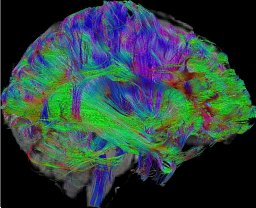
To evaluate emerging structure-function relations in a neural circuit that mediates complex behavior, we investigated age-related differences among cortical regions that support face recognition behavior and the fiber tracts through which they transmit and receive signals using functional neuroimaging and diffusion tensor imaging. In a large sample of human participants (aged 6-23 years), we derived the microstructural and volumetric properties of the inferior longitudinal fasciculus (ILF), the inferior fronto-occipital fasciculus, and control tracts, using independently defined anatomical markers. We also determined the functional characteristics of core face- and place-selective regions that are distributed along the trajectory of the pathways of interest. We observed disproportionately large age-related differences in the volume, fractional anisotropy, and mean and radial, but not axial, diffusivities of the ILF. Critically, these differences in the structural properties of the ILF were tightly and specifically linked with an age-related increase in the size of a key face-selective functional region, the fusiform face area. This dynamic association between emerging structural and functional architecture in the developing brain may provide important clues about the mechanisms by which neural circuits become organized and optimized in the human cortex.
A useful framework for understanding the mental representation of facial identity is face-space (Valentine, 1991), a multi-dimensional cognitive map in which individual faces are coded relative to the average of previously encountered faces, and in which the distance among faces represents their perceived similarity. We examined whether individuals with prosopagnosia, a disorder characterized by an inability to recognize familiar faces despite normal visual acuity and intellectual abilities, evince behavior consistent with this underlying representational schema. To do so, we compared the performance of 6 individuals with congenital prosopagnosia (CP), with a group of age- and gender-matched control participants in a series of experiments involving judgments of facial identity. We used digital images of male and female faces and morphed them to varying degrees relative to an average face, to create caricatures, anti-caricatures, and anti-faces (i.e. faces of the opposite identity). Across 5 behavioral tasks, CP individuals' performance was similar to that of the control group and consistent with the face-space framework. As a test of the sensitivity of our measures in revealing face processing abnormalities, we also tested a single acquired prosopagnosic (AP) individual, whose performance on the same tasks deviated significantly from the control and CP groups. The findings suggest that, despite an inability to recognize individual identities, CPs perceive faces in a manner consistent with norm-based coding of facial identity, although their representation is likely supported by a feature-based strategy. We suggest that the apparently normal posterior cortical regions, including the fusiform face area, serve as the neural substrate for at least a coarse, feature-based face-space map in CP and that their face recognition impairment arises from the disconnection between these regions and more anterior cortical sites.