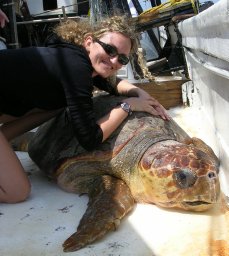
Thirty-four juvenile loggerhead sea turtles captured by trawling from the Charleston, South Carolina (USA), shipping channel (32°42′N; −79°47′W) between May 2004 and August 2007 were tagged with satellite transmitters to assess the extent to which they remained near the capture location given their collection along a seasonal migratory corridor. Seventy-five percent of juveniles were classified as seasonal residents. Migrants predominantly swam north in the spring and nomads wandered south in the summer, but predictive indicators for non-resident status were not identified. All but one juvenile generally remained south of 34°N, within 40 km of shore, and in waters <30 m deep throughout the year. Nine of 14 loggerhead sea turtles monitored during the winter remained exclusively over the continental shelf, three briefly occurred in oceanic habitats, and two foraged extensively in oceanic habitats. Residents distributed >15 km from shore between spring and autumn were three times as likely to occur in oceanic habitats in winter. Modest seasonal movements contrasted with adults tagged at similar latitudes and with juveniles tagged further north and suggest distinct foraging groups within a regional foraging ground.
Seasonal trawling was conducted randomly in coastal (depths of 4.6-17 m) waters from St. Augustine, Florida, (29.9 degrees N) to Winyah Bay, South Carolina (33.1 degrees N), during 2000-03, 2008-09, and 2011 to assess annual trends in the relative abundance of sea turtles. A total of 1262 loggerhead sea turtles (Caretta caretta) were captured in 23% (951) of 4207 sampling events. Capture rates (overall and among prevalent 5-cm size classes) were analyzed through the use of a generalized linear model with log link function for the 4097 events that had complete observations for all 25 model parameters. Final models explained 6.6% (70.1-75.0 cm minimum straight-line carapace length [ESCLmin]) to 14.9% (75.1-80.0 cm SCLmin) of deviance in the data set. Sampling year, geographic sub-region, and distance from shore were retained as significant terms in all final models, and these terms collectively accounted for 6.2% of overall model deviance (range: 4.5-11.7% of variance among 5-cm size classes). We retained 18 parameters only in a subset of final models: 4 as exclusively significant terms, 5 as a mixture of significant or nonsignificant terms, and 9 as exclusively nonsignificant terms. Four parameters also were dropped completely from all final models. The generalized linear model proved appropriate for monitoring trends for this data set that was laden with zero values for catches and was compiled for a globally protected species. Because we could not account for much model deviance, metrics other than those examined in our study may better explain catch variability and, once elucidated, their inclusion in the generalized linear model should improve model fits.
Sixteen satellite-tagged adult male loggerhead sea turtles (Caretta caretta) dispersed widely from an aggregation near Port Canaveral, Florida, USA (28°23′N, −80°32′W) after breeding. Northbound males migrated further (990 ± 303 km) than southbound males (577 ± 168 km) and transited more rapidly (median initial dive duration = 6 (IQR = 4–16) versus 19 (IQR = 10–31) min, respectively).. Migration occurred along a depth corridor (20–40 m) except where constricted by a narrow continental shelf width. Males foraged in areas 27 ± 41 km2 day−1 at locations <1–80 km from shore for 100.1 ± 60.6 days, with variability in foraging patterns not explained by turtle size or geography. Post-breeding dispersal patterns were similar to patterns reported for adult female loggerhead sea turtles in this region and adult male loggerhead sea turtles elsewhere in the northern hemisphere; however, foraging ground distributions were most similar to adult female loggerhead sea turtles in this region.
Satellite transmitters were attached to 25 reproductively active and four inactive adult male loggerhead sea turtles (86.6–107.0 cm SCLmin) captured from the Port Canaveral, FL, USA shipping channel to assess horizontal and vertical distributions. During the breeding period, male loggerheads aggregated (44% of 755 turtle days) in a 117.6 km2 core area that encompassed the shipping channel. Median dive duration during the breeding period was 27 min (IQR = 15–42 min) and males spent 4% (IQR = 3–5%) of the time at the surface, with significantly shorter dives associated with reproductively active males. Migrant and resident males dispersed concurrently, with residents shifting > 30 km east across the continental shelf over a more protracted departure schedule than migrants. Dive duration and time spent at the surface increased through the fall. Cluster analysis revealed the strongest association for dive duration with sea state during and after the breeding period, with significantly longer dives during more turbulent conditions. In contrast, univariate associations with surface interval duration were not elucidated.
A regional (29.9 to 33.1° N) trawl survey was conducted from 2000 to 2003 and 2008 to 2011 to assess the relative abundance of sea turtles on an important foraging ground. A total of 1461 loggerhead sea turtles Caretta caretta were captured in 23% of 4756 trawling events ran- domly conducted in coastal waters 4 to 17 m deep. Seventy-five percent of positive catches con- sisted of the capture of a single loggerhead sea turtle with up to 10 loggerhead sea turtles cap- tured per event. Loggerhead sea turtle capture locations were significantly clustered throughout the survey area. Nine percent of sampling events (446) occurred in spatial 'hotspots' and captured 23% of loggerhead sea turtles (339). Four percent of sampling events (193) occurred in spatial 'coldspots' and captured 1% of loggerhead sea turtles (18). The probability of loggerhead sea tur- tle capture in any given trawling event was significantly greater following the capture of a logger- head sea turtle in the previous trawling event, but twice as great within hotspots (0.53) as else- where (0.25). Hot- and coldspots were not explained by carapace length, turtle sex, genetic haplotype, 25 biotic and abiotic attributes associated with trawling events, or bycatch co-occur- rence. Because of the universal application of these standardized and relatively easy to compute metrics, we recommend their inclusion in future studies to account for discrepancies in spatial distribution patterns.
 Michael D. Arendt合作论文数6
 J. David Whitaker合作论文数4Albert L. Segars合作论文数4
 Lindsey Parker合作论文数4Julia L Byrd合作论文数4Jeffrey A. Schwenter合作论文数3
 Joseph Michael Quattro合作论文数Department of Biological Sciences, University of South Carolina3David William Owens合作论文数2
 Mark S Roberts合作论文数Department of Health Policy & Management, School of Public Health, University of Pittsburgh;Public Health Dynamics Laboartory, School of Public Health, University of Pittsburgh2
 Gaëlle Blanvillain合作论文数College of Charleston2Segars Al L合作论文数1




