We study spaces of conformal blocks associated with line bundles over elliptic curves, with coefficients in a vertex algebra. For vertex algebras satisfying suitable finiteness and semisimplicity conditions, which are met by all admissible affine vertex algebras as well as admissible W-algebras associated with nilpotent elements of standard Levi type, we prove the holonomicity of the sheaf of conformal blocks over the moduli space of bundles. Furthermore, we show that the space of flat sections of the associated Jacobi-invariant connection is spanned by trace functions on modules. This result provides a substantial generalization of the celebrated theorem of Yongchang Zhu to quasi-lisse vertex algebras. As a special case, we deduce that for affine vertex algebras at admissible level, the dimension of the space of conformal blocks coincides with the number of admissible weights at that level.
We introduce filtrations in chiral homology complexes of smooth elliptic curves, exploiting the mixed Hodge structure on cohomology groups of configuration spaces. We use these to relate the chiral homology of a smooth elliptic curve with coefficients in a vertex algebra with the Poisson homology of the associated Poisson scheme. As an application we deduce finite dimensionality results for chiral homology in low degrees.
We study the q-characters and modular data of exceptional W-algebras and give several examples and applications. We establish equality of q-characters and modular data between certain boundary W-algebras, leading in particular to a largely complete determination of fusion rules of exceptional W-algebras in type A.
We develop techniques to construct isomorphisms between simple affine W-algebras and affine vertex algebras at admissible levels. We then apply these techniques to obtain many new, and conjecturally all, admissible collapsing levels for affine W-algebras. In short, if a simple affine W-algebra at a given level is equal to its affine vertex subalgebra generated by the centraliser of an sl(2)-triple associated with the underlying nilpotent orbit, then that level is said to be collapsing. Collapsing levels are important both in representation theory and in theoretical physics. Our approach relies on two fundamental invariants of vertex algebras. The first one is the associated variety, which, in the context of admissible level simple affine W-algebras, leads to the Poisson varieties known as nilpotent Slodowy slices. We exploit the singularities of these varieties to detect possible collapsing levels. The second invariant is the asymptotic datum. We prove a general result asserting that, under appropriate hypotheses, equality of asymptotic data implies isomorphism at the level of vertex algebras. Then we use this to give a sufficient criterion, of combinatorial nature, for an admissible level to be collapsing. Our methods also allow us to study isomorphisms between quotients of W-algebras and extensions of simple affine vertex algebras at admissible levels. Based on such examples, we are led to formulate a general conjecture: for any finite extension of vertex algebras, the induced morphism between associated Poisson varieties is dominant.
We study the first chiral homology group of elliptic curves with coefficients in vacuum insertions of a conformal vertex algebra V. We find finiteness conditions on V guaranteeing that these homologies are finite dimensional, generalizing the $C_2$-cofinite, or quasi-lisse condition in the degree 0 case. We determine explicitly the flat connections that these homologies acquire under smooth variation of the elliptic curve, as insertions of the conformal vector and the Weierstrass $\zeta$ function. We construct linear functionals associated to self-extensions of V-modules and prove their convergence under said finiteness conditions. These linear functionals turn out to be degree 1 analogs of the n-point functions in the degree 0 case. As a corollary we prove the vanishing of the first chiral homology group of an elliptic curve with values in several rational vertex algebras, including affine $sl_2$ at non-negative integral level, the (2,2k+1)-minimal models and arbitrary simple affine vertex algebras at level 1. Of independent interest, we prove a Fourier space version of the Borcherds formula.
The purpose of this note is to establish an isomorphism from the vector space of extensions between two modules over a vertex algebra, to an appropriate first chiral homology of one dimensional projective space with coefficients in the corresponding chiral algebra.
We prove some isomorphisms between exceptional W-algebras associated with exceptional simple Lie algebras.
In this note we study holomorphic integer graded vertex superalgebras. We prove that all such vertex superalgebras of central charge 8 and 16 are purely even. For the case of central charge 24 we prove that the weight-one Lie superalgebra is either zero, of superdimension 24, or else is one of an explicit list of 1332 semisimple Lie superalgebras.
We prove a new quasiparticle sum expression for the character of the Ising model vertex algebra, related to the Jackson-Slater q-series identity of Rogers-Ramanujan type and to Nahm sums for the matrix ( (8 3)(3 2) ). We find, as consequences, an explicit monomial basis for the Ising model and a description of its singular support. We find that the ideal sheaf of the latter, defining it as a subscheme of the arc space of its associated scheme, is finitely generated as a differential ideal. We prove three new q-series identities of the Rogers-Ramanujan-Slater type associated with the three irreducible modules of the Virasoro Lie algebra of central charge 1/2. We give a combinatorial interpretation to the identity associated with the vacuum module.
First, we prove the Kac-Wakimoto conjecture on modular invariance of characters of exceptional affine W-algebras. In fact more generally we prove modular invariance of characters of all lisse W-algebras obtained through Hamiltonian reduction of admissible affine vertex algebras. Second, we prove the rationality of a large subclass of these W-algebras, which includes all exceptional W-algebras of type A and lisse subregular W-algebras in simply laced types. Third, for the latter cases we compute S-matrices and fusion rules. Our results provide the first examples of rational W-algebras associated with non-principal distinguished nilpotent elements, and the corresponding fusion rules are rather mysterious.
We encapsulate the basic notions of the theory of vertex algebras into the construction of a comonad on an appropriate category of formal distributions. Vertex algebras are recovered as coalgebras over this comonad.
These are expanded and revised notes for a minicourse entitled "Affine W-algebras", which took place as part of the thematic month "Quantum Symmetries" at the Centre de Recherches Mathematiques in Montreal, Canada in October 2022. The first few sections consist of rapid introductions to vertex algebras, affine Kac-Moody algebras and their integrable and admissible modules, and the homological BRST procedure for quantum Hamiltonian reduction. The affine W-algebras are defined using these ingredients. The remainder of the notes treats the structure and representation theory of the exceptional affine W-algebras, with emphasis on modular tensor categories of representations.
We give a simple description of the closure of the nilpotent orbits appearing as associated varieties of admissible affine vertex algebras in terms of primitive ideals.
In [15] (see also [20]) Schellekens proved that the weight-one space V-1 of a strongly rational, holomorphic vertex operator algebra V of central charge 24 must be one of 71 Lie algebras. During the following three decades, in a combined effort by many authors, it was proved that each of these Lie algebras is realised by such a vertex operator algebra and that, except for V-1 = {0}, this vertex operator algebra is uniquely determined by V-1. Uniform proofs of these statements were given in [42, 26]. In this paper we give a fundamentally different, simpler proof of Schellekens' list of 71 Lie algebras. Using the dimension formula in [12] and Kac's "very strange formula" [28] we show that every strongly rational, holomorphic vertex operator algebra V of central charge 24 with V-1 not equal {0} can be obtained by an orbifold construction from the Leech lattice vertex operator algebra V-Lambda. This suffices to restrict the possible Lie algebras that can occur as weight-one space of V to the 71 of Schellekens. Moreover, the fact that each strongly rational, holomorphic vertex operator algebra V of central charge 24 comes from the Leech lattice Lambda can be used to classify these vertex operator algebras by studying properties of the Leech lattice. We demonstrate this for 43 of the 70 non-zero Lie algebras on Schellekens' list, omitting those cases that are too computationally expensive. (C) 2021 Elsevier Inc. All rights reserved.
We apply results from the geometry of nilpotent orbits and nilpotent Slodowy slices, together with modularity and asymptotic analysis of characters, to prove many new isomorphisms between affine W-algebras and affine Kac-Moody vertex algebras and their finite extensions at specific admissible levels. In particular we identify many new collapsing levels for W-algebras.
We study the chiral homology of elliptic curves with coefficients in a quasiconformal vertex algebra V. Our main result expresses the nodal curve limit of the first chiral homology group in terms of the Hochschild homology of the Zhu algebra of V. A technical result of independent interest regarding the relationship between the associated graded of V with respect to Li's filtration and the arc space of the C-2-algebra is proved.
We prove a dimension formula for orbifold vertex operator algebras of central charge 24 by automorphisms of order $n$ such that $\Gamma_0(n)$ is a genus zero group. We then use this formula together with the inverse orbifold construction for automorphisms of orders 2, 4, 5, 6 and 8 to establish that each of the following fifteen Lie algebras is the weight-one space $V_1$ of exactly one holomorphic, $C_2$-cofinite vertex operator algebra $V$ of CFT-type of central charge 24: $A_5C_5E_{6,2}$, $A_3A_{7,2}C_3^2$, $A_{8,2}F_{4,2}$, $B_8E_{8,2}$, $A_2^2A_{5,2}^2B_2$, $C_8F_4^2$, $A_{4,2}^2C_{4,2}$, $A_{2,2}^4D_{4,4}$, $B_5E_{7,2}F_4$, $B_4C_6^2$, $A_{4,5}^2$, $A_4A_{9,2}B_3$, $B_6C_{10}$, $A_1C_{5,3}G_{2,2}$ and $A_{1,2}A_{3,4}^3$.
We develop an orbifold theory for finite, cyclic groups acting on holomorphic vertex operator algebras. Then we show that Schellekens' classification of V-1-structures of meromorphic conformal field theories of central charge 24 is a theorem on vertex operator algebras. Finally, we use these results to construct some new holomorphic vertex operator algebras of central charge 24 as lattice orbifolds.
We study modularity of the characters of a vertex (super)algebra equipped with a family of conformal structures. Along the way we introduce the notions of rationality and cofiniteness relative to such a family. We apply the results to determine modular transformations of trace functions on admissible modules over affine Kac–Moody algebras and, via BRST reduction, trace functions on minimal series representations of principal affine W-algebras.
We investigate associative quotients of vertex algebras. We also give a short construction of the Zhu algebra, and a proof of its associativity using elliptic functions.
 Reimundo Heluani合作论文数Department of Mathematics;University of California;Department of Mathematics, University of California , Berkeley7
 Tomoyuki Arakawa合作论文数Research Institute for Mathematical Sciences, Kyoto University7
 Sven Möller合作论文数Dept Math, Rutgers State Univ3
 Paul Gaynor合作论文数2
 Sadhana Talele合作论文数2
 Michael J. Cree合作论文数University of Waikato2
 Nils R. Scheithauer合作论文数Universität Heidelberg Mathematisches Institut2Nakatsuka Shigenori合作论文数1Bely Rodriguez Morales合作论文数1
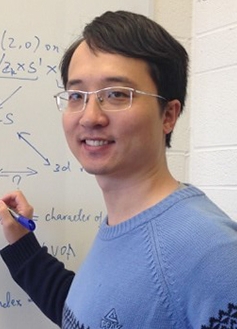 Wenbin Yan (颜文斌)合作论文数Yau Mathematical Sciences Center, Tsinghua University1Anne Moreau合作论文数Centre Hospitalier Universitaire De Nantes1Hiroki Shimakura合作论文数1Ching Hung Lam合作论文数Institute of Mathematics, Academia Sinica1




