A study on Laguerre-Gaussian (LG) modes selection in cw and pulsed Nd:YAG or Yb:YAG ceramic lasers pumped by diodes or an external laser source was carried out. Methods of scalar and vector LG modes selection from low to high orders, involving shaping of the pump profile, usage of intra-cavity lenses, uniaxial crystals and polarization selective mirrors, are considered. CCD camera images of beam profiles of hollow scalar LG(pm) modes (p-radial, m-azimuth indices) of record high-orders and Bessel-like multi-ring modes with highly directional propagation properties are presented. CW and pulsed ceramic lasers with radially or azimuthally polarized LG vector modes of low and high orders are also demonstrated. Applications of the developed laser schemes and LG beams are discussed. (C) 2013 WILEY-VCH Verlag GmbH & Co. KGaA, Weinheim
The possibility of use of ordinary short-focus lenses with strong spherical aberration for mode selection in a laser resonator is demonstrated. Plano-convex spherical lenses with foci from 2.5 to 10.0 cm placed inside the resonator of the CW laser diode pumped Yb:YAG laser were used to select circular modes of Laguerre-Gauss and Bessel-Gauss type, or to get ring-like, multi-mode off-axis oscillations with variable inner and outer diameters of rings. At the constant pump power mode selection was obtained by shifting an intracavity lens along the resonator axis relative to the Yb:YAG ceramics active element of 1.1 mm thickness. Peaked and hollow multi-ring beams with output power up to 30 mW were produced. Near diffraction free (ndf) propagation of the central part (minimum or maximum) of these beams was observed along distances over 10 m from the resonator output coupler. The mechanisms of mode selection due to spherical aberration in the resonator and ndf propagation of output beams are considered. The possibility of producing radially polarized beams from the laser with an intracavity lens and possible applications of the devised laser scheme are discussed.
A laser output coupler comprising a resonant grating submirror monolithically associated with a multilayer submirror according to a constructive interference scheme polarizes the emission of a rare-earth-doped YAG-ceramic microchip laser over its full bandwidth. The design and fabrication of the resonant grating mirror are described. A polarization contrast ratio of more than 1000 was obtained with single transverse mode operation.
A simple model of self-pulsation in lasers is considered. The laser is described by the system of two ordinary differential equations for the number of photons in the cavity and the number of excitations in the active medium, leading to the equation for the oscillator Toda with damping. For the case of strong spiking, the damping is considered as perturbation; the estimates in terms of elementary functions are suggested for the period of pulsation, damping rate, amplitude and phase of pulsation, quasi-energy and the output power. These estimates are compared to the numerical solution and to the experimental data.
 Akira Shirakawa (白川晃)合作论文数Institute for Laser Science, Research Organization for Coherent Photon Science, University of Electro-Communications;電気通信大学コヒーレント光量子科学研究機構レーサー新世代研究センター33
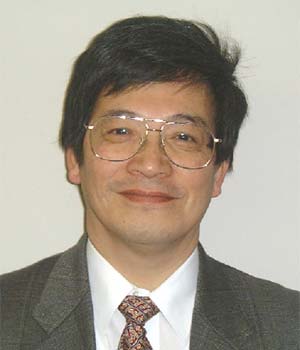 Ken-Ichi Ueda (植田憲一)合作论文数Institute for Laser Science, University of Electro-Communications;Hamamatsu Photonics32
 T. Yanagitani合作论文数21K. Takaichi合作论文数20
 A. S. Kaminskii合作论文数20Yu V Senatsky合作论文数17H Yagi合作论文数16J. Lu合作论文数10
 Dmitrii Kouznetsov合作论文数8H YAGI合作论文数7Yu. N. Barabanenkov合作论文数7J LI合作论文数6
 Olivier Parriaux合作论文数6
 Yan Feng (冯衍)合作论文数University of Chinese Academy of Sciences5T. Uematsu合作论文数4M Musha合作论文数4Y SATO合作论文数4
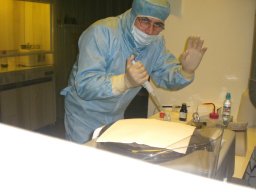 s tonchev合作论文数Newport Corp, MKS4
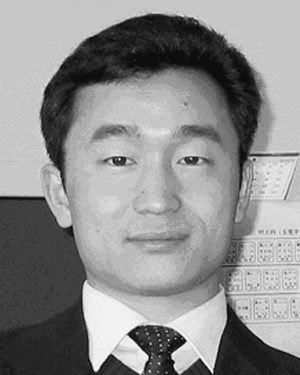 Jianren Lu合作论文数4j c pommier合作论文数3KI UEDA合作论文数3YN BARABANENKOV合作论文数3A. V. Taranov合作论文数3
 Serge Reynaud合作论文数Laboratoire Kastler-Brossel, Sorbonne University2
 Alexandre V. Tishchenko合作论文数2
 Hideki Yagi合作论文数Konoshima Chemical Co., Ltd.2Florent Pigeon合作论文数Faculté de Médecine Laboratoire d'Histologie, Embryologie et Cytogénétique 51095 Reims Cedex France 51095 Reims Cedex France2E. N. Khazanov合作论文数2
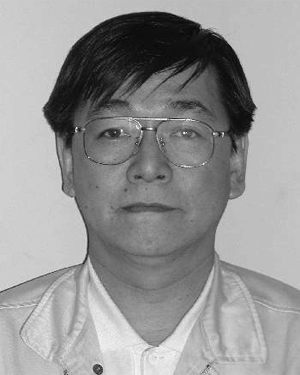 Takagimi Yanagitani合作论文数2H Oberst合作论文数2E. Gamet合作论文数2Sergey Ivanov合作论文数2
 M. P. Thirugnanasambandam合作论文数CALTECH1En Khazanov合作论文数1Klaus Petermann合作论文数1
 Masaki Tokurakawa合作论文数1
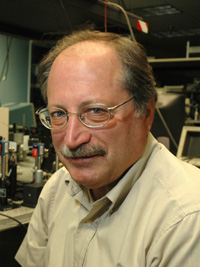 Steven R. J. Brueck合作论文数Center for High Technology Materials, University of New Mexico;Physics & Astronomy Department, University of New Mexico;School of Engineering, University of New Mexico1
 Hans Joachim Eichler合作论文数Department of Optics and Atomic Physics, Technische Universität Berlin;Department of Optical Engineering, Zhejiang University1Jia Li合作论文数1Alexander Neumann合作论文数1
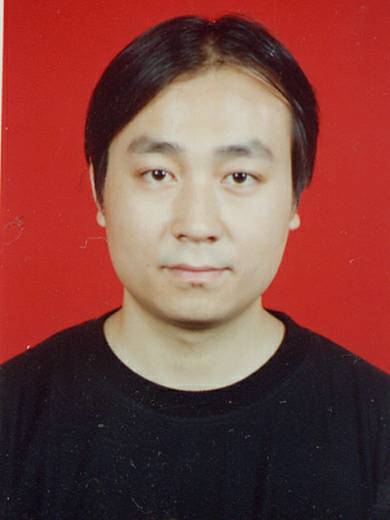 Shenghong Huang (黄生洪)合作论文数School of Engineering Science, University of Science and Technology of China1Y. Kuznetsova合作论文数1
 Alexander A. Kaminskii合作论文数Shubnikov Institute of Crystallography, Russian Academy of Sciences1
 S. N. Bagayev合作论文数Department of the Institute of Laser Physics,Siberian Branch of the Russian Academy of Sciences1
 Nathalie Destouches合作论文数Université de Lyon1
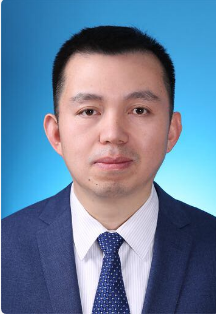 Guanshi Qin (秦冠仕)合作论文数College of Electronic Science & Engineering, Jilin University1
 N. M. Lyndin合作论文数1Motoyuki Tanisho合作论文数1N. Lyndin合作论文数1




