Graph-based Approximate Nearest Neighbor Search (ANNS), particularly using Hierarchical Navigable Small World (HNSW) graphs, offers state-of-the-art query performance for large-scale, high-dimensional data. However, the efficiency and accuracy of HNSW indexes degrade seriously under dynamic conditions involving frequent data deletions and reinsertions, often necessitating costly full index rebuilds. This paper introduces PRO-HNSW (Proactive Repair and Optimized HNSW), a novel and lightweight maintenance framework designed to efficiently preserve and even enhance the quality of the HNSW graph in dynamic environments. PRO-HNSW systematically addresses key structural degradation factors by incorporating three targeted modules: (1) a RemoveObsoleteEdges module to prune edges pointing to deleted nodes while preserving minimal connectivity, (2) a RepairDisconnectedNodes module that re-establishes connectivity for isolated nodes via BFS-based neighbor discovery, and (3) a ResolveUnidirectionalEdges module to ensure more balanced and navigable graph structures. Extensive experiments on eight diverse benchmark datasets demonstrate that PRO-HNSW significantly outperforms not only the standard HNSW but also the state-of-the-art MN-RU method. Notably, on the high-dimensional GIST1M dataset under high data churn, PRO-HNSW achieves a peak recall of 84.23%, a significant 2.56 percentage points higher than even the ideal HNSW-Rebuild baseline, showcasing its superior ability to produce a more optimal graph structure. Our findings also reveal that applying specific PRO-HNSW maintenance modules to a freshly built static HNSW index can improve its initial recall, highlighting its utility as a general graph optimization technique. PRO-HNSW thus provides a practical and robust solution for maintaining highperformance ANNS in evolving real-world applications.
The Text-to-SQL task translates natural language questions into SQL queries, enabling intuitive database interaction for non-experts. While recent methods leveraging Large Language Models (LLMs) achieve strong performance, their reliance on proprietary models raise concerns about deployment feasibility and data privacy. In this work, we introduce LitE-SQL, a Lightweight and Efficient framework with two components: (i) a Schema Retriever that performs efficient schema linking using a vector database of pre-computed schema embeddings, and (ii) a SQL Generator fine-tuned in two stages-supervised fine-tuning followed by execution-guided reinforcement-enabling self-correction without costly multi-candidate generation. On BIRD, LitE-SQL achieves 72.10
As data volumes continue to grow, optimizing database performance has become increasingly critical, making the implementation of effective tuning methods essential. Among various approaches, database parameter tuning has proven to be a highly effective means of enhancing performance. Recent studies have shown that machine learning techniques can successfully optimize database parameters, leading to significant performance improvements. However, existing methods still face several limitations. First, they require substantial time to generate large training datasets. Second, to cope with the challenges of highdimensional optimization, they typically optimize only a subset of parameters rather than the full configuration space. Third, they often rely on information from similar workloads instead of directly leveraging information from the target workload. To address these limitations, we propose LatentTune, a novel approach that differs fundamentally from traditional methods. To reduce the time required for data generation, LatentTune incorporates a data augmentation strategy. Furthermore, it constructs a latent space that compresses information from all database parameters, enabling the optimization of the full configuration space. In addition, LatentTune integrates external metric information into the latent space, allowing for precise tuning tailored to the actual target workload. Experimental results demonstrate that LatentTune outperforms baseline models across four workloads on MySQL and RocksDB, achieving up to 1332 % improvement for RocksDB and 11.82 % throughput gain with 46.01 % latency reduction for MySQL.
Protein-ligand interactions play an essential role in many biological processes, and prior knowledge of ligand binding sites is necessary for successful drug design. Many 3D structure- and sequence-based methods have been proposed for identifying ligand binding sites. The 3D structure-based methods typically achieve better binding site prediction than the sequence-based methods. However, as deep-learning techniques that can extract structural information from large-scale sequence data have been developed, the performance gap between 3D structure- and sequence-based methods is narrowing. Nonetheless, there remains room for improvement in sequence-based prediction. We propose Pseq2Sites, a sequence-based deep-learning model for predicting ligand binding sites. Pseq2Sites comprises a 1D convolutional neural network that extracts local features from the protein sequence, and a position-based attention mechanism that captures long-distance dependencies between binding residues. To verify the effectiveness of the proposed method, we compared it with other state-of-the-art methods using three public datasets: COACH420, HOLO4K, and CSAR-NRC HiQ. Utilizing solely protein sequence information, Pseq2Sites outperformed 3D structure-based state-of-the-art methods on external test datasets; within the COACH420 dataset, Pseq2Sites remarkably identified 97% of the binding pockets (at a significance level delta = 0.5), which was 27% higher than the second highest-performing model. Pseq2Sites also achieved outstanding binding site prediction, even for proteins with low similarity to the training dataset. Our code is available at https://github.com/Blue1993/Pseq2Sites.
The explosive growth in data has triggered the emergence of NoSQL databases, which can be used to efficiently deal with unstructured and semi-structured data. RocksDB is a widely used persistent key–value store developed by Facebook to support high-throughput storage environments. It provides flexible configuration knobs that can be tuned to optimize performance. However, optimizing the RocksDB performance for specific workloads is challenging because the knobs have complicated inner relationships and different impacts according to workload type. In addition, RocksDB performance is measured using multiple metrics, such as latency and space amplification, which should be simultaneously considered. To address these issues, we designed a workload-aware configuration tuning framework called K2vTune, which can recognize the configuration knobs of RocksDB according to the workload type and effectively consider multiple performance metrics using our knob2vec method. The knob2vec method learns feature vectors for knobs that can capture both the latent relationships between knobs and workload-specific features to develop an attention neural network for accurate configuration-based performance prediction. K2vTune converts multiple metrics into a single problem and optimizes the problem using a genetic algorithm. We evaluated the proposed method using six different RocksDB workloads and confirmed that K2vTune achieved significant tuning performance improvement compared to baselines, showing 8.83% improvements over the state-of-the-art baseline.
A persistent key-value store, RocksDB, is adapt-able to various workloads and provides fast and low-latency storage for devices that are utilized by numerous applications. RocksDB has been introduced with numerous configuration options for customization and performance optimization. Unfor-tunately, determining an optimal configuration for each given workload remains challenging due to the overwhelming number of options. This complexity is compounded by different types of workloads, thereby requiring efficient configuration tuning. Recent studies have approached automatic tuning techniques to solve this problem by applying reinforcement learning approaches or transferring prior knowledge to predictive models in order to tune unobserved target workloads. However, the former method is time-consuming, and the latter results in unstable optimal performance according to the accuracy of the predictive models. The models trained with prior knowledge, estimate RocksDB performance of given configurations on the target workload, where those workload mismatches degrade tuning performance. To address these challenges, we propose MetaTune, which introduces a meta learner, which is a meta-learning technique, to train a workload -specific predictive model. MetaTune effectively transfers prior knowledge and effi-ciently fine-tunes the model for new workloads. We conducted a comparative analysis of MetaTune with the state-of-the-art baselines across a heterogeneous set of workloads. MetaTune achieved 3.78% to 53.25% improvement in tuning performance compared to the most recent baseline.
In this study, we suggest a novel video retargeting approach by considering the essential factors of a video: main object and movement thereof. Such two factors have been considered including the region of interest (ROI) for target object. Experimentally, we set the main object as human for storing the interaction object and movement in each sequential frame. Our method aims to preserve the ROI to the maximum extent possible over retargeting constraints for the target resolution. With a view to preserving the original main object, we rely on an object detection model to identify human-oriented objects; subsequently, we conduct a decision-making process to determine the suitability of our scheme. Upon the application of the proposed method, video frames are split into many patches and then generated with a precise target resolution using a video super-resolution model. The results of retargeting the frame images are compared against quality assessment metrics. The PSNR, SSIM, MS-SSIM, LPIPS, BMPRI, BRISQUE, PIQE and NIQE were used. We perform comparative experiments to confirm that the proposed approach can maintain the original ratio of important objects and the content of the video. We experimentally demonstrate that the proposed approach could enhance video resolution while ensuring visually pleasing quality and original important object.
Heterologous boost regimens are being increasingly considered against SARS-CoV-2. We report results for the 32 of 45 participants in the Phase 1 CoV2-001 clinical trial (Kim et al., Int J Iinfect Dis 2023, 128:112- 120) who elected to receive an EUA-approved SARS-CoV-2 mRNA vaccine 6 to 8 months following a two -dose primary vaccination with the GLS-5310 bi-cistronic DNA vaccine given intradermally and followed by application of suction using the GeneDerm device. Receipt of EUA-approved mRNA vaccines after GLS-5310 vaccination was well-tolerated, with no reported adverse events. Immune responses were enhanced such that binding antibody titers, neutralizing antibody titers, and T-cell responses increased 1,187-fold, 110-fold, and 2.9-fold, respectively. This paper is the first description of the immune responses following heterologous vaccination with a DNA primary series and mRNA boost. & COPY; 2023 The Author(s). Published by Elsevier Ltd. This is an open access article under the CC BY-NC-ND license (http://creativecommons.org/licenses/by-nc-nd/4.0/).
Visual field defects (VFD) are closely associated with driver hazard perception. Drivers with advanced VFD are more likely to be involved in traffic accidents than healthy-sighted drivers even though they apply extra movements to overcome the defects. Given difficulties in dealing with particular situations, such as finding traffic signals, machinery assistance is necessary for improving driving safety. However, it has been less explored that which assistance systems would be helpful for visually impaired drivers in which traffic situations. To have a better understanding of driving with VFD and provide a safer traffic environment for drivers with advanced VFD, this study aimed to investigate effects of three driver assistance systems on reducing traffic accidents regarding several traffic situations. Methods:A driving simulator experiment using 66 healthy-sighted drivers generated advanced VFD on a screen for all simulations. This study designed a Baseline condition and three assistance systems based on time-to-collision (TTC) in hazardous events: automatic braking (AB; TTC = 0.8s) and giving voice guidance about driver behavior to cope with encountering situations. Two guidance systems were presented in different alert timings (VGEarly; TTC = 4s, VGLate; mean TTC = 2.81s). We classified 29 hazardous events into four categories: traffic signals, oncoming right-turning cars, objects that appear from driver’s right and left sides, then counted the number of traffic accidents. Results:Data provided that all assistance systems showed the lower number of accidents than the Baseline. Whereas drivers in the Baseline were not able to find traffic signals due to the defect, no accident cases related to the situation were observed in the assistance system conditions. When an oncoming car turned to the right, drivers in the VGEarly showed the lowest accident rate among all conditions. The AB led the great number of accidents in the oncoming car situation but yielded no accidents with hazards approaching from the right. Results showed that both VG systems were more likely to reduce the accidents with hazards from the left than the AB. More specifically, the VGEarly decreased the accident rate by approximately 15% more than the VGLate.Discussions:This study attempted to figure out which system is effective for visually impaired drivers in which traffic situation. Interestingly, the effect depended on situations. For example, the AB led no accidents when encountering objects from the right side unlike the VG systems. The VGLate had a potential of reducing accidents, but the VGEarly more contributed to reducing accidents rather than the VGLate. Because VFD led failure in driver perception that is a very initial stage of information processing, in general, VGEarly is considered to produce appropriate performance. The current study is limited to investigating accident rates, thus next study should perform further analyses of driver response that can provide two-way feedback between the system and the driver. Despite the limitation, the present study found that assistance timings and traffic situations are critical factors influencing system design for visually impaired drivers. Empirical findings are expected to provide insights into practical assistance designs for driving with VFD.
Database systems typically have many knobs that must be configured by database administrators to achieve high performance. RocksDB achieves fast data writing performance using a log-structured merge-tree. This database contains many knobs related to write and space amplification, which are important performance indicators in RocksDB. Previously, it was proved that significant performance improvements could be achieved by tuning database knobs. However, tuning multiple knobs simultaneously is a laborious task owing to the large number of potential configuration combinations and trade-offs. To address this problem, we built a tuning system for RocksDB. First, we generated a valuable RocksDB data repository for analysis and tuning. To find the workload that is most similar to a target workload, we created a new representation for workloads. We then applied the Mahalanobis distance to create a combined workload that is as close to the original target workload as possible. Subsequently, we trained a deep neural network model with the combined workload and used it as the fitness function of a genetic algorithm. Finally, we applied the genetic algorithm to find the best solution for the original target workload. The experimental results demonstrated that the proposed system achieved a significant performance improvement for various target workloads.
Objectives: The CoV2-001 phase I randomized trial evaluated the safety and immunogenicity of the GLS-5310 bi-cistronic DNA vaccine through 48 weeks of follow-up. Design: A total of 45 vaccine-naïve participants were recruited between December 31, 2020, and March 30, 2021. GLS-5310, encoding for the SARS-CoV-2 spike and open reading frame 3a (ORF3a) proteins, was administered intradermally at 0.6 mg or 1.2 mg per dose, followed by application of the GeneDerm suction device as part of a two-dose regimen spaced either 8 or 12 weeks between vaccinations. Results: GLS-5310 was well tolerated with no serious adverse events reported. Antibody and T cell responses were dose-independent. Anti-spike antibodies were induced in 95.5% of participants with an average geometric mean titer of ∼480 four weeks after vaccination and declined minimally through 48 weeks. Neutralizing antibodies were induced in 55.5% of participants with post-vaccination geometric mean titer of 28.4. T cell responses were induced in 97.8% of participants, averaging 716 site forming units/106 cells four weeks after vaccination, increasing to 1248 at week 24, and remaining greater than 1000 through 48 weeks. Conclusion: GLS-5310 administered with the GeneDerm suction device was well tolerated and induced high levels of binding antibodies and T-cell responses. Antibody responses were similar to other DNA vaccines, whereas T cell responses were many-fold greater than DNA and non-DNA vaccines.
감성 분석은 텍스트로부터 주관적인 의견 및 성향을 분석하고, 감정 탐지는 ‘행복’, ‘슬픔’과 같이 텍스트에서 나타나는 감정을 검출하는 연구다. 멀티 모달 데이터는 텍스트뿐만 아니라 이미지, 음성 데이터가 함께 나타나는 것을 의미한다. 관련 선행 연구에서 순환 신경망 모형 혹은 교차 트랜스포머를 사용한다. 하지만 순환 신경망 모형은 장기 의존성 문제를 가지며, 교차 트랜스포머는 모달리티별 특성을 반영하지 못하는 문제점이 있다. 이를 해결하기 위해 본 연구에서는 멀티 모달 데이터가 하나의 네트워크로 학습되는 단일 입출력 트랜스포머 기반 모형 SMERT를 제안한다. SMERT는 모달리티 결합 표현형을 얻어 이를 감성 분석 및 감정 탐지에 활용한다. 또한, BERT의 훈련 태스크를 멀티 모달 데이터에 활용하기 위해 개량하여 사용한다. 제안하는 모델의 검증을 위해 CMU-MOSEI 데이터셋과 여러 평가 지표를 이용하고, 모달리티 조합별 비교실험과 예시를 통해 모델의 우수성을 검증하였다.
이미지 캡션 생성이란 주어진 이미지로부터 객체 요소를 파악하여 장면을 설명하는 자연어를 자동으로 서술하는 연구이다. 선행 연구에서는 주로 단일 특징 추출기를 통해 이미지에서 정보를 포착한 후, 순환 신경망 기반의 디코더를 통해 캡션을 생성한다. 하지만 단일 특징 추출기를 사용하기 때문에 다중관점의 이미지 정보를 사용할 수 없고, 순환 신경망 기반의 장기 의존성 문제를 가지는 디코더를 사용한다. 이를 해결하기 위해서 본 연구는 복수의 특징 추출기를 사용하는 다중 관점 인코더를 통해 다양한 각도의 이미지 정보를 가공하여 전달한다. 또한, 순환 신경망의 한계를 보완하기 위해서, 트랜스포머 모델 기반의 디코더 레이어에 추가적인 멀티-헤드 주의 기제 기법을 통해 생성된 문장을 재구축하여 문장의 완성도를 높이는 자가 교열 트랜스포머를 제안한다. 제안하는 모델의 검증을 위해 MSCOCO 데이터셋을 이용하여 다양한 비교실험으로 정량적, 정성적 평가를 통해 제안한 방법론의 우수성을 검증하였다.
Recently, convolutional neural network (CNN) compression via low-rank decomposition has achieved remarkable performance. Finding the optimal rank is a crucial problem because rank is the only hyperparameter for controlling computational complexity and accuracy in compressed CNNs. In this paper, we propose a global optimal rank selection method based on Bayesian optimization (BayesOpt), which is a machine learning based global optimization technique. By utilizing both a simple objective function and a proper optimization scheme, the proposed method produces a global optimal rank that provides a good trade-off between computational complexity and accuracy degradation. In addition, our method also reflects the correlation of each rank in multi-rank selection, and is able to flexibly yield an optimal rank with a given fixed compression ratio. Experimental results indicate that the proposed algorithm can identify the global optimal rank regardless of the huge size of dataset or the various structural features of CNNs. In all experiments on multi-rank selection, the proposed method produces the rank with higher accuracy and lower computational complexity than the state-of-the-art rank selection method, variational Bayesian matrix factorization (VBMF).
Nystrom 방법은 Symmetric Positive -Semidefinite (SPSD) 행렬의 열들을 균등하게 샘플링하여 SPSD 행렬의 저-랭크 성분을 예측하는 방법이다. 그러나, 정확한 복원을 위해서는 선택된 열들로 이뤄진 집합의 행렬이 풀-랭크의 성질을 만족해야 하는 강력한 전제조건이 수반되는데, 실제로 이러한 조건을 만족시키는 샘플링 방법을 찾기는 매우 어렵다. 본 논문에서는 원래의 SPSD 행렬로부터 가능한 한 정보를 많이 가진 열들을 획득하기 위하여 간접적으로 기하학적 Coherence 값을 활용하는 방법을 새롭게 제안하였다. 또한, 제안하는 방법에서는, Coherence 값을 적절한 레벨로 맞추고 이를 통해 성공적인 SPSD 행렬의 저-랭크 성분 예측을 가능케 하기 위하여 극 희귀 랜덤 투사법을 활용하였다. 결과적으로 제안하는 기법은 기존의 Nystrom 샘플링 방법들에 비하여, 계산량은 현격히 줄고 성능은 one-shot 기법과 같은 최상위 기법에 근접하는 효율적인 기법임을 실험을 통하여 검증하였다.
The perceptual loss functions have been used successfully in image transformation for capturing high-level features from images in pre-trained convolutional neural networks (CNNs). Standard perceptual losses require numerous parameters to compare differences in feature-maps on both an input image and a target image; thus, it is not affordable for resource-constrained devices in terms of utilizing a feature-maps. Hence, we propose a compressed perceptual losses oriented Tensor Train (TT) decomposition on the feature-maps. Additionally, to decide an optimal TT-ranks, the proposed algorithm used the global analytic solution of Variational Bayesian Matrix Factorization (VBMF). Therefore, in proposed method, the low-rank approximated feature-maps consist of salient features by virtue of these two techniques. To the best of our knowledge, we are the first to consider curtailing redundancies in feature-maps via low-rank TT-decomposition. Experimental results in style transfer tasks demonstrate that our method not only yields similar qualitative and quantitative results as that of the original version, but also reduces memory requirement by approximately 77%.
Face and expression recognition problem can be converted into superposition of low-rank matrix and sparse error matrix, which have the merits of robustness to occlusion and disguise. Low-rank matrix manifests neutral facial image and sparse matrix captures emotional expression with respect to whole image. To separate these matrices, the problem is formulated to minimize the nuclear norm and L-1 norm, then can be solved by using a closed-form proximal operator which is called Singular Value Thresholding (SVD). However, this conventional approach has high computational complexity since it requires computation of singular value decomposition of large sized matrix at each iteration. In this paper, to reduce this computational burden, a fast approximation method for SVT is proposed, utilizing a suitable low-rank matrix approximation involving random projection. Basically, being associated with sampling, a low-rank matrix is modeled as bilateral factorized matrices, then update these matrices with greedy manner. Experiments are conducted on publicly available different dataset for face and expression recognition. Consequently, proposed algorithm results in the improved recognition accuracy and also further speeding up the process of approximating low-rank matrix, compared to the conventional SVT based approximation methods. The best recognition accuracy score of 98.1% in the JAFFE database is acquired with our method about 55 times faster than SVD based method.
In recovering low-dimensional representations of high-dimensional data, graph or manifold-regularized schemes have been investigated as a key tool in many areas to preserve the neighborhood structure of the data set. In spite of its effectiveness, these methods are often not tractable in practice, because graph structures of data lead to a large matrix (e.g., affinity of Laplacian matrix) and the methods require eigenanalysis of it interactively. In this paper, we propose an efficient low-rank matrix approximation that regularized by graph information derived from row and column range spaces of data. To deal with high computational complexity issue, we leverage the Nyström method, which has been universally used to approximate low-rank component of Symmetric Positive Semi-Definite (SPSD) matrices with sampling. Moreover, we devise a Clustered Nystrom extension with QR decomposition to efficiently aggregate more information from samples and to accurately approximate low-rank structure. We compare the performance of the proposed algorithm with other several general algorithms in clustering experiments on benchmark dataset. Our experimental results show that our method has a favorable running speed while the accuracy of our proposed method is better or comparable to the competing methods.
Robust principal component analysis, which extracts low-dimensional data from high-dimensional data, can also be regarded as a source separation problem of the sparse error matrix and the low-rank matrix. Until recently, various methods have attempted to precisely predict the discrete rank function by assigning a weight to the nuclear norm. However, if the weights are not in ascending order, the algorithms will diverge and exhibit high computational complexity. Moreover, from the viewpoint of source separation, these methods overlook the fact that two components must be sufficiently different for accurate demixing. In this paper, we employ the incoherence term with convex shape, which considers that components must appear different from one another for boosting separability. Since it is intractable to directly exploit mutual incoherence defined in linear algebra, we guarantee the incoherence by indirectly making the sparse matrix lack the low-rank property by using the duality norm principle. This approach can also be associated with the null space. To analyze the results of the proposed algorithm geometrically, we measure the geodesic distance between the tangent spaces of the manifolds of two separate components. As this distance increases, the degree of dissimilarity of the two components is adequately assured; thus, separation succeeds. Furthermore, this paper is the first to provide insights into the relationship between source separation conditions and the derivatives of the nuclear norm and $L_{1}$ norm. Experiments are conducted on still image separation and background subtraction to confirm the superiority of the proposed methods both qualitatively and quantitatively.
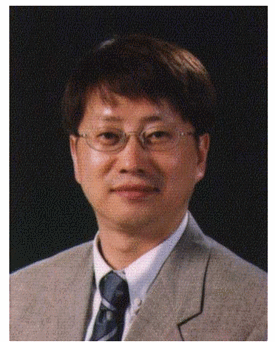 Yoonsik Choe合作论文数Dept Elect & Elect Engn, Yonsei Univ10
 Sanghyun Park合作论文数Department of Computer Science, Yonsei University8
 Sangmin Seo合作论文数Dept Comp Sci, Yonsei Univ4
 Si Young Song合作论文数Division of Gastroenterology, Department of Internal Medicine, College of Medicine, Yonsei University;Korea Health Industry Development Institute;Industry -University Convergence Center, YUHS;National Academy of Medicine of Korea4
 han-soo Kim合作论文数3
 Hyun Ok Kim合作论文数Department of Laboratory Medicine, College of Medicine, Yonsei University3Hak Jun Hyun合作论文数2Ijoo Kwon合作论文数2Bohyun Jeon合作论文数2Deborah Kane合作论文数2Yeeun Oh合作论文数2Susan Spruill合作论文数2hyojin lee合作论文数2Ji-Eun Park合作论文数2Areum Gil合作论文数2
 Jonghwan Choi合作论文数Yonsei Univ, Dept Comp Sci, Seoul, South Korea2Young K Park合作论文数2Jin Gu Yoon合作论文数2Hye Seong合作论文数2Christine Roberts合作论文数2
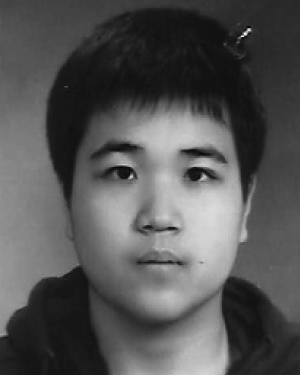 Jinuk Park合作论文数KAIST2Park Jeong Youp合作论文数Dept Internal Med, Div Gastroenterol, Yonsei Univ2
 Joel Maslow合作论文数2Kudchodkar Sagar B合作论文数Vaccine & Immunotherapy Ctr, Wistar Inst Anat & Biol2
 Joon Young Song合作论文数Department of Internal Medicine, College of Medicine, Korea University2
 Woo Joo Kim合作论文数Department of Internal Medicine, College of Medicine, Korea University2
 Taehyeon Kim合作论文数Holiday Robotics2
 Kar Muthumani合作论文数Department of Pathology and Laboratory Medicine, University of Pennsylvania2
 Hee Woong Kim合作论文数Graduate School of Information, Yonsei University2Euiyeol Oh合作论文数1Sunhee Lee合作论文数1Sun-Kyung Yoon合作论文数1Yonggun Lee合作论文数1Kyeonghun Kim合作论文数1Dong Hwi Kim合作论文数1
 Jong-Su Yoon合作论文数1giyoun jung合作论文数1sangseok koh合作论文数1Sujin Lee合作论文数1Huijun Jin合作论文数1Jaehyun Bae合作论文数1Tae Hoon Lee合作论文数1
 Miran Heo合作论文数NVIDIA1Hyojin Lee合作论文数Depart. of Environmental Engineering, Seoul National Univ. of Sci. and Tech.1
 Chi-Hyun Park合作论文数1Huiping Zhou合作论文数Univ Tsukuba, Fac Engn Informat & Syst, Tsukuba, Ibaraki, Japan1Moonsup Jeong合作论文数GeneOne Life Sci Inc, Seoul, South Korea1Byoungguk Kim合作论文数1




