Radio channel measurements and channel modeling have always been a driving force of the wireless COST actions. These high spirits have been kept up also in COST 2100, where significant advances, particularly in channel measurements, have been made. Channel measurements are indispensable for wireless system design. It is the wireless channel that determines the ultimate performance limits of any communication system. In the beginnings of cellular communications, fading and path loss of the narrowband channel were the key figures of merit. This has changed with wideband multiantenna, multiuser systems. New important features of the radio channel became obvious: the channels’ frequency selectivity, directivity, polarimetric properties, and their relation to channels of the other users. Also for emerging systems, the channel properties need to be identified and modeled: Peer-to-peer systems, which employ distributed nodes indoors or outdoors, show surprising fading characteristics. The propagation channels between vehicles suffer from severe fading under high Doppler shifts. Ultrawideband systems provide an extremely high delay resolution, which needs to be captured. Finally, radio systems using millimeter and submillimeter waves experience strong shadowing by human bodies. All these effects need to be measured and modeled accordingly. Once measurements have been done, and researchers obtained an abundance of data, these measurements need to be analyzed in a sound way. For modeling purposes it is often advantageous to separate the effects of the antenna from the radio channel. This can be achieved by high-resolution parameter estimation, where the channel is characterized as a superposition of multiple wave fronts. Using this data along with maps or photographs of the environment, scattering objects can be automatically located, which provides a deep insight into the processes going on in the radio channel. However, high-resolution parameter estimation methods have several pitfalls, depending on the calibration of the measurement equipment. Only with the knowledge of possible pitfalls, these can be avoided.
The vehicle-to-vehicle (V2V) propagation channel has significant implications on the design and performance of novel communication protocols for vehicular ad hoc networks (VANETs). Extensive research efforts have been made to develop V2V channel models to be implemented in advanced VANET system simulators for performance evaluation. The impact of shadowing caused by other vehicles has, however, largely been neglected in most of the models, as well as in the system simulations. In this paper we present a shadow fading model targeting system simulations based on real measurements performed in urban and highway scenarios. The measurement data is separated into three categories, line-of-sight (LOS), obstructed line-of-sight (OLOS) by vehicles, and non-line-of-sight due to buildings, with the help of video information recorded during the measurements. It is observed that vehicles obstructing the LOS induce an additional average attenuation of about 10 dB in the received signal power. An approach to incorporate the LOS/OLOS model into existing VANET simulators is also provided. Finally, system level VANET simulation results are presented, showing the difference between the LOS/OLOS model and a channel model based on Nakagami-m fading.
In vehicle-to-vehicle (V2V) communication systems, the antennas are prone to shadowing, and the antenna gain is dissimilar even for same antenna elements if mounted at different positions on the car. This letter investigates the impact of antenna placement based on channel measurements performed with four omnidirectional antennas mounted on the roof, bumper, windscreen, and left-side mirror of the transmitter and receiver cars. Results suggest to use antennas with complementary characteristics, e.g., antennas on each side, mounted on the roof and bumper, to exploit diversity and decrease the effect of shadowing.
In this paper we present an analysis of the effects of antenna placement on the radio channel properties for Vehicle-to-Vehicle communications based on measurements performed in three different propagation scenarios; highway, urban and rural. Four omni-directional antennas were mounted at four different positions: roof, bumper, left-side mirror and inside windscreen of two standard station wagons (Volvo V70). The channel transfer functions were measured for all antenna combinations with a wideband MIMO channel sounder. The results from this initial analysis show that the antenna mounted on the left-side mirror outperforms other antennas when vehicles are moving in convoy and are aligned well to each other. Whereas, if the TX and RX are moving in opposite direction, i.e., towards each other, bumper antenna shows good performance as long as LOS is available in between the antenna elements. In total some kind of diversity arrangement with complementary antennas seems to be the preferred solution, to decrease the effect of shadowing. (Less)
To make transportation safer, more efficient, and less harmful to the environment, traffic telematics services are currently being intensely investigated and developed. Such services require dependable wireless vehicle-to-infrastructure and vehicle-to-vehicle communications providing robust connectivity at moderate data rates. The development of such dependable vehicular communication systems and standards requires accurate models of the propagation channel in all relevant environments and scenarios. Key characteristics of vehicular channels are shadowing by other vehicles, high Doppler shifts, and inherent nonstationarity. All have major impact on the data packet transmission reliability and latency. This paper provides an overview of the existing vehicular channel measurements in a variety of important environments, and the observed channel characteristics (such as delay spreads and Doppler spreads) therein. We briefly discuss the available vehicular channel models and their respective merits and deficiencies. Finally, we discuss the implications for wireless system design with a strong focus on IEEE 802.11p. On the road towards a dependable vehicular network, room for improvements in coverage, reliability, scalability, and delay are highlighted, calling for evolutionary improvements in the IEEE 802.11p standard. Multiple antennas at the onboard units and roadside units are recommended to exploit spatial diversity for increased diversity and reliability. Evolutionary improvements in the physical (PHY) and medium access control (MAC) layers are required to yield dependable systems. Extensive references are provided.
This paper presents a double directional analysis of vehicle-to-vehicle channel measurements conducted in three different traffic scenarios. Using a high- resolution algorithm, we derive channel parameters like Angle-of-Arrival (AOA), Angleof- Departure (AOD), propagation delay and Doppler shift and identify underlying propagation mechanisms by combining these estimates with maps of the measurement sites. The results show that first-order reflections from a small number of interacting objects can account for a large part of the received signal in the absence of line-of-sight (LOS). This effect is especially pronounced in the two traffic scenarios where the road is not lined with buildings. We also found that the direction spread is low (and conversely that the antenna correlation is high) in such scenarios, which suggests that beamforming rather than diversity-based methods should be used if multiple antenna elements are available. The situation is reversed, however, in the third scenario, a narrow urban intersection, where a larger number of higher-order reflections is found to result in a higher direction spread.
Vehicle-to-vehicle (V2V) communications have received increasing attention lately, but there is a lack of reported results regarding important quantities such as path loss. This paper presents parameterized path loss models for V2V communications based on extensive sets of measurement data collected mainly under line-of-sight conditions in four different propagation environments: highway, rural, urban, and suburban. The results show that the path loss exponent is low for V2V communications, i.e., path loss slowly increases with increasing distance. We compare our results to those previously reported and find that, while they confirm some of the earlier work, there are also differences that motivate the need for further studies.
In this paper we analyze the Ricean K-factor for vehicle-to-vehicle (V2V) communications in a typical open sub-urban street crossing. The channel conditions vary from non line-of sight (NLOS) to line-of-sight (LOS). The antenna arrays used for recording the radio channels consist of 4 elements with directional radiation patterns. We measured 16 individual single-input single-output channels, with a bandwidth of 240MHz for a duration of 20 s. We performed two kind of evaluations. For the first analysis we partitioned the 240MHz bandwidth into 24 sub-bands with 10MHz each, according to 802.11p. The small-scale fading of the first delay bin is Ricean distributed with a time-varying K-factor. The later delay bins are mostly Rayleigh distributed. We observe that the large/small K-factor values are not necessarily correlated with the received power. We show that the K-factor can not be assumed to be constant in time, frequency, and space. The antenna radiation patterns, and the illuminated objects by them at different time instances are the cause of these variations. The second evaluation considers the 240MHz bandwidth, and the narrow-band K-factor is calculated for each frequency bin, with Δf = 312 kHz. We corroborate the need to consider the frequency variation of the K-factor. We conclude that a multi-dimensional varying K-factor models the large-scale statistical behaviour more accurately than a constant K-factor.
The scalability of intelligent transport systems (ITS) applications is difficult to test in a field operational test (FOT) due to the high number of ITS equipped vehicles required. Therefore, compu ...
In this paper we present an overview of a vehicle-to-vehicle radio channel measurement campaign at 5.6 GHz. The selected measurement scenarios are based on important safety-related applications. We explain why these scenarios are interesting from the aspect of radio propagation. Further we describe the power-delay profile and the Doppler spectral density of two situations especially suitable for collision avoidance applications: A traffic congestion situation where one car is overtaking another one, and a general line-of-sight obstruction between the transmitter and the receiver car. The evaluations show that in these situations the radio channel is highly influenced by the rich scattering environment. Most important scatterers are traffic signs, trucks, and bridges, whereas other cars do not significantly contribute to the multipath propagation.
The scalability of intelligent transport systems (ITS) applications is difficult to test in a field operational test (FOT) due to the high number of ITS equipped vehicles required. Therefore, computer simulations for evaluating different wireless communication technologies for ITS different applications can serve as a complement. In this paper we present results from lab measurements conducted on the CVIS hardware platform equipped with the upcoming standard IEEE 802.11p. We have measured the packet error rate versus the signal-to-noise ratio (SNR) for different packet lengths. This lab measurement is the first step towards an outdoor measurement campaign which also considers interference. The outdoor measurements will then be fed into a computer simulator together with a realistic channel model for evaluating the scalability of VANETs in a highway scenario.
A key component in vehicular communications systems is the channel estimation filter that suppresses the additive noise in the channel estimates from pilot symbols. A filter which offers the best performance in terms of mean square error (MSE) is the well known Wiener filter. A drawback of using filters based on second order statistics is that they have to be recalculated when the statistical properties of the channel have changed. In vehicular communications the observed channels do not follow the wide-sense stationary (WSS) uncorrelated-scattering (US) properties, and therefore their power spectral density varies over time. A non-stationary process can be divided in time into consecutive stationarity regions where the WSS and US properties are assumed to hold, allowing to calculate the coefficients of a Wiener filter. In this paper we analyze the increase of the MSE observed when using a mismatched Wiener filter. The mismatch results from using the filter coefficients calculated for a past stationarity region. We relate this concept of performance degradation to spectral distance metrics. We use the spectral divergence between scattering functions at different time instances. Furthermore, we introduce a new metric, the filter divergence, which takes noise into account. We show that, by accepting an increase of MSE, the same filter coefficients can be used for several time regions, which allows computational complexity reduction in a real system.
This paper presents the results of an empirical study of wireless propagation channels for vehicle-to-vehicle communications in street intersections, a scenario especially important for collision avoidance applications. The results are derived from a channel measurement campaign performed at 5.6 GHz in four different types of urban intersections. We present results on typical power delay profiles, pathloss and delay spreads and discuss important propagation mechanisms. By comparing the results of the different intersections, we find that absence of line-of-sight is problematic for system coverage, especially when there are few other significant scattering objects in and around the intersection. Roadside buildings can create important propagation paths that account for a considerable part of the total received power.
Recent years have seen an increasing attention given to wireless Personal Area Networks (PANs), which are typically networks with small transmitter-receiver separation. The desire for high data rates has led to an interest in deploying multipleinput multiple-output (MIMO) transmission for such systems, but up until this date there exists, to the authors¿ best knowledge, no MIMO channel model that enables performance simulations of such systems. An important characteristic of PANs, and at the same time an important difference to regular wireless local area networks, is the interaction between the antenna array and the user. In conjunction with the irregular antenna arrangements that are typical for PAN devices, this has been shown to lead to flexible channel statistics. In this paper we present a MIMO model for PANs that incorporates these effects by prescribing different small-scale statistics and gains to different antenna elements. The proposed model can thus be seen as a generalization of the classical MIMO model for line-of-sight situations. The model is compared to several sets of measurement data and found to provide a very good description of the essential PAN channel characteristics. We also provide a detailed parameterization of the model for a particular PAN scenario.
 Fredrik Tufvesson合作论文数Department of Electrical and Information Technology, Lund University50
 Andreas F. Molisch合作论文数Department of Electrical Engineering, Viterbi School of Engineering, University of Southern California44
 Nicolai Czink合作论文数Technische Universit25
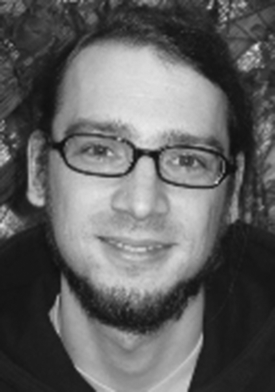 Alexander Paier合作论文数23
 Christoph Mecklenbräuker合作论文数Institute of Telecommunications, Technische Universitat Wien;WiTECH Centre, Chalmers University of Technology22
 Thomas Zemen合作论文数Forschungszentrum Telekommunikation Wien20
 Charlotte Dumard合作论文数18
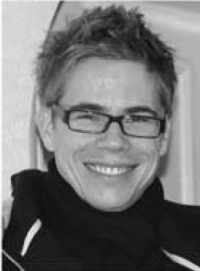 Peter Almers合作论文数13
 Laura Bernado合作论文数Forschungszentrum Telekommunikation Wien, Telecommunications Research Center Vienna (ftw.)12
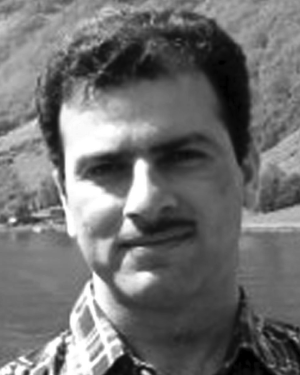 Shurjeel Wyne合作论文数Department of Electrical and Information Technology;Lund University;Department of Electrical and Information Technology, Lund University8
 Taimoor Abbas合作论文数Lund University7Anders J. Johansson合作论文数6
 Oliver Klemp合作论文数6Helmut Hofstetter合作论文数5
 Gerald Matz合作论文数Institute of Telecommunications, Technische Universität Wien5
 Erik Ström合作论文数Division of Communications, Antennas, and Optical Networks, Chalmers University of Technology4Juergen Kunisch合作论文数4
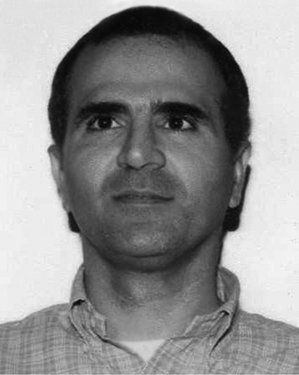 Shahriar Emami合作论文数Freescale Semiconductor , Inc4
 Andrew Fort合作论文数4
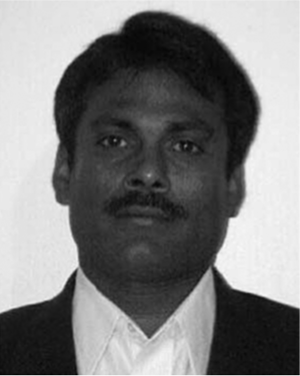 Balakrishnan Kannan合作论文数Cochin University of Science & Technology4
 Hans G. Schantz合作论文数Ohio State University;ElectroScience Laboratory;Domain Corporation;ElectroScience Laboratory, Ohio State University4Paier, A.合作论文数3
 Chia-Chin Chong合作论文数Inst. for Digital Commun., Univ. of Edinburgh3
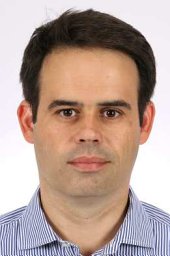 Telmo G. Santos合作论文数Faculdade de Ciências e Tecnologia, Universidade Nova de Lisboa3
 Katrin Sjöberg合作论文数3Dajana Cassioli合作论文数Dipartimento di Ingegneria e Scienze Dell'Informazione e Matematica, Universita degli Studi dell'Aquila3A J Johansson合作论文数2knut evensen合作论文数2oyvind kristiansen合作论文数2
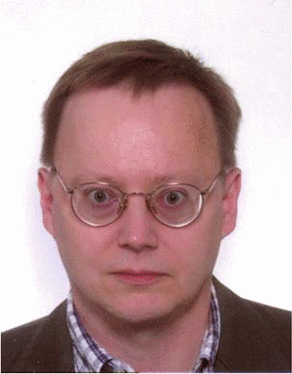 Gunnar Eriksson合作论文数2er paier合作论文数2runar sorasen合作论文数2
 martin jacob合作论文数Inst Nachrichtentech, Tech Univ Carolo Wilhelmina Braunschweig2
 Martin Kaske合作论文数2
 Alexis Paolo Garcia Ariza合作论文数Ilmenau Univ. of Technol.;c2Poutanen, J.合作论文数2
 Andreas Thiel合作论文数2
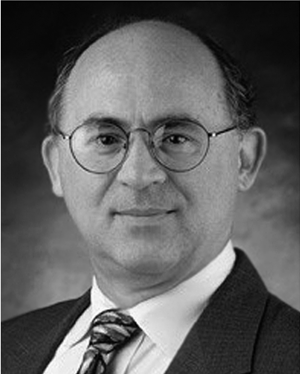 Kazimierz Siwiak合作论文数2Elisabeth Uhlemann合作论文数Bachelor degree projects for D3, 10 credits, at Halmstad University – Project Supervisor2
 Katsuyuki Haneda合作论文数Department of Electronics and Nanoengineering, School of Electrical Engineering, Aalto University;Helsinki University of Technology2
 Jussi Salmi合作论文数Signal Processing Laboratory;Helsinki University of Technology;Signal Processing Laboratory, Helsinki University of Technology2
 Jonas Medbo合作论文数Ericsson Research, Ericsson AB2Kai Siwiak合作论文数2
 Marie Elisabeth Gaup Moe合作论文数Centre for Quantifiable Quality of Service in Communication Systems, Norwegian University of Science and Technology2
 Andreas Kwoczek合作论文数2Ulrich Schuster合作论文数2T. Zemen合作论文数1forschungszentrum telekommunikation wien合作论文数1ASIM ASHRAF合作论文数1




