Global electricity generation from natural gas is expected to continue in an upward trend in the coming years thereby increasing the interdependency between the electricity and the Natural gas transportation system. The reliability concerns associated with this interdependency has necessitated an integrated approach to planning both systems to achieve an overall system reliability. This paper proposes a planning approach that minimizes the capital and operational cost of the electricity and natural gas transmission system subject to probabilistic constraints such that a desired confidence level of supply is attained, A Chance constrained and reliability programming optimization model was proposed for solving the long-term integrated planning problem and their performance was compared by illustrating them on the standard IEEE 30 bus test system superimposed on the Belgian high-calorific gas network.
There is an increasing integration of distributed natural gas-fired electric power generations across the globe. The natural gas-fired power generators are dependent on the availability of reliable natural gas distribution systems. This interdependency coupled with the scalability of the natural gas-fired distributed power generators presents the management of an energy utility with real options to execute, delay or abandon long-term expansion plans based on new realities of electric power demand. A real options analysis of these flexibilities is carried out in this paper. The assessment of these options includes the identification and valuation of the identified options. The value of flexibilities and options is illustrated by assessing the options to implement, delay or abandon expansion plans in the presence of uncertain electric power demand on 9 and 33 bus electricity distribution systems.
The increasing integration of natural gas-fired distributed power generators at the distribution level of the electric power system presents reliability concerns. We present a comprehensive long-term planning model of natural gas distribution pipelines, natural gas-fired distributed power generators, and capacitor banks. The planning problem is modeled as a chance constrained mixed integer nonlinear optimization problem. Chance constrained programming affords the planner to simultaneously ensure a desired system reliability level while accommodating the risk of uncertain electricity demand. The objective of the planning problem is the minimization of the fixed and operating costs of both natural gas and electricity systems over a planning period of ten years. We solve this problem using a sequential planning approach. The outputs of the planning model are the best location and size of the natural gas-fired generators and the capacitor banks. The minimum acceptable reliability level in our model is set to 96%. We illustrate our approach using a simple radial distribution test system. We show that an energy system with desired reliability can be attained while accommodating the uncertainties of electricity demand in the long-term plan. In addition, we show a relationship between the expansion plans and the reliability policies of a distribution utility.
Natural gas is increasingly becoming the preferred choice of fuel for flexible electricity generation globally resulting in an electricity system whose reliability is progressively dependent on that of the natural gas transportation system. The cascaded relationship between the reliabilities of these system necessitates an integrated approach to planning both systems. This paper presents a chance constrained programing approach to minimize the investment cost of integrating new natural gas-fired generators, natural gas pipeline, compressors, and storage required to ensure desired confidence levels of meeting future stochastic power and natural gas demands. The proposed model also highlights the role of natural gas storage in managing short-time uncertainties in developing a long-term expansion plan for both the electric and natural gas systems. A two-stage chance constrained solution algorithm is employed in solving the mix-integer nonlinear programing optimization problem and illustrated on a standard IEEE 30 bus test system superimposes on the Belgian high-calorific gas network.
A sequential recourse stochastic optimization approach to solving the long-term integrated planning problem of a Natural Gas (NG) distribution system and Natural Gas-fired Distributed Generators (NGDGs) is presented. The NGDG location and sizing problem under uncertain demand is solved in the first stage. The computed location and size of NGDG is employed to compute the NG demand at each node. The deterministic mixed integer non-linear programming NG optimal pipeline route selection problem is solved in the second stage. The solution methodology is illustrated using a simple case study over a long term planning period of 20 years. This work extends previous heuristic based approaches dependent on consideration of limited candidate solutions by employing a two stage recourse stochastic optimization technique and an analytical solution technique for solving the integrated problem. The proposed model allows for planning the future integration of NGDG and NG-pipelines without having to populate a set of expansion options.
This work examines the effects of large-scale integration of wind powered electricity generation in a deregulated energy-only market on loads (in terms of electricity prices and supply reliability) and dispatchable conventional power suppliers. Hourly models of wind generation time series, load and resultant residual demand are created. From these a non-chronological residual demand duration curve is developed that is combined with a probabilistic model of dispatchable conventional generator availability, a model of an energy-only market with a price cap, and a model of generator costs and dispatch behavior. A number of simulations are performed to evaluate the effect on electricity prices, overall reliability of supply, the ability of a dominant supplier acting strategically to profitably withhold supplies, and the fixed cost recovery of dispatchable conventional power suppliers at different levels of wind generation penetration. Medium and long term responses of the market and/or regulator in the long term are discussed.
We would like to express our appreciation to participants at the “Electricity Transmission Policies: Issues and Alternatives” workshop sponsored by the School of Public Policy for comments and suggestions and, in particular, Marcy Cochlan, Randy Stubbings, Joseph Doucet, Larry Ruff, Richard Tabors, Steven Stoft, Dan Levson, Bob Baer, Aidan Hollis, Carl Fuchshuber, Tom Cottrell, Cory Temple and Evan Bahry. The graciousness and spirit with which they provided comments does not of course imply endorsement of our approach or conclusions. In addition, we benefited from the comments of an anonymous referee. The views expressed in these publications are those of the authors' alone and should not be interpreted as the views of the School of Public Policy or of its supporters, staff or boards.
 William D. Rosehart合作论文数Department of Electrical and Computer Engineering, Schulich School of Engineering, University of Calgary8
 Hamidreza Zareipour合作论文数Department of Electrical and Computer Engineering,Schulich School of Engineering, University of Calgary7
 Babatunde Odetayo合作论文数Corresponding author.6
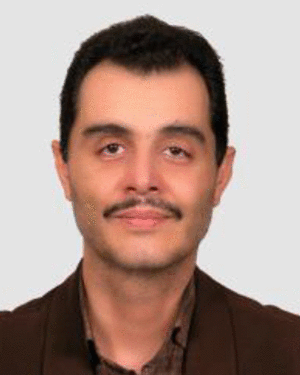 Ali Reza Seifi合作论文数2
 Mostafa Kazemi合作论文数Dept. of Electr. Eng., Sharif Univ. of Technol.;c;Dept. of Electr. Eng., Sharif Univ. of Technol.1
 Aidan Hollis合作论文数Department of Economics;University of Calgary;Department of Economics, University of Calgary1
 Jeffrey Church合作论文数Department of Economics, The University of Calgary1




