This paper presents LIGHTDOG, a torque-controlled, hydraulically-actuated quadrupedal robot designed for a high power-to-weight ratio and substantial payload capabilities. Hydraulic systems present complexity, weight, and thermal management challenges, which are addressed by embedding all the oil channels inside the robot, inspired by biological vascular structures. This embedding is facilitated by a distinctive robot body design featuring integrated oil channels and the inclusion of a double-vane rotary actuator design, allowing for the internalization of oil channels within the joints. These oil channels not only contribute to the robot’s compactness and lightness, but also allow heat spread throughout the body to dissipate through the robot’s frame, managing heat during robot motion without the need for external radiators. The rotary actuator is equipped with a structure designed to reduce internal leakage and friction torque, which can reduce energy losses in the hydraulic system. Optimization methods were applied to the slider-crank mechanism and hydraulic actuator sizing to reduce lateral and axial forces, as well as the energy consumed by the hydraulic actuators. Our work has validated the feasibility and payload capacity of LIGHTDOG through several experiments. LIGHTDOG, weighing 45 kg, demonstrates a payload capacity of 130 kg during a squatting motion, significantly exceeding its own weight.
Hydraulic actuating system exhibits potential for legged robots to achieve highly agile dynamic movement because of their high power-to-weight ratio. However, the low energy efficiency of the hydraulic system can reduce the operating time and cause heat dissipation. In this article, an optimal control framework based on the model predictive control (MPC) is proposed to improve energy efficiency and provide robust supply of pressure required for robot tasks. The MPC includes the power loss function and supply pressure regularization term as the cost function and limitation on the pump speed and acceleration as the constraints. When implemented to the hydraulic biped robot, LIGHT, the proposed method allows legged robots to achieve the commanded motion without losing balance while minimizing energy consumption. The energy saving performance of the proposed method with MPC is also validated via simulation and experiment.
This paper proposes a real-time footstep planning framework based on the A* footstep planning algorithm. The proposed footstep planner utilizes an energy consumption-based cost function to generate energy efficient navigation plan. To increase the computational efficiency, the cost-to-go heuristic function, which approximates the remaining cost to reach the goal, is modeled more precisely by considering the angle difference between the robot and the goal position. Furthermore, an efficient dual-level feasibility check is done to avoid occlusion with the environment while stepping over small objects if possible. Finally, the proposed footstep planning algorithm is integrated with the mapping algorithm and the walking controller to solve the humanoid navigation problem and validated in simulation and real-world experiments.
This paper introduces a 2-Degree of Freedom (2-DOF) rolling joint with a modified internal link configuration and the novel interior reinforcement structures that allow the reduced overall size and higher overall joint stiffness. A constant kinematic relationship between links consisting of the mechanism has been discovered through kinematic analysis. Utilizing this kinematic relationship, the novel interior reinforcement structure is added to improve joint stiffness. Furthermore, decreasing the overall size of the joint is accomplished by changing the geometry of the internal links. With these improvements, the new design of the 2-DOF rolling joint is proposed. Experimental results demonstrate an improved joint stiffness of the proposed joint while achieving reduced overall size and an extensive range of motion.
Purpose: Dominant optic atrophy is one of the most common hereditary optic neuropathies, causing progressive bilateral vision loss that begins early in life. Optic atrophy 1 (OPA1) gene mutation brings about mitochondrial dysfunction, which results in clinical manifestations of dominant optic atrophy. Here, we report a case of dominant optic atrophy caused by the c.1334G>A mutation of the OPA1 gene, the first known case in Korea to our knowledge.Case summary: A 12-year-old female patient with no specific medical history or systemic symptoms visited our clinic complaining of a progressive decrease in vision in either eye. Slit-lamp microscopy, intraocular pressure, ocular motility, and pupil reflex were normal. However, her best-corrected visual acuity in both eyes was 20/100, and her color vision was reduced to 8/12 in Ishihara’s test. Fundus examination showed temporal pallor of the optic nerve head in both eyes, and a corresponding cecocentral scotoma was observed on Goldmann visual field examination. Optical coherence tomography revealed significant thinning of the peripapillary retinal fiber layer and macular ganglion cell layer in both eyes. Genetic examination confirmed the c.1334G>A mutation of the OPA1 gene.Conclusions: We report a case of dominant optic nerve atrophy caused by c.1334G>A mutation of the OPA1 gene and its clinical manifestations.
Responsive valve in a compact package ADVANTAGES • High response improves control capability • Compact light weight package for mobile applications • Rugged construction designed for extreme conditions
Vision aided dynamic exploration on bipedal robots poses an integrated challenge for perception and control. Rapid walking motions as well as the vibrations caused by the landing-foot contact-force introduce critical uncertainty in the visual-inertial system, which can cause the robot to misplace its feet placing on complex terrains and even fall over. In this paper, we present a streamlined integration of an efficient geometric footstep planner and the corresponding walking controller for a humanoid robot to dynamically walk across rough terrain at speeds up to 0.3 m/s. To handle perception uncertainty that arises during dynamic locomotion, we present a geometric safety scoring method in our footstep planner to optimally select feasible path candidates. In addition, the real-time performance of the perception pipeline allows for reactive locomotion such as generating a new corresponding swing leg trajectory in mid-gait if a sudden change in the terrain is detected. The proposed perception-control pipeline is evaluated and demonstrated with real experiments using a full-scale humanoid to traverse across various terrains.
This letter proposes a design method of a compact embedded hydraulic power unit (HPU) for a bipedal robot and a controller to regulate the supply pressure. The HPU consists of an integrated pump-motor unit. The unit is immersed in hydraulic oil for efficient space utilization and heat dissipation from the motor. This HPU design is analyzed to establish a relationship between the thermal variables and the motor design parameters such as gap radius and wire radius via its thermal and electrical modeling. Through this analysis, the design parameters of suitable pump-driving motor are chosen. This letter also proposes a control method for the HPU to regulate the supply pressure while minimizing the energy loss caused by the bypass through a pressure-regulating valve. The HPU is mounted on top of the bipedal robot platform, LIGHT, with twelve degrees of freedom actuated by the proposed HPU. Finally, the durability of the designed HPU is demonstrated through a long-term driving test at a high pressure. Furthermore, air-walking and squat motion experiments are conducted with the bipedal robot to demonstrate the capabilities of the HPU and its controller.
Geologic heterogeneity, which commonly exists in target reservoirs for CO2 sequestration, has a significant effect on CO2 trapping. In this study, we performed Darcy-scale multiphase flow experiments on a heterogeneous rock with in-situ imaging techniques to obtain X-ray images of CO2 saturation during both drainage and imbibition. Residual trapping was assessed using the initial-residual characteristic curve. The distribution of residual CO2 saturation widened as the initial saturation increased, implying that the capillary heterogeneity becomes increasingly important with higher initial CO2 saturation. During dissolution, we discovered new flow regimes in heterogeneous media and proposed a quantitative scaling relationship for their temporal evolution. The highporosity layers showed a descending slope of similar to 0.4 during the early stage of dissolution, whereas it decreased by an order of magnitude (slope similar to 0.04) during the later stage. The high-capillarity layers, however, showed a single descending trend during dissolution. The highly time-resolved images of CO2 saturation provide a detailed understanding of the dynamic processes of both residual and dissolution trapping in heterogeneous media, which contributes to a wide range of applications, including environmental remediation, CO2 sequestration, and the enhancement of energy resources from hydrocarbon reservoirs.
This letter presents a state estimation algorithm for the legged robot by defining the problem as a Maximum A Posteriori (MAP) estimation problem and solving the problem with the Gauss-Newton algorithm. Moreover, marginalization by the Schur Complementmethod is adopted tomake a fixed size problem. Each component of the cost function and its Jacobian are derived utilizing the SO(3) manifold structure, while we reparameterize the state with nominal state and variation to make linear algebra and vector calculus applied properly. Furthermore, a slip rejection method is proposed to reduce the erroneous effect of fault modeling of kinematics models. The proposed algorithm is verified by comparison with the Invariant Extended Kalman Filter (IEKF) in real robot experiments on various environments.
In this study, a learning-based force controller for a hydraulic actuator is presented. We propose a control method with an inverse model composed of a deep neural network, which accurately tracks a force trajectory. This learning-based controller can be trained offline using force and position data sets from the hydraulic actuator. The methodology for training the controller network and the experimental setup for data collection are proposed. The learning-based controller was implemented on a hydraulic actuator hardware platform. The proposed learning-based controller demonstrates improved tracking performance compared to that of conventional model-based adaptive control methods.
To achieve human-level object manipulation capability, a robot must be able to handle objects not only with prehensile manipulation, such as pick-and-place, but also with nonprehensile manipulation. To study nonprehensile manipulation, we studied robotic batting, a primitive form of nonprehensile manipulation. Batting is a challenging research area because it requires sophisticated and fast manipulation of moving objects and requires considerable improvement. In this paper, we designed a batting system for dynamic manipulation of a moving ball and proposed several algorithms to improve the task performance of batting. To improve the recognition accuracy of the ball, we proposed a circle-fitting method that complements color segmentation. This method enabled robust ball recognition against illumination. To accurately estimate the trajectory of the recognized ball, weighted least-squares regression considering the accuracy according to the distance of a stereo vision sensor was used for trajectory estimation, which enabled more accurate and faster trajectory estimation of the ball. Further, we analyzed the factors influencing the success rate of ball direction control and applied a constant posture control method to improve the success rate. Through the proposed methods, the ball direction control performance is improved.
This study presents the design and system integration of the 13-degree-of-freedom legged platform, GAZELLE. The goal of this research is to develop a fast and reliable biped platform for walking experiments. Rapid leg movement can increase robustness in walking stability. During external push or walking on uneven ground, fast leg movement can realize an abrupt change on the landing position. GAZELLE is characterized by a lightweight design, a link-driven structure for low leg inertia, a wide range of motion, and a direct-stacked fin air-cooling module. The actuator is designed using a special type of harmonic drive (lightweight CSF type) and a 200 W brushless DC motor with high power density. The knee and ankle joints are link-driven; hence, the actuators can be placed on the upper position, and the leg inertia is reduced. A novel air cooler design for the cylinder-type motor, which is extremely light and highly efficient, is introduced herein and realized by stacking cooling fins to the motor housing. This study also includes a brief introduction of a stabilizing controller and the walking experiment results of GAZELLE.
This paper proposes a novel algorithm for joint space position/torque hybrid control of a mammal-type quadruped robot. With this control algorithm, the robot demonstrated both dynamic locomotion and push reaction abilities without the need for torque control in the ab/ad joints. Based on the tipping and slipping condition of the legged robot, we showed that reaction to a typical push in the horizontal direction does not require full contact-force-control in the frontal plane. Furthermore, we showed that position/torque hybrid control in Cartesian space is directly applicable to joint space hybrid control due to the joint configuration of the quadruped robot. We conducted experiments on our legged robot platform to verify the performance of our hybrid control algorithm. With this approach, the robot displayed stability while walking and reacting to external push disturbances.
In this article, we propose a delayed reference generation method for a humanoid to stably imitate human walking. An admissible condition for a robust imitation is first defined from the state of the robot and the target support polygon. In addition, a motion buffer is proposed and implemented to apply a time delay to the human motion according to the abovementioned condition for use as a reference to the robot. A data acquisition device and the HUBO2+ humanoid platform were used in teleoperation experiments to verify the effectiveness of the proposed method. We confirmed that the robot could stably imitate human footsteps under either static or dynamic walking when applying the proposed method.
Recent research on humanoid robot actuators has shown that the use of series elastic actuators (SEAs) is necessary for accurate and robust torque control. Among the numerous implementations of an SEA, using a spring as an elastomer is considered to be the most suitable. However, a major disadvantage of this method in terms of torque control is the hysteresis of the elastomer. Although various hysteresis modeling methods have been studied to resolve the hysteresis problem of an elastomer, they are not sufficiently accurate to perform torque control. Therefore, we propose a hysteresis model and compensation method to estimate torque based on deformation for the hysteresis of an elastomer SEA to resolve the problems encountered in previous studies. Torque control is evaluated with the proposed hysteresis compensation method. Torque measurements obtained using the proposed hysteresis model improve the maximum error by up to 10% compared with that of Hooke's law, which has a maximum error of 25%. Torque control of an elastomer SEA can be performed with improved accuracy by using the proposed hysteresis model and compensation method.
This study proposes a biped-robot pelvis-kinematics estimator based on the touch-point updating method. Because the pelvis frame is used as the base coordinate for the control, the kinematics of it with respect to the global frame should be precisely estimated. To this end, it was necessary to know where the robot made contact with the ground. The touch-point concept was introduced as the temporal contact-point, which was instantly the robot's rotation center. By updating this point, the biped's global pelvis-kinematics could be estimated. The proposed estimator was implemented into the actual robot, and its superiority was verified through ground-truth data.
 Jaesung Oh合作论文数23
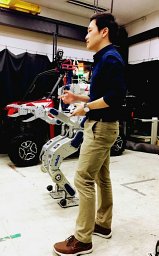 Hyoin Bae合作论文数School of Mechanical Aerospace Systems Engineering, Korea Advanced Institute of Science and Technology19
 Hyobin Jeong合作论文数Inst Mol Biol17
 In-Ho Lee合作论文数Department of Chemical Engineering, Sogang University16
 Kang Kyu Lee合作论文数Sch Elect Engn, Korea Univ15
 Okkee Sim合作论文数kaist15
 Baek-kyu Cho合作论文数Kookmin University13
 Ill-Woo Park合作论文数13
 Jung-Yup Kim合作论文数HUBO Laboratory, Humanoid Robot Research Center, Department of Mechanical Engineering, Korea Advanced Institute of Science and Technology, Daejeon, South Korea 305-70113Jungho Lee合作论文数12
 Buyoun Cho合作论文数Korea Adv Inst Sci & Technol, Humanoid Res Ctr, Sch Mech Aerosp & Syst Engn, Dept Mech Engn, 291 Daehak Ro, Daejeon 305338, South Korea10
 Jeongsoo Lim合作论文数The School of Mechanical, Aerospace & Systems Engineering, Division of Mechanical Engineering, KAIST Korea Advanced Institute of Science and Technology, Daejeon, Republic of Korea10
 Kue-Young Kim合作论文数Groundwater & Geothermal Resources Division 30, Korea Institute of Geoscience and Mineral Resources10
 Jungwoo Heo合作论文数9Pan-mook Lee合作论文数Mechanical Engineering, Korea Advanced Institute of Science and Technology9Inhyeok Kim合作论文数9
 Paul Oh合作论文数Department of Mechanical Engineering, Howard R. Hughes College of Engineering, University of Nevada, Las Vegas;DRC-Hubo9
 Bong-Huan Jun合作论文数9
 Jin-Yeong Park合作论文数9
 Sung-Woo Kim合作论文数8
 Hyunmin Joe合作论文数Korea Adv Inst Sci & Technol, Dept Mech Engn, Sch Mech Aerosp & Syst Engn, Humanoid Res Ctr, 291 Daehak Ro, Daejeon 305338, South Korea7Hae-Won Park合作论文数6
 Taejin Jung合作论文数6
 Dongil Choi合作论文数Department of Radiology and Center for Imaging Science, Sungkyunkwan University School of Medicine6
 Jung-Hoon Kim合作论文数Department of Physics;Coherent X-Ray Research Center;Korea Advanced Institute of Science and Technology;Coherent X-Ray Research Center, Korea Advanced Institute of Science and Technology6
 Seunghoon Shin合作论文数5
 Lee Moonyoung合作论文数Department of Dentistry, Saint Barnabas Hospital5
 Jong-Il Park合作论文数Department of Computer Science, Hanyang University5Mingeuk Kim合作论文数5
 Inwook Shim合作论文数Agency for Defense Development5
 Sang Hwa Lee合作论文数5Min-Su Kim合作论文数4Taehee Kim合作论文数4
 Seunghak Shin合作论文数4
 In So Kweon合作论文数Robotics and Computer Vision Lab, School of Electrical Engineering, Korea Advanced Institute of Science and Technology4
 Yunsu Bok合作论文数Department of Electrical Engineering, KAIST4
 Weon Shik Han合作论文数Department of Earth System Sciences, Yonsei University4
 Kyungdon Joo合作论文数Carnegie Mellon University4
 Daniel M. Lofaro合作论文数Drexel Autonomous Systems Lab (DASL), Bossone Research Center4
 Youngmoo E. Kim合作论文数Dept Elect & Comp Engn, Drexel Univ4Yong-Kon Lim合作论文数4Robert Ellenberg合作论文数4SubPark Hyun合作论文数3Yujin Heo合作论文数Korea Adv Inst Sci & Technol, Humanoid Robot Res Ctr, Dept Mech Engn, 291 Daehak Ro, Daejeon 34141, South Korea3
 Joon-Ha Kim合作论文数Korea Adv Inst Sci & Technol, Dept Mech Engn, Sch Mech Aerosp & Syst Engn, Humanoid Res Ctr, Daejeon, South Korea3
 Sang-Sin Park合作论文数Korea Adv Inst Sci Technol3David Grunberg合作论文数Electrical Engineering, Drexel University3
 Dong-Geol Choi合作论文数Department of Electrical Engineering, KAIST3Fill-Youb Lee合作论文数3




