During the ongoing Covid-19 pandemic, people all over the world were forced to think about new ways of interacting with each other and this has especially challenged academics in their outreach activities with pupils. New online formats needed to be developed, and we used this opportunity to design and implement an (not only) online Masterclass using data from the KASCADE experiment. The masterclass is built on the KASCADE Cosmic Ray Data Centre and uses Jupyterhub and Notebooks for data analysis. We gained first practical experience during the International Cosmic Day with students at the age of 14-19 years. The Masterclass includes lectures on cosmic ray physics and data analysis, which are then consolidated in a hands-on part. By performing a cosmic-ray composition analysis on KASCADE data, the participants gain experience in using the KCDC open data web platform, working in the Jupyter environment, preprocessing data from a real astroparticle physics experiment, programming Python and performing exploratory data analysis.
Investigations of the energy spectrum as well as the mass composition of cosmic rays in the energy range of PeV to EeV are important for understanding both, the origin of the galactic and the extragalactic cosmic rays. The multi-detector arrangement of KASCADE and its extension KASCADE-Grande was designed for observations of cosmic ray air showers in this energy range. The experimental installation was completed in 2013, however, the collaboration continues to analyse the recorded data. In this contribution, we discuss the status and results of recent analyses in particular in view of tests of the validity of hadronic interaction models used for the interpretation of measured air-shower data.
The LOPES experiment was a radio interferometer built at the existing air shower array KASCADE-Grande in Karlsruhe, Germany. The last configuration of LOPES was called LOPES 3D and consisted of ten tripole antennas. Each of these antennas consisted of three crossed dipoles east-west, north-south, and vertically aligned. With this, LOPES 3D had the unique possibility to study the benefits of measurements with vertically aligned antennas in the environment of the well understood and calibrated particle detector array KASCADE-Grande. The measurements with three spatially coincident antennas allows a redundant reconstruction of the electric field vector. Several methods to exploit the redundancy were developed and tested. Furthermore, for the first time in LOPES, the background noise could be studied polarization- and direction dependent. With LOPES 3D it could be demonstrated that radio detection reaches a higher efficiency for inclined showers when including measurements with vertically aligned antennas and that the vertical component gets more important for the measurement of inclined showers. In this contribution we discuss a weighting scheme for the best combination of three redundant reconstructed electric field vectors. Furthermore, we discuss the influence of these weighting schemes on the ability to reconstruct air showers using the radio method. We show an estimate of the radio efficiency for inclined showers with focus on the benefits of measurements with vertically aligned antennas and we present the direction dependent noise in the different polarizations.
KCDC, the 'KASCADE Cosmic-ray Data Centre', is a web-based interface where initially the scientific data from the completed air-shower experiment KASCADE-Grande was made available for the astroparticle community as well as for the interested public. Over the past 7 years, we have continuously extended the data shop with various releases and increased both the number of detector components from the KASCADE-Grande experiment and the data sets and corresponding simulations. With the latest releases we added a new and independent data shop for a specific KASCADE-Grande event selection and by that created the technology for integrating further data shops and data of other experiments, like the data of the air-shower experiment MAKET-ANI in Armenia. In addition, we made available educational examples how to use the data, more than 100 cosmic ray energy spectra from various experiments, and recently attached a public server with access to Jupyter notebooks. In this paper we present a brief history of KCDC, the main features of the recent release as well as will discuss future development plans.
LOPES, the LOFAR prototype station, was an antenna array for cosmic-ray air showers operating from 2003 to 2013 within the KASCADE-Grande experiment. Meanwhile, the analysis is finished and the data of air-shower events measured by LOPES are available with open access in the KASCADE Cosmic Ray Data Center (KCDC). This article intends to provide a summary of the achievements, results, and lessons learned from LOPES. By digital, interferometric beamforming the detection of air showers became possible in the radio-loud environment of the Karlsruhe Institute of Technology (KIT). As a prototype experiment, LOPES tested several antenna types, array configurations and calibration techniques, and pioneered analysis methods for the reconstruction of the most important shower parameters, i.e., the arrival direction, the energy, and mass-dependent observables such as the position of the shower maximum. In addition to a review and update of previously published results, we also present new results based on end-to-end simulations including all known instrumental properties. For this, we applied the detector response to radio signals simulated with the CoREAS extension of CORSIKA, and analyzed them in the same way as measured data. Thus, we were able to study the detector performance more accurately than before, including some previously inaccessible features such as the impact of noise on the interferometric cross-correlation beam. These results led to several improvements, which are documented in this paper and can provide useful input for the design of future cosmic-ray experiments based on the digital radio-detection technique.
Muons in extensive air showers (EAS) are a sensitive probe for the primary cosmic ray mass and the physics of hadronic interactions at very high energies, hence it is important to precisely measure and carefully analyze this particular shower component. In practice, however, such measurements are difficult to carry out due to the penetrating nature of muons and their low density in the shower. This way just in a few experimental facilities the shower muon component has been measured event-by-event in combination with other EAS observables. One of them was the multicomponent air shower experiment KASCADE-Grande, which was designed to study cosmic rays in the energy interval from 1 PeV to 1 EeV and was located at the site of the Karlsruhe Institute of Technology, Germany at 110 m a.s.l. In this work, we will present an analysis of the KASCADE-Grande data in terms of the muon content (E-mu > 230 MeV) of cosmic-ray induced air showers as a function of the primary energy (E = 10 PeV 1 EeV) and the zenith angle (< 35 degrees). We test also the predictions on the shower muon content of the post-LHC hadronic interaction models EPOS-LHC, QGSJET-II-04, SIBYLL 2.3 and SIBYLL 2.3c by comparing the model expectations with experimental results.
The SENSE project is a Horizon 2020 Coordination and Support Action aiming to coordinate research and development efforts in academia and industry in low light-level sensoring. In addition, SENSE aims to transfer knowledge by initiating information and training events and material, for sharing the status of existing LLL sensors and providing information by outreach experiments and activities. This contribution focuses on developments, characteristics and existing calibration setups within the SENSE partner institutions for photo-sensing technologies like Silicon Photo-multiplier (SiPM). A short summary of the SENSE roadmap for the development of low lightlevel sensors will be given. In addition, a specific example of application of SiPMs in the field of astroparticle physics experiments will be discussed in more details, namely the scintillation detector readout for the surface detector enhancement of the IceCube observatory.
Over the past 20 years, KASCADE and its extension KASCADE-Grande were dedicated to measure high-energy cosmic rays with primary energies of 100 TeV to 1 EeV. The data accumulation was fully completed and all experimental components were dismantled, though the analysis of the high-quality data is still continued. E.g., we investigated the validity of the hadronic interaction model of the new SIBYLL version 2.3c. We also published a new result of a search for large-scale anisotropies performed with the KASCADE-Grande data. Investigation of the attenuation length of the muon in the atmosphere is also updated with the predictions of the SIBYLL 2.3 interaction model. We investigated, in addition, the muon content of high-energy air showers and compared them to all post-LHC interaction models. In this contribution, the new and updated results from KASCADE-Grande will be presented. An update of the web-based data center KCDC offering the original scientific data from KASCADE-Grande to the public will be briefly discussed as well.
In this work, we report measurements on the muon content (Eth > 230 MeV) of extensive air showers (EAS) induced by cosmic rays with primary energy from 10 PeV up to 1 EeV performed with the KASCADE-Grande experiment. The measurements are confronted with SIBYLL 2.3. The results are focused on the dependence of the total muon number and the lateral density distribution of muons in EAS on the zenith angle and the total number of charged particles in the shower. We also present updated results of a detailed study of the attenuation length of shower muons, which reveal a deviation between the measured data and the predictions of the post-LHC hadronic interaction models SIBYLL 2.3, QGSJET-II-04 and EPOS-LHC.
Thomas Huber∗1,2, Thomas Berghöfer3, Domenico della Volpe4, Andreas Haungs1, Katharina Henjes-Kunst3, Katrin Link1, Razmik Mirzoyan5, Teresa Montaruli4, Andrii Nagai4, Derek Strom5 – the SENSE Consortium 1 Institut für Kernphysik, Karlsruhe Institute of Technology, Karlsruhe, Germany 2 DESY in Zeuthen, Germany 3 DESY in Hamburg, Germany 4 Dep. de physique nuclaire et corpusculaire, Université de Geneve, Switzerland 5 Max Planck Institute for Physics, Munich, Germany
We outline the science motivation for SGSO, the Southern Gamma-Ray Survey Observatory. SGSO will be a next-generation wide field-of-view gamma-ray survey instrument, sensitive to gamma-rays in the energy range from 100 GeV to hundreds of TeV. Its science topics include unveiling galactic and extragalactic particle accelerators, monitoring the transient sky at very high energies, probing particle physics beyond the Standard Model, and the characterization of the cosmic ray flux. SGSO will consist of an air shower detector array, located in South America. Due to its location and large field of view, SGSO will be complementary to other current and planned gamma-ray observatories such as HAWC, LHAASO, and CTA.
We present the results of the search for large-scale anisotropies in the arrival directions of cosmic rays performed with the KASCADE-Grande experiment at energies higher than 10(15) eV. To eliminate spurious anisotropies due to atmospheric or instrumental effects we apply the east-west method. We show, using the solar time distribution of the number of counts, that this technique allow us to remove correctly the count variations not associated to real anisotropies. By applying the east-west method we obtain the distribution of number of counts in intervals of 20 minutes of sidereal time. This distribution is then analyzed by searching for a dipole component; the significance of the amplitude of the first harmonic is 3.5 sigma, therefore, we derive its upper limit. The phase of the first harmonic is determined with an error of a few hours and is in agreement with the measurements obtained in the 10(14) < E < 2 x 10(15) eV energy range by the EAS-TOP, IceCube, and IceTop experiments. This supports the hypothesis of a change of the phase of the first harmonic at energies greater than similar to 2 x 10(14) eV.
J.C. Arteaga-Velázquez∗1, D. Rivera-Rangel1, W.D. Apel2, K. Bekk2, M. Bertaina3, J. Blümer2,4†, H. Bozdog2, E. Cantoni3,6,A. Chiavassa3, F. Cossavella4, K. Daumiller2, V. de Souza7, F. Di Pierro3, P. Doll2, R. Engel2,4, D. Fuhrmann8, A. Gherghel-Lascu5, H.J. Gils2, R. Glasstetter8, C. Grupen9, A. Haungs2, D. Heck2, J.R. Hörandel10, T. Huege2, K.-H. Kampert8, D. Kang4, H.O. Klages2, K. Link4, P. Łuczak11, H.J. Mathes2, H.J. Mayer2, J. Milke2, C. Morello6, J. Oehlschläger2, S. Ostapchenko12, T. Pierog2, H. Rebel2, M. Roth2, H. Schieler2, S. Schoo2, F.G. Schröder2, O. Sima13, G. Toma5, G.C. Trinchero6, H. Ulrich2, A. Weindl2, J. Wochele2, J. Zabierowski11 KASCADE-Grande Collaboration‡ 1 Instituto de Física y Matemáticas, Universidad Michoacana, Morelia, Mexico 2 Institut für Kernphysik, KIT Karlsruhe Institute of Technology, Germany 3 Dipartimento di Fisica, Università degli Studi di Torino, Italy 4 Institut für Experimentelle Teilchenphysik, KIT Karlsruhe Institute of Technology, Germany 5 Horia Hulubei National Institute of Physics and Nuclear Engineering, Bucharest, Romania 6 Osservatorio Astrofisico di Torino, INAF Torino, Italy 7 Universidade São Paulo, Instituto de Física de São Carlos, Brasil 8 Fachbereich Physik, Universität Wuppertal, Germany 9 Department of Physics, Siegen University, Germany 10 Dept. of Astrophysics, Radboud University Nijmegen, The Netherlands 11 National Centre for Nuclear Research, Department of Astrophysics, Lodz, Poland 12 Frankfurt Institute for Advanced Studies (FIAS), Frankfurt am Main, Germany 13 Department of Physics, University of Bucharest, Bucharest, Romania
SENSE, a roadmap for the ideal low light-level sensor development is a project funded by the European Commission under Future and Emerging Technologies (FET) Open Coordination and Support Action (CSA). It aims at coordinating, monitoring, and evaluating the R&D efforts of research groups and industry in advancing low light-level (LLL) sensors and liaise with strategically important European initiatives and research groups and companies worldwide. The projects objectives are: (1) to conduct the development of a European R&D roadmap towards the ultimate LLL sensors, and to monitor and evaluate the progress of the development with respect to the roadmap, (2) to coordinate the R&D efforts of research groups and industry in advancing LLL sensors and liaise with strategically important European initiatives and research groups and companies worldwide, (3) to transfer knowledge by initiating information and training events and material, (4) to disseminate information by suitable outreach activities. The consortium has four partners: the Deutsches Elektronen Synchrotron (Coordinator), Germany; the Universite de Geneve, Switzerland; the Max-Planck Institute for Physics, Germany and Karlsruhe Institute of Technology, Germany. Several international experts for all areas of LLL development are involved in SENSE, some advise the project n the Experts Group and the others in the working group of the project which is regulated by a Cooperation Agreement.
The KASCADE and KASCADE-Grande experiments operated in KIT-Campus North, Karlsruhe (Germany) from 1993 to 2012. The two experiments studied primary cosmic rays in the energy range from 10 14 eV to 10 18 eV, investigating the change of slope of the spectrum detected at 2 - 4 × 10 15 eV, the so called knee. We briefly review the performance of the experiments and then the main results obtained in the operation of both experiments: the test of hadronic interaction models, the all particle primary spectrum, the elemental composition of primary cosmic rays (with the first claim of a knee-like feature of the heavy primaries spectrum) and the search for large scale anisotropies.
SENSE - Ultimate low light-level sensor development, is a European project with the aim to coordinate research and development efforts in academia and industry in low light-level (LLL) sensoring. In the framework of SENSE several training and learning activities are and shall be developed. The aim is to introduce the topic of LLL sensor R&D and to attract young researchers to technology development. This includes training events during summer school, virtual training sessions accessible from the website and also the development of show case experiments. In this context an experiment for the measurement of cosmic muons is currently developed at KIT: It consists of thermal cans that act as water-cherenkov-detectors. Muons passing through this detectors produce photons which, in contrast to previous experiments, are measured using state-of-the-art SiPMs. The usage of SiPMs has several advantages: They are more robust compared to PMTs and they work without high voltage which is especially important for a hands-on-experiment for students. To capture the photons within the thermal can wavelength shifting fibres, like used in the IceCube and the AugerPrime scintillators, are attached to the SiPM. This show-case experiment should be used for trainings with high school or young university students.
The ‘KASCADE Cosmic ray Data Centre’ is a web portal (https://kcdc.ikp.kit.edu), where the data of the astroparticle physics experiment KASCADE-Grande are made available for the interested public. The KASCADE experiment was a large-area detector for the measurement of high-energy cosmic rays via the detection of extensive air showers. The multi-detector installations KASCADE and its extension KASCADE-Grande stopped the active data acquisition in 2013 after more than 20 years of data taking. In several updates since our first release in 2013 with KCDC we provide the public measured and reconstructed parameters of more than 433 million air showers. In addition, KCDC provides meta data information and documentation to enable a user outside the community of experts to perform their own data analysis. Simulation data from three different high energy interaction models have been made available as well as a compilation of measured and published spectra from various experiments. In addition, detailed educational examples shall encourage high-school students and early stage researchers to learn about astroparticle physics, cosmic radiation as well as the handling of Big Data and about the sustainable and public provision of scientific data.
The KASCADE-Grande observatory was a ground-based air shower array dedicated to study the energy and composition of cosmic rays in the energy interval E = 1 PeV –1 EeV. The experiment consisted of different detector systems which allowed the simultaneous measurement of distinct components of air showers (EAS), such as the muon content. In this contribution, we study the total muon number and the lateral density distribution of muons in EAS detected by KASCADE-Grande as a function of the zenith angle and the total number of charged particles. The attenuation length of the muon content of EAS is also measured. The results are compared with the predictions of the SIBYLL 2.3 high-energy hadronic interaction model.
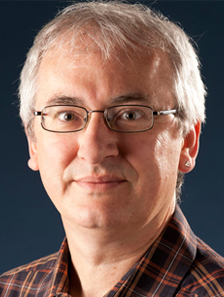 Andreas Haungs合作论文数Institute for Astroparticle Physics, Karlsruhe Institute of Technology;Pierre Auger Observatorium;IceCube-Gen2161
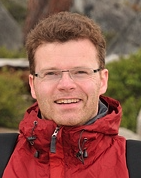 Tim Huege合作论文数Institute for Astroparticle Physics, Karlsruhe Institute of Technology;Faculty of Sciences and Bioengineering Sciences, Vrije Universiteit Brussel155
 Tanguy Pierog合作论文数154C. Morello合作论文数152H. Schieler合作论文数150D. Heck合作论文数150K. Daumiller合作论文数148A. Weindl合作论文数148de souza合作论文数147HJ Mathes合作论文数147
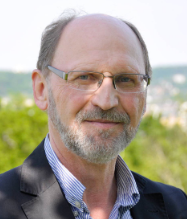 Karl - Heinz Kampert合作论文数Bergische Universitat Wuppertal147
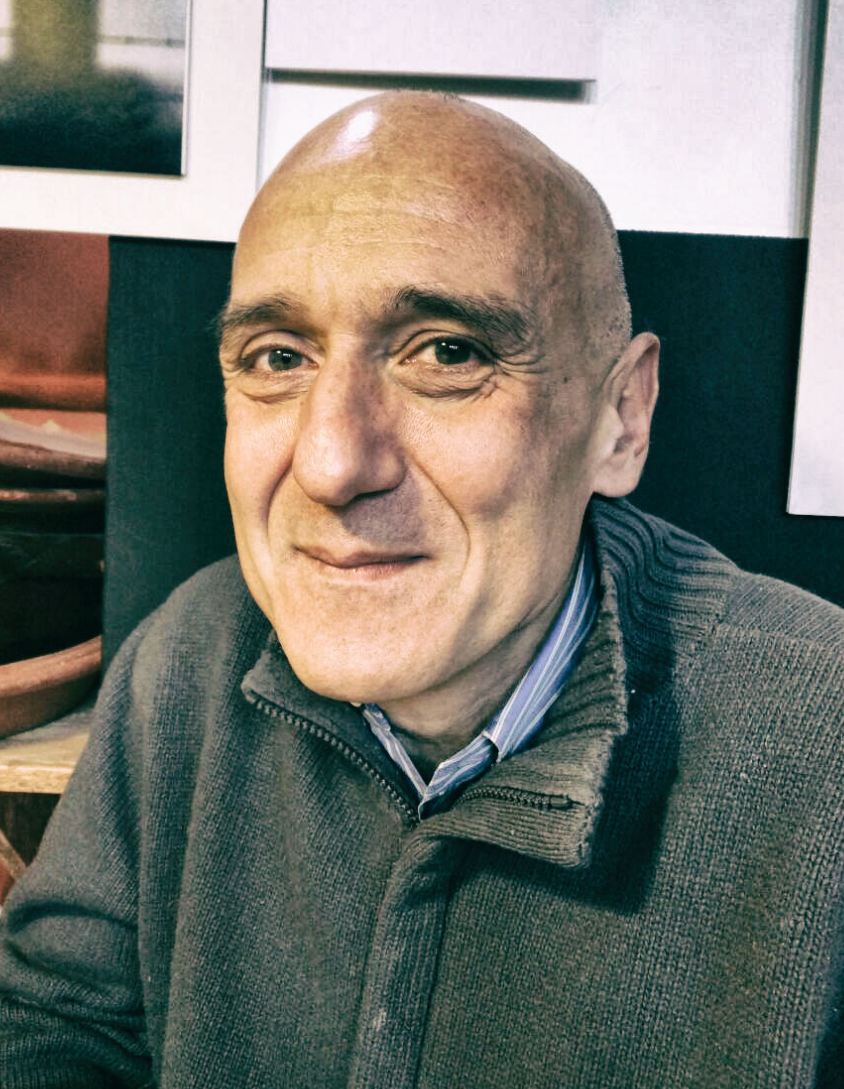 Andrea Chiavassa合作论文数Dipartimento di Fisica, Università degli studi di Torino136I. M. Brancus合作论文数134O. Sima合作论文数133
 Mario Edoardo Bertaina合作论文数Dipartimento di Fisica, Università degli studi di Torino125G. Toma合作论文数121R. Engel合作论文数113
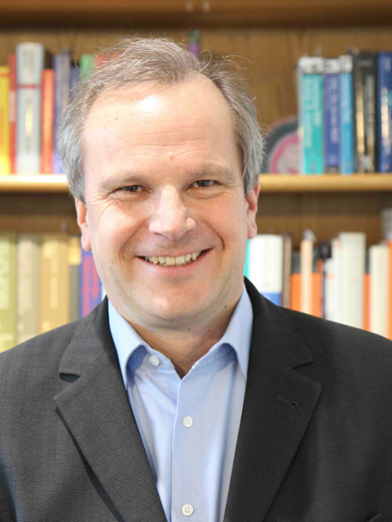 Jörg R. Hörandel合作论文数Department of Astrophysics, Faculty of Science, Radboud University/Department of Physics and Astronomy, Vrije Universiteit Brussel111
 N. Palmieri合作论文数110J. Wochele合作论文数99Marianne Ludwig合作论文数99M. Melissas合作论文数99Janusz Zabierowski合作论文数98H. Rebel合作论文数97Petra Doll合作论文数97
 B. Mitrica合作论文数Horia Hulubei Natl Inst Nucl Phys & Engn96
 C. Grupen合作论文数Siegen University Department of Physics96K. Bekk合作论文数96
 Hans O. Klages合作论文数96
 Gian Carlo Trinchero合作论文数95
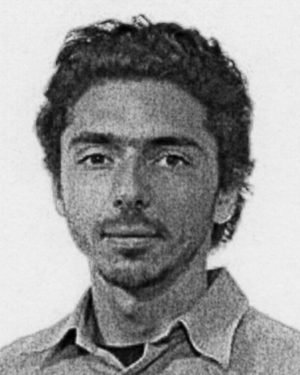 F. Di Pierro合作论文数95P. Łuczak合作论文数95H. Bozdog合作论文数94Julian Rautenberg合作论文数93D. Kang合作论文数89W.-D. Apel合作论文数89h gemmeke合作论文数88
 Elena Carla Cantoni合作论文数87D. Fuhrmann合作论文数86M. Roth合作论文数84
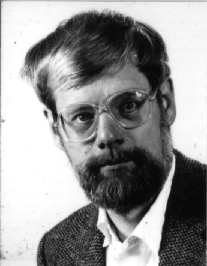 Peter L. Biermann合作论文数Research Department Millimeter- and Submillimeter Astronomy, Max Planck Institute for Radio Astronomy84P. G. Isar合作论文数80B. Fuchs合作论文数79A. Saftoiu合作论文数78
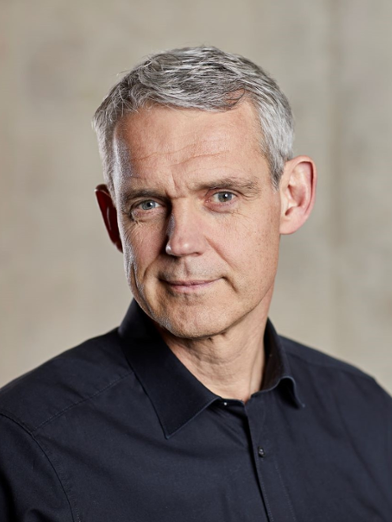 Heino Falcke合作论文数Radboud University74J. Oehlschlaeger合作论文数68
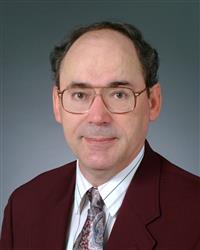 Friedhelm Schroeder合作论文数Department of Veterinary Physiology & Pharmacology, College of Veterinary Medicine and Biomedical Sciences, Texas A&M University67Piera L. Ghia合作论文数67F. Cossavella合作论文数66




