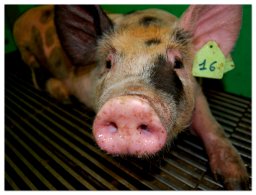
Salivary glycoprotein profiles, obtained after boronic acid enrichment, were studied for the first time in pigs in order to search for specific overall alterations related to acute inflammatory condition. Five healthy pigs and five pigs suffering from rectal prolapse were used, and the levels of acute phase proteins were measured to determine the degree of inflammation of the animals. The enriched glycoprotein profiles, achieved by two-dimensional gel electrophoresis (2DE) were statistically evaluated and spots that appeared differentially regulated between states were subjected to MS analysis for protein identification. Spots from three unique proteins were identified: carbonic anhydrase VI (CA VI), α-1-antichymotrypsin and haptoglobin (Hp). CA VI appeared as two adjacent horizontal spot trains in the glycoprotein profile of healthy animals in its regular isoelectric points (pI). One spot of α-1-antichymotrypsin was found in saliva from pigs with rectal prolapse in an unusual basic pI, and was considered as a breakdown product. Hp was identified as several spot trains in saliva from pigs with rectal prolapse in an unusual alkaline pI and was consequently further investigated. SDS-PAGE and 2DE of paired serum and saliva samples combined with Western blot analysis showed that the unusual Hp position observed in saliva samples was absent in serum. Furthermore, N-glycans from serum and saliva Hp glycopatterns were evaluated from SDS-PAGE Hp bands and showed that the serum N-glycan distribution in Hp β-chain was comparable in quantity and quality in both groups of animals. In saliva, no Hp β-chain derived N-glycans could unambiguously be identified from this sample set, thus needing further detailed investigations in the future.
During the last years, an antimicrobial protein from the RegIII family has been consistently identified as one of the main up-regulated mRNA transcripts in the pig small intestinal mucosa during different infections such as enterotoxigenic Escherichia coli (ETEC). This transcript has been mainly referred to in the literature as pancreatitis-associated protein (PAP/RegIIIα). However, the identity of this transcript has not been confirmed, and no evidence of its expression at the protein level is available in the literature, because the absence of a specific antibody. In this study, we first unequivocally identified the PAP/RegIII family protein mainly expressed in ETEC infected pig intestine as RegIIIγ by 2D-DIGE and MALDI-TOF/TOF. This shows that the pig differs from species like human and mice in that RegIIIγ (and not RegIIIα) might be the major RegIII isotype during intestinal infection. Immunoblotting analysis with a specifically generated polyclonal rabbit antibody revealed that pig RegIIIγ is expressed throughout the intestinal tract, but most abundantly in the ileum. Although a higher abundance of mRNA was paralleled by higher protein abundance, a lack of linear relationship was found between RegIIIγ mRNA and protein abundances in the jejunal mucosa, the latter most pronounced in the case of natural infection. This may be related to the secretory nature of RegIIIγ. This would mean that the antimicrobial protein RegIIIγ is a good candidate as a non-invasive faecal intestinal health biomarker in swine.
Animals with different health status have been studied in order to extend the knowledge about protein composition of porcine saliva samples and to discover potential salivary markers for systemic disease in porcine production. Clinical examination of animals was performed at farm level where 10 healthy pigs and 10 animals with evident clinical signs of disease were randomly selected. Saliva and blood samples were obtained and afterwards animals were humanely sacrificed to perform a complete necropsy. Levels of two acute phase proteins, haptoglobin and C-reactive protein, were used to identify possible active infections of the animals. Moreover, serological analysis, to the main porcine infectious diseases in the area, was performed. Salivary proteins were separated by two-dimensional gel electrophoresis followed by mass spectrometry for the identification of specific proteins. A total of 58 spots out of 75 were successfully identified by MS, which correspond to 20 unique proteins. Two different approaches were used to perform a statistical comparison of saliva protein patterns from healthy and diseased animals using the relative spot volume (% spot volume/total volume of all spot in the gel, approach "A") or taking also into account the total protein content of each saliva sample (μg of spot/mL of saliva, approach "B"). Both analyses showed three proteins in common that are differentially regulated between states. However, approach B was selected for biomarker searching since it gave an estimation of protein concentration and showed differential expression of proteins between both health states in a total of 10 proteins, which were up-regulated in disease. Mass spectrometric analysis identified those proteins as salivary lipocalin, lipocalin 1, double headed protease inhibitor protein, adenosine deaminase, haptoglobin, albumin fragments, S100-A8, S100-A9, S100-A12 and pancreatic alpha amylase. These proteins could be considered as potential salivary markers of disease.
The field of system biology among the disciplines, genomics, transcriptomics, proteomics and other “omics” technologies, has become one of the important scientific fields nowadays and will play a major role in investigating biological processes on a global level. Huge financial, technological and organisation efforts are needed to perform system biology based approaches. Progresses in molecular biology have led to the sequencing of the whole genome of several organisms, ranging from bacteria to various mammals including human. While the term “genomics” has already been used for a long time, new technologies such as transcriptomics, proteomics and metabolomics have been introduced during the last two decades and are beginning to expand rapidly. In general the “omics technologies” deal with hundreds or thousands of genes and/or their products such as mRNA, proteins or metabolites. Genomics is the study of genes, their variation and function by sequencing and mapping them. Similarly, transcriptomics deals with information at the messenger RNA (mRNA) level in an organism, tissue or cells at a given time by providing quantitative or semi-quantitative data. The transcriptome is however, not a straight copy of the genome, since the sequence of RNA molecules can be altered due to differential splicing and RNA editing. In contrast to the genome, which is static, the transcriptome is changing depending on environmental signals. Although, genomics and transcriptomics provide huge amount of information for understanding biological processes, the knowledge regarding the products of genes and transcripts remained underutilized. While, in last three decades predominantly genes and gene expression profiles were investigated and genomics has become the major side in biosciences, the analysis of proteins in a global approach was neglected mostly. However, since the 1990s also proteomics has gained increasing interest in the field of biosciences. The term proteomics was mentioned for the first time in Siena/Italy by Marc Wilkins in 1994 on occasion of the symposium on “2D Electrophoresis: from protein maps to genomes" (Wilkins 1997). Proteomics is defined as the qualitative and quantitative comparison of proteins in a cell or organism under defined conditions at a given time point. In other words proteomics is a term coined to comprise a field that attempts to understand the expression, function and regulation of the entire set of proteins encoded by an organism (Liebler 2002). In addition, since the proteins within a cell are the functioning units, their expression is strongly influenced by the environmental signals such as drugs, toxins, stress, age and other surrounding conditions. It is a complementary technology to genomic as well as transcriptomic research (Wilkins et al., 2007). Proteomics aims to deliver statistically
Saliva contains a number of proteins that may be useful as biomarkers of health and disease and can be easily obtained from large numbers of animals in a non-invasive, stress-free way. The objective of this study was to explore the protein composition of porcine saliva from 10 specific pathogen free pigs using first one-dimensional SDS-PAGE and then two-dimensional electrophoresis and mass spectrometry. A reference proteome pattern for porcine saliva was established with the identification of 13 different, mainly saliva-specific, proteins. These reference data will facilitate the investigation of salivary proteins potentially altered in disease and could serve as novel diagnostic biomarkers.
 Ebrahim Razzazi-Fazeli合作论文数7
 Ingrid Miller合作论文数4Gutiérrez A M合作论文数3
 Ines Swoboda合作论文数Vienna General Hospital (AKH),, Medical University of Vienna3Sandra Pfeiffer合作论文数2
 Laura Soler合作论文数Department of Animal Medicine and Surgery, University of Murcia2Hummel Karin合作论文数2Manfred Gemeiner合作论文数2
 Jose Ceron合作论文数Laboratorio Interdisciplinar de Analisis Clinicos, Universidad de Murcia2C. Mayrhofer合作论文数1Michelle Craner合作论文数1J. Satchwell合作论文数1
 Theo Niewold合作论文数Department of Biosystems, Faculty of Bioscience Engineering, Katholieke Universiteit Leuven1
 Andrew Bottrill合作论文数Prot & Nucle Acid Chem Lab, Univ Leicester1Quirce S合作论文数1
 Pashley Catherine H合作论文数Institute for Lung Health, University of Leicester1
 Andrew Wardlaw合作论文数University of Leicester1
 Katja Sterflinger合作论文数Institute of Microbiology and Microbial Biotechnology, University of Natural Resources and Life Sciences;Institut fur Bioverfahrenstechnik, University of Natural Resources and Life Sciences;Institute of Natural Sciences and Technology in the Arts, Academy of Fine Arts Vienna1
 Marianne Raith合作论文数1
 David J Cousins合作论文数School of Physics and Chemistry, Lancaster University1
 Daniel Kolarich合作论文数Department of Chemistry, University of Natural Resources and Applied Biosciences Vienna1
 Mariona Pascal合作论文数Hospital Clínic1
 Sebastien Carpentier合作论文数Laboratory of Tropical Crop Improvement, Katholieke Universiteit Leuven1
 Silvia Martinez Subiela合作论文数Department of Animal Medicine and Surgery, Faculty of Veterinary Medicine, University of Murcia1




