Wireless Local Area Networks (WLANs) have been deployed more densely according to high wireless demands. In a dense environment where a lot of stations (STAs) located closely, co-channel interference decreases system performance seriously. IEEE 802.11ax Task Group focuses on spatial reuse that utilizes finite frequency resources to address this problem. Although existing studies about spatial reuse have been discussed so far, interference from other basic service sets (BSSs) and cooperation with each access point (AP) have not been considered fully. To enhance communication fairness, we propose fair Dynamic Sensitivity and Transmission Power Control (fairDSTPC) that adjusts CCAT and transmission power based on AP cooperation. We improve communication environment of BSS which results in the worst throughput by exchanging information, such as throughput and number of sent data frames, between APs. Simulation results showed that our method achieved effectiveness compared with existing method and legacy system. In an open space scenario, our method reached approximately two times higher 5% ile downlink throughput than an existing method while maintaining 5% ile uplink throughput and aggregate throughput.
Carrier sense multiple access/collision avoidance (CSMA/CA) in wireless local area network (WLAN) is considered as a complex protocol for modeling due to its autonomous function and influence of interference with medium shared by multiple nodes. IEEE 802.11ax, a sixth generation WLAN standard, enables various flows with different modulation coding scheme (MCS) and traffic load, transmission power (TxP), clear channel assessment threshold (CCAT) to coexist in a WLAN. This variation makes modeling of WLAN system more difficult. This paper proposes a throughput model for high efficiency WLAN analysis under any traffic load and MCS condition. This model factorizes throughput into five elements. This flexible model can be applied to any complex topology. In simulation evaluation, a correlation coefficient between the results of the proposed model and simulation is observed by at most 0.981. Furthermore, The results shows that the influence on the throughput due to the change in TxP is correctly modeled and minimum TxP for maximum throughput is revealed on a condition.
Electronic anesthesia record data have been accumulated, and efforts to solve medical problems using data analysis methods and machine learning have been conducted. Post-induction hypotension frequently occurred after induction of anesthesia. Intraoperative hypotension is associated with various adverse events such as myocardial infarction and cerebral infarction. In a related study, eight machine learning methods were used to construct hypotension prediction models and evaluated by area under the curve (AUC), using data collected from an institution in the United States. Nevertheless, it was not focused on improving prediction power. This paper aims to predict post-induction hypotension with high prediction power using 1,626 electronic anesthesia record data. Our hypotension prediction model using a stacking method is introduced. F-measure 0.60 was achieved by using our method through the evaluation.
Post-induction hypotension frequently occurred after anesthesia induction. Avoiding post-induction hypotension is important as it is associated with postoperative adverse outcomes. Related studies have shown that the dose of anesthetic induction drugs affects the post-induction hypotension. The purpose of this study is to propose an anesthetic dose that does not cause post-induction hypotension according to the patient's condition. A model for predicting the optimal dose of an anesthetic induction drug is constructed using a regression model which is one of machine learning methods by focusing on electronic anesthesia records. The prediction coefficient of determination 0.5008 was achieved by adjusting the explanatory variables and parameters and using ridge regression.
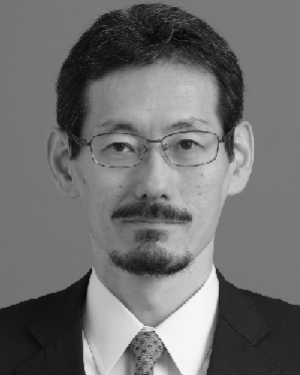 Hiroshi Shigeno合作论文数4
 Nanaka Asai合作论文数2
 Hiroyuki Seki合作论文数2Takanobu Ohnuma合作论文数2
 Satoshi Ideno合作论文数2
 Jungo Kato合作论文数2Hiroshi Morisaki合作论文数2
 Chiaki Doi合作论文数Graduate School of Pharmaceutical Sciences;Chiba University;Graduate School of Pharmaceutical Sciences, Chiba University2Takashige Yamada合作论文数2Yusuke Tanaka合作论文数1Riku Inada合作论文数1




