In range-Doppler imaging radars, the sidelobes of strong scatterers may mask weak scatterers in the matched filter outputs. Adaptive pulse compression and iterative adaptive approach pioneer a class of iterative filtering algorithms with remarkable sidelobe suppression performance. These algorithms formulate a multivariate linear model (MLM) by taking the complex scattering coefficients in all range-Doppler cells as its parameters, and solve for these parameters iteratively. As the MLM is potentially overparameterized, they incur significantly high computational costs. To address this issue, we propose a computationally efficient iterative filtering approach named iterative sidelobe suppression via progressive model expansion (PME-ISS) in this article. It adaptively formulates a series of progressively expanding MLMs based on the estimated distribution of scatterer cells (DSC), which refers to range-Doppler cells occupied by scatterers, and estimates the complex scattering coefficients of these scatterers iteratively. To ensure the compactness of the MLMs, we propose a DSC estimation method composed of identifying potential scatterer cells and removing range-Doppler cells not occupied by scatterers. A specific implementation algorithm of PME-ISS is derived, and its computational cost analysis is provided. Simulations demonstrate a computational cost reduction of multiple orders of magnitude compared with existing iterative filtering algorithms without sacrificing sidelobe suppression performance.
Solving hyperbolic conservation law equations accurately remains a challenging task. The notable feature of this system of equations is that, regardless of whether the initial conditions are smooth, solutions containing both strong and weak discontinuities will eventually emerge as time evolves, and these discontinuous solutions will further propagate over time. To address this type of singularly strong discontinuities, a high-accuracy pseudo arc-length method (PALM) based on the Toro-V & aacute;zquez (TV) splitting is proposed in this paper. The method realizes the adaptive adjustment of the mesh by introducing the arc-length constraint equations, which reduces the domain of influence of the singularities and indirectly eliminates and attenuates the singularity of the equations. In the high order reconstruction stage, it is mapped to the computational arc-length space and combined with the optimized weighted essentially non-oscillatory-z (WENO-Z) scheme, so that the subtle changes and complex structures in the flow can be captured and resolved to the greatest extent. Meanwhile, the high-accuracy pseudo arc-length method is combined with the positivity-preserving Harten-Lax-van Leer (HLL) scheme to form a composite format that is both stable and robust. This combination allows the algorithm to maintain excellent computational stability and accuracy when dealing with complex flows and extreme conditions. Numerical example results show that the pseudo arc-length method based on Toro-V & aacute;zquez splitting not only maintains the high accuracy property, but also performs well in dealing with shock waves and high-frequency wave flow problems.
Random frequency and pulse repetition interval agile (RFPA) radars, distinguished by their superior electronic counter-countermeasure capability, show great potential in numerous applications. However, the wide distribution of distant sidelobes along the range dimension limits their practical application. The recently proposed multitimeslot wide-gap frequency-hopping sequence paired with a low-pass filter (LPF) in the receiver offers a different perspective for the distant sidelobe suppression of RFPA radars. Nevertheless, energy leakage from adjacent pulses' echoes within and outside the subband of each pulse's echo limits its performance. While the reduction of the former energy leakage has been addressed in one of our previous works, the reduction of the latter poses a challenge to the design of the receiving filter. Reducing the latter energy leakage by simply increasing the LPF's stopband attenuation extends its impulse response, which, in turn, increases the span of the near sidelobes of RFPA radars. The subsequent processing for near sidelobe suppression, such as the iterative adaptive approach based on matched filter outputs, also becomes computationally more costly. To address this issue, we formulate an optimal finite impulse response distant sidelobe suppression filter (FIR-DSSF) design problem for random multitimeslot wide-gap frequency-hopping and pulse repetition interval agile (RMWFPA) radars. The optimization objective is to maximize the signal-to-distant-sidelobe-related-interference ratio (SDIR) in the samples related to one range-velocity cell. By deriving a lower bound of the SDIR, this optimization problem is relaxed into a generalized Rayleigh quotient maximization problem independent of the probing scene. Then, we give its closed-form solution. Simulations demonstrate superior distant sidelobe suppression performance for RMWFPA radars with the optimized FIR-DSSFs without significantly increasing the span of the near sidelobes.
This paper proposes a high-order pseudo arc-length method (PALM) for multi-medium flows with strong robustness, stability, and positivity preservation for solving one- and two-dimensional compressible Euler equations. The main idea of the proposed scheme is to add an additional arc-length constraint equation to the original control equation and map it to the uniform orthogonal arc-length space. We discretize the space with high accuracy by using the high-order weighted essentially non-oscillatory (WENO) interpolation reconstruction, which overcomes the difficulty of constructing the high-order format due to the physical space deformation caused by the grid movement. The application scope of the positivity-preserving algorithm is further expanded, and the positivity-preserving limiter of the high-order WENO pseudo arc-length adaptive method in the coordinate system of the arc-length calculation is constructed and proved, solving the problem of the negative density and pressure caused by the interaction between a strong shock wave and a strong sparse wave. For grid motion after interpolation of the level set function, a third-order non-conservative interpolation scheme is offered to ensure the interface capture accuracy. Finally, combined with level set interface tracking and the real ghost fluid method interface-processing techniques, the algorithm is applied to calculate multi-medium flows. Numerical examples show that the PALM almost eliminates the mass loss near the interface and maintains the high-accuracy and high-resolution characteristics of the algorithm when dealing with extreme problems such as low density, low pressure, strong shock waves, or strong sparse waves.
Random frequency and pulse repetition interval agile (RFPA) signals have excellent anti-jamming ability and achieve low probability of intercept (LPI), making them promising for applications in radar systems. However, their matched filter (MF) outputs suffer from random range-velocity sidelobes. In the range dimension, these sidelobes can be classified into two categories: the distant sidelobe floor spread out beyond the minimum interval between pulses, and the near sidelobe plateau confined within about one pulsewidth. These sidelobes seriously degrade the target detection capability of RFPA signals. To address this issue, we propose the concept of a multi-timeslot wide-gap frequency-hopping sequence (multi-timeslot WGFHS) and use it in the design of RFPA signals. In doing so, the distant sidelobes are easily suppressed with a simple low-pass filter (LPF) in the receiver if the parameters of the multi-timeslot WGFHS are chosen properly, while the remaining near sidelobes are suppressed by the iterative adaptive approach based on matched filter outputs (MF-IAA). Simulation results show that the proposed method can effectively suppress the sidelobes of RFPA signals, accurately recover the range-velocity images, and successfully detect weak targets in the presence of strong targets or clutter.
Recently, a two-dimensional joint iterative adaptive filtering (2-D JIAF) has been proposed to address the masking effect of large targets on adjacent small targets in multi-target scenarios. However, its perfor-mance is impaired for the cases with fast moving targets due to intrapulse Doppler mismatch. In this paper, we consider the intrapulse Doppler shifts in filtering design and propose a robust iterative adap-tive filtering algorithm based on matched filter outputs, termed robust iterative adaptive filtering against intrapulse Doppler shifts (RIAF-IDS), to suppress the range sidelobes induced by intrapulse Doppler mis-match and improve the filtering performance. The proposed algorithm can jointly suppress range-Doppler sidelobes and obtain accurate estimation of range-Doppler image even in cases with fast moving targets. The derivation of RIAF-IDS is provided in detail, and its filtering performance is validated through several simulations, which demonstrate that RIAF-IDS has superior Doppler tolerance over 2-D JIAF at the cost of more computation. (c) 2023 Elsevier B.V. All rights reserved.
This article presents a computationally efficient iterative adaptive approach based on range–Doppler matched filter outputs for sidelobe suppression and range–Doppler imaging. A sidelobe suppression scheme, named as dimension reduction based fast iterative adaptive approach (DR-FIAA), is designed by adopting a small processing window on range–Doppler matched filter outputs to eliminate the masking of weak targets by strong targets nearby with low computational complexity. Two specific methods are proposed under this scheme, namely synchronous FIAA (SY-FIAA) and sequential FIAA (SE-FIAA). Compared to SY-FIAA, SE-FIAA has lower computational complexity at the cost of some performance loss. Based on the structure relationships among covariance matrices, further reduced computational complexity can be achieved by SY-FIAA and SE-FIAA. Numerical examples for different scenarios are included to demonstrate the effectiveness of the proposed designs.
Small moving targets with low signal-to-noise ratio have the characteristics of weak intensity and small size. For stationary targets, it can be enhanced by the time-domain multi-frame accumulation algorithm. However, for small moving targets, the traditional direct multi-frame accumulation method cannot effectively enhance the target due to the change of the position of the target between frames and the spread of target energy. Based on this feature, this paper proposes an enhancement method based on uniform moving small targets. Because the target moves at a uniform speed between frames, the target smear image can be obtained by directly accumulating multiple frames of the collected target image sequence according to the stationary target, and then according to the smear information, the real moving speed of the target can be reversed. Finally, according to this speed, the small target image sequence is shifted and accumulated by multiple frames. In order to verify the effectiveness of the proposed method, the experiment is designed to simulate the motion of a small target by carrying a faint point light source on a motorized slide at constant speed, collecting data for correlation processing. The experimental results show that the method proposed in this paper can quickly and accurately estimate the speed of the small target moving between frames. The accumulation of small target images shifted according to this speed can significantly enhance the target and improve the signal-to-noise ratio.
Adaptive pulse compression (APC) has been proposed based on the minimum mean square error (MMSE) criterion to effectively suppress range sidelobes of strong targets and retrieve all targets in multi-target scenarios. However, MMSE-based algorithms suffer from deteriorated performance in the presence of targets with range-straddling due to modelling mismatch. This degradation can be partially compensated by modified MMSE-based algorithms. To further suppress sidelobes when range straddling occurs, we propose a modified APC algorithm robust to targets with range-straddling, namely range-straddling-robust APC (RSR-APC). We first establish the signal model for targets with range-straddling and then derive the expressions of the MMSE filter based on matched filter outputs and the range-straddling offsets based on an improved Rife algorithm. Simulation results show that the proposed algorithm can suppress sidelobes of targets with range-straddling and improve estimation accuracy of target positions in different scenarios.
Random frequency and pulse repetition interval (PRI) agile (RFPA) signals bring excellent performance of electronic counter-countermeasures to radar systems and have been received considerable attention in recent years. However, the research on their ambiguity function (AF) is not comprehensive. In this article, the analytical expressions of the AF expectation and variance are given. According to the expressions, the direct relationships between the key metrics of the AF and the waveform parameters of RFPA signals are specified. The results in this article are verified by Monte Carlo simulations and provide some insights into RFPA waveform design.
In multitarget scenarios, the masking of small targets by large targets nearby may severely deteriorate radar detectability due to the range and Doppler sidelobes. In this article, a 2-D joint iterative adaptive filtering (2-D JIAF) method is proposed, by adopting the reiterative minimum mean square error (RMMSE) criterion to the outputs of a 2-D matched filter. The main advantages of the proposed method over the state-of-the-art (SOTA) methods, including modified adaptive multipulse compression and iterative adaptive approach, are twofold: 1) it is able to suppress the sidelobes in both range and Doppler dimensions and thus obtain an improved range-Doppler image; 2) the computational complexity is significantly reduced by adopting a small processing window in both range and Doppler dimensions. The derivation of 2-D JIAF is detailed and an efficient two-stage implementation is outlined. The performance of 2-D JIAF is validated with simulation results over a wide range of scenarios and compared with two SOTA approaches. The impacts of different parameters, including the number of iterations and the choice of the size of the processing window, are also extensively studied with Monte Carlo trials.
 Siliang Wu (吴嗣亮)合作论文数School of Information and Electronics, Beijing Institute of Technology8
 Jing Tian (田静)合作论文数School of Information and Electronics, Beijing Institute of Technology5
 Xingwang Long合作论文数School of Information and Electronics, Beijing Institute of Technology4
 Ju Wang (王菊)合作论文数School of Information and Electronics, Beijing Institute of Technology3
 Wenhao Wu (吴文昊)合作论文数School of Information and Electronics, Beijing Institute of Technology3Yupeng Piao合作论文数1
 Biao Zhang合作论文数1WANG Chentao (王晨涛)合作论文数1
 Juan Ma合作论文数1
 Peng Li (李鹏)合作论文数School of Mechano-Electronic Engineering, Xidian University1
 Weixian Qian (钱惟贤)合作论文数School of Electronic and Optical Engineering, Nanjing University of Science and Technology1
 Wei Cui (崔嵬)合作论文数School of Information and Electronics, Beijing Institute of Technology1
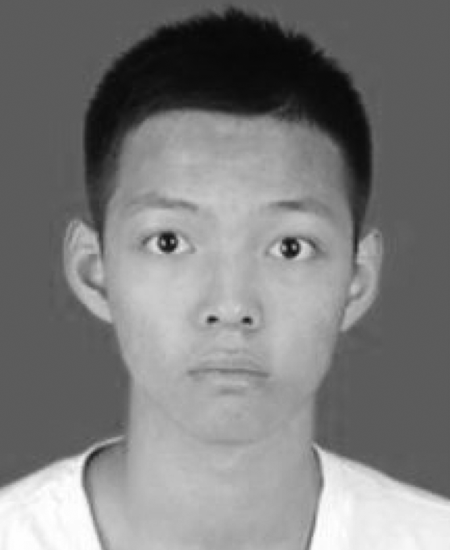 Ning Chen (陈宁)合作论文数1
 Tianbao Ma (马天宝)合作论文数School of Mechatronics Engineering, Beijing Institute of Technology1




