Aegagropiles are conglomerations of fibre debris from Posidonia oceanica meadows that are frequently found along Mediterranean beaches, but the plant organ from which these fibres arise remains unknown. In this study, a histological comparison of P. oceanica organs from 3 shoots with the structure of aegagropile fibres showed that most of them arise from leaf sheaths and rhizomes, suggesting that they are degradation products from the “matte” rather than from the leaf litter, which is mainly composed of detached leaf blades. Moreover, fungal hyphae, micro-sclerotia and typical degradation traces were found in the peripheral tissues of living P. oceanica organs, as well as in degrading aegagropiles. We assume, by comparing Vohník’s observations and the observations made in this study, that these endophytic fungi and degradation traces might be attributed to a dark septate endophyte (DSE) in the Aigialaceae (Pleosporales), Posidoniomyces atricolor, which was recently described as an endosymbiont in P. oceanica roots. It constitutes one of the most important microorganisms by abundance that degrade P. oceanica tissues within the matte and give rise to the different fibre types in aegagropiles. This study shows that the proliferation of fungi causes organ degradation in Posidonia, starting early in living P. oceanica plants, continuing in the matte and, probably, in the leaf litter. The DSE plays a much more important role than that of a simple plant endosymbiont; its omnipresence within P. oceanica (and the degradation of the middle lamella and cell death during proliferation) causing the degradation of various Posidonia organs also contributes to the enrichment of the ‘matte’ compartment of this ecosystem, notably favouring nitrogen retention in its chitinous walls.
Aegagropiles are round-shaped conglomerations of Posidonia oceanica debris commonly found along the coasts of the Mediterranean Sea. This study presents a detailed description of the composition of aegagropiles in terms of their internal organisation in different layers (and the orientation of the fibres in these layers), the proportion of constituent elements (fibres and minerals) and the histological (by way of microscopic observations) nature of all of these aegagropiles elements. The aim of this work is to take a detailed interest in the structure of the aegagropiles of Posidonia oceanica and to determine the process that forms them. Aegagropiles are an assemblage of two types of debris from the P. oceanica meadow: (1) plant-based: fibres more or less degraded from P. oceanica shoots (leaves and rhizomes) and (2) mineral particles such as silicates and biotic Ca-carbonate debris. On the basis of structural and compositional observations, we proposed an elucidation of the cycle in several phases: initiation of a “roll” by aggregation of litter fibres and sand in the ripple marks, growth, breakdown of the roll into small balls (microbial and mechanical degradation) and export of aegagropiles down (into the abyss) or on to the beaches. Calculations estimate that considering its density of 0.2 g/cm3, an aegagropile represents the accumulation of fibres from approximately 25 shoots of P. oceanica.
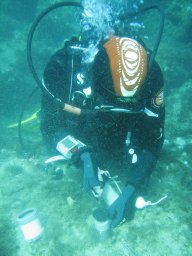
This paper presents a new non-destructive sampling technique that consists of cutting all of the leaves of a Posidonia oceanica shoot (with scissors) just above the ligula of the external leaves. Developed in an undisturbed meadow in Corsica (France) at depths of 12-15 m, this sampling technique is called the Non-Destructive Shoot sampling Method (NDSM). The results of using this method indicate that most biometric parameters and relevant water quality indices can be measured and calculated from seagrasses sampled using the NDSM. It was determined that sampling shoots using the NDSM ensured a 100% survival rate. Notably, the NDSM allowed sampled shoots to grow back to lengths similar to those of an adjacent control meadow within three months. Biochemical analyses indicated that meadow portions and seagrass leaves regrown after NDSM sampling differed little in chemical composition (C, N and P and essential metal micronutrients Fe, Cu, Zn, Mn, Ni and Mo) to control seagrasses. Thus, the NDSM limits the negative effects of the sampling. Although not lethal to the plant, sampling seagrasses according to the NDSM requires exemption from the competent authority according to local, regional or national regulations for each protected species.
Acknowledgment The end aim would be... ...a more complet conceptual model of the Posidonia oceanica meadow based on historical date (1975). The starting point So to fill these data gaps, we have implemented: Estimation of biomass on a bathymetric and seasonal profile and with cartography of the Calvi bay we estimated the total production of the meadow. Mapping (multibeam sonar) of the Calvi bay to characterize the impact of human activities. Method of kriging of the Calvi bay to highlight areas of interest in the bay. Modeling the phenology of Posidonia meadow at short, medium and long terms with the 30 years of data collected by the lab and the phD data.
 Sylvie Gobert合作论文数Institut de Chimie, Université de Liège5
 Philippe Compère合作论文数University of Liege3
 Angelique Leonard合作论文数university of liege2
 Jonathan Richir合作论文数MARE Centre, University of LIEGE;Institute of Marine Sciences, University of Portsmouth;University of LIEGE, University of Portsmouth2
 Nicolas Vandewalle合作论文数Group for Research and Applications in Statistical Physics ( GRASP );Institut de Physique;Université de Liège;Institut de Physique, Université de Liège2
 Erwan Plougonven合作论文数CNRS, Univ. Bordeaux2
 Michel Marengo合作论文数1
 Sonia Ternengo合作论文数1
 Pierre Boissery合作论文数1




