End-to-end learning has shown great potential in autonomous parking, yet the lack of publicly available datasets limits reproducibility and benchmarking. While prior work introduced a visual-based parking model and a pipeline for data generation, training, and close-loop test, the dataset itself was not released. To bridge this gap, we create and open-source a high-quality dataset for end-to-end autonomous parking. Using the original model, we achieve an overall success rate of 85.16
Federated learning allows for cooperative training among distributed clients by sharing their locally learned model parameters, such as weights or gradients. However, as model size increases, the communication bandwidth required for deployment in wireless networks becomes a bottleneck. To address this, we propose a residual-based federated learning framework (ResFed) that transmits residuals instead of gradients or weights in networks. By predicting model updates at both clients and the server, residuals are calculated as the difference between updated and predicted models and contain more dense information than weights or gradients. We find that the residuals are less sensitive to an increasing compression ratio than other parameters, and hence use lossy compression techniques on residuals to improve communication efficiency for training in federated settings. With the same compression ratio, ResFed outperforms current methods (weight-or gradient-based federated learning) by over 1.4× on federated datasets, including MNIST, FashionMNIST, SVHN, CIFAR-10, CIFAR-100, FEMNIST, in client-to-server communication, and can also be applied to reduce communication costs for server-to-client communication.
Parallax processing and structure preservation have long been important and challenging tasks in image stitching. In this paper, an image stitching method based on sliding camera to eliminate perspective deformation and asymmetric optical flow to solve parallax is proposed. By maintaining the viewpoint of two input images in the mosaic non-overlapping area and creating a virtual camera by interpolation in the overlapping area, the viewpoint is gradually transformed from one to another so as to complete the smooth transition of the two image viewpoints and reduce perspective deformation. Two coarsely aligned warped images are generated with the help of a global projection plane. After that, the optical flow propagation and gradient descent method are used to quickly calculate the bidirectional asymmetric optical flow between the two warped images, and the optical-flow-based method is used to further align the two warped images to reduce parallax. In the image blending, the softmax function and registration error are used to adjust the width of the blending area, further eliminating ghosting and reducing parallax. Finally, by comparing our method with APAP, AANAP, SPHP, SPW, TFT, and REW, it has been proven that our method can not only effectively solve perspective deformation, but also gives more natural transitions between images. At the same time, our method can robustly reduce local misalignment in various scenarios, with higher structural similarity index. A scoring method combining subjective and objective evaluations of perspective deformation, local alignment and runtime is defined and used to rate all methods, where our method ranks first.
In the rapidly evolving field of autonomous driving systems, the refinement of path planning algorithms is paramount for navigating vehicles through dynamic environments, particularly in complex urban scenarios. Traditional path planning algorithms, which are heavily reliant on static rules and manually defined parameters, often fall short in such contexts, highlighting the need for more adaptive, learning-based approaches. Among these, behavior cloning emerges as a noteworthy strategy for its simplicity and efficiency, especially within the realm of end-to-end path planning. However, behavior cloning faces challenges, such as covariate shift when employing traditional Manhattan distance as the metric. Addressing this, our study introduces the novel concept of Residual Chain Loss. Residual Chain Loss dynamically adjusts the loss calculation process to enhance the temporal dependency and accuracy of predicted path points, significantly improving the model's performance without additional computational overhead. Through testing on the nuScenes dataset, we underscore the method's substantial advancements in addressing covariate shift, facilitating dynamic loss adjustments, and ensuring seamless integration with end-to-end path planning frameworks. Our findings highlight the potential of Residual Chain Loss to revolutionize planning component of autonomous driving systems, marking a significant step forward in the quest for level 5 autonomous driving system.
We propose a stitching method of multiple remote-sensing images based on infinite homography and global seam finding to reduce edge stretching and seam errors and improve the spatiotemporal efficiency. First, by assuming that the scene is far away from the camera, we construct and use an infinite homography instead of mesh-based warping to improve the speed and robustness of stitching. Due to the fact that the aircraft always flies horizontally, we add the horizontal flight prior into the camera parameter optimization to solve the edge stretching problem. Second, we globally find the optimal seam between multiple images and convert the global seam finding into a multi-label assignment to obtain a smaller seam error. In the iteration of alpha expansion, by dynamically adjusting the weight of the pixel to the terminal, the pixels are induced to be assigned to the label with more allocated pixels, which reduces the number of input images participating in image blending. Finally, comparative experiments with other methods prove that our method has less alignment error and edge stretching. Furthermore, our method is more robust, occupies less memory and runs faster, which makes our method more effective and practical in multiple image stitching.
The implementation of Autonomous Driving (AD) technologies within urban environments presents significant challenges. These challenges necessitate the development of advanced perception systems and motion planning algorithms capable of managing situations of considerable complexity. Although the end-to-end AD method utilizing LiDAR sensors has achieved significant success in this scenario, we argue that its drawbacks may hinder its practical application. Instead, we propose the vision-centric AD as a promising alternative offering a streamlined model without compromising performance. In this study, we present a path planning method that utilizes 2D bounding boxes of objects, developed through imitation learning in urban driving scenarios. This is achieved by integrating high-definition (HD) map data with images captured by surrounding cameras. Subsequent perception tasks involve bounding-box detection and tracking, while the planning phase employs both local embeddings via Graph Neural Network (GNN) and global embeddings via Transformer for temporal-spatial feature aggregation, ultimately producing optimal path planning information. We evaluated our model on the nuPlan planning task and observed that it performs competitively in comparison to existing vision-centric methods.
Federated learning enables cooperative training among massively distributed clients by sharing their learned local model parameters. However, with increasing model size, deploying federated learning requires a large communication bandwidth, which limits its deployment in wireless networks. To address this bottleneck, we introduce a residual-based federated learning framework (ResFed), where residuals rather than model parameters are transmitted in communication networks for training. In particular, we integrate two pairs of shared predictors for the model prediction in both server-to-client and client-to-server communication. By employing a common prediction rule, both locally and globally updated models are always fully recoverable in clients and the server. We highlight that the residuals only indicate the quasi-update of a model in a single inter-round, and hence contain more dense information and have a lower entropy than the model, comparing to model weights and gradients. Based on this property, we further conduct lossy compression of the residuals by sparsification and quantization and encode them for efficient communication. The experimental evaluation shows that our ResFed needs remarkably less communication costs and achieves better accuracy by leveraging less sensitive residuals, compared to standard federated learning. For instance, to train a 4.08 MB CNN model on CIFAR-10 with 10 clients under non-independent and identically distributed (Non-IID) setting, our approach achieves a compression ratio over 700X in each communication round with minimum impact on the accuracy. To reach an accuracy of 70%, it saves around 99% of the total communication volume from 587.61 Mb to 6.79 Mb in up-streaming and to 4.61 Mb in down-streaming on average for all clients.
Vehicle perception systems strive to achieve comprehensive and rapid visual interpretation of their surroundings for improved safety and navigation. We introduce YOLO-BEV, an efficient framework that harnesses a unique surrounding cameras setup to generate a 2D bird's-eye view of the vehicular environment. By strategically positioning eight cameras, each at a 45-degree interval, our system captures and integrates imagery into a coherent 3x3 grid format, leaving the center blank, providing an enriched spatial representation that facilitates efficient processing. In our approach, we employ YOLO's detection mechanism, favoring its inherent advantages of swift response and compact model structure. Instead of leveraging the conventional YOLO detection head, we augment it with a custom-designed detection head, translating the panoramically captured data into a unified bird's-eye view map of ego car. Preliminary results validate the feasibility of YOLO-BEV in real-time vehicular perception tasks. With its streamlined architecture and potential for rapid deployment due to minimized parameters, YOLO-BEV poses as a promising tool that may reshape future perspectives in autonomous driving systems.
Autonomous driving has been an active area of research and development, with various strategies being explored for decision-making in autonomous vehicles. Rule-based systems, decision trees, Markov decision processes, and Bayesian networks have been some of the popular methods used to tackle the complexities of traffic conditions and avoid collisions. However, with the emergence of deep learning, many researchers have turned towards Bird's-Eye View based methods to improve the precision of trajectory prediction. Despite the promising results achieved by some CNN-based methods, the failure to establish correlations between sequential images often leads to more collisions. In this paper, we propose an attention-based method that overcomes the limitation by establishing feature correlations between regions in Bird's-Eye View images using variants of multi-head attention. Our method combines the advantages of CNN with different kernel sizes in capturing regional features with multi-head self-attention structure to enhance the relationship between different local areas. Our method takes “Bird's Eye View” graphs generated from camera and LiDAR sensors as input, and simulates the position (x, y) and head offset angle (Yaw) to generate future trajectories. Each trajectory consists of 12 way-points and each point contains the above position and yaw information. Experiment results demonstrate that our proposed method outperforms existing vision-based strategies, achieving an average of only 12.4 collisions per 1000 miles of driving distance on the L5kit test set. This significantly improves the success rate of collision avoidance and provides a potential solution for autonomous driving. We have uploaded the GitHub link 1 1 Github link: https://github.com/HaynesLi/SSN of this algorithm.
Using real road testing to optimize autonomous driving algorithms is time-consuming and capital-intensive. To solve this problem, we propose a GAN-based model that is capable of generating high-quality images across different domains. We further leverage Contrastive Learning to train the model in a self-supervised way using image data acquired in the real world using real sensors and simulated images from 3D games. In this paper, we also apply an Attention Mechanism module to emphasize features that contain more information about the source domain according to their measurement of significance. Finally, the generated images are used as datasets to train neural networks to perform a variety of downstream tasks to verify that the approach can fill in the gaps between the virtual and real worlds.
CNN-based face detection methods have achieved significant progress in recent years. In addition to the strong representation ability of CNN, post-processing methods are also very important for the performance of face detection. In general, the face detection method predicts several candidate bounding-boxes for one face. NMS is used to filter out inaccurate candidate boxes to get the most accurate box. The principle of NMS is to select the box with a higher score as the basic box and then delete the box which has a large overlapping area with the basic box but has a lower score. However, the current NMS method and its improved versions do not perform well when face image quality is poor or faces are in a cluster. In these situations, even after NMS filtering, there is often a face corresponding to multiple predicted boxes. To reduce this kind of negative result, in this paper, we propose a new NMS method that operates in the reverse order of other NMS methods. Our method performs well on low-quality and tiny face samples. Experiments demonstrate that our method is effective as a post-processor for different face detection methods.
Several autonomous driving strategies have been applied to autonomous vehicles, especially in the collision avoidance area. The purpose of collision avoidance is achieved by adjusting the trajectory of autonomous vehicles (AV) to avoid intersection or overlap with the trajectory of surrounding vehicles. A large number of sophisticated vision algorithms have been designed for target inspection, classification, and other tasks, such as ResNet, YOLO, etc., which have achieved excellent performance in vision tasks because of their ability to accurately and quickly capture regional features. However, due to the variability of different tasks, the above models achieve good performance in capturing small regions but are still insufficient in correlating the regional features of the input image with each other. In this paper, we aim to solve this problem and develop an algorithm that takes into account the advantages of CNN in capturing regional features while establishing feature correlation between regions using variants of attention. Finally, our model achieves better performance in the test set of L5Kit compared to the other vision models. The average number of collisions is 19.4 per 10000 frames of driving distance, which greatly improves the success rate of collision avoidance.
Efficient communication is significant for federated learning and DNN model deployment. However, transferring hundreds of millions of DNN parameters over networks with limited bandwidth results in long communication delays or even data losses. To alleviate or even remove the communication bottleneck, efficient methods for parameter compression can be applied. Inspired by video encoding, which exploits inter-frame similarity for compression, we investigate the strong temporal correlations of parameter updates in two near epochs of the DNN model and introduce a model parameter residual encoding framework. By transmitting encoded residual between model parameters in two near epochs, the receiver can reconstruct new model parameters and finish the updates with less communication cost. Furthermore, with respect to our framework, we develop lossless and lossy model parameter compression methods and demonstrate them on popular classification and detection networks. The results show that the lossless method can compress the data size of the parameters to less than 90%, and the lossy method can shrink the parameter size to less than 50% with a fair low loss. Our source code is released at https://github.com/zhouliguo/DNN_param_encode.
There are many artificial intelligence algorithms for autonomous driving, but directly installing these algorithms on vehicles is unrealistic and expensive. At the same time, many of these algorithms need an environment to train and optimize. Simulation is a valuable and meaningful solution with training and testing functions, and it can say that simulation is a critical link in the autonomous driving world. There are also many different applications or systems of simulation from companies or academies such as SVL and Carla. These simulators flaunt that they have the closest real-world simulation, but their environment objects, such as pedestrians and other vehicles around the agent-vehicle, are already fixed programmed. They can only move along the pre-setting trajectory, or random numbers determine their movements. What is the situation when all environmental objects are also installed by Artificial Intelligence, or their behaviors are like real people or natural reactions of other drivers? This problem is a blind spot for most of the simulation applications, or these applications cannot be easy to solve this problem. The Neurorobotics Platform from the TUM team of Prof. Alois Knoll has the idea about "Engines" and "Transceiver Functions" to solve the multi-agents problem. This report will start with a little research on the Neurorobotics Platform and analyze the potential and possibility of developing a new simulator to achieve the true real-world simulation goal. Then based on the NRP-Core Platform, this initial development aims to construct an initial demo experiment. The consist of this report starts with the basic knowledge of NRP-Core and its installation, then focus on the explanation of the necessary components for a simulation experiment, at last, about the details of constructions for the autonomous driving system, which is integrated object detection and autonomous control.
CNN-based object detection methods have achieved significant progress in recent years. The classic structures of CNNs produce pyramid-like feature maps due to the pooling or other re-scale operations. The feature maps in different levels of the feature pyramid are used to detect objects with different scales. For more accurate object detection, the highest-level feature, which has the lowest resolution and contains the strongest semantics, is up-scaled and connected with the lower-level features to enhance the semantics in the lower-level features. However, the classic mode of feature connection combines the feature of lower-level with all the features above it, which may result in semantics degradation. In this paper, we propose a skipped connection to obtain stronger semantics at each level of the feature pyramid. In our method, the lower-level feature only connects with the feature at the highest level, making it more reasonable that each level is responsible for detecting objects with fixed scales. In addition, we simplify the generation of anchor for bounding box regression, which can further improve the accuracy of object detection. The experiments on the MS COCO and Wider Face demonstrate that our method outperforms the state-of-the-art methods.
Real-time semantic segmentation in traffic scenes plays an essential part in autonomous driving. The encoder–decoder-based network architecture can well combine the context information and detailed information required for the semantic segmentation task. Achieving a good balance between inference speed and accuracy is a crucial challenge, as considerable real-time semantic segmentation models process information in real-time at the expense of accuracy degradation. This paper presents an encoder–decoder network model based on Cross Stage Partial (CSP) block for real-time semantic segmentation in traffic scenes. Integrating the CSP block can not only lessen the computational overhead but also enhance the feature extraction ability of the network. In addition, we append the Fast Spatial Pyramid Pooling module to the backbone of the network, which can aggregate global information at a low computational cost. On NVIDIA RTX 3090, the middle model of our method can achieve a mean intersection over union (mIOU) of 80.8% at 64.3 frames per second (FPS) on the Cityscapes test set and an mIOU of 81.3% at 105.3 FPS on the CamVid Test Set. The large model of our method can realize an mIOU of 81.5% at 48.4 FPS on the test set of Cityscapes. Our source code is available at https://github.com/zhouliguo/cspsg.
Autonomous driving has been an active area of research and development, with various strategies being explored for decision-making in autonomous vehicles. Rule-based systems, decision trees, Markov decision processes, and Bayesian networks have been some of the popular methods used to tackle the complexities of traffic conditions and avoid collisions. However, with the emergence of deep learning, many researchers have turned towards CNN-based methods to improve the performance of collision avoidance. Despite the promising results achieved by some CNN-based methods, the failure to establish correlations between sequential images often leads to more collisions. In this paper, we propose a CNN-based method that overcomes the limitation by establishing feature correlations between regions in sequential images using variants of attention. Our method combines the advantages of CNN in capturing regional features with a bi-directional LSTM to enhance the relationship between different local areas. Additionally, we use an encoder to improve computational efficiency. Our method takes "Bird's Eye View" graphs generated from camera and LiDAR sensors as input, simulates the position (x, y) and head offset angle (Yaw) to generate future trajectories. Experiment results demonstrate that our proposed method outperforms existing vision-based strategies, achieving an average of only 3.7 collisions per 1000 miles of driving distance on the L5kit test set. This significantly improves the success rate of collision avoidance and provides a promising solution for autonomous driving.
Conducting real road testing for autonomous driving algorithms can be expensive and sometimes impractical, particularly for small startups and research institutes. Thus, simulation becomes an important method for evaluating these algorithms. However, the availability of free and open-source simulators is limited, and the installation and configuration process can be daunting for beginners and interdisciplinary researchers. We introduce an autonomous driving simulator with photorealistic scenes, meanwhile keeping a user-friendly workflow. The simulator is able to communicate with external algorithms through ROS2 or Socket.IO, making it compatible with existing software stacks. Furthermore, we implement a highly accurate vehicle dynamics model within the simulator to enhance the realism of the vehicle's physical effects. The simulator is able to serve various functions, including generating synthetic data and driving with machine learning-based algorithms. Moreover, we prioritize simplicity in the deployment process, ensuring that beginners find it approachable and user-friendly.
Deep learning is a key approach for the environment perception function of Cooperative Intelligent Transportation Systems (C-ITS) with autonomous vehicles and smart traffic infrastructure. The performance of the object recognition and detection strongly depends on the data volume in the model training, which is usually not sufficient due to the limited data collected by a typically small fleet of test vehicles. In today's C-ITS, smart traffic participants are capable of timely generating and transmitting a large amount of data. However, these data can not be used for model training directly due to privacy constraints. In this paper, we introduce a federated learning framework coping with Hierarchical Heterogeneity (H 2 -Fed), which can notably enhance the conventional pre-trained deep learning model. The framework exploits data from connected public traffic agents in vehicular networks without affecting user data privacy. By coordinating existing traffic infrastructure, including roadside units and road traffic clouds, the model parameters are efficiently disseminated by vehicular communications and hierarchically aggregated. Considering the individual heterogeneity of data distribution, computational and communication capabilities across traffic agents and roadside units, we employ a novel method that addresses the heterogeneity in different aggregation layers of the framework architecture, i.e., aggregation in layers of roadside units and cloud. The experimental results indicate that our method can well balance the learning accuracy and stability according to the knowledge of heterogeneity in current communication networks. Comparing to other baseline approaches, the evaluation on federated datasets shows that our framework is more general and capable especially in application scenarios with low communication quality. Even when 90% of the agents are timely disconnected, the pre-trained deep learning model can still be forced to converge stably, and its accuracy can be enhanced from 68% to over 90% after convergence.
 Alois Christian Knoll合作论文数Department of Computer Science, School of Computation, Information and Technology, Technical University of Munich14
 Zhongyuan Wang (王中元)合作论文数School of Computer Science, Wuhan University8
 Guang Chen (陈广)合作论文数Robotics & Embodied AI Lab, School of Computer Science and Technology, Tongji University6
 Yimin Luo合作论文数National Climate Center Beijing, National Climate Center5
 Haichuan Li合作论文数4
 Andreas Festag合作论文数Technische Hochschule Ingolstadt4
 Rong Zhu (朱荣)合作论文数School of Computer Science, Wuhan University4Lian Liu合作论文数3Ruining Wang合作论文数3
 Rui Song合作论文数Department of Statistics, North Carolina State University3
 Shizheng Wang合作论文数Chinese Academy of Sciences, Chinese Academy of Sciences3Alois Knoll合作论文数2Mingyue Feng合作论文数2
 Zhenshan Bing合作论文数2Wenjuan Liao合作论文数Nanyang Technological University, Singapore, Singapore2Jia-yi CHANG (常嘉义)合作论文数2Siwen Liu合作论文数Wuhan Univ, Comp Sch, Natl Engn Res Ctr Multimedia Software, Wuhan, Hubei, Peoples R China2
 Zheng He (何政)合作论文数National Engineering Research Center for Multimedia Software, School of Computer Science, Wuhan University2
 Shu Wang (王殊)合作论文数School of Electronic Information and Communications, Huazhong University of Science and Technology2
 Qing Li (李庆)合作论文数National Institute of Standards and Technology2
 Lingjuan Lv (吕灵娟)合作论文数Sony AI2Huicai Zhong合作论文数2
 Yuhong Huang合作论文数School of Computation, Information and Technology, Technische Universität München;Department of Informatics, Technical University of Munich1Jiangang Yang (杨建刚)合作论文数1Nanxi Wang合作论文数1
 Heng Guo (郭亨)合作论文数PRIS Lab, School of Artificial Intelligence, Beijing University of Posts and Telecommunications;Graduate School of Information Science and Technology, Osaka University1Dingheng Zeng合作论文数1
 Jinxiu (Sherry) Liang合作论文数National Engineering Research Center of Visual Technology, Peking University1
 Lin Gu (谷林)合作论文数Center for Advanced Intelligence Project, RIKEN1
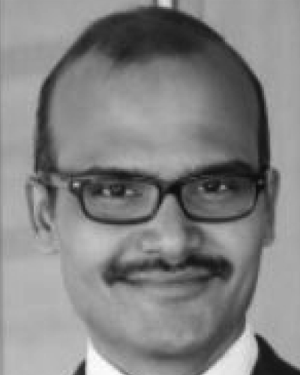 Venkatnarayanan Lakshminarasimhan合作论文数1ZHONG Min-Hui (钟敏慧)合作论文数1Zhonghao Li (李中浩)合作论文数1
 Taiyi Su合作论文数1Shengdi Zhou合作论文数State Key Laboratory of Virtual Reality Technology and Systems, Beihang University1
 Baojin Huang合作论文数School of Computer, Wuhan University1Yu Yan合作论文数1Qi Sun合作论文数1Marzana Khatun合作论文数1
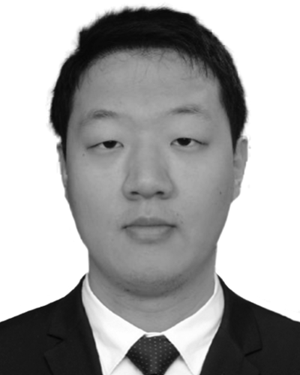 Cao Cong合作论文数Tianjin Univ, Sch Elect & Informat Engn, Tianjin, Peoples R China1Rolf Jung合作论文数1Yichao Gao合作论文数1Chubin Zhuang合作论文数1Hong Chen合作论文数1Taiheng Zhang合作论文数1Yuqiang Zheng合作论文数1Zhou Yirui合作论文数Shanghai University1




