We developed an algorithm to estimate the performance of an optical system based on the errors of its individual components. After a short training period with classical simulated systems, the performance evaluation for tolerancing could be accelerated by a factor of about three million. Additionally, we propose a probability-based sorting algorithm to combine individual, erroneous components in order to compensate for the tolerance budget within the system and increase the overall yield.
We report on the design and fabrication of a novel all-glass four-channel beam splitter based on a Kösters prism for use in space. The Kösters prism, which consists of three pairs of individual prisms, is used to separate an incoming telescope beam into four spectral channels (λ = 800–1700 nm) with the goal to obtain a multi-band photometry of cosmic sources in the optical/near-infrared bands. We performed optical design studies to evaluate the influence of geometrical tolerances of the six individual prisms on the image quality. A stray light analysis revealed the impact of the composition on the overall optical performance. Mechanical design studies benchmarked possible mounting strategies. We considered optical adhesives, soldering and clamping. The influence of the mechanical loads during a rocket launch as well as thermal loads at 140 K (the operation temperature of the optical element) were studied. We optimized the coating properties of the prisms by considering the results from the optical design study as well as the technological requirements for the direct bonding of the prisms. Bonding strategies to realize the prism pairs were developed and successfully tested. A demonstrator Kösters prism was manufactured and is ready to validate its optical performance.
In this paper, we propose a strong system for dynamic projection mapping (DPM). It consists of a high-speed 500-fps camera, high-speed 24-bit 947-fps RGB projector, and newly developed 8-bit 2,880-fps infrared (IR) projector. This configuration allows us to capture the depth map and project the depth-aware image at a high frame rate. We also realize 0.4-ms markerless 3D pose tracking using the depth map by leveraging small inter-frame motions under high-frame-rate capture. We exploit these captured data and apply the depth-aware DPM to an entire scene with low latency, in a setting in which tracking-based and modelless mapping are combined and performed simultaneously.
Optical systems can benefit strongly from freeform surfaces; however, the choice of the right surface representation is not trivial and many aspects must be considered. In this work, we discuss the general approach classical globally defined representations, as well as the basic mathematics and properties of the most commonly used descriptions and present a new description developed by us for describing freeform surfaces.
In modern laser-based ion acceleration systems, the field distribution of the focused laser beam at the position of the target strongly influences the overall characteristics of the resulting ion beam. To obtain an unidirectional and quasi mono-energetic ion beam, a flat-top field distribution of the focused laser beam is optimal. This can only be achieved, by using a beam-profiling system that reshapes the incident laser beam into an Airy-shaped field distribution in the far field. Here, we present an extensive design study of such a beam-profiling system based on two free-form mirrors. In order to realize the rings of zero intensity, corresponding to the roots of the Airy-function, strong curvature peaks on the first mirror are necessary. Additionally, the alternating phase in between these rings can only be achieved with grooves on the second mirror. These aspects actually raise the question, if the used purely geometric optical modeling approach is still valid. Therefore, our design study is entirely accompanied with wave-optical simulations to identify influences of diffraction within the beam profiling system. We find that especially the grooves on the second mirror are mandatory, not only to ensure the alternating phase, but also to realize the roots of zero intensity of the Airy-function. On the other hand, these grooves cause diffraction effects in the beam-profiling system that slightly degrade the at-top focal field. These influences are in the range of a few percent and cannot be further avoided.
Optical systems can benefit strongly from freeform surfaces, however the choice of the right representation isn`t an easy one. Classical representations like X-Y-polynomials, as well as Zernike-polynomials are often used for such systems, but should have some disadvantage regarding their orthogonality, resulting in worse convergence and reduced quality in final results compared to newer representations like the Q-polynomials by Forbes. Additionally the supported aperture is a circle, which can be a huge drawback in case of optical systems with rectangular aperture. In this case other representations like Chebyshev-or Legendre-polynomials come into focus. There are a larger number of possibilities; however the experience with these newer representations is rather limited. Therefore in this work the focus is on investigating the performance of four widely used representations in optimizing two ambitious systems with very different properties: Three-Mirror-Anastigmat and an anamorphic System. The chosen surface descriptions offer support for circular or rectangular aperture, as well as different grades of departure from rotational symmetry. The basic shapes are for example a conic or best-fit-sphere and the polynomial set is non-, spatial or slope-orthogonal. These surface representations were chosen to evaluate the impact of these aspects on the performance optimization of the two example systems. Freeform descriptions investigated here were XY-polynomials, Zernike in Fringe representation, Q-polynomials by Forbes, as well as 2-dimensional Chebyshev-polynomials. As a result recommendations for the right choice of freeform surface representations for practical issues in the optimization of optical systems can be given.
As the scientific field of the freeform optics is newly developing, there is only a small number of approved starting systems for the imaging lens design. We investigate the possibility to generate starting configurations of freeform lenses with the Simultaneous Multiple Surface (SMS) method. Surface fit and transfer to the ray tracing program are discussed in detail. Based on specific examples without rotational symmetry, we analyze the potential of such starting systems. The tested systems evolve from Scheimpflug configurations or have arbitrarily tilted image planes. The optimization behavior of the starting systems retrieved from the 3D-SMS is compared to classical starting configurations, like an aspheric lens. Therefore we evaluate the root mean square (RMS) spot radius before and after the optimization as well as the speed of convergence. In result the performance of the starting configurations is superior. The mean RMS spot diameter is reduced about up to 17.6 % in comparison to an aspheric starting configuration and about up to 28 % for a simple plane plate.
A micro‐projector based on OLED micro‐displays is presented. Three high brightness OLEDs, red, green and blue colored, are used to realize a full color imaging. The system design and the realized optical prototype of the projection lens are discussed.
Microdisplays, whether they are of the liquid-crystal-on-silicon (LCOS) or organic light-emitting diode (OLED) type, have been, up until now, mainly used in multimedia applications or head-mounted displays. Due to their interesting possibilities, these displays open more and more alternative applications; for example, in optical metrology. Projection lenses for this application area need to be specially designed because the requirements on these systems differ completely from those for multimedia applications. The lenses must have very low geometrical image distortion and they have to be adapted to small objects and/or image distances. On the other hand, they often work with light sources with small spectral bandwidths; consequently, they do not need to be corrected for chromatic aberrations. In addition, the numerical aperture has to be large enough to collect and transfer as much light as possible, but also the size of the projection lens has to be as small as possible to ensure compact measurement systems. All these requirements lead to a compromise in optical lens design. Three optical system designs and realizations - one with an OLED microdisplay and two with an LCOS microdisplay - are presented.
An ultra compact projection system for mobile application based on OLED microdisplay has been developed. This OLED projection system will be integrated into a wearable optical system like mobile phone or PDA. System design and realized prototype of the projection lens will be presented.
Abstract— A visual system for stimulating specific human brain functions inside a clinical magnetoencephalography (MEG) measurement chamber was developed. This system is based on a three‐panel LCOS projection unit and uses a 4.5‐m‐long image‐guiding optical‐fiber bundle to transfer the image into the magnetically shielded MEG measurement chamber. In addition to a proper optical system design, special attention had to be paid to all materials used inside the magnetically shielded chamber. Here, no interfering fields due to electrics or ferromagnetic materials are allowed. The system concept, optical design, and the realized prototype are presented.
For stimulating specific human brain functions inside a clinical MEG measurement chamber a visual stimulation system was developed. This 3‐panel LCOS projection system uses a 4 meter long image guiding optical fiber bundle to transfer the image into the magnetically shielded measurement chamber. System design and realized prototype are presented.
For a lot of HMD application it is desirable to know where the user is looking at. For this purpose an ocular OLED-HMD system with collinear eye-tracking was developed. A viewing angle of 36° is realized in combination with an eye-tracker FOV of 20mm. The system is desired for medical applications.
New projection concepts based on OLED (organic light-emitting diode)-microdisplays will be presented. Up to now mostly all projection systems are based on reflective and/or transmissive microdisplays like digital micromirror devices (DMDs), nematic liquid crystals displays (LCDs) or liquid crystal on silicon displays (LCOS). But the size of necessary light source and illumination optics is a strong limitation for the miniaturization of the projection system itself or for system integration. Here we propose to use a high-brightness OLED-microdisplay as active element for image or pattern generation, giving the possibility to realize compact projection or imaging units. Optical parameters of the microdisplays are determined to get input data for optical system design. Based on these experimental results specially adapted optical systems are designed. First prototypes and realized projection systems for applications in optical 3Dshape detection are presented.
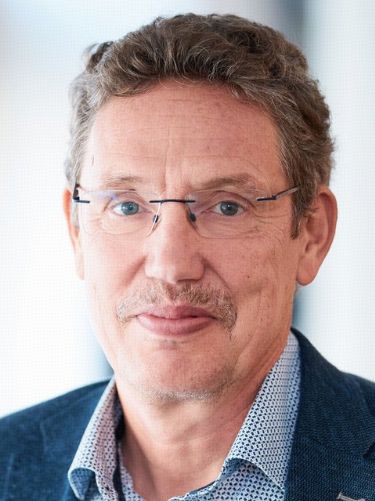 Gunther Notni合作论文数Technische Universität Ilmenau;Fraunhofer IOF;Thüringer Zentrum für Maschinenbau8
 Stefan Riehemann合作论文数7
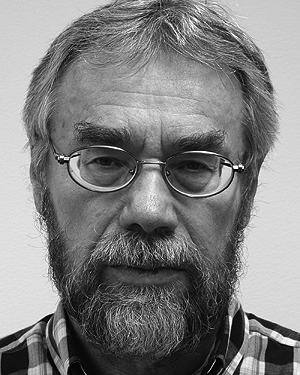 Martin Palme合作论文数4
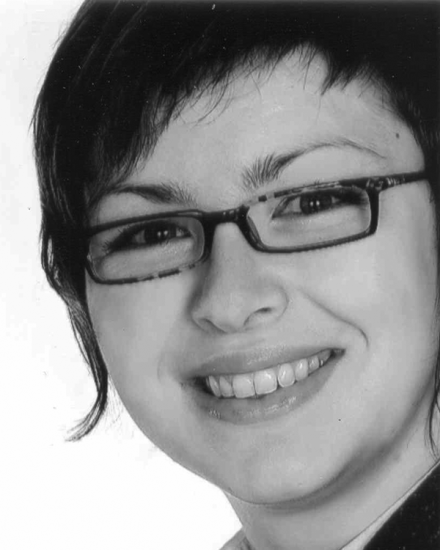 constanze grossmann合作论文数3
 Herbert Gross合作论文数3Takeshi Yuasa合作论文数2Hidenori Kasebe合作论文数2Kiwamu Sumino合作论文数2Petra Aswendt合作论文数2
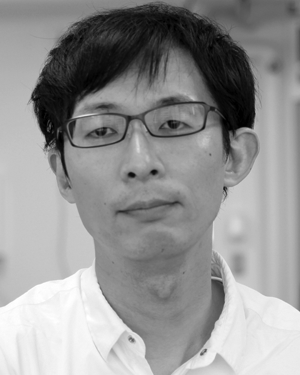 Yoshihiro Watanabe合作论文数Graduate School of Information Science and Technology;University of Tokyo;Graduate School of Information Science and Technology, University of Tokyo2M. M. Guenther合作论文数1
 Roland Hoefling合作论文数1s schmidl合作论文数1Svetlana Shestaeva合作论文数1
 Kevin Grabowski合作论文数1
 Peter Kuehmstedt合作论文数1
 Stefan Schwinde合作论文数1nancy wolf合作论文数1
 Pascal Birckigt合作论文数1Enrico Hilpert合作论文数1
 Anika Broemel合作论文数1d ochse合作论文数1Sören Schmidt合作论文数1
 Robert Bruning合作论文数1Ralph Schlegel合作论文数1
 Jens Haueisen合作论文数Institute of Biomedical Engineering and Informatics, Technical University Ilmenau1
 Carolin Rothhardt合作论文数1
 Horst Michael Groß合作论文数Fachgebiet Neuroinformatik und Kognitive Robotik, Institut für Technische Informatik und Ingenieurinformatik, Startseite, Fakultät Informatik und Automatisierung, Technische Universitaet Ilmenau1Vegard Vangdal合作论文数1Uwe Vogel合作论文数Fraunhofer IPSM1Ralph Huonker合作论文数1Karsten Friedrich合作论文数1Sylvio Klose合作论文数1Roland HöFling合作论文数1Stefan Risse合作论文数1




