Creeping bentgrass (Agrostis stolonifera, allotetraploid 2n = 4x = 28) is one of the major cool-season turfgrasses. It is widely used on golf courses due to its tolerance to low mowing and aggressive growth habit. In this study, we investigated genome relationships of creeping bentgrass relative to the Triticeae (a consensus map of Triticum aestivum, T. tauschii, Hordeum vulgare, and H. spontaneum), oat, rice, and ryegrass maps using a common set of 229 EST-RFLP markers. The genome comparisons based on the RFLP markers revealed large-scale chromosomal rearrangements on different numbers of linkage groups (LGs) of creeping bentgrass relative to the Triticeae (3 LGs), oat (4 LGs), and rice (8 LGs). However, we detected no chromosomal rearrangement between creeping bentgrass and ryegrass, suggesting that these recently domesticated species might be closely related, despite their memberships to different Pooideae tribes. In addition, the genome of creeping bentgrass was compared with the complete genome sequence of Brachypodium distachyon in Pooideae subfamily using both sequences of the above-mentioned mapped EST-RFLP markers and sequences of 8,470 publicly available A. stolonifera ESTs (AgEST). We discovered large-scale chromosomal rearrangements on six LGs of creeping bentgrass relative to B. distachyon. Also, a total of 24 syntenic blocks based on 678 orthologus loci were identified between these two grass species. The EST orthologs can be utilized in further comparative mapping of Pooideae species. These results will be useful for genetic improvement of Agrostis species and will provide a better understanding of evolution within Pooideae species.
Zoysia grasses are well adapted to warm climates and the transition zone in the United States. In this study, the genetic relationship of 11 turfgrass commercial cultivars and 12 experimental genotypes of Zoysia spp. was estimated using 24 Zoysia-specific simple sequence repeat (SSR) and six conserved-intron scanning primer (CISP) markers previously developed for the warm season grasses such as rice, sorghum, and Pennisetum. All 23 Zoysia accessions tested, except ‘Zorro’ and ‘Zeon’, were genetically fingerprinted using 51 allelic amplicons. The SSR markers were able to separate the cultivars ‘Empire’ and ‘El Toro’, which were previously inseparable using AFLP markers. The dendrogram constructed using the UPGMA method indicated that the accessions were classified into three clusters. All cultivars (or genotypes) in cluster I corresponded to cold tolerant individuals, while clusters II and III represented accessions with high or intermediate susceptibility to winter injury, respectively. Overall, accessions bred from either common parents or the same collection sites were categorized in the same cluster. These results demonstrate the effectiveness of Zoysia SSR markers and the transferability of six CISP markers for genetic diversity of these cultivars and experimental genotypes, providing a useful genetic tool for improvement of Zoysia germplasm. INTRODUCTION The genus Zoysia has 11 recognized species with a native distribution from New Zealand to the island of Hokkaido in Japan and from French Polynesia to Mauritius. Three of these species have been commonly used as turfgrass: Z. japonica Steudel, Z. matrella (L.) Merrill and Z. pacifica (Goudswaard) Hotta & Kuroki. Many commercial cultivars currently utilized in United States are not specimens of a single species, but rather, interspecific hybrids (Engelke and Anderson, 2003; Forbes, 1952; Matumura et al., 1990; Yaneshita et al., 1997). Zoysia grasses are well adapted for lawns and golf turf in warm climates and transition zone areas of the United States due to their improved cold and shade tolerance and low-maintenance requirements. For these reasons, Zoysia grasses are a more sustainable grass species for the transition zone region than other warm season grasses (Engelke and Anderson, 2003; Patton and Reicher, 2007). On the other hand, the lack of cold hardiness and slow establishment traits represent major barriers for expanding the geographic range of Zoysia grass cultivation and create a need for improved cultivars (Patton and Reicher, 2007; Patton et al., 2007). Morphological characteristics cannot be the sole criteria for classifying Zoysia grasses due to their continuous variation among and within the species (Yaneshita et al., 1997). DNA marker technology has been utilized to differentiate Zoysia species and for linkage or trait mapping studies (Cai et al., 2004; Manli et al., 2010; Tsuruta et al., 2008; Yaneshita et al., 1997 and 1999). Since molecular markers provide easily quantifiable measurements for studying genetic relationships, several DNA marker types have been applied in genetic diversity studies of other grasses (Al-Humaid and Motawei, 2004; Bai et al., 2003; Budak et al., 2003 and 2004; Caetano-Anollés et al., 1998; Golembiewski et al., 1997; Ho et al., 1997; Wang et al., 2009; Yerramsetty et al., 2005). Simple sequence repeat (SSR) markers have been widely used to investigate genetic diversity, population genetic structure, linkage mapping, and paternity testing. These DNA markers have been useful for characterizing plant genetic resources due to high polymorphism and abundance (Goldstein and Schlöterer, 1999; Wang et al., 2005). Polymorphic SSR markers have been identified in expressed sequence tags (EST) and applied within and across taxa since sequences containing conserved regions of a gene flanking a hypervariable region are transferable to different grass species (Kantety et al., 2002). The cross-utilization of genomic markers to study genetic relationships requires the identification of conserved genomic sequences across taxa and identification of differences at the DNA sequence level to show diversity. Conserved-intron scanning primers (CISP) evaluated by Feltus et al. (2006) were designed within relatively conserved exons located near exon-intron boundaries and used to scan introns for that contained sufficient variation for marker identification. The improvement of Zoysia cultivars to advance the adaptation of this warm-season grass to colder climates requires knowledge of the genetic variability in the available germplasm. The genetic relationships of cultivars and experimental genotypes have been previously investigated for Zoysia using anonymous nuclear AFLP (amplified fragment length polymorphism) markers but some cultivars were genetically inseparable (Chen et al., 2009). The objective of Loreto Araneda and Geunhwa Jung, Stockbridge School of Agriculture, University of Massachusetts Amherst, MA 01003 USA; Jeonghwa Lee, The National Academy of Agricultural Science, Korea; Zhenbang Chen, University of Georgia, USDA-ARS; Paul Raymer, Dept. of Crop and Soil Sciences, University of Georgia. *Corresponding author: Geunhwa Jung (jung@umass.edu). Abbreviations: AFLP, Amplified Fragment Length Polymorphism; CISP, Conserved-Intron Scanning Primer; EST, Expressed Sequence Tags; SSR, Simple Sequence Repeat
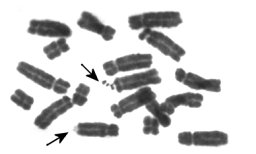
Chromosome numbers and karyotypes of seven specific taxa of the Chilean endemic genus Placea were determined. Chromosome numbers of P. lutea, P. ornata, P. grandiflora, P. germainii and P. aff. davidii are described for the first time. All taxa are diploid with 2n=2x=16 and karyotypes are composed of four metacentric (4 m), ten submetacentric (10 sm), and two subtelocentric (2 st) chromosomes. The most symmetrical karyotype was observed in P lutea (AI: 6.84) while the most asymmetrical karyotype was shown by P. arzae (AI: 9.72). The constancy in karyotype formulae and high similarity in asymmetry indexes suggest that some orthoselection mechanism might be involved in Placea's chromosomal evolution. In spite that no significant karyotypic differences were observed, the species may be differentiated by their chromosomal sizes. Moreover, the tribal position of Placea and its likely relationships with other hippeastroid genera are discussed.
Chromosome numbers and karyotypes of seven specific taxa of the Chilean endemic genus Placea were determined. Chromosome numbers of P. lutea, P. ornata, P grandiflora, P germainii andP. aff davidii are described for the first time. All taxa are diploid with 2«=2x=16 and karyotypes are composed of four metacentric (4 m), ten submetacentric (10 sm), and two subtelocentric (2 st) chromosomes. The most symmetrical karyotype was observed in P. lutea (AI: 6.84) while the most asymmetrical karyotype was shown by P. arzae (AI: 9.72). The constancy in karyotype formulae and high similarity in asymmetry indexes suggest that some orthoselection mechanism might be involved in Placea's chromosomal evolution. In spite that no significant karyotypic differences were observed, the species may be differentiated by their chromosomal sizes. Moreover, the tribal position of Placea and its likely relationships with other hippeastroid genera are discussed.Se determinaron números cromosómicos y cariotipos de siete especies del género endémico chileno Placea. Los números cromosómicos para P. lutea, P. ornata, P. grandiflora, P. germainii y P. aff. davidii son descritos por primera vez. Todas las taxa son diploides con 2«=2x=16 y los cariotipos están compuestos por cuatro cromosomas metacéntricos (4 m), diez submetacéntricos (10 sm) y dos subtelocéntricos (2 st). El cariotipo más simétrico fue observado enP. lutea (AI: 6,84), mientras que el cariotipo más asimétrico fue encontrado enP. arzae (AI: 9,72). La constancia en las fórmulas cariotípicas y la alta similaridad en los índices de asimetría sugieren que algún mecanismo de ortoselección podría estar involucrado en la evolución cromosómica del género Placea. A pesar que no se observaron diferencias cariotípicas significativas, las especies pueden ser diferenciadas por los tamaños cromosómicos. Además, se discuten la posición tribal de Placea y su relación probable con otros géneros Hippeastroides.
 Nicolás García合作论文数3
 Carlos M Baeza合作论文数Departamento de Botánica, Universidad de Concepción3
 Mauricio Cisternas合作论文数3
 Geunhwa Jung合作论文数2Zhenbang Chen合作论文数Dep. of Crop and Soil Sciences, Univ. of Georgia1
 Taehyun Chang合作论文数1Bae Jin-Joo合作论文数1
 P. L. Raymer合作论文数1Maiko Inoue合作论文数1Nanda Chakraborty合作论文数1Joe Curley合作论文数1
 Sung-Chur Sim合作论文数Ohio Agricultural Research and Development Center, The Ohio State University1Scott E. Warnke合作论文数1




