针对网侧变流器双闭环控制中电压外环对DC-link电压振荡抑制响应慢及电流内环对前馈补偿延时的问题,提出了一种直接控制DC-link电容器充电功率的网侧变流器单闭环控制策略.本策略中引入的前馈补偿直接施加在控制电压的节点上,以及一个跟踪-微分器用于外界扰动动态前馈补偿的获取.在Matlab/Simulink平台中通过两种典型情况研究了所提出的网侧变流器控制策略对DC-link电压振荡抑制的有效性.结果表明,所提出的网侧变流器控制策略能有效抑制DC-link电压的冲击幅值及振荡,提出的前馈补偿方案及跟踪-微分器解决了电流内环对前馈补偿的延时以及经典微分器的噪声放大效应.
Today's electric power systems (EPSs) are facing new challenges including the increasing penetration of renewable generation,increasing participation of demand response from consumers,and rapid growth of non-linear and sensitive loads.The smart grid is expected as an effective approach to solving these problems.However,how controllable the grid is,how possibly smart the grid is.Making the EPS more controllable is the road to make it smarter.In this paper,electronic power transformer (EPT) is proposed to improve the controllability of the EPS.The application scenarios of the EPT are analyzed in detail.Three case studies including applying EPTs to the generation system,transmission system,and distribution system are analyzed.The simulation results demonstrate there are enormous potential of the EPT to enhance the controllability of the power systems.
As the most important equipment in oil production,pumping unit has a great potential in energy-saving.An energy-saving control strategy of time-sharing start and interleaving run is presented in this paper for pumping units,which is based on the periodic alternation characteristics of loads and the cluster distribution advantage of pumping units in different production areas.The active power load curve similar to sine wave is given,and the control scheme and optimization model of time-sharing start and interleaving run for pumping units are proposed.Finally,the examples of five pumping units working with identical loads and different loads are optimized with the proposed strategy to realize load leveling,and the energy-saving effects under synchronous run and time-sharing start and interleaving run are calculated.The results indicate that the control strategy put forward in this paper is effective in load leveling and energy-saving.
This paper analyses the harmonic pollution to power grids caused by thyristor-controlled devices. It also formulates a mathematic derivation for the voltage spikes in thyristor-controlled branches to explain the harmonic and EMI derived from the reverse-recovery characteristics of the thyristor. With an equivalent nonlinear time-varying voltage source, a detailed simulation model is established, and the periodic dynamic switching characteristic of the thyristor can be explicitly implied. The simulation results are consistent with the probed results from on-site measurements. An improved trigger system with gate-shorted circuit structure is proposed to reduce the voltage spikes that cause EMI. The experimental results indicate that a prototype with the improved trigger system can effectively suppress the voltage spikes.
In light of the research on and development of the experimental and teaching system for electric power engineering program, an open multifunctional experimental-teaching system is built with the theory and practice of all major professional courses combined for not only their auxiliary teaching experiments, but also the comprehensive application of and research on professional knowledge. Thus students are enabled to train in work on comprehensive experimental topics and application topics using what knowledge acquired to cultivate their hands-on ability, multiple application ability and innovative ability. Applications of the system in China's 100-odd universities are favorably commented on by students for its excellent instructional effects.
This paper presents the design and development of a three-phase 10-kV/400-V 500-kVA electronic power transformer (EPT). The power circuit is designed in a modular fashion, i.e., the main circuit consists of many identical ac-dc-dc-ac modules (abbreviated as power modules). Each power module consists of a high-voltage power cell, a low-voltage power cell (LVPC), a medium-frequency isolation transformer, and a filter. The corresponding control and protection system is developed. A special three-stage startup strategy is designed to shorten the startup time and reduce the startup inrush current. The negative-sequence current compensation is introduced in the input stage to handle the unbalanced loads. To keep the dc-link voltages balanced, an individual dc voltage balancing controller based on regulating the output power of each parallel LVPC is proposed. The detailed control hardware design and software implementation are discussed. The functions of this 10-kV EPT prototype are verified through the laboratory and field tests. The results are shown in this paper. Currently, the prototype is operating in the industrial power grid.
This paper presents the design of the voltage source converter(VSC) excitation system and an integrated prototype using digital signal processor(DSP) as the core of the excitation controller is developed. Compared with the static excitation systems with thyristor, the VSC excitation system owns one more channel offering positive damping to power system by controlling reactive power of VSC on its ac side, and this approach is approved much faster than field voltage regulation. To design the prototype, the VSC excitation system has to meet the practical condition of the selected synchronous generator(SG) set such as generator capacity, terminal voltage, field voltage and field current, etc. The designed VSC excitation system consists of converters containing a front-end three-phase VSC and a back-end H-bridge chopper, a step-down transformer, and a coordinate excitation controller. Through a series of experiments, it is demonstrated that the VSC excitation system is able to improve both transient stability and steady-state stability limit of power systems. It is a prospective substitute to the conventional thyristor based static excitation system and an attractive solution to strengthen power system stability as well as increase the capability of long-distance transmission systems.
A multiphase motor has several major advantages, such as high reliability, fault tolerance, and high power density. It is a critical issue to develop a reliable and efficient multiphase motor drive system. In this paper, a transformerless voltage source converter-based drive system for a medium-voltage (MV) multiphase motor is proposed. This drive converter employs cascaded H-bridge rectifiers loaded by H-bridge inverters as the interface between the grid and multiphase motor. The cascaded H-bridge rectifier technique makes the drive system able to be directly connected to the MV grid without the phase-shifting transformer because it can offset the voltage level gap between the MV grid and the semiconductor devices, provide near-sinusoidal AC terminal voltages without filters, and draw sinusoidal line current from the grid. Based on a digital signal processor (DSP), a complete improved Phase Disposition Pulse Width Modulation (PD-PWM) method is developed to ensure the individual DC-link capacitor voltage balancing for enhancing the controllability and limiting the voltage and power stress on the H-bridge cells. A downscaled prototype is designed and developed based on a nine-phase motor. The experimental results verify the excellent performances of the proposed drive system and control strategy in steady-state and variant-frequency startup operations.
The wind energy is one of the fastest growing and most competitive new energy now,it’s quite necessary to develop an experimental platform which can be used for the scientific research and teaching on wind power technology in the laboratory environ-ment.This paper analyzes the characteristics of different wind velocities and wind turbines,proposes a physical model which fit the sci-entific research and teaching,developes a simulated doubly -fed wind power system experimental platform and the capacity of the mod-el is 10kW,The platform can run independently or connect with the power system dynamic simulation system,and can be connected to the WDT -III power system comprehensive experimental teaching system which is widely used in the national universities.The experi-ment results show that the dynamic characteristic of the model is consistent with the theory characteristic of the wind turbine,and can be used for the research and teaching experiment,the experimental platform has been applied in more than ten scientific research insti-tutions and colleges.
In this paper, to improve the dynamic performance of DFIG-based WT, a NADRC technology is proposed. The proposed NADRC can actively estimate and compensate the plant internal dynamics and external disturbances in real time. Therefore, it improves the tracking performance of the rotor current without any overshoot and steady-state error, and enhances the fault ride-through capability of DFIG-based wind turbine. Compared with the proportional PI control, the proposed NADRC during grid fault can significantly suppress the peak values of stator and rotor currents and DC-link voltage, and decrease the oscillation time of electromagnetic torque. Moreover, the proposed NADRC has a characteristic of one-parameter tuning by using the parameterization technique of controller, and parameter tuning of NADRC is only determined by the rise time of the system step response. A series of simulations for various cases on a 1.5-MW DFIG-based wind turbine are implemented, and the results validate the stability of the proposed NADRC and the strong robustness against the plant internal dynamics and external disturbances.
Control strategy of a cascaded multilevel converter based electrical power transformer (EPT) in a distribution system with capabilities of low voltage ride‐through and unbalanced load current management is investigated in this study. The mathematical model and decoupled control schemes of the system, including a high‐voltage side control scheme, an isolation‐stage control scheme, and a low‐voltage side control scheme, are presented in detail. A dual current control scheme is introduced to control both positive and negative sequence currents for enhancing the low voltage ride‐through capability of the high‐voltage side cascaded H‐bridge converter. Positive, negative, and zero‐sequence voltages are controlled for the low voltage side three‐phase four‐wire converter in the decoupled control scheme, respectively, for unbalanced load current management. A proportional resonant controller (PRC) is utilized to control the zero‐sequence voltage, while the root locus method is applied in the PRC design. Three‐dimensional space vector pulse width modulation (PWM) switching strategy is then used for the low voltage side converter. Simulation studies were conducted with MATLAB/Simulink to validate the coordinated control strategy. © 2016 Institute of Electrical Engineers of Japan. Published by John Wiley & Sons, Inc.
This study presents a hybrid compensator based on distribution static synchronous compensator (DSTATCOM) and thyristor switched capacitor (TSC), which is intended to continuously compensate reactive power with higher quality and lower cost. The proposed coordination control strategies, in essence, are to continuously assign the reactive power between the DSTATCOM and the TSC. Usually, the fast response characteristic of the DSTATCOM will be lost for that the output of the DSTATCOM is limited by the conventional coordination control strategy. In order to improve the transient performance of hybrid compensator, the fast voltage control strategy is proposed to fast respond to the demand, and reactive power reserve control strategy is proposed to restore the capacity. The operation principle, control algorithm, and design procedure of a prototype are described. Laboratory tests and field tests have validated that the performance of the compensator is satisfactory, and the cost reduction of hybrid compensator is significant.
Digital-Analog integrated simulation combines the advantages of digital simulation with the advantages of physical simulation. The applicability of traditional simulation system is increased. The DC component of output voltage restricts the versatility of Digital-Analog integrated simulation. Unlike general inverters, the inverter of Digital-Analog integrated simulation interface (DAISI) has its unique features. A new control strategy is put forward to restrain the steady and transient DC component without additional hardware circuit. The feedback control loop along with the output voltage control loop adjust the duty cycle of sinusoidal pulse width modulation which compensate for the DC voltage component in the DAISI. Simulation and experiment verify the effectiveness of the control strategy.
直流输电相关技术的发展使得构建一个多级直流网络配电系统成为可能。首先详细分析了直流配电电压等级序列制定的基本原则与主要约束条件。在分析各电压等级直流配电能力基础上,以负荷需求为基本出发点,综合考虑相关设备制造水平、电网结构优化需要等方面,提出了一套高压、中压、低压以及超低压相互配合的直流配电网电压等级序列。最后通过具体算例,简要分析了多级直流配电的经济性。
为提高电力系统阻尼振荡的能力,利用静止同步串联补偿器SSSC (static synchronous series compensator)的串联补偿特性,在单机无穷大系统下建立了带SSSC的修正Phillips-Heffron模型,提出SSSC与发电机励磁最优协调控制策略;将SSSC补偿阻抗作为控制器的控制变量,推导出控制器数学模型.仿真结果表明,与常规线性最优励磁控制相比,所提的控制策略能更有效地抑制电力系统振荡.
故障检测在双电源自动转换开关中至关重要,小波变换模的极值点对应信号突变点,有很强的提取信号特征的能力.选取合适的小波函数及分解层数,提取小波系数的模极大值作为判断电源电压发生跌落依据,进行电源投切.利用Matlab/Simulink建立双电源自动转换开关模型,考虑理想环境与白噪声环境,分别采用小波分析、傅氏算法和两点法检测电压跌落故障.仿真实验结果表明,与传统检测方法相比,小波分析提高了检测的快速性、可靠性以及抗干扰性.
In modern power system, increasing pressures of system stability have become more and more serious. Because ex citation systems are one of the most effective and economical ways contribute to effective control of voltage, increasing attention has been focused on the effects of excitation control. To satisfy the needs of modern power system, excitation system based on full-controlled devices is proposed to be used in synchronous generator excitation, and a new decoupled control technique is adopted to design a controller for current source converter based ex citation system in this paper. Then, the modified Heffron-Phllips mathematical model of synchronous generator based on this new type of excitation system is discussed, which helps to explicate the principle of reactive power injector in the new excitation system and its design strategy. Also, the crucial function of reactive power injector that could provide more damping to the system is explained. The simulation results are presented to demonstrate the correctness and effectiveness of the proposed approaches, and its advantage over the conventional excitation system.
This study utilizes the electronic power transformer (EPT) to enhance the damping of interarea oscillations in a multimachine power system based on active power modulation. The dynamic model of EPT is established, and decoupled vector control schemes of inner current control loops and outer active and reactive power control loops are modeled and designed. A power oscillation damper (POD) applied to the active power control loop of EPT is introduced to improve the stability of the power system. The POD controller parameters are designed based on the frequency response method. A study system based on the classical two-area four-machine system is built for damping controller design and time domain simulation, and the design procedures are presented in detail. The effectiveness of the designed POD controller is verified through eigenvalue analysis and time domain simulations. Copyright (C) 2014 John Wiley & Sons, Ltd.
Electronic Power Transformer (EPT) is capable of improving power quality without additional devices; hence it has the potential of pervasive application in prospective utility grid. Ahead of field test, transient analysis of EPT is necessary to verify power supply reliability as well as ensure safety. In this paper, the Electro-Magnetic Transient (EMT) simulation model of an industrial prototype of 10kV/400V/500kVA unidirectional EPT is built in PSCAD/EMTDC. Then the validation of the model and case studies under fault conditions are carried out. Simulation results show that the prototype can withstand phase-to-phase and phase-to-ground faults and sustain regular output after timely adjustment.
大容量液流电池系统LCFBS(Large Capacity Flow Battery System)的内电阻特性与锂电池、铅蓄电池有较大差异。基于100 k W全钒液流电池系统的试验数据,采用多元高次多项式拟合的方法得到内阻的精确解析式,再根据电动势和荷电状态SOC(State Of Charge)的理论解析式,构建了大容量液流电池系统的数学模型;利用MATLAB/Simulink搭建了具有一定精度的容量液流电池系统单元的仿真模型,通过仿真验证了数学模型的精确度,使内阻的相对误差控制在4.5%以内。
 Chengxiong Mao (毛承雄)合作论文数School of Electrical and Electronic Engineering, Huazhong University of Science and Technology199
 Dan Wang (王丹)合作论文数School of Electrical and Electronic Engineering, Huazhong University of Science and Technology109
 Zhaoqing Hu合作论文数19
 Haibo Liu合作论文数15GuoDong Li (李国栋)合作论文数10
 Xiang Yu (余翔)合作论文数School of Management, Huazhong University of Science and Technology10
 Jiawei Yang (杨嘉伟)合作论文数9Xun Chen (陈迅)合作论文数9WU Jiandong (吴建东)合作论文数8
 Junfeng Zhang (张俊峰)合作论文数7JunFeng Zhang (张俊峰)合作论文数7Dexian Yang (杨德先)合作论文数School of Electrical and Electronic Engineering, Huazhong University of Science and Technology7Jinping HE (何金平)合作论文数6
 Buhan Zhang (张步涵)合作论文数Electric Power Security and High Efficiency Lab,Huazhong University of Science and Technology,Wuhan ,China6
 Hualiang Fang (方华亮)合作论文数School of Electrical Engineering and Automation, Faculty of Engineering, Wuhan University6Huibo Lou合作论文数6LiangHe Zhu (朱良合)合作论文数5Hui Luan (栾会)合作论文数5
 Bing Tian合作论文数Department of Medicine, The University of Texas Medical Branch5YI Changsong (易长松)合作论文数4li weibo合作论文数4
 Chen Zhu合作论文数4Junwen Xie合作论文数4Yan-yan CUI (崔艳艳)合作论文数4
 Yang Yi (易杨)合作论文数College of Electrical Engineering and Automation, Fuzhou University4
 Wei-Jen Lee合作论文数Department of Electrical Engineering, University of Texas at Arlington;Energy Systems Research Center, University of Texas at Arlington4
 Libing Wang (王利兵)合作论文数4
 Yuping Duan (段玉萍)合作论文数School of Mathematical Sciences, Beijing Normal University4
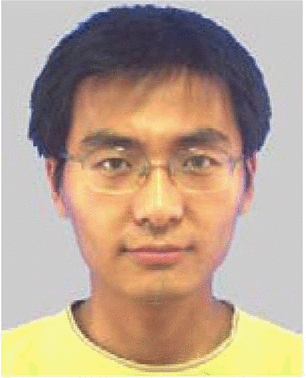 Sheng Wang合作论文数3
 Hua Fan合作论文数Huazhong University of Science and Technology3ZHANG Jing (张敬)合作论文数3
 Qiuyuan Wang合作论文数Peking University3QiYan Li (李启炎)合作论文数3XiZai Wu (吴希再)合作论文数3Jie Ceng (曾杰)合作论文数3Shu Fan (范澍)合作论文数3
 Lina He合作论文数3
 He Yu合作论文数3
 Jie Tian合作论文数3Jiewei Cao (曹解围)合作论文数3Bo Wang (王波)合作论文数3Jun Qiu (邱军)合作论文数3Guihua Mei (梅桂华)合作论文数3xueqiang fu合作论文数2Qianglin Zuo (左强林)合作论文数2Binqian Zhou合作论文数2Chang ZHANG (张昌)合作论文数2




