This paper presents the findings from the third edition of the Chat Translation Shared Task. As with previous editions, the task involved translating bilingual customer support conversations, specifically focusing on the impact of conversation context in translation quality and evaluation. We also include two new language pairs: English-Korean and English-Dutch, in addition to the set of language pairs from previous editions: English-German, English-French, and English-Brazilian Portuguese. We received 22 primary submissions and 32 contrastive submissions from eight teams, with each language pair having participation from at least three teams. We evaluated the systems comprehensively using both automatic metrics and human judgments via a direct assessment framework. The official rankings for each language pair were determined based on human evaluation scores, considering performance in both translation directions--agent and customer. Our analysis shows that while the systems excelled at translating individual turns, there is room for improvement in overall conversation-level translation quality.
The quality of open-weight LLMs has seen significant improvement, yet they remain predominantly focused on English. In this paper, we introduce the EuroLLM project, aimed at developing a suite of open-weight multilingual LLMs capable of understanding and generating text in all official European Union languages, as well as several additional relevant languages. We outline the progress made to date, detailing our data collection and filtering process, the development of scaling laws, the creation of our multilingual tokenizer, and the data mix and modeling configurations. Additionally, we release our initial models: EuroLLM-1.7B and EuroLLM-1.7B-Instruct and report their performance on multilingual general benchmarks and machine translation.
Despite the recent success of automatic metrics for assessing translation quality, their application in evaluating the quality of machine-translated chats has been limited. Unlike more structured texts like news, chat conversations are often unstructured, short, and heavily reliant on contextual information. This poses questions about the reliability of existing sentence-level metrics in this domain as well as the role of context in assessing the translation quality. Motivated by this, we conduct a meta-evaluation of existing sentence-level automatic metrics, primarily designed for structured domains such as news, to assess the quality of machine-translated chats. We find that reference-free metrics lag behind reference-based ones, especially when evaluating translation quality in out-of-English settings. We then investigate how incorporating conversational contextual information in these metrics affects their performance. Our findings show that augmenting neural learned metrics with contextual information helps improve correlation with human judgments in the reference-free scenario and when evaluating translations in out-of-English settings. Finally, we propose a new evaluation metric, Context-MQM, that utilizes bilingual context with a large language model (LLM) and further validate that adding context helps even for LLM-based evaluation metrics.
While general-purpose large language models (LLMs) demonstrate proficiency on multiple tasks within the domain of translation, approaches based on open LLMs are competitive only when specializing on a single task. In this paper, we propose a recipe for tailoring LLMs to multiple tasks present in translation workflows. We perform continued pretraining on a multilingual mixture of monolingual and parallel data, creating TowerBase, followed by finetuning on instructions relevant for translation processes, creating TowerInstruct. Our final model surpasses open alternatives on several tasks relevant to translation workflows and is competitive with general-purpose closed LLMs. To facilitate future research, we release the Tower models, our specialization dataset, an evaluation framework for LLMs focusing on the translation ecosystem, and a collection of model generations, including ours, on our benchmark.
Despite the recent success of automatic metrics for assessing translation quality, their application in evaluating the quality of machine-translated chats has been limited. Unlike more structured texts like news, chat conversations are often unstructured, short, and heavily reliant on contextual information. This poses questions about the reliability of existing sentence-level metrics in this domain as well as the role of context in assessing the translation quality. Motivated by this, we conduct a meta-evaluation of existing automatic metrics, primarily designed for structured domains such as news, to assess the quality of machine-translated chats. We find that reference-free metrics lag behind reference-based ones, especially when evaluating translation quality in out-of-English settings. We then investigate how incorporating conversational contextual information in these metrics for sentence-level evaluation affects their performance. Our findings show that augmenting neural learned metrics with contextual information helps improve correlation with human judgments in the reference-free scenario and when evaluating translations in out-of-English settings. Finally, we propose a new evaluation metric, Context-MQM, that utilizes bilingual context with a large language model (LLM) and further validate that adding context helps even for LLM-based evaluation metrics.
To measure context-aware machine translation (MT) systems quality, existing solutions have recommended human annotators to consider the full context of a document. In our work, we revised a well known Machine Translation quality assessment framework, Multidimensional Quality Metrics (MQM), (Lommel et al., 2014) by introducing a set of nine annotation categories that allows to map MT errors to source document contextual phenomenon, for simplicity sake we named such phenomena as contextual triggers. Our analysis shows that the adapted categories set enhanced MQM’s potential for MT error identification, being able to cover up to 61% more errors, when compared to traditional non-context core MQM’s application. Subsequently, we analyzed the severity of these MT “contextual errors”, showing that the majority fall under the critical and major levels, further indicating the impact of such errors. Finally, we measured the ability of existing evaluation metrics in detecting the proposed MT “contextual errors”. The results have shown that current state-of-the-art metrics fall short in detecting MT errors that are caused by contextual triggers on the source document side. With the work developed, we hope to understand how impactful context is for enhancing quality within a MT workflow and draw attention to future integration of the proposed contextual annotation framework into current MQM’s core typology.
We present the joint contribution of IST and Unbabel to the WMT 2022 Chat Translation Shared Task. We participated in all six language directions (English ↔ German, English ↔ French, English ↔ Brazilian Portuguese). Due to the lack of domain-specific data, we use mBART50, a large pretrained language model trained on millions of sentence-pairs, as our base model. We fine-tune it using a two step fine-tuning process. In the first step, we fine-tune the model on publicly available data. In the second step, we use the validation set. After having a domain specific model, we explore the use of kNN-MT as a way of incorporating domain-specific data at decoding time.
This paper reports the findings of the second edition of the Chat Translation Shared Task. Similarly to the previous WMT 2020 edition, the task consisted of translating bilingual customer support conversational text. However, unlike the previous edition, in which the bilingual data was created from a synthetic monolingual English corpus, this year we used a portion of the newly released Unbabel’s MAIA corpus, which contains genuine bilingual conversations between agents and customers. We also expanded the language pairs to English↔German (en↔de), English↔French (en↔fr), and English↔Brazilian Portuguese (en↔pt-br).Given that the main goal of the shared task is to translate bilingual conversations, participants were encouraged to train and test their models specifically for this environment. In total, we received 18 submissions from 4 different teams. All teams participated in both directions of en↔de. One of the teams also participated in en↔fr and en↔pt-br. We evaluated the submissions with automatic metrics as well as human judgments via Multidimensional Quality Metrics (MQM) on both directions. The official ranking of the systems is based on the overall MQM scores of the participating systems on both directions, i.e. agent and customer.
We report the results of the first edition of the WMT shared task on chat translation. The task consisted of translating bilingual conversational text, in particular customer support chats for the English-German language pair (English agent, German customer). This task varies from the other translation shared tasks, i.e. news and biomedical, mainly due to the fact that the conversations are bilingual, less planned, more informal, and often ungrammatical. Furthermore, such conversations are usually characterized by shorter and simpler sentences and contain more pronouns. We received 14 submissions from 6 participating teams, all of them covering both directions, i.e. En->De for agent utterances and De->En for customer messages. We used automatic metrics (BLEU and TER) for evaluating the translations of both agent and customer messages and human document-level direct assessments (DDA) to evaluate the agent translations.
In this paper we provide a systematic comparison of existing and new document-level neural machine translation solutions. As part of this comparison, we introduce and evaluate a document-level variant of the recently proposed Star Transformer architecture. In addition to using the traditional metric BLEU, we report the accuracy of the models in handling anaphoric pronoun translation as well as coherence and cohesion using contrastive test sets. Finally, we report the results of human evaluation in terms of Multidimensional Quality Metrics (MQM) and analyse the correlation of the results obtained by the automatic metrics with human judgments.
This paper describes Unbabel's submission to the WMT2019 APE Shared Task for the English-German language pair. Following the recent rise of large, powerful, pre-trained models, we adapt the BERT pretrained model to perform Automatic Post-Editing in an encoder-decoder framework. Analogously to dual-encoder architectures we develop a BERT-based encoder-decoder (BED) model in which a single pretrained BERT encoder receives both the source src and machine translation tgt strings. Furthermore, we explore a conservativeness factor to constrain the APE system to perform fewer edits. As the official results show, when trained on a weighted combination of in-domain and artificial training data, our BED system with the conservativeness penalty improves significantly the translations of a strong Neural Machine Translation system by -0.78 and +1.23 in terms of TER and BLEU, respectively. Finally, our submission achieves a new state-of-the-art, ex-aequo, in English-German APE of NMT.
We present the contribution of the Unbabel team to the WMT 2019 Shared Task on Quality Estimation. We participated on the word, sentence, and document-level tracks, encompassing 3 language pairs: English-German, English-Russian, and English-French. Our submissions build upon the recent OpenKiwi framework: we combine linear, neural, and predictor-estimator systems with new transfer learning approaches using BERT and XLM pre-trained models. We compare systems individually and propose new ensemble techniques for word and sentence-level predictions. We also propose a simple technique for converting word labels into document-level predictions. Overall, our submitted systems achieve the best results on all tracks and language pairs by a considerable margin.
We address the issues arising when a neural machine translation engine trained on generic data receives requests from a new domain that contains many specific technical terms. Given training data of the new domain, we consider two alternative methods to adapt the generic system: corpus-based and instance-based adaptation. While the first approach is computationally more intensive in generating a domain-customized network, the latter operates more efficiently at translation time and can handle on-the-fly adaptation to multiple domains. Besides evaluating the generic and the adapted networks with conventional translation quality metrics, in this paper we focus on their ability to properly handle domain-specific terms. We show that instance-based adaptation, by fine-tuning the model on-the-fly, is capable to significantly boost the accuracy of translated terms, producing translations of quality comparable to the expensive corpusbased method.
In this thesis we investigate methods for deploying machine translation (MT) in real-world application scenarios related to the use of MT in computer assisted translation (CAT), where human translators post-edit MT outputs. In particular, we investigate (in chronological order) MT adaptation under two working conditions: single-domain and multi-domain. In the former, we assume that MT receives requests by a single user working on a single domain, while in the latter we assume the MT system to receive requests i) from multiple users working on different domains, ii) with no predefined order, and iii) without domain information. In the single-domain case, we first focus on word alignment, a core component of online adaptive phrase-based MT (PBMT) that is crucial for extracting features from a post-edited segment. In particular, we concentrate on improving word alignment in presence of out-of-vocabulary words observed in the source sentences or introduced by the post-editor. In the multi-domain scenario we turned our focus to the neural MT (NMT) paradigm. In particular, we introduce a scalable solution that adapts on-the-fly a generic NMT model to each incoming translation request. It relies on a procedure that locally fine-tunes the model to each input sentence using samples retrieved from a pool of parallel data. Our instance-based adaptation uses a more general formulation of the log-likelihood approach to control the contribution of relevant and irrelevant words during model update. Finally, we test our approach on a simulated continuous learning setting, where the system receives user feedback under form of post-editing.
Previous phrase-based approaches to Automatic Post-editing (APE) have shown that the dependency of MT errors from the source sentence can be exploited by jointly learning from source and target information.By integrating this notion in a neural approach to the problem, we present the multi-source neural machine translation (NMT) system submitted by FBK to the WMT 2017 APE shared task.Our system implements multi-source NMT in a weighted ensemble of 8 models.The n-best hypotheses produced by this ensemble are further re-ranked using features based on the edit distance between the original MT output and each APE hypothesis, as well as other statistical models (n-gram language model and operation sequence model).This solution resulted in the best system submission for this round of the APE shared task for both en-de and de-en language directions.For the former language direction, our primary submission improves over the MT baseline up to -4.9 TER and +7.6 BLEU points.For the latter, where the higher quality of the original MT output reduces the room for improvement, the gains are lower but still significant (-0.25 TER and +0.3 BLEU).
We investigate the application of Neural Machine Translation (NMT) under the following three conditions posed by real-world application scenarios. First, we operate with an input stream of sentences coming from many different domains and with no predefined order. Second, the sentences are presented without domain information. Third, the input stream should be processed by a single generic NMT model. To tackle the weaknesses of current NMT technology in this unsupervised multi-domain setting, we explore an ef-ficient instance-based adaptation method that, by exploiting the similarity between the training instances and each test sentence, dynamically sets the hyperparameters of the learning algorithm and updates the generic model on-the-fly. The results of our experiments with multi-domain data show that local adaptation outperforms not only the original generic NMT system, but also a strong phrase-based system and even single-domain NMT models specifi-cally optimized on each domain and applicable only by violating two of our afore-mentioned assumptions.
M. Amin Farajian, Marco Turchi, Matteo Negri, Nicola Bertoldi, Marcello Federico. Proceedings of the 15th Conference of the European Chapter of the Association for Computational Linguistics: Volume 2, Short Papers. 2017.
Abstract Improving machine translation (MT) by learning from human post-edits is a powerful solution that is still unexplored in the neural machine translation (NMT) framework. Also in this scenario, effective techniques for the continuous tuning of an existing model to a stream of manual corrections would have several advantages over current batch methods. First, they would make it possible to adapt systems at run time to new users/domains; second, this would happen at a lower computational cost compared to NMT retraining from scratch or in batch mode. To attack the problem, we explore several online learning strategies to stepwise fine-tune an existing model to the incoming post-edits. Our evaluation on data from two language pairs and different target domains shows significant improvements over the use of static models.
In this paper, we describe FBK’s neural machine translation (NMT) systems submitted at the International Workshop on Spoken Language Translation (IWSLT) 2016. The systems are based on the state-of-the-art NMT architecture that is equipped with a bi-directional encoder and an attention mechanism in the decoder. They leverage linguistic information such as lemmas and part-of-speech tags of the source words in the form of additional factors along with the words. We compare performances of word and subword NMT systems along with different optimizers. Further, we explore different ensemble techniques to leverage multiple models within the same and across different networks. Several reranking methods are also explored. Our submissions cover all directions of the MSLT task, as well as en-{de, fr} and {de, fr}-en directions of TED. Compared to previously published best results on the TED 2014 test set, our models achieve comparable results on en-de and surpass them on en-fr (+2 BLEU) and fr-en (+7.7 BLEU) language pairs.
 André F. T. Martins合作论文数Computer Science Department, Instituto Superior Técnico;Electrical and Computer Engineering Department, Instituto Superior Técnico;Unbabel;SARDINE Lab, Instituto de Telecomunicações, University of Lisbon;Priberam11
 Marcello Federico合作论文数Amazon9
 Matteo Negri合作论文数Fondazione Bruno Kessler6
 Patrick Fernandes合作论文数Carnegie Mellon University;Instituto Superior Técnico;Google6
 Marco Turchi合作论文数Zoom6
 José G. C. De Souza合作论文数FBK6
 Ricardo Rei合作论文数Sword Health5
 Sweta Agrawal合作论文数Instituto de Telecomunicações5
 João Alves合作论文数4
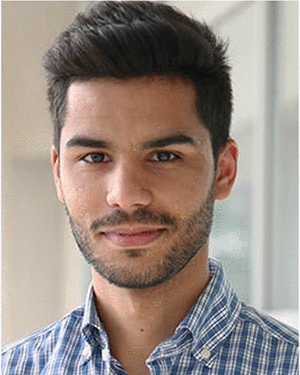 Antonio Lopes合作论文数4
 Pedro Henrique Martins合作论文数Unbabel4
 Nicola Bertoldi合作论文数FBK4Duarte M. Alves合作论文数3José Pombal合作论文数3Nuno Miguel Guerreiro合作论文数Unbabel;Instituto Superior Técnico;Instituto de Telecomunicações3Jonay Trenous合作论文数2
 Ana C. Farinha合作论文数Unbabel Res, Lisbon, Portugal2
 Rajen Chatterjee合作论文数Apple2
 Pierre Colombo合作论文数Equall.AI;CentraleSupélec;Université Paris Saclay2
 Luisa Bentivogli合作论文数Fondazione Bruno Kessler2
 Helena Moniz合作论文数L2F INESC-ID/IST, L2F INESC-ID/IST2Helena Wu合作论文数1Costanza Conforti合作论文数1Tânia Vaz合作论文数1
 António Farinhas合作论文数Instituto Superior Técnico;Sword Health1Manuel Faysse合作论文数1
 Michael J.Q. Zhang合作论文数Courant Institute, New York University1Miguel Vera合作论文数1Miguel Menezes合作论文数1Marianna Buchicchio合作论文数1
 Góis António合作论文数Inst Telecomunicacoes1Mateusz Klimaszewski合作论文数1Ben Peters合作论文数1
 Duygu Ataman合作论文数Università degli Studi di Trento1
 Rachel Bawden合作论文数Inria1
 Vevake Balaraman合作论文数University of Trento1
 Mattia Antonino Di Gangi合作论文数University of Trento1
 Shahab Jalalvand合作论文数SJ-AI Services1
 Mauro Cettolo合作论文数Centro per la Ricerca Scientifica e Tecnologica1Sameen Maruf合作论文数Oracle1
 Prashant Mathur合作论文数Amazon1
 Marcos Treviso合作论文数Instituto de Telecomunicacoes1
 Gonçalo M. Correia合作论文数Priberam Labs;Técnico Lisboa1
 Alexandra Birch合作论文数Institute for Language, Cognition and Computation, School of Informatics, University of Edinburgh1
 Gholamreza (Reza) Haffari合作论文数Department of Data Science & AI, Faculty of Information Technology, Monash University;Openstream.Ai1Christian Girardi合作论文数1
 Barry Haddow合作论文数Aveni1
 Ankit K. Srivastava合作论文数Dublin City University, Dublin City University1
 Santanu Pal合作论文数Wipro1




