Growing surge of misinformation among COVID-19 can post great hindrance to truth, it can magnify distrust in policy makers and/or degrade authorities' credibility, and it can even harm public health. Classification of textual context on social media data relating COVID-19 is an effective tool to combat misinformation on social media platforms. We leveraged Twitter data in developing classification methods to detect misinformation and to identify tweet sentiment. Six fusion-based classification models were built fusing three classical machine learning algorithms: multinomial naïve Bayes, logistic regression, and support vector classifier. The best performing models were selected to detect misinformation and to classify sentiment on tweets that were created during early outbreak of COVID-19 pandemic and the fifth month into pandemic. We found that majority of the public held positive sentiment toward all six types of misinformation news on Twitter social media platform. Except political or biased news, general public expressed more positively toward unreliable, conspiracy, clickbait, unreliable with political/biased, and clickbait with political/biased news later in the summer month than earlier during the outbreak. The results provide decision or policy makers valuable knowledge gain in public opinion towards various types of misinformation spreading over social media.
This paper introduces the Service member Veteran Risk Profile (SVRP), a mathematical process/solution to quantitatively represent transitioning Service member (TSM) and/or Veteran quality of life risks by integrating clinical and social determinant data into an individual risk profile. The SVRP creates, for the first time, a mechanism for the Department of Defense (DoD) and Department of Veterans Affairs (VA) to holistically represent the challenges of military members transitioning into civilian life that can lead to negative outcomes and proactively identify transitioning Service members and Veterans at risk. More importantly, the SVRP supports clinical and non-clinical modalities to reduce the negative impacts of transition and beyond for TSM and Veterans. Lastly, the SVRP can be displayed through user-friendly visualizations so DoD/VA policymakers and decision-makers can make more informed policy and resource decisions to improve TSM/Veteran overall quality of life.
This work examines the scenario of ATR classification in multi-label settings by using the framework of a classification sequence. Classification tasks are often composed of a sequence of identification tasks that together, generate an overall classification. For instance, objects may be sorted and classified as one particular target type and then those targets are further identified. Rather than passing all objects through each classifier, a sequence of classifiers may be used to identify objects without the need to process data through each classifier. Such sequences exist for two-label outcomes (such as target and non-target) and have been called: Believe the Negative, Believe the Positive, and Believe the Extremes. In each of these sequences, the first classification system is able to identify objects such that only a portion of objects must be passed to the second system for identification. However, to extend these sequences to k-labels, a new definition of the ordering on the labels must be generated in order to incorporate all k-labels into the classification sequence. In this work, we develop the mathematical structures that exist for a k-label classification sequence, provides formula for both the optimal performance and operational cost of these sequences, and examines the performance of such sequences under a variety of operating conditions. Conceptually, we will begin and demonstrate these results with a 3-label ATR system. In conclusion, this work will demonstrate the utility of using a sequence to fuse information in a multi-label classification task.
This paper will introduce the origins and demonstrate how the concept and implementation of Total Exposure Health(TEH) is ushering in a bold solution to capture workplace, environmental, and lifestyle exposures to the individual usingadvances in
A detection system outputs two distinct labels, thus, there are two errors it can make. The Receiver Operating Characteristic (ROC) function quantifies both of these errors as parameters vary within the system. Combining two detection systems typically yields better performance when a combining rule is chosen appropriately. When two or more detection systems are combined the assumption of independence is usually made in order to simplify the mathematics, so that we need only combine the individual ROC curves from each system into one ROC curve. This paper investigates label fusion of two and more detection systems drawn from a single Detection System Family (DSF). Given that one knows the ROC function for the DSF, we seek a formula with the resultant ROC function of the fused detection systems as a function (specifically, a transformation) of the ROC function. In previous work, we derived this transformation for the disjunction and conjunction label rules. This paper extends those results to several detection systems within the same family. Examples are given that demonstrates these new transformations acting on the ROC function.
We examine necessary and sufficient conditions for recurrence and positive recurrence of a class of irreducible, level-dependent quasi-birth-and-death (LDQBD) processes with a block tridiagonal structure that exhibits asymptotic convergence in the rows as the level tends to infinity. These conditions are obtained by exploiting a multidimensional Lyapunov drift approach, along with the theory of generalized Markov group inverses. Additionally, we highlight analogies to well-known average drift results for level-independent quasi-birth-and-death (QBD) processes.
This paper will investigate the fusion of various detection and classification systems. The architecture of combining these systems is the main interest of this work. We assume the detection and classification systems are known and they are legacy systems such that we know their receiver operating characteristic (ROC) functions, or their approximate ROC functions. Given an objective function we seek the optimal architecture that maximizes the objective function. Combining detection systems sequentially has been around for decades, especially in the bio-medical field where tests are preformed sequentially such that the outcome of one test will determine which test will be performed next. In military applications, we often use multiple detection systems in parallel and combine the outputs into a “fusion” center to determine the final answer. We conjecture that there might be a parallel and series mixture that would yield better performance. Part of determining this mixture is determining which systems go "where" in the mix. We investigate this architecture.
Complex ATR tasks are often decomposed into the identification of sub-targets, that is, objects are sorted and identified as one particular target type and then those targets are further identified. For instance, a field of view may be partitioned into natural and man-made objects. After which, the man-made objects are screened to identify a particular object of interest. These tasks combine classifiers which operate in isolation of each other, yet in fact, perform as a classification sequence. This work examines this scenario, building the ATR task as a sequence of target identifications. Two sequences will be highlighted: Believe the Negative (BN) and Believe the Extremes (BE). In a BN sequence, the second classification system only operates if a target is identified from the first classification system. In a BE sequence, the second classification system only operates if there is no identification from the first classification system. Performance of these classification sequences will be compared to classification systems operating separately. Further, sequence augmentation will be examined to demonstrate how the ATR task may still be completed when information is missing on the primary target. This missing information may represent atmospheric blurring, alternate field of view, or other disturbances. An example of the performance of the sequences under simulated, theoretical levels of missing information is examined, and formulas are presented to describe the optimal performance of these systems when augmented and un-augmented. In conclusion, this work demonstrates utility in how these sequences fuse target information in order to complete an ATR task.
The US Air Force has multiple detection systems for specific applications that could be combined to work together to yield better accuracy than the individual systems. The amount of time and money used to design, build, simulate, test, validate and verify such combining can be long and expense. Also, there can be several ways to combine these multiple systems, thus, generating more time and cost to determine an optimal (or approximately optimal) combination rule. This paper considers a simple version of this greater problem posed as follows. Suppose we have two legacy detections system families that are designed to detect the same "target" and we conjecture that combining them would yield a new detection system with improved accuracy. Suppose we know the ROC functions of both detection system families, but do not know (or have access to) the data that produced them. Can we construct the ROC function of the combined systems from the individual ROC functions? Copula theory has been in existence since 1959. This theory produces the means to address the dependence between random variables. This paper takes copula and applies it to the fusion of detection systems. Examples will be given that demonstrate how the formulas are used.
This paper presents a method to quantify detection system families (DSFs) based upon the Precision-Recall (PR) curve and variations of the PR curve. The PR curve is related to the Receiver Operating Characteristic (ROC) curve. The ROC curve of a detection system family shows the trade-off between the probabilities of a true positive classification versus the probability of a false positive classification. The conditional probabilities are conditioned on the true outcomes. The PR curve is similar in the sense that the conditional probabilities are conditioned on the outcomes of the detection systems that "say" they are true outcomes. We present the function that produces the PR curve, called the PR function. We produce the (nonlinear) transformation that relates the ROC function to the Precision-Recall function. We discuss variations of the Precision-Recall function that will be useful. Given two detection system families A and B, for which we know their respective ROC functions, we know the transformation that produces the ROC function of the conjunction of A with B, and the ROC function of the disjunction of A with B. We review these transformations and relate them to the PR functions. In particular, given the PR functions for detection system families A and B, we produce the PR functions for the detection system families A conjoin B and A disjoin B. Examples are given that demonstrate the theory and usefulness of the transformation to predict the performance of the fused systems. The extension to multiple label classification systems will be presented.
This paper investigates the fusion process of combining cyber sensors on a network to detect and classify cyber behaviors – good and bad. Some bad cyber activity can be confused as appropriate (good) activity and vice versa. To wrongly block good activity is an error. Also, to allow bad cyber activity to continue believing it to be good activity is also an error. We wish to minimize these errors. Some bad cyber activity can be classified according to its severity. Confusing an extremely severe cyber activity for a mildly bad cyber activity can be a costly mistake also. We assume there are several classification systems present on the network, that is, a sensor, processor and exploiter at a minimum for each system. Also, the sensors may be disparate. Assume each system has a ROC manifold that is known, or has a good approximation. The goal of this paper is to demonstrate that there a best combining rule.
In a two class label scenario, classification systems may be used to assess whether or not an element of interest belongs to the "target" or "non-target" class. The performance of the system is summarized visually as a trade-off between the proportions of elements correctly labeled as "target" plotted against the proportion of elements incorrectly labeled as "target." These proportions are empirical estimates of the true and false positive rates, and their trade-off plot is known as a receiver operating characteristic (ROC) curve. Classification performance can be increased, however, if the information provided by multiple systems can be fused together to create a new, combined system. This research focuses on label-fusion as a common method to increase classification performance and quantifying the bias that occurs when misspecifying the partitioning of the underlying event set. This partitioning will be defined in terms of what be called within and across label fusion. When incorrect assumptions are made about the partitioning of the event set, bias will occur and both the ROC curve and its optimal parameters will be incorrectly quantified. In this work, we analyze the effects of individual classification system performance, correlation, and target environment on the magnitude of this performance bias. This work will then inspire the development of formulas to adjust optimal performance measures to appropriately reflect the fused system performance according to event set partitioning. As such, bias may be appropriately adjusted without redesigning the fused system, allowing greater use of currently fused systems across multiple platforms and environments.
Phase modulation methods for imaging around corners with reflectively scattered light required illumination of the occluded scene with a light source either in the scene or with direct line of sight to the scene. The RM (reflection matrix) allows control and refocusing of light after reflection, which could provide a means of illuminating an occluded scene without access or line of sight. Two optical arrangements, one focal-plane, the other an imaging system, were used to measure the RM of five different rough-surface reflectors. Intensity enhancement values of up to 24 were achieved. Surface roughness, correlation length, and slope were examined for their effect on enhancement. Diffraction-based simulations were used to corroborate experimental results.
A detection system outputs two distinct labels, thus, there are two errors it can make. The Receiver Operating Characteristic (ROC) function quantifies both of these errors as parameters vary within the system. Combining two detection systems typically yields better performance when a combining rule is chosen appropriately. When detection systems are combined the assumption of independence is usually made in order to simplify the mathematics, so that we need only combine the individual ROC curve from each system into one ROC curve. This paper investigates label fusion of two detection systems drawn from a single Detection System Family (DSF). Given that one knows the ROC function for the DSF, we seek a formula with the resultant ROC function of the fused detection systems as a function (specifically, a transformation) of the ROC function. In this paper, we derive this transformation for the disjunction and conjunction label rules. Examples are given that demonstrates this transformation. Furthermore, another transformation is given to account for the dependencies between the two systems within the family. Examples will be given that demonstrates these ideas and the corresponding transformation acting on the ROC curve.
The reflection matrix (RM) measured from a rough-surface reflector contains the phase information of the light from each spatial light modulator (SLM) segment to every segment in the observation plane. This phase infor- mation can be used to produce phase maps that can refocus light to any segment in the observation plane. The measurement of an RM requires the optical system to be completely static; any disturbances result in degraded ability to refocus light. Diffraction based simulations show that RMs contain redundant phase information that can be exploited. A method is presented that allows control of the refocused light in the observation plane from a single reference phase map. This allows for the continuous optimization of the reference phase map, that compensates for system disturbances, while preserving the ability to control the location of the refocused light and eliminate the need to measure the entire RM.
Several cyber-attacks on the cyber-physical systems (CPS) that monitor and control critical infrastructure were publically announced over the last few years. Almost without exception, the proposed security solutions focus on preventing unauthorized access to the industrial control systems (ICS) at various levels – the defense in depth approach. While useful, it does not address the problem of making the systems more capable of responding to the malicious actions of an attacker once they have gained access to the system. The first step in making an ICS more resilient to an attacker is identifying the cyber security vulnerabilities the attacker can use during system design. This paper presents a method that reveals cyber security vulnerabilities in ICS through the formal modeling of the system and malicious agents. The inclusion of the malicious agent in the analysis of an existing systems identifies security vulnerabilities that are missed in traditional functional model checking.
Given two legacy exploitation systems, whose performances are known, one might wish to determine if combining these together using some rule would yield a new exploitation system with improved performance. This is the fusion process. Often there are several performance objectives one would consider in this process. We investigate the fusion process based upon multiple performances. This is related to multi-objective optimization, but is different in some aspects. In this paper we pose a multi-performance problem for combining two classifications systems and derive the multi-performance fusion theory. A classification system with M possible output labels will have M(M-1) possible errors. The Receiver Operating Characteristic (ROC) manifold was created to quantify all of these errors. The assumption of independence is usually made to simply the mathematics of combining the individual systems into one system. Boolean rules do not exist for multiple symbols, thus, Boolean-like rules were created that would yield label fusion rules. An M-label system will have M! consistent rules. The formula for the resultant ROC manifold of the fused classification systems which incorporates the individual classification systems previously was derived. For the multi-performance problem we show how the set of permutations of the label set is used to generate all of the consistent rules and how the permutation matrix is incorporated into a single formula for the ROC manifold. Examples will be given that demonstrate how the solution to the multi-performance fusion problem relates to the solution of the single performance fusion problem.
The challenges for providing war fighters with the best possible actionable information from diverse sensing modalities using advances in big-data and machine learning are addressed in this paper. We start by presenting intelligence, surveillance, and reconnaissance (ISR) related big-data challenges associated with the Third Offset Strategy. Current approaches to big-data are shown to be limited with respect to reasoning/understanding. We present a discussion of what meaning making and understanding require. We posit that for human-machine collaborative solutions to address the requirements for the strategy a new approach, Qualia Exploitation of Sensor Technology (QuEST), will be required. The requirements for developing a QuEST theory of knowledge are discussed and finally, an engineering approach for achieving situation understanding is presented.
 Steven K Rogers合作论文数Automatic Target Recognition and Sensor Fusion, Air Force Research Laboratory32Steven N. Thorsen合作论文数18Matthew Kabrisky合作论文数15
 Kabban Christine Schubert合作论文数14
 Kenneth W. Bauer合作论文数12
 Christine M. Schubert合作论文数11
 Bruce W. Suter合作论文数U.S. Air Force Research Laboratory10
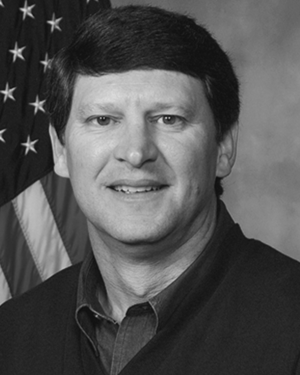 Richard A. Raines合作论文数7
 Magnus, A.L.合作论文数Air Force Institute of Technology;c;Air Force Institute of Technology7
 Robert Mills合作论文数Wright-Patterson AFB, Air Force Institute of Technology7Dennis W. Ruck合作论文数7Dw Ruck合作论文数6gregory t warhola合作论文数5
 Michael A. Temple合作论文数Department of Electrical and Computer Engineering,
Air Force Institute of Technology5
Michael A. Temple合作论文数Department of Electrical and Computer Engineering,
Air Force Institute of Technology5 Kenneth M. Hopkinson合作论文数5
 Barry E. Mullins合作论文数Air Force Institute of Technology5james a fitch合作论文数4Jared Culbertson合作论文数Air Force Res. Lab., Wright-Patterson AFB;c;Air Force Res. Lab., Wright-Patterson AFB4
 Rusty O. Baldwin合作论文数Air Force Institute of Technology4
 M. Brent Reynolds合作论文数4
 John Colombi合作论文数Air Force Institute of Technology, Riverside Research Institute4
 stephen e nauyoks合作论文数3
 Seth Wagenman合作论文数3Kenneth W. Burgi合作论文数3
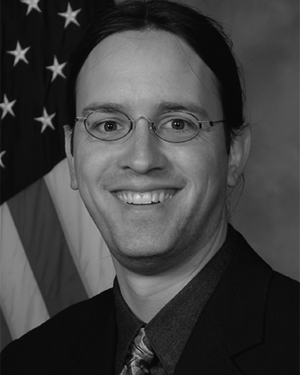 Gilbert L. Peterson合作论文数3Kirk Sturtz合作论文数3Bobby D. Birrer合作论文数Air Force Institute of Technology3Thomas J. Burns合作论文数3Jc Gainey合作论文数2Dennis W. Quinn合作论文数2daniel r zahirniak合作论文数2CE MARTIN合作论文数2Thomas F. Rathbun合作论文数2Gl Tarr合作论文数2steven d pinski合作论文数2
 Timothy H. Lacey合作论文数2Fielding, K.H.合作论文数2
 Sandra L. Vaughan合作论文数2
 Kevin L. Priddy合作论文数Battelle Memorial Institute;Cognitive Systems Group;Cognitive Systems Group, Battelle Memorial Institute2
 Peter S. Maybeck合作论文数Air Force Institute of Technology2
 Byron M. Welsh合作论文数2Martin P. Desimio合作论文数2
 Marcus L. Roberts合作论文数2Don R. Hulce合作论文数2Alan V. Lair合作论文数Department of Mathematics and Statistics, Air Force Institute of Technology2
 Scott A. Sallberg合作论文数2
 Guna Seetharaman合作论文数U.S. Naval Research Laboratory2
 Matthew Fickus合作论文数Department of Mathematics and Statistics, Air Force Institute of Technology2
 Xiang-Gen Xia (夏香根)合作论文数Department of Electrical and Computer Engineering, University of Delaware2




