Worldwide, reefs are under significant pressure, and hence, understanding the consequences of natural and anthropogenically driven sediment influx to reef systems is crucial to planning future protection strategies. Most reef systems are associated with clear water settings, but reefs also evolved in turbid water environments stressed by high rates of sediment influx. Mixed carbonate–clastic environments have been considered unfavourable to reef-building organisms. Currently, we lack generally applicable models for (i) reef growth under the stress of siliciclastic sediment influx and (ii) tools that diagnose ancient reefs that developed in sediment-stressed environments. Case studies of sediment-stressed reefs from the Devonian to the recent reviewed here demonstrate that reef organisms show the ability to survive, and even thrive, under clastic sediment influx. These case studies were selected based on (i) the presence of a mixed carbonate-clastic matrix and (ii) the existence of a coral framework. For each example, the system was characterised in terms of sediment input, organism growth forms and the overall reef architecture. The host sediment from Cenozoic reefs is typically better described than that within Palaeozoic and Mesozoic communities. This may be due to the closer affinity between Cenozoic communities and recent species compared to more ancient systems. The same reasoning accounts for the paucity of data describing the internal structure of many fossil reefs, a feature also related to outcrop quality. Moreover, the juxtaposition of siliciclastic interbeds and ancient reefal bodies should not be taken as conclusive evidence that clastic influx was contemporaneous with the active growth stages of the framework organisms. Based on the data reviewed here, no relationship was identified between the nature of the reef builders, the character of the siliciclastic component and the reef structure. We suggest that this lack of understanding of mixed carbonate-clastic reef systems significantly compromises potential forecasts of future reef development.
Iberian and north-western African occurrences of early Carboniferous (Mississippian) ammonoids show a distinct pattern of increasing provincialism during the late Vis & eacute;an. Clear separation of northern Variscan and southern Variscan/north Gondwanan ammonoid occurrences took place during late Vis & eacute;an times and is clearly expressed by decreasing numbers of common genera and higher taxa in both realms. The north-westernmost African occurrences north of the South Atlas Fault, i.e. the central and eastern Moroccan Meseta show very close biogeographic relationships to the North Variscan occurrences (South Portuguese Zone as well as the British Isles and the Rhenohercynian Zone in Central Europe). Latest Vis & eacute;an occurrences south of the South Atlas Fault, such as the Anti-Atlas of Morocco and the Saoura Valley of Algeria, differ strikingly in their composition of genera and are much closer related to the Palaeotethyan occurrences in the Cantabrian Mountains, the Montagne Noire, and the South Urals. The ammonoids provide firm evidence for the continuation of the Subvariscan-Rhenohercynian Sea into the north-westernmost part of Africa. Close similarity of ammonoid communities suggest the existence of a connection of the South Variscan and north Gondwanan shelves in Vis & eacute;an times and a narrow Galicia-Moldanubian Ocean (Proto-Tethys auctorum) or, more probably, a dextral shear zone juxtaposing north Gondwana against Laurussia + Armorica. This result is supported by data from rugose corals and calcareous microbiota, which flourished on surrounding carbonate platforms.
Les bassins sédimentaires sont les témoins incontournables de l’évolution spatio-temporelle de la chaîne varisque. Au Dévonien terminal les marges passives laissent la place aux bassins d’avant-pays qui sont suivis par les bassins paraliques pendant le Carbonifère. Le remplissage et faciès sédimentaires enregistrent l’évolution des prismes orogéniques. L’effondrement gravitaire de la chaîne s’enregistre finalement dans les bassins stéphaniens.
The late Visean-Serpukhovian is a critical time in reef evolution and climate history, characterized by the gradual collapse of coral reef systems during the onset of the main glaciation phase of the late Palaeozoic Ice Age (LPIA). However, detailed palaeoecological variations of coral reefs during the collapse phase are not well understood. In this study, about one-meter thick coral biostromes are reported from the upper Visean Shangsi Formation in the Yashui section, central Guizhou Province, South China. Coral colonies are primarily in growth position resulting in the classification of autobiostrome and autoparabiostrome. Dominant colonial rugose coral species are Stylostrotion petalaxoidea and Siphonodendron pauciradiale, respectively. The biostromal framework is simple and primarily constructed by bafflestones with slightly positive relief. Diversified dwellers are found between coral skeletons, including abundant foraminifers, crinoids, calcareous algae and brachiopods with less bryozoans, tabulate and solitary rugose corals, gastropods and ostracods. Relative sea-level fluctuations control the growth and demise of the Yashui biostromes, evidenced from changes in both microfacies and biotic assemblages from their underlying to overlying strata. The petalaxoidea biostrome developed in relative deeper water depth than that of the pauciradiale biostrome, between storm wave-base and fair-weather wave-base on a shallow photic open-marine shelf. The pauciradiale biostrome in South China (eastern Palaeotethys) has similar biotic composition, colony preservation and depositional environments to coeval coral biostromes in Ireland (western Palaeotethys). The Yashui coral biostromes formed shortly after the LPIA onset, evidenced in small-scaled eustatic fluctuations and a positive shift in brachiopod oxygen isotopic signatures.
ABSTRACTDuring the Middle Devonian, reef growth reached an acme, and corals and stromatoporoids colonized depositional niches commonly considered unfavourable for reefal organisms. This paper documents the detailed facies architecture and palaeoecology of a stratigraphically thin (ca12 m, ‘carpet reef’), lower Givetian reefal body exposed along the walls and ceilings of the labyrinthine passages in the Klutert Cave in western Germany. The cave exposures (ca26 000 m2of rock surface) and data from short cores, neighbouring caves and outcrops document the growth and demise of an autoparabiostrome. The reef forms part of a parasequence with a lower carbonate and an upper clastic unit, bounded by flooding surfaces. Despite the comparatively small study area (ca1 km2), the exceptional exposure quality reveals facies changes over relatively short distances both vertical and lateral. The sedimentary matrix of the reefal build‐up contains between 20 to 95 wt.‐% of clay and quartz of silt to sand fraction. Based on this observation, the corals and stromatoporoids thrived in murky waters and under sediment‐stressed conditions. Stromatoporoids, for example, display irregular ragged flanks, a feature that is in agreement with a sediment‐stressed environment. No evidence of reduced growth rates, decreased calcification rates, or lower numbers of species is found. In fact, coral diversity and density are highest within one of the two biostromal units that show peak clastic matrix values, indicating a remarkable adaptation of reef builders to sediment‐stressed conditions. The initial settlement of rugose phaceloid corals took place on a mixed clastic–carbonate substrate (the basal flooding surface). Up‐section, a succession of coral–stromatoporoids is present that is here described in great detail. Reef collapse occurred when much of the accommodation space was filled, and argillaceous sediments suffocated stromatoporoids and corals in a protected, low‐energy environment.
Modern coral reefs and associated biodiversity are severely threatened by increasing terrestrial runoff. Similar scenarios could be suspected for geological times, but reef coral resilience is still an enigma. In late Visean-Serpukhovian (Mississippian foraminiferal zones/MFZ 14-16) times, a major glaciation phase of the late Palaeozoic Ice Age (LPIA) associated with enhanced terrestrial weathering and runoff coincides with a biodiversity crisis and coral reef decline. In this study, the impact of enhanced terrestrial runoff is tested on size variations of colonial corals Aulina rotiformis and Lithostrotion decipiens along a gradient of contemporaneous (Serpukhovian) open marine carbonate to near-shore siliciclastic facies in South China. Along this gradient, their sizes decrease from carbonate, through intermediate carbonate-siliciclastic, to siliciclastic facies. This is consistent with increasing abundance of terrestrial materials of high silicon, aluminium and phosphorus values. On a larger million-year-long interval (MFZ14-16) and for several palaeocontinents, size data of Lithostrotion decipiens and Siphonodendron pauciradiale show a distinct decline in late Visean, when enhanced terrestrial weathering occurred commonly with palaeosols developed during regression. This suggests that terrestrial sediment and nutrient input may have mainly controlled phenotypic plasticity in Mississippian reef corals, with a decrease in size as a component of resilience across the LPIA onset.
The mid-Tournaisian black radiolarian cherts of the Lydiennes Formation are exposed in deep-shelf successions of the Puech de la Suque and Col des Tribes sections of the Mont Peyroux Nappe area in the Montagne Noire, southern France. This interval represents the mid-Tournaisian anoxic event that is also termed the Lower Alum Shale Event. This event is associated with a global marine transgression that was characterized by increased productivity and drastic facies changes from pelagic carbonate sedimentation to the widespread deposition of black organic-rich siliceous shales and radiolarites in many parts of the world. In the present study, high-resolution inorganic geochemistry and framboidal pyrite analyses were employed to decipher changes in depositional conditions during the mid-Tournaisian anoxic event in the Montagne Noire. The results show that the total organic carbon contents of sediments associated with the Lower Alum Shale Event vary from 0.09 to 1.9 wt %. These low to moderate total organic carbon contents, high U/Th, low C-org/P and intermediate V/Cr ratios, enrichment in redox-sensitive trace elements, such as U, Mo and V, as well as varying sizes of pyrite framboids, indicate periodic dysoxic to anoxic bottom-water conditions during deposition of the studied sediments. Anomalous Hg spikes (>500 ppb) are also reported in the mid-Tournaisian deep-water marine succession of the Montagne Noire in the present study, which confirm a possible influence of increased regional volcanic activity during this environmental turnover.
Abstract. The evolution of reefs over geologic time is diverse and includes a range of different builders. An understanding of the consequences of natural and anthropogenically-driven sediment influx to reef systems is crucial to planning future protection and mitigation strategies. Most reef systems are associated with clear water settings, however, many reef communities have evolved in turbid water environments stressed by high rates of sediment influx. Conventionally, these mixed carbonate-clastic environments have been considered unfavourable to reef organisms. Utilising case-studies of sediment-stressed reefs from the Devonian to Recent, we clearly demonstrate that reef organisms can survive, and even thrive, under the influence of clastic sediment influx. Ten case-studies were selected on the basis of: i) the presence of a mixed carbonate-clastic matrix, and ii) the existence of a coral framework. For each example, the system was characterised in terms of sediment input, organism growth forms (with a focus on corals) and the overall reef morphology. The host sediment from Cenozoic reefs was found to be typically better-described than that within Paleozoic and Mesozoic communities. This may be due to the closer affinity between Cenozoic communities and recent species when compared to more ancient systems. The same reasoning accounts for the paucity of data describing the internal structure of many fossil reefs, a feature also related to outcrop quality. This study clearly demonstrates that, while reefs in sediment-impacted environments are common, there is no general developmental model that can be applied to all reefs. No relationship was identified between the nature of the reef builders, the character of the siliciclastic component and the reef structure. We demonstrate that, in the majority of cases, the clastic matrix within reefs, both ancient and recent, is insufficiently described – this inhibits understanding of mixed carbonate-clastic reef systems and significantly compromising forecasts of future reef development.
Chapter 3 Sedimentary Basins and Evolution of Reliefs Associated with the Variscan Cycle in France and Adjacent Countries Markus ARETZ, Markus ARETZ Géosciences Environnement Toulouse (GET), Paul Sabatier University, Toulouse, FranceSearch for more papers by this authorÉlise NARDIN, Élise NARDIN Géosciences Environnement Toulouse (GET), Paul Sabatier University, Toulouse, FranceSearch for more papers by this authorFrédéric CHRISTOPHOUL, Frédéric CHRISTOPHOUL Géosciences Environnement Toulouse (GET), Paul Sabatier University, Toulouse, FranceSearch for more papers by this authorJulien DENAYER, Julien DENAYER Evolution and Diversity Dynamics Lab, Department of Geology, University of Liège, BelgiumSearch for more papers by this author Markus ARETZ, Markus ARETZ Géosciences Environnement Toulouse (GET), Paul Sabatier University, Toulouse, FranceSearch for more papers by this authorÉlise NARDIN, Élise NARDIN Géosciences Environnement Toulouse (GET), Paul Sabatier University, Toulouse, FranceSearch for more papers by this authorFrédéric CHRISTOPHOUL, Frédéric CHRISTOPHOUL Géosciences Environnement Toulouse (GET), Paul Sabatier University, Toulouse, FranceSearch for more papers by this authorJulien DENAYER, Julien DENAYER Evolution and Diversity Dynamics Lab, Department of Geology, University of Liège, BelgiumSearch for more papers by this author Yoann Denèle, Yoann DenèleSearch for more papers by this authorJulien Berger, Julien BergerSearch for more papers by this author Book Author(s):Yoann Denèle, Yoann DenèleSearch for more papers by this authorJulien Berger, Julien BergerSearch for more papers by this author First published: 20 December 2023 https://doi.org/10.1002/9781394264995.ch3 AboutPDFPDF ToolsRequest permissionExport citationAdd to favoritesTrack citation ShareShareShare a linkShare onEmailFacebookTwitterLinkedInRedditWechat Summary Middle and Upper Paleozoic sedimentary basins provide invaluable information on the birth, life and death of the Variscan orogenic belt. This chapter discusses the history of Variscan sedimentary basins through a north-south transect from the Ardenne to the Pyrenees, via the French Massif Central and a few detours illustrating some areas of particular interest. Sedimentary records are best known in areas that were part of the passive margin of southern Laurussia. Symmetrically to the north of the belt, a vast foreland basin is formed on the southern segment during the Devonian and the Carboniferous. The Inner Variscan zone includes the Saxothuringian zone and the Iberian-Armorican zones. The hypothesis that the Armorican Massif belongs to the Gondwanan margin is supported by paleontological and sedimentary data while disputed by geochronological data. Stephanian-Permian basins formed in the internal zones of the Variscan belt in response to its gravitational collapse during the latest Carboniferous. References Andrews , J. , Arbizu , M. , Barroquère , G. , Bresiére , G. , Bodin , J. , Bouquet , C. , Brula , P. , Colwill , D. , Majesté-Menjoulas , C. , Ríos , L.M. ( 1996 ). Dévonien – Carbonifère inférieur . In Synthèse géologique et géophysique des Pyrénées , A. Barnolas and J.C. Chiron (eds), 1st edition . BRGM-ITGE , Orléans and Madrid . Google Scholar Aretz , M. ( 2001 ). The upper Viséan coral-horizons of Royseux – The development of an unusual facies in Belgian Early Carboniferous . Bull. Tohoku Uni. Museum , 1 , 86 – 95 . Google Scholar Aretz , M. ( 2002 ). Habitatanalyse und Riffbildungspotential kolonialer rugoser Korallen im Unterkarbon (Mississippium) von Westeuropa . Kölner Forum Geol. Pal. , 10 , 1 – 155 . Google Scholar Aretz , M. ( 2016 ). The Kulm facies of the Montagne Noire (Mississippian, southern France) . Geol. Belgica , 19 ( 1–2 ), 69 – 80 . 10.20341/gb.2015.018 Web of Science®Google Scholar Aretz , M. and Chevalier , E. ( 2007 ). After the collapse of stromatoporid-coral reefs – The Famennian and Dinantian reefs of Belgium: Much more than Waulsortian mounds . Geol. Soc., London, Sp. Pub. , 275 , 163 – 188 . 10.1144/GSL.SP.2007.275.01.11 Google Scholar Aretz , M. , Legrand-Blain , M. , Vachard , D. , Izart , A. ( 2019 ). Gigantoproductid and allied productid brachiopods from the “Calcaires à Productus ” (late Viséan-Serpukhovian; Montagne Noire, southern France): Taxonomy and palaeobiogeographical position in the Palaeotethys . Geobios , 55 , 17 – 40 . 10.1016/j.geobios.2019.06.007 Web of Science®Google Scholar Aretz , M. , Herbig , H.-G. , Wang , XD ., Gradstein , F.M. , Agterberg , F.P. , Ogg , J.G. ( 2020 ). Chapter 23 – The Carboniferous Period . In Geological Time Scale 2020 , F.M. Gradstein , J.G. Ogg , M.D. Schmitz , G.M. Ogg (eds). Elsevier , Amsterdam . 10.1016/B978-0-12-824360-2.00023-1 Google Scholar Arthaud , F. ( 1970 ). Etude tectonique et microtectonique comparée de deux domaines hercyniens : les nappes de la Montagne Noire et l'anticlinal de l'lglesiente . PhD thesis, University of Montpellier , Montpellier . Google Scholar Asselberghs , E. ( 1936 ). Le Dévonien du bord nord du Bassin de Namur . Mém. Inst. géol. Univ. Louvain , 10 , 230 – 327 . Google Scholar Asselberghs , E. ( 1946 ). L’éodévonnien de l'Ardenne et des régions voisines . Mém. Inst. géol. Univ. Louvain , 14 , 1 – 598 . Google Scholar Babin , C. , Cavet , P. , Lardeux , H. , Morzadec , P. , Paris , F. , Poncet , J. , Racheboeuf , P.R. ( 1972 ). Le Dévonien du massif Armoricain . Bull. Soc. Géol. France , 7 ( 14 ), 94 – 109 . 10.2113/gssgfbull.S7-XIV.1-5.94 Google Scholar Bai , S. ( 1994 ). Devonian Events and Biostratigraphy of South China: Conodont Zonation and Correlation, Bio-Event and Chemo-Event, Milankovitch Cycle and Nickel-Episode . Beijing University Press , Beijing . Google Scholar Ballèvre , M. and Lardeux , H. ( 2005 ). Signification paléoécologique et paléogéographique des bivalves du Carbonifère inférieur du bassin d'Ancenis (Massif Armoricain) . C.R. Palevol. , 4 , 109 – 121 . 10.1016/j.crpv.2004.11.011 Google Scholar Ballèvre , M. , Bosse , V. , Ducassou , C. , Pitra , P. ( 2009 ). Palaeozoic history of the Armorican Massif: Models for the tectonic evolution of the suture zones . C.R. Geosci. , 341 , 174 – 201 . 10.1016/j.crte.2008.11.009 Web of Science®Google Scholar Ballèvre , M. , Bosse , V. , Dabard , M.-P. , Ducassou , C. , Fourcade , S. , Paquette , J.-L. , Peucat , J.-J. , Pitra , P. ( 2013 ). Histoire géologique du Massif Armoricain : actualité de la recherche . Bull. Soc. Géol. Min. Bretagne , 10–11 , 5 – 96 . Google Scholar Ballèvre , M. , Manzotti , P. , Dal Piaz , G.V. ( 2018 ). Pre-Alpine (Variscan) inheritance: A key for the location of the future Valaisan Basin (Western Alps) . Tectonics , 37 , 786 – 817 . 10.1002/2017TC004633 Web of Science®Google Scholar Barféty , J.-C. , Montjuvent , G. , Pécher , A. , Carme , F. ( 1988 ). Notice explicative, carte géologique de la France (1/50 000), feuille La Mure (821) . BRGM , Orléans . Google Scholar Bartels , C. , Briggs , D.E.G. , Brassel , G. ( 1998 ). The Fossils of the Hunsrück Slate – Marine Life in the Devonian . Cambridge University Press , Cambridge . Google Scholar Basile , C. ( 2006 ). A new interpretation of Stephanian deformation in the Decazeville basin (Massif Central, France): Consequences on late Variscan tectonism . Int. J. Earth Sci. , 95 , 133 – 139 . 10.1007/s00531-005-0062-6 Web of Science®Google Scholar Beauchamp , J. , Izart , A. , Piqué , A. ( 1991 ). Les bassins d'avant-pays de la chaîne hercynienne au Carbonifère inférieur . Can. J. Earth Sci. , 28 , 2023 – 2041 . 10.1139/e91-183 Google Scholar Beccaletto , L. , Capar , L. , Serrano , O. , Marc , S. ( 2015 ). Structural evolution and sedimentary record of the Stephano-Permian basins occurring beneath the Mesozoic sedimentary cover of the southwestern Paris basin (France) . Bull. Soc. Géol. France , 186 ( 6 ), 429 – 450 . 10.2113/gssgfbull.186.6.429 Google Scholar Becq-Giraudon , J.F. ( 1983 ). Synthèse structurale et paléogéographique du bassin houiller du Nord . Mémoire BRGM , 123 , 1 – 67 . Google Scholar Becq-Giraudon , J.F. and Van Den Driessche , J. ( 1994 ). Dépôts périglaciaires dans le Stéphano-Autunien du Massif Central : témoin de l'effondrement d'un haut plateau hercynien . C. R. Acad. Sciences, sér. IIA , 318 , 675 – 682 . Google Scholar Bergues , J. , Grolier , J. , Soula , J.-C. , Travert , P. ( 1983 ). Interprétation de la structure du bassin houiller de St Eloy d'après les résultats d'essais mécaniques et les modèles tectoniques . 5th Int. Cong. Rock Mechanics (Melbourne, Australia), Proceedings B , E1 – E5 . Google Scholar Bixel , F. ( 1984 ). Le volcanisme stéphano-permien des Pyrénées . PhD Thesis, Toulouse III – Paul Sabatier University , Toulouse . Google Scholar Blanalt , J.-G. and Doubinger , J. ( 1973 ). Contenu paléontologique du gisement frasnien de la carrière Wenger et Petit à Hersbach (Vallée de la Bruche, Vosges) . Sci. Géol., Bull. et Mém. , 26 ( 1 ), 75 – 90 . 10.3406/sgeol.1973.1427 Google Scholar Blanalt , J.-G. and Lillié , F. ( 1973 ). Données nouvelles sur la stratigraphie des terrains sédimentaires dévono-dinantiens de la vallée de la Bruche (Vosges septentrionales) . Sci. Géol., Bull. et Mém. , 26 ( 1 ), 69 – 74 . 10.3406/sgeol.1973.1426 Google Scholar Blieck , A. , Brice , D. , Feist , R. , Guillot , F. , Majeste-Menjoulas , C. , Meilliez , F. ( 1988 ). The Devonian of France and Belgium . Mem. Can. Soc. Pet. Geol. , 14 ( 1 ), 359 – 400 . Google Scholar Bodin , J. ( 1987 ). Le Dévonien inferieur et moyen des Pyrénées ariegeoises et centrales : biostratigraphie, séries hétéropiques et mise en évidence de nappes hercyniennes précoces . PhD Thesis, Toulouse III – Paul Sabatier University , Toulouse . Google Scholar Bonijoly , D. and Castaing , C. ( 1984 ). Fracturation et genèse des bassins stéphaniens du Massif central français en régime compressif . Ann. Soc. Géol. Nord , 103 , 187 – 199 . Google Scholar Bonte , A. ( 1969 ). Le Boulonnais . Ann. Soc. Géol. Nord , 89 ( 1 ), 23 – 46 . Google Scholar Botquelen , A. , Gourvennec , R. , Loi , A. , Pillola , G.L. , Leone , F. ( 2006 ). Replacements of benthic associations in a sequence stratigraphic framework, examples from Upper Ordovician of Sardinia and Lower Devonian of the Massif Armoricain . Palaeogeo., Palaeoclim., Palaeoeco. , 239 ( 3–4 ), 286 – 310 . 10.1016/j.palaeo.2006.01.016 Web of Science®Google Scholar Bouckaert , J. ( 1961 ). Le Namurien à Namur . Bull. Soc. Bel. Géol. , 70 , 358 – 375 . Google Scholar Boulvain , F. and Coen-Aubert , M. ( 1998 ). Le monticule frasnien de la carrière du Nord à Frasnes (Belgique) : sédimentologie, stratigraphie séquentielle et coraux . Prof. Paper, Serv. Géol. Bel. , 285 , 1 – 47 . Google Scholar Boulvain , F. , Bultynck , P. , Coen , M. , Coen-Aubert , M. , Lacroix , D. , Laloux , M. , Casier , J.-G. , Dejonghe , L. , Dumoulin , V. , Ghysel , P. et al. ( 1999 ). Les formations du Frasnien de la Belgique . Memoirs of the Geological Survey of Belgium , 44 , 1 – 125 . Google Scholar Bouquet , C. and Stoppel , D. ( 1975 ). Contribution à l’étude du Paléozoïque des Pyrénées centrales (Hautes vallées de la Garonne et d'Aure) . Bull. BRGM , 1 ( 1 ), 7 – 61 . Google Scholar Bourges , P. , Rolando , J.-P. , Souquet , P. ( 1987 ). Le Permien de la partie occidentale du détroit de Rodez (France) : systèmes de dépôt, dynamique du bassin . Ann. Soc. Géol. Nord , 106 , 173 – 182 . Google Scholar Bouroz , A. ( 1969 ). Le Carbonifère du Nord de la France . Ann. Soc. Géol. Nord , 89 , 47 – 65 . Google Scholar Bouroz , A. ( 1978 ). Essai de synthèse tectonique du bassin houiller de Saint Etienne . Rev. Ind. Miné. , 60 ( 10 ), 319 – 493 . Google Scholar Bourrouilh , R. ( 1973 ). Stratigraphie, sédimentologie et tectonique de l’île de Minorque et de l'extrémité NE de l’île de Majorque, Espagne. La terminaison nord-orientale de Cordillères Bétiques en Méditerranée occidentale . Thesis, Pierre and Marie Curie University , Paris . Google Scholar Bourrouilh , R. and Bourque , P.-A. ( 1995 ). Marqueurs d’évolution de marges continentales paléozoïques : les monticules carbonatés à stromatactis . Bull. Soc. géol. France , 166 ( 6 ), 711 – 724 . CASGoogle Scholar BRGM, ELFRE, ESSO-REP, SNPA ( 1974 ). Géologie du bassin d'Aquitaine . BRGM éditions . 28 . Google Scholar D. Brice (ed.) ( 1988 ). Le Dévonien de Ferques (Boulonnais–France). Synthèse des données nouvelles en stratigraphie, sédimentologie, paléontologie et tectonique . In Biostrat. du Paléozoïque . Le Dévonien de Ferques , Bas-Boulonnais . Google Scholar Brigaud , B. , Gand , G. , Bonvalot , J. ( 2006 ). Étude de deux formations carbonifères du Morvan méridional dans le cadre de l'Orogénèse hercynienne (Région du Creusot, Sâone et Loire) . Rev. sci Bourgogne-Nature , 3–2006 , 37 – 54 . Google Scholar Bultynck , P. , Coen-Aubert , M. , Dejonghe , L. , Godefroid , J. , Hance , L. , Lacroix , D. , Préat , A. , Stainier , X. , Steemans , P. , Streel , M. et al. ( 1991 ). Les formations du Dévonien moyen de la Belgique
Despite its major role in the Earth’s climate regulation, the evolution of high-latitude ocean dynamics through geological time remains unclear. Around Antarctica, changes in the Southern Ocean (SO) circulation are inferred to be responsible for cooling from the late Eocene and glaciation in the early Oligocene. Here, we present a geochemical study of foraminifera from DSDP Site 277 (Campbell Plateau), to better constrain thermal and redox evolution of the high latitude southwest Pacific Ocean during this time interval. From 56 to 48 Ma, Mg/Ca- and δ18O-paleothermometers indicate high surface and bottom water temperatures (24–26°C and 12–14°C, respectively), while weak negative Ce anomalies indicate poorly oxygenated bottom waters. This is followed by a cooling of ∼4° between 48 and 42 Ma, possibly resulting from a weakening of a proto-EAC (East Australian Current) and concomitant strengthening of a proto-Ross gyre. This paleoceanographic change is associated with better ventilation at Site 277, recorded by an increasing negative Ce anomaly. Once this proto-Ross gyre was fully active, increasing biogenic sedimentation rates and decreasing Subbotina sp. δ13C values indicate enhanced productivity. This resulted in a shoaling of the oxygen penetration in the sediment pile recorded by increasing the foraminiferal U/Ca ratio. The negative Ce anomaly sharply increased two times at ∼35 and ∼31 Ma, indicating enhanced seawater ventilation synchronously with the opening of the Tasmanian and Drake Passage gateways, respectively. The Oligocene glaciation is recorded by a major increase of bottom seawater δ18O during the EOT (Eocene-Oligocene Transition) while Mg/Ca-temperatures remain rather constant. This indicates a significant ice control on the δ18O record.
During the Mississippian period, metazoan reefs and other marine faunas gradually recovered from the Late Devonian mass extinctions and reached a peak in the late Visean (~334-332 Ma). Faunal diversity started to decline from the latest Visean (~332-330 Ma) through Serpukhovian (~330-323 Ma), with significant genera/ species losses and ecosystem reconstruction. This Middle-Late Mississippian biodiversity crisis (M-LMBC) was thought to have been caused by global cooling associated with the late Paleozoic Ice Age (LPIA), but existing sedimentological and temperature proxy data suggest that the global cooling event-that marks the onset of the main glaciation phase of LPIA-happened either-4 Myr before or ~1-5 Myr after the initial biodiversity decline at-332 Ma. Here, we report oxygen isotope data of diagenetically screened, well-preserved brachiopod calcite (delta(18)Ocalcite) from late Visean-Serpukhovian (or Middle-Late Mississippian;-334-323 Ma) strata in South China where biodiversity data are well documented. The delta(18)Ocalcite data reveal a -2.0(sic) positive shift from-4.6 +/- 0.2(sic) to-2.7 +/- 0.5(sic) with an estimated ~4.7-5.5 C drop in sea surface temperature (SST) during ~332.5-331.5 Ma in the late Visean. This cooling event coincides with fast decline of metazoan reef abundance, followed by decrease of benthic faunal diversity. The delta(18)Ocalcite data, in combination with calibrated sedimentological and biodiversity data, demonstrate the coupling between late Visean (~332 Ma) onset of the main glaciation phase of the LPIA and initiation of the M-LMBC.
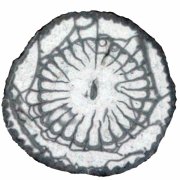
Colonial heterocorals are uncommon faunal component of the Serpukhovian limestones of the Montagne Noire and Pyrenees in southern France. Four species are introduced into the newly established genus Semenomalophyllia . They all share the typical septal arrangement of heterocorals, at least in early stage of development. The fused axial ends of septa commonly withdraw during the ontogeny of larger sized species such as Semenomalophyllia herbigi and S. perretae . In S. weyeri , the septa are withdrawn from the axis and arranged in two series (‘minor’ and ‘major’) that show a striking morphological convergence with rugose corals. The corallites of the smallest species S. webbi are very similar to the solitary heterocorallian Heterophyllia ornata and possibly evolved from it. S. weyeri and S. perretae are commonly colonised by alcyonacean octocorals as indicated by the occurrence of sclerites covering the corallites. These are described as Lafustalcyon vachardi gen. et sp. nov., a new taxon yet only known in the Serpukhovian strata, and only affecting heterocoral colonies. In addition to the alcyonacean octocorals, a diverse assemblage of epibionts colonised the heterocorals: calcifying microbes, bryozoans, foraminifers, microconchids, crinoids, boring organisms, and microproblematica. Syn-vivo relationships can be demonstrated only between Semenomalophyllia and Lafustalcyon as the first commonly bio-immured the second. Other encrusting organisms could have colonised either living, erected colonies or broken or tilted dead colonies.
This article compiles data on the Devonian-Carboniferous Boundary successions from countries and regions, which have not been dealt with separately in this special issue. Data derive from different palaeocontinents on a large palaeoclimatic gradient from the southern high latitudes of western Gondwana through the palaeotropics into the temperate/boreal northern latitudes of Siberia. The quality of the data is variable, but often surprisingly good, although major uncertainties can persist and traditional positions of the boundary do not withhold modern stratigraphic results and concepts. Not all these regions have been on the forefront of the DCB discussions in recent years, but they provide invaluable insights into the regional and global dimensions of uppermost Devonian and lowermost Carboniferous changes in the biosphere and geosphere. Almost globally documented are faunal turnovers and collapse of ecosystems in the Hangenberg extinctions. Those allow the placement of the DCB even if index fossils are absent or scarce. However, it also shows the regional differences, which advocate for a holistic approach to the boundary by ensuring global correlation without relying on the conceptual dominance a single taxon, which might be less powerful outside its usual facies.
The establishment of the Antarctic Circumpolar Current (ACC) is one of the most important events of the Cenozoic for both global oceanic circulation and climate. The onset of this major current hinges on the opening of two major oceanic passages, the Drake Passage and the Tasmanian gateways that connect Pacific, Atlantic and Indian oceans, allowing a modern-like thermohaline circulation. For decades, the ACC onset has been considered as the trigger of the Oligocene glaciation at 33.7 Ma, which marks the beginning of the modern icehouse climate. Today, this scenario is debated. The main obstacle to evaluate the ACC influence on the Oligocene glaciation remains the ill-constrained timing of the Drake Passage gateway opening. Here, we analyse the geochemical composition and Sr isotope ratio of dated planktonic and benthic foraminifera from two IODP and ODP legs in the Southern Atlantic and Pacific oceans (SAO and PO, respectively) to assess the variability of seawater masses? chemical composition through time and to better constrain the timing of the Drake Passage gateway opening along the Eocene-Oligocene interval. These results, based on seawater paleo temperature (Mg/Ca molar ratios), redox (Ce/Ce* anomaly) and provenance (Sr-87/Sr-86) proxies, highlight a gradual seawater mass mixing between the SAO and PO from 31 Ma to 26 Ma. Combined with a reconsideration of the fossil fish teeth Neodymium isotope records, these geochemical tracers evidencing the SAO-PO interconnection depicts the Drake Passage gateway opening and deepening during this 31-26 Ma interval and thus, the timing of the ACC onset. Hence, antecedence of the Oligocene glaciation onset (at 33.7 Ma) relative to the ACC onset (31-26 Ma) implies that the ACC did not trigger the Oligocene glaciation and that the role of atmospheric pCO(2) should be further considered.
The wide-spread occurrences of black shales at specific levels in the Upper Devonian strata results in the definition of a series of Late Devonian events by analogy with the Mesozoic Anoxic events. These events are often associated with transgressive pulses and especially well-expressed by important turnovers in the ammonoids, but they do not necessarily affect other clades and ecosystems. No unique cause for these events has been identified. Overall, two events clearly stick out. Those are first-order mass extinctions, which took place at the ends of the Frasnian and Famennian stages. Each mass extinction can be described as a multi-phased crisis. Late Devonian mass extinctions took place in the early phases of colonization of the continental surfaces by plants and animals, but the developing continental diversity and ecosystems much better resisted ecological perturbations than did their marine counterparts. Characteristic in the neritic realms is the collapse and final disappearance of the stromatoporoid sponge-coral reef system and associated reefbuilders and dwellers. However, these mass extinctions are best expressed in the pelagic realm, where major faunal turnovers have been identified and evidence points to the collapse of food webs. The abruptness of these turnovers may be exaggerated due to lower sedimentation rate and higher condensation in the pelagic realm, which may partly obscure gradual changes. The causes leading to the mass extinctions remain debated and various hypotheses, which are based on the interplay of different factors, seem to provide the most likely scenarios to explain not only the biological component of the extinctions, but also the important changes in relative sea-level, climate, and sea water chemistry, which occurred at the same time.
The stability of our stratigraphic schemes is an important task for the geoscience community in order to provide a solid temporal framework and calendar for the description and reconstruction of Earth’s history and geological processes. The International Commission on Stratigraphy (ICS) via its subcommissions has and continues to put a large effort into this task in defining Global Boundary Stratotype Sections and Points (GSSPs) as global references. This results in an impressive and globally accepted chronostratigraphic zonation for the Phanerozoic and Precambrian (see the charts on stratigraphy.org). So, we can assume that once the long process of establishing a GSSP has been closed, stratigraphic stability for this boundary has been achieved and that a powerful stratigraphic instrument has become available for the geoscience community. Although the golden spike is a powerful symbol for finality and stability, a GSSP is not set in stone. Stratigraphy and also its timescales are only summarising the current state of knowledge, and since this knowledge is continuously progressing and new techniques and concepts become available, we have to adapt and integrate these new data in our schemes. The DevonianCarboniferous Boundary (DCB), corresponding to the base of the Carboniferous Period, is a good example for such a scenario. In fact, the definition of the base of the Carboniferous Period at the Second Heerlen Congress in 1935 (Jongmans and Gothan, 1937) is the first internationally and widely recognised chronostratigraphic boundary, hence the first GSSP in our modern understanding. In the deeper-water cephalopod facies of the Rhenish Mountains (Germany), a section — Ober-Röddinghausen in the Hönne Valley — and a point — the base of the Gattendorfia Zone represented by the FAD of the goniatite Gattendorfia subinvoluta — were selected to define the base of the Carboniferous by an international board, what was later to become the Commission on Carboniferous Stratigraphy (ICS was not existing at this time). The Ober-Röddinghausen stratotype already highlighted the importance of the sections in the Rhenish Mountains for the stratigraphic division and subsequent discussions of the latest Devonian–earliest Carboniferous time. This is the consequence of a long tradition of studying the DCB in that region and resulting in a very detailed knowledge. This perception is highlighted in ideas like “time-specific facies” (e.g. Walliser, 1984) and “Rhenish Standard Succession” (e.g. Becker et al., 2016), which emphasise the importance of the Rhenish sections for global correlation. Today, the local lithostratigraphic units of the northern Rhenish Mountains have often lost their original lithostratigraphic connotation and they have become chronostratigraphic time markers. Thus, names like Hangenberg Sandstone (or strata named as equivalents of the Hangenberg Sandstone) have not only been used around the globe, but they are thought to set distinctive time markers. In the 1960s and 1970s, the arrival of fine-scaled biostratigraphy using conodonts brought to light a hiatus at the boundary level in the Ober-Röddinghausen section (Alberti et al. 1974). Hence, the Ober-Röddinghausen stratotype was abandoned and the search for a new stratotype started. The IUGS working group responsible for the new stratotype used as stratigraphic marker the first occurrence of the conodont Siphonodella sulcata, which immediately precedes the entry of Gattendorfia in the Hönne Valley (Paproth and Streel, 1984). The GSSP (Paproth et al., 1991) for the base of the Tournaisian Stage, hence the base of the Carboniferous System, was defined in the La Serre E’ section (Montagne Noire, southern France) (Fig. 1). According to a morphometric study of the supposedly preserved Si. praesulcata–Si. sulcata This is the editorial to the special issue “Global review of the DevonianCarboniferous Boundary”
Sections with continuous sedimentation across the Devonian–Carboniferous (D-C) boundary in the Montagne Noire allow to build a virtual transect from shoreline to deep basin. Nearshore facies characterise the D-C boundary stratotype and neighbouring sections at La Serre in the Cabrières klippen domain, and offshore facies are present at the Col de Tribes and Puech de la Suque sections in the Mont Peyroux nappe domain. Both domains exhibit equivalents of the Hangenberg Black Shale (HBS). At La Serre, an initial regressive trend is indicated by the presence of oculated trilobites in the topmost pre-HBS Wocklumeria Limestones. Above the HBS level, regressive depositional conditions characterise oolitic deposits that comprise lithic erosional flows with an admixture of transported shallow-water biotas. Maximum regression is recognised with the deposition of coarse breccias and local features of emergence prior to the first appearance of Protognathodus kockeli. The oolites are superseded by the transgression of outer shelf deposits. In the nappe domain, the HBS is intercalated in outer ramp nodular limestones, and it exhibits detrital elements pointing to its regressive nature. The regressive trend culminates than reverses when post-HBS carbonate sedimentation resumes. Protognathodus kockeli appears in the post-HBS carbonates. Associated oculated trilobites indicate shallower bathymetric conditions then those of the pre-HBS Wocklumeria Limestones. Thereafter, replacement of sighted trilobites by blind ones and the protognathodid biofacies by facies dominated by siphonodellids indicate a deepening trend. The near- and offshore sites of the D-C transition permit correlation of short-term bathymetric fluctuations with faunal turnovers and entries of biostratigraphic markers.
Colonial rugose corals with a heterocoral-like septal pattern are diverse and common in the Tournaisian–Viséan (Mississippian) of South China. Numerous species were named in classical works but most of them require systematic revision. Newly collected material allowed eight Heterostrotion species to be recognized (ranging from the upper Tournaisian up to the middle Viséan), including a new species H. huaqiaoense; three Stylostrotion species (middle Viséan), including a new species S. houi and four Polygonaria species (upper Tournaisian and upper Viséan). Heterostrotion as the oldest genus of the Stylostrotionidae probably originated in the western Palaeotethys and migrated to South China during the Tournaisian. The development of the cerioid genus Polygonaria from large-sized Heterostrotion during the late Tournaisian is described. The origin of Stylostrotion is however proposed in the evolution of Heterostrotion by a reduction of the minor septa and the development of a columella during the middle Viséan. Stylostrotion is known only from China, where it seems to have evolved by homeomorphy with Siphonodendron, which only occurred in that area in the late Viséan. http://zoobank.org/urn:lsid:zoobank.org:pub:15F3D222-7027-4771-A8B5-05F024D298A0
 Julien Denayer合作论文数17
 Daniel Vachard合作论文数UMR 8014 du CNRS, Université des Sciences et Technologies de Lille12
 Hans-Georg Herbig合作论文数Institut für Geologie und Paläontologie, Philipps-Universität Marburg12
 Le Yao (要乐)合作论文数Nanjing Institute of Geology and Palaeontology, Chinese Academy of Sciences;University of Chinese Academy of Sciences10
 Xiangdong Wang (王向东)合作论文数School of Earth Sciences and Engineering, Nanjing University10
 Elise Nardin合作论文数biogéosciences, université de Bourgogne10
 hg herbig合作论文数8Pedro Cózar合作论文数7
 Frederic Boulvain合作论文数Belgian Geological Survey7
 Guillaume Dera合作论文数IPSL, CEA-CNRS-UVSQ7
 Edouard Poty合作论文数7
 Yves Godderis合作论文数Géosciences Environnement Toulouse - Observatoire Midi-Pyrénées6
 Yannick Donnadieu合作论文数Laboratoire des Sciences du Climat de l'Environnement, CEA Saclay6
 Axel Munnecke合作论文数University Erlangen-Nürnberg Institute of Paleontology6
 Ian D. Somerville合作论文数University College Dublin6
 Melina Macouin合作论文数Laboratoire de Paléomagnétisme, Institut de Physique de Globe de Paris5
 Jitao Chen (陈吉涛)合作论文数Nanjing Institute of Geology and Paleontology, Chinese Academy of Sciences5Alain Izart合作论文数5
 Emmanuelle Vennin合作论文数UMR 5561, CNRS5e poty合作论文数4Yuping Qi (祁玉平)合作论文数4Bernard Mottequin合作论文数4
 Sven Hartenfels合作论文数4luc hance合作论文数3
 John Nudds合作论文数Department of Earth and Environmental Sciences, School of Natural Sciences, Faculty of Science and Engineering, The University of Manchester3
 Chavagnac Valérie合作论文数Geosci Environm Toulouse, Univ Toulouse3E. Chevalier合作论文数3
 Ondřej Bábek合作论文数Department of Geology, Faculty of Science, Palacký University Olomouc;Department of Geological Sciences, Masaryk University3
 Francois-Xavier Devuyst合作论文数3
 Jose-Javier Alvaro合作论文数3
 Stephen W. Lokier合作论文数School of Built and Natural Environment, School of Environmental Sciences,University of Derby3
 Adrian Immenhauser合作论文数Institut fur Geologie, Mineralogie und Geophysik, Ruhr-Universitat Bochum3Jiri Kalvoda合作论文数3Guillaume Le Hir合作论文数3F. Lacan合作论文数2laurent barchy合作论文数2K. F. T. Atif合作论文数2mrw amler合作论文数2Lucie Hubert-Théou合作论文数2Tanja Unger合作论文数2Carlo Corradini合作论文数2
 Florent Hodel合作论文数Géosciences Environnement Toulouse (GET), Observatoire Midi Pyrénées, Université de Toulouse, CNRS, IRD, 14 avenue E. Belin, F-31400 Toulouse, France2
 Galen P. Halverson合作论文数Department of Earth and Planetary Sciences, McGill University2
 Wei Lin (林巍)合作论文数Key Laboratory of Earth and Planetary Physics, Institute of Geology and Geophysics, Innovation Academy for Earth Science, Chinese Academy of Sciences;University of Chinese Academy of Sciences2
 Gregory Webb合作论文数School of the Environment, Faculty of Science, The University of Queensland2
 Fischer Valentin合作论文数Geology Department, University of Liège2
 Ismael Coronado合作论文数Departamento de Paleontología, Universidad Complutense de Madrid2
 Dieter Korn合作论文数Leibniz Institute for Research on Evolution and Biodiversity, Museum fur Naturkunde2
 Vincent Lefebvre合作论文数2




