A nonlinear domain decomposition (DD) solver is considered with respect to improved energy efficiency. In this method, nonlinear problems are solved using Newton's method on the subdomains in parallel and in asynchronous iterations. The method is compared to the more standard Newton-Krylov approach, where a linear domain decomposition solver is applied to the overall nonlinear problem after linearization using Newton's method. It is found that in the nonlinear domain decomposition method, making use of the asynchronicity, some processor cores can be set to sleep to save energy and to allow better use of the power and thermal budget. Energy savings on average for each socket up to 77% (due to the RAPL hardware counters) are observed compared to the more traditional Newton-Krylov approach, which is synchronous by design, using up to 5120 Intel Broadwell (Xeon E5-2630v4) cores. The total time to solution is not affected. On the contrary, remaining cores of the same processor may be able to go to turbo mode, thus reducing the total time to solution slightly. Last, we consider the same strategy for the ASPIN (Additive Schwarz Preconditioned Inexact Newton) nonlinear domain decomposition method and observe a similar potential to save energy.
We present a numerical two-scale simulation approach of the Nakajima test for dual-phase steel using the software package FE2TI, a highly scalable implementation of the well known homogenization method FE2. We consider the incorporation of contact constraints using the penalty method as well as the sample sheet geometries and adequate boundary conditions. Additional software features such as a simple load step strategy and prediction of an initial value by linear extrapolation are introduced. The macroscopic material behavior of dual-phase steel strongly depends on its microstructure and has to be incorporated for an accurate solution. For a reasonable computational effort, the concept of statistically similar representative volume elements (SSRVEs) is presented. Furthermore, the highly scalable nonlinear domain decomposition methods NL-FETI-DP and nonlinear BDDC are introduced and weak scaling results are shown. These methods can be used, e.g., for the solution of the microscopic problems. Additionally, some remarks on sparse direct solvers are given, especially to PARDISO. Finally, we come up with a computationally derived Forming Limit Curve (FLC).
The Roofline model is widely used to visualize the performance of executed code together with the upper performance bounds given by the memory bandwidth and the processor peak performance. The model can thus provide an insightful visualization of bottlenecks. In this paper, we try to establish realistic bandwidth ceilings for the sparse triangular solve step of PARDISO, a leading sparse direct solver package, which is also part of the Intel MKL library. The performance of the forward and backward substitution process is analyzed and benchmarked for a representative set of sparse matrices on seven modern x86-type multicore architectures and the Knights Landing manycore architecture. It is shown how to accurately measure the necessary quantities also for threaded code, and the measurement approach, its validation, as well as limitations are discussed. Our modeling approach covers the serial and parallel execution phases, allowing for in-socket performance predictions.
Lattice Boltzmann methods (LBM) are an important part of current computational fluid dynamics (CFD). They allow easy implementations and boundary handling. However, competitive time to solution not only depends on the choice of a reasonable method, but also on an efficient implementation on modern hardware. Hence, performance optimization has a long history in the lattice Boltzmann community. A variety of options exists regarding the implementation with direct impact on the solver performance. Experimenting and evaluating each option often is hard as the kernel itself is typically embedded in a larger code base. With our suite of lattice Boltzmann kernels we provide the infrastructure for such endeavors. Already included are several kernels ranging from simple to fully optimized implementations. Although these kernels are not fully functional CFD solvers, they are equipped with a solid verification method. The kernels may act as an reference for performance comparisons and as a blue print for optimization strategies. In this paper we give an overview of already available kernels, establish a performance model for each kernel, and show a comparison of implementations and recent architectures.
Matrix-free finite element implementations of massively parallel geometric multigrid save memory and are often significantly faster than implementations using classical sparse matrix techniques. They are especially well suited for hierarchical hybrid grids on polyhedral domains. In the case of constant coefficients all fine grid node stencils in the interior of a coarse macro element are equal. However, for non-polyhedral domains the situation changes. Then even for the Laplace operator, the non-linear element mapping leads to fine grid stencils that can vary from grid point to grid point. This observation motivates a new two-scale approach that exploits a piecewise polynomial approximation of the fine grid operator with respect to the coarse mesh size. The low-cost evaluation of these surrogate polynomials results in an efficient stencil assembly on-the-fly for non-polyhedral domains that can be significantly more efficient than matrix-free techniques that are based on an element-wise assembly. The performance analysis and additional hardware-aware code optimizations are based on the Execution-Cache-Memory model. Several aspects such as two-scale a priori error bounds and double discretization techniques are presented. Weak and strong scaling results illustrate the benefits of the new technique when used within large scale PDE solvers.
In spring 2015, the Leibniz Supercomputing Centre (Leibniz-Rechenzentrum, LRZ), installed their new Peta-Scale System SuperMUC Phase2. Selected users were invited for a 28 day extreme scale-out block operation during which they were allowed to use the full system for their applications. The following projects participated in the extreme scale-out workshop: BQCD (Quantum Physics), SeisSol (Geophysics, Seismics), GPI-2/GASPI (Toolkit for HPC), Seven-League Hydro (Astrophysics), ILBDC (Lattice Boltzmann CFD), Iphigenie (Molecular Dynamic), FLASH (Astrophysics), GADGET (Cosmological Dynamics), PSC (Plasma Physics), waLBerla (Lattice Boltzmann CFD), Musubi (Lattice Boltzmann CFD), Vertex3D (Stellar Astrophysics), CIAO (Combustion CFD), and LS1-Mardyn (Material Science). The projects were allowed to use the machine exclusively during the 28 day period, which corresponds to a total of 63.4 million core-hours, of which 43.8 million core-hours were used by the applications, resulting in a utilization of 69%. The top 3 users were using 15.2, 6.4, and 4.7 million core-hours, respectively.
Even on modern supercomputer architectures, Earth mantle simulations are so compute intensive that they are considered grand challenge applications. The dominating roadblocks in this branch of Geophysics are model complexity and uncertainty in parameters and data, e.g., rheology and seismically imaged mantle heterogeneity, as well as the enormous space and time scales that must be resolved in the computational models. This article reports on a massively parallel all-at-once multigrid solver for the Stokes system as it arises in mantle convection models. The solver employs the hierarchical hybrid grids framework and demonstrates that a system with coupled velocity components and with more than a trillion (1.7.10(12)) degrees of freedom can be solved in about 1,000 s using 40,960 compute cores of JUQUEEN. The simulation framework is used to investigate the influence of asthenosphere thickness and viscosity on upper mantle velocities in a static scenario. Additionally, results for a time-dependent simulation with a time-variable temperature-dependent viscosity model are presented.
Summary Memory‐bound algorithms show complex performance and energy consumption behavior on multicore processors. We choose the lattice Boltzmann method on an Intel Sandy Bridge cluster as a prototype scenario to investigate if and how single‐chip performance and power characteristics can be generalized to the highly parallel case. First, we perform an analysis of a sparse‐lattice lattice Boltzmann method implementation for complex geometries. Using a single‐core performance model, we predict the intra‐chip saturation characteristics and the optimal operating point in terms of energy‐to‐solution as a function of implementation details, clock frequency, vectorization, and number of active cores per chip. We show that high single‐core performance and a correct choice of the number of active cores per chip are the essential optimizations for the lowest energy‐to‐solution at minimal performance degradation. Then we extrapolate to the Message Passing Interface (MPI)‐parallel level and quantify the energy‐saving potential of various optimizations and execution modes, where we find these guidelines to be even more important, especially when communication overhead is non‐negligible. In our setup, we could achieve energy savings of 35% in this case, compared with a naive approach. We also demonstrate that a simple non‐reflective reduction of the clock speed leaves most of the energy‐saving potential unused. Copyright © 2015 John Wiley & Sons, Ltd.
In mantle circulation models the simulation domain is a thick spherical shell representing the earth’s mantle. Typically, finite elements are the method of choice to account for the spherical geometry. The wide range of length scales involved in earth dynamics is a major challenge. Capturing localized features such as faulted plate boundaries requires local resolutions in the order of O(1)km whereas the radius of earth mantle is in O(10)km. That is, a globally refined mesh of this resolution needs O(10) degrees of freedom (DOF). To realize such extreme resolutions, most codes utilize adaptive mesh refinement techniques. However, this class of methods leads to an increase in algorithmic complexity which in turn often results in significant computational overheads and causes additional communication requirements and memory traffic.
Die Lattice-Boltzmann-Methoden haben sich als wichtige Verfahren zur numerischen Stromungssimulation etabliert. Insbesondere fur parallele Simulationen von Stromungen in komplexen Geometrien bieten sie einen relativ einfachen algorithmischen Ansatz. Es existieren daher verschiedene Programmpakete, die auf den weltweit grosten HPC-Systemen eingesetzt werden. Fur diese Algorithmenklasse ist es daher essentiell auf die aktuellen und zukunftigen Herausforderungen solcher Systeme hinsichtlich der Skalierbarkeit aller Komponenten sowie der bestmoglichen Hardware- und Energieeffizienz vorbereitet zu sein. Die vorliegende Arbeit behandelt zwei wichtige Aspekte, welche die Skalierbarkeit und die parallele Performance Lattice-Boltzmann-basierter Stromungsloser wesentlich beeinflussen: eine skalierbare und effiziente Gebietszerlegung fur die zugrunde liegende Anwendung und eine hohe Rechenknoten-Performance. In dieser Arbeit wird das ILBDC-Programmpaket genutzt, das seit vielen Jahren fur die Simulation von Stromungen durch komplexe Geometrien, wie Festbettreaktoren, eingesetzt wird. Die Reprasentation einer Simulationsgeometrie erfolgt innerhalb des Stromungslosers des ILBDCs durch eine Adjazenzliste, in der die Nachbarschaftsbeziehungen der einzelnen Fluidzellen gespeichert werden. Fur die Erzeugung der Adjazenzliste wird ein paralleler und skalierbarer Algorithmus vorgestellt, der unabhangig von der Anzahl der zu erzeugenden Teilgebiete arbeitet. Die in dieser Arbeit erzielten Steigerungen hinsichtlich Performance und Energieeffizienz lassen sich auch auf hochparallele Simulationen transferieren. Zusammen mit der skalierbaren Gebietszerlegung steht somit ein hochperformanter Stromungsloser fur aktuelle und zukunftige HPC-Systeme zur Verfugung.
Simple floating point operations like addition or multiplication on normalized floating point values can be computed by current AMD and Intel processors in three to five cycles. This is different for denormalized numbers, which appear when an underflow occurs and the value can no longer be represented as a normalized floating-point value. Here the costs are about two magnitudes higher.
Computational fluid dynamics (CFD) requires a vast amount of compute cycles on contemporary large-scale parallel computers. Hence, performance optimization is a pivotal activity in this field of computational science. Not only does it reduce the time to solution, but it also allows to minimize the energy consumption. In this work we study performance optimizations for an MPI-parallel lattice Boltzmann-based flow solver that uses a sparse lattice representation with indirect addressing. First we describe how this indirect addressing can be minimized in order to increase the single-core and chip-level performance. Second, the communication overhead is reduced via appropriate partitioning, but maintaining the single core performance improvements. Both optimizations allow to run the solver at an operating point with minimal energy consumption.
We present a simple library which equips MPI implementations with truly asynchronous non-blocking point-to-point operations, and which is independent of the underlying communication infrastructure. It utilizes the MPI profiling interface (PMPI) and the MPI_THREAD_MULTIPLE thread compatibility level, and works with current versions of Intel MPI, Open MPI, MPICH2, MVAPICH2, Cray MPI, and IBM MPI. We show performance comparisons on a commodity InfiniBand cluster and two tier-1 systems in Germany, using low-level and application benchmarks. Issues of thread/process placement and the peculiarities of different MPI implementations are discussed in detail. We also identify the MPI libraries that already support asynchronous operations. Finally we show how our ideas can be extended to MPI-IO.
Several possibilities exist to implement the propagation step of lattice Boltzmann methods. This paper describes common implementations and compares the number of memory transfer operations they require per lattice node update. A performance model based on the memory bandwidth is then used to obtain an estimation of the maximum achievable performance on different machines. A subset of the discussed implementations of the propagation step are benchmarked on different Intel- and AMD-based compute nodes using the framework of an existing flow solver that is specially adapted to simulate flow in porous media, and the model is validated against the measurements. Advanced approaches for the propagation step like “A–A pattern” or “Esoteric Twist” require more programming effort but often sustain significantly better performance than non-naïve but straightforward implementations.
GPI is a PGAS model based library that targets to provide low-latency and highly efficient communication routines for large scale systems. We compare and analyse the performance of two algorithms, which are implemented with GPI and MPI. These algorithms are a sparse matrix-vector-multiplication (SpMVM) and a fluid flow solver based on a lattice Boltzmann method (LBM). Both algorithms are purely memory-bound on a single node, whereas at the large scale, the communication between the processes becomes more significant. GPI, in principle, is fully capable of performing communication alongside computation. Both the algorithms are modified to leverage this feature. In addition to the näıve approach with blocking calls in MPI, the algorithms are also evaluated using non-blocking calls and explicit asynchronous progress via an external library. We conclude that GPI implementations handle non-blocking asynchronous communication very effectively and thus hiding communication costs.
The road to exascale computing poses many challenges for the High Performance Computing (HPC) community. Each step on the exascale path is mainly the result of a higher level of parallelism of the basic building blocks (i.e., CPUs, memory units, networking components, etc.). The reliability of each of these basic components does not increase at the same rate as the rate of hardware parallelism. This results in a reduction of the mean time to failure (MTTF) of the whole system. A fault tolerance environment is thus indispensable to run large applications on such clusters. Checkpoint/Restart (C/R) is the classic and most popular method to minimize failure damage. Its ease of implementation makes it useful, but typically it introduces significant overhead to the application. Several efforts have been made to reduce the C/R overhead. In this paper we compare various C/R techniques for their overheads by implementing them on two different categories of applications. These approaches are based on parallel-file-system (PFS)-level checkpoints (synchronous/asynchronous) and node-level checkpoints. We utilize the Scalable Checkpoint/Restart (SCR) library for the comparison of node-level checkpoints. For asynchronous PFS-level checkpoints, we use the Damaris library, the SCR asynchronous feature, and application-based checkpointing via dedicated threads. Our baseline for overhead comparison is the naïve application-based synchronous PFS-level checkpointing method. A 3D lattice-Boltzmann (LBM) flow solver and a Lanczos eigenvalue solver are used as prototypical applications in which all the techniques considered here may be applied.
Today's High Performance Computing (HPC) clusters consist of hundreds of thousands of CPUs, memory units, complex networks, and other components. Such an extreme level of hardware parallelism reduces the mean time to failure (MTTF) of the overall cluster. The future of HPC urgently demands to develop environments that facilitate programs to run successfully even in the presence of failures. Checkpoint/Restart (C/R) is one of the most common techniques to provide fault tolerance. C/R is relatively easy to implement, but typically it introduces significant overhead in the runtime of the application. In this paper, a check pointing technique is presented that significantly reduces the checkpoint overhead and is highly scalable. This is achieved by overlapping the I/O for writing the checkpoint with the computation of the application. For this asynchronous check pointing technique, a theoretical model is developed to estimate the checkpoint overhead. An implementation of this technique is then benchmarked and compared with other check pointing strategies. We show our approach to have marginal overhead as opposite to standard synchronous check pointing for typical application scenarios. A comparison with the node-level check pointing technique by using Scalable Checkpoint/Restart (SCR) library is also presented.
We present a simple, parallel and distributed algorithm for setting up and partitioning a sparse representation of a regular discretized simulation domain. This method is scalable for a large number of processes even for complex geometries and ensures load balancing between the domains, reasonable communication interfaces, and good data locality within the domain. Applying this scheme to a list-based lattice Boltzmann flow solver can achieve similar or even higher flow solver performance than widely used standard graph partitioner such as METIS and PT-SCOTCH.
Checkpoint/restart (C/R) is a classical approach to introduce fault tolerance in large HPC applications. Although it is relatively easy as compared to other fault tolerance approaches, its overhead hinders its wide usage. We present an application-level checkpointing technique that significantly reduces the checkpoint overhead. The checkpoint I/O is overlapped with the computation of the application by following a two-stage checkpointing mechanism with dedicated threads for doing I/O.
 Gerhard Wellein合作论文数Regionales Rechenzentrum Erlangen21
 Thomas Zeiser合作论文数15
 Georg Hager合作论文数Regionales Rechenzentrum Erlangen14
 Simon Bauer合作论文数Tech Univ Munich, Dept Informat, Chair Network Architectures & Serv, Munich, Germany3
 Marcus Mohr合作论文数3Axel Klawonn合作论文数Universitat Duisburg-Essen3
 Oliver Rheinbach合作论文数Fakultät für Mathematik, Universität Duisburg-Essen3
 Ulrich Rüde合作论文数Dept. of Computer Science, University Erlangen-Nuremberg3
 Martin Lanser合作论文数3Radim Janalik合作论文数2
 faisal shahzad合作论文数Korea Inst Sci & Technol, Ctr Mat Architecturing, Seoul 136791, South Korea2J. Weismüller合作论文数2
 Barbara Wohlmuth合作论文数Department of Mathematics, Technische Universitat Munchen2Jan Treibig合作论文数2
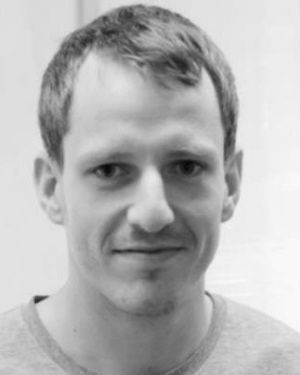 Moritz Kreutzer合作论文数Erlangen Reg Comp Ctr, Univ Erlangen Nurnberg2
 O. Schenk合作论文数Computer Science Department2Karl-Ulrich Bamberg合作论文数1
 Ashutosh Rajiv Gandhi合作论文数1Matthias Uran合作论文数1Stephan Köhler合作论文数1Nikhil Anand合作论文数1
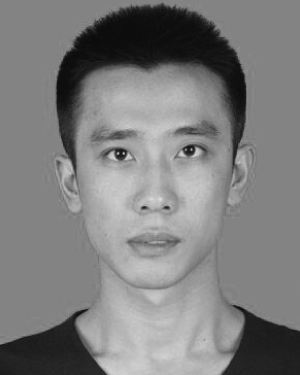 Jiaxing Qi合作论文数1
 Markus Huber合作论文数1
 Momme Allalen合作论文数1Abhishek Y. Deshmukh合作论文数German Research School for Simulation Sciences, Rheinisch Westfalische Technische Hochschule Aachen Fakultat 4 Maschinenwesen1Tobias Falkenstein合作论文数1Lorenz John合作论文数1Daniel Drzisga合作论文数Tech Univ Munich1Antonio Ragagnin合作论文数Univ Trieste, Dipartimento Fis, Sez Astron, I-34131 Trieste, Italy1
 Christoph Federrath合作论文数Research School of Astronomy and Astrophysics, College of Science and Medicine, Australian National University1
 Anupam Karmakar合作论文数1
 Lisa Scheunemann合作论文数Institute of Mechanics, University of DuisburgEssen1
 Klaus Dolag合作论文数Fakultät für Physik, Ludwig-Maximilians-Universität München;Max Planck Institute for Astrophysics1
 Christian Waluga合作论文数1
 Bjorn Gmeiner合作论文数1Lorenzen Konstantin合作论文数1Schwörer Magnus合作论文数1Philipp Edelmann合作论文数Max-Planck-Institut für Astrophysik, Max-Planck-Institut für Astrophysik1Luigi Iapichino合作论文数Institut fur Theoretische;Physik und Astrophysik;Universitat Wurzburg1
 Jorg Schroder合作论文数Fakultät für Ingenieurwissenschaften, Universität Duisburg-Essen1
 Ralf Klessen合作论文数Institut für Theoretische Astrophysik, Zentrum für Astronomie, Universität Heidelberg1
 Arndt Bode合作论文数School of Computation, Information and Technology, Technische Universitat Munchen1
 Bettina Krammer合作论文数MoRitS Nano- and Biotechnology, Bielefeld University & University of Applied Sciences Bielefeld;Exascale Computing Research;Universite de Versailles St-Quentin-en Yvelines1
 Margarita Petkova合作论文数1Hinnerk Stüben合作论文数1Holger Stengel合作论文数1
 Herbert Huber合作论文数1Reinhold Bader合作论文数1
 Helmut Satzger合作论文数Sektion Physik, Ludwig-Maximilians-Universität1




