Diffusion Models have become very popular for Semantic Image Synthesis (SIS) of human faces. Nevertheless, their training and inference is computationally expensive and their computational requirements are high due to the quadratic complexity of attention layers. In this paper, we propose a novel architecture called SISMA, based on the recently proposed Mamba. SISMA generates high quality samples by controlling their shape using a semantic mask at a reduced computational demand. We validated our approach through comprehensive experiments with CelebAMask-HQ, revealing that our architecture not only achieves a better FID score yet also operates at three times the speed of state-of-the-art architectures. This indicates that the proposed design is a viable, lightweight substitute to transformer-based models.
In this work, we present a Bird’s Eye View (BEV) Alignment approach for the LiDAR-Camera calibration task. Building upon previous BEV-based work, we extract sensor-wise BEV features from each input modality using domain-specific architectures. Then, we employ a CNN-based encoder to align the two BEVs and estimate the calibration matrix. However, corresponding 2D and 3D features may be spatially distant in BEV space, and as a consequence the encoder alone might struggle to learn the height dimension and estimate the correct registration matrix. To address this, we introduce an implicit alignment step to cross-attend the downsampled 3D features with those from RGB for computing point-to-pixel correspondences and estimating a coarse calibration matrix. To improve the implicit alignment, we also enforce the prediction of correct point-to-pixel correspondences by direct supervision of the similarity matrix computed into the cross attention module. Then, the coarsely aligned 3D features and the RGB features are fed to the BEV Alignment step, in which the CNN-based encoder refines the coarse estimate into a final, more accurate calibration matrix. Notably, both the steps are optimized in an end-to-end fashion. Our method significantly outperforms previous point-to-pixel matching methods, achieving state-of-the-art calibration accuracy. On the KITTI and nuScenes benchmarks, our method reduces the Relative Rotation Error (RRE) by 74
We present CalibBEV, a novel Bird's Eye View (BEV) alignment approach for LiDAR-camera calibration. Our method unifies LiDAR and camera data into a shared 3D spatial representation, enabling accurate and robust cross-modal calibration. CalibBEV extracts sensor-wise BEV features from each modality using domain-specific architectures and estimates the calibration matrix through a two-step alignment process. First, we perform an implicit alignment by regressing a coarse calibration matrix directly from the BEV features. To ease this alignment, we enforce semantic consistency between BEV representations across modalities using a contrastive loss inspired by CLIP, guiding both networks toward a unified feature space. In the second step, we leverage our BEV formulation to explicitly align the features of one modality with the other, refining the initial coarse estimate into a final, more accurate calibration matrix. CalibBEV significantly outperforms prior point-to-pixel matching methods, achieving state-of-the-art calibration accuracy. On the KITTI and nuScenes benchmarks, our method reduces the Relative Rotation Error (RRE) by 51
Diffusion Models have become very popular for Semantic Image Synthesis (SIS) of human faces. Nevertheless, their training and inference is computationally expensive and their computational requirements are high due to the quadratic complexity of attention layers. In this paper, we propose a novel architecture called SISMA, based on the recently proposed Mamba. SISMA generates high quality samples by controlling their shape using a semantic mask at a reduced computational demand. We validated our approach through comprehensive experiments with CelebAMask-HQ, revealing that our architecture not only achieves a better FID score yet also operates at three times the speed of state-of-the-art architectures. This indicates that the proposed design is a viable, lightweight substitute to transformer-based models.
Continual learning (CL) in the context of Generative Adversarial Networks (GANs) remains a challenging problem, particularly when it comes to learn from a few-shot (FS) samples without catastrophic forgetting. Current most effective state-of-the-art (SOTA) methods, like LFS-GAN, introduce a non-negligible quantity of new weights at each training iteration, which would become significant when considering the long term. For this reason, this paper introduces continual few-shot learning with low-rank adaptation in GANs named CoLoR-GAN, a framework designed to handle both FS and CL together, leveraging low-rank tensors to efficiently adapt the model to target tasks while reducing even more the number of parameters required. Applying a vanilla LoRA implementation already permitted us to obtain pretty good results. In order to optimize even further the size of the adapters, we challenged LoRA limits introducing a LoRA in LoRA (LLoRA) technique for convolutional layers. Finally, aware of the criticality linked to the choice of the hyperparameters of LoRA, we provide an empirical study to easily find the best ones. We demonstrate the effectiveness of CoLoR-GAN through experiments on several benchmark CL and FS tasks and show that our model is efficient, reaching SOTA performance but with a number of resources enormously reduced. Source code is available on Github .
Self-supervised learning (SSL) has recently emerged as a key strategy for building foundation models in remote sensing, where the scarcity of annotated data limits the applicability of fully supervised approaches. In this work, we introduce WaveMAE, a masked autoencoding framework tailored for multispectral satellite imagery. Unlike conventional pixel-based reconstruction, WaveMAE leverages a multi-level Discrete Wavelet Transform (DWT) to disentangle frequency components and guide the encoder toward learning scale-aware high-frequency representations. We further propose a Geo-conditioned Positional Encoding (GPE), which incorporates geographical priors via Spherical Harmonics, encouraging embeddings that respect both semantic and geospatial structure. To ensure fairness in evaluation, all methods are pretrained on the same dataset (fMoW-S2) and systematically evaluated on the diverse downstream tasks of the PANGAEA benchmark, spanning semantic segmentation, regression, change detection, and multilabel classification. Extensive experiments demonstrate that WaveMAE achieves consistent improvements over prior state-of-the-art approaches, with substantial gains on segmentation and regression benchmarks. The effectiveness of WaveMAE pretraining is further demonstrated by showing that even a lightweight variant, containing only 26.4% of the parameters, achieves state-of-the-art performance. Our results establish WaveMAE as a strong and geographically informed foundation model for multispectral remote sensing imagery.
Due to the limitations of current optical and sensor technologies and the high cost of updating them, the spectral and spatial resolution of satellites may not always meet desired requirements. For these reasons, Remote-Sensing Single-Image Super-Resolution (RS-SISR) techniques have gained significant interest. In this paper, Swin2-MoSE model is proposed, an enhanced version of Swin2SR. The model introduces MoE-SM, an enhanced Mixture-of-Experts (MoE) to replace the Feed-Forward inside all Transformer block. MoE-SM is designed with Smart-Merger, and new layer for merging the output of individual experts, and with a new way to split the work between experts, defining a new per-example strategy instead of the commonly used per-token one. Furthermore, it is analyzed how positional encodings interact with each other, demonstrating that per-channel bias and per-head bias can positively cooperate. Finally, the authors propose to use a combination of Normalized-Cross-Correlation (NCC) and Structural Similarity Index Measure (SSIM) losses, to avoid typical MSE loss limitations. Experimental results demonstrate that Swin2-MoSE outperforms any Swin derived models by up to 0.377-0.958 dB (PSNR) on task of 2x$2\times$, 3x$3\times$ and 4x$4\times$ resolution-upscaling (Sen2Ven mu s$\text{Sen2Ven}\mu \text{s}$ and OLI2MSI datasets). It also outperforms SOTA models by a good margin, proving to be competitive and with excellent potential, especially for complex tasks. Additionally, an analysis of computational costs is also performed. Finally, the efficacy of Swin2-MoSE is shown, applying it to a semantic segmentation task (SeasoNet dataset). Code and pretrained are available on
In semantic image synthesis the state of the art is dominated by methods that use customized variants of the SPatially-Adaptive DE-normalization (SPADE) layers, which allow for good visual generation quality and editing versatility. By design, such layers learn pixel-wise modulation parameters to de-normalize the generator activations based on the semantic class each pixel belongs to. Thus, they tend to overlook global image statistics, ultimately leading to unconvincing local style editing and causing global inconsistencies such as color or illumination distribution shifts. Also, SPADE layers require the semantic segmentation mask for mapping styles in the generator, preventing shape manipulations without manual intervention. In response, we designed a novel architecture where cross-attention layers are used in place of SPADE for learning shape-style correlations and so conditioning the image generation process. Our model inherits the versatility of SPADE, at the same time obtaining state-of-the-art generation quality improving FID score by 5.6%, 1.4% and 3.4% on CelebMask-HQ, Ade20k and DeepFashion datasets respectively, as well as improved global and local style transfer. Code and models available at https://github.com/TFonta/CA2SIS.
Perception is a crucial aspect of an autonomous driving system. One essential task is represented by multi-camera 3D object detection, which allows an intelligent vehicle to detect the surrounding obstacles using a camera-only setup. Currently, there are a lot of different approaches trying to solve this task, with many of them being transformer-based. Specifically, most of these make use of object queries instead of a Bird's Eye View plane to directly represent the set of possible detections and avoid any post-processing operation, like non-maxima suppression. However, the ambiguous supervision caused by the bipartite matching loss typically leads to training instability. To overcome this limitation, we propose an additional module able to “push” the object queries toward the locations that more likely contain obstacles, providing both better insights into their position to the detection module and stabilizing the bipartite matching during training. We evaluate our proposal against different objet queries-based baselines both on the nuScenes dataset test and validation sets. Specifically, compared to the lightweight PETR architecture, we highlight an increase of 1.6% both in NDS and mAP under the same configuration settings.
Semantic Image Synthesis (SIS) is among the most popular and effective techniques in the field of face generation and editing, thanks to its good generation quality and the versatility is brings along. Recent works attempted to go beyond the standard GAN-based framework, and started to explore Diffusion Models (DMs) for this task as these stand out with respect to GANs in terms of both quality and diversity. On the other hand, DMs lack in fine-grained controllability and reproducibility. To address that, in this paper we propose a SIS framework based on a novel Latent Diffusion Model architecture for human face generation and editing that is both able to reproduce and manipulate a real reference image and generate diversity-driven results. The proposed system utilizes both SPADE normalization and cross-attention layers to merge shape and style information and, by doing so, allows for a precise control over each of the semantic parts of the human face. This was not possible with previous methods in the state of the art. Finally, we performed an extensive set of experiments to prove that our model surpasses current state of the art, both qualitatively and quantitatively.
Diffusion models have become the most popular approach for high-quality image generation, but their high computational cost still remains a significant challenge. To address this problem, we propose U-Shape Mamba (USM), a novel diffusion model that leverages Mamba-based layers within a U-Net-like hierarchical structure. By progressively reducing sequence length in the encoder and restoring it in the decoder through Mamba blocks, USM significantly lowers computational overhead while maintaining strong generative capabilities. Experimental results against Zigma, which is currently the most efficient Mamba-based diffusion model, demonstrate that USM achieves one-third the GFlops, requires less memory and is faster, while outperforming Zigma in image quality. Frechet Inception Distance (FID) is improved by 15.3, 0.84 and 2.7 points on AFHQ, CelebAHQ and COCO datasets, respectively. These findings highlight USM as a highly efficient and scalable solution for diffusion-based generative models, making high-quality image synthesis more accessible to the research community while reducing computational costs.
Joint audio-video (AV) generation is still a significant challenge in generative AI, primarily due to three critical requirements: quality of the generated samples, seamless multimodal synchronization and temporal coherence, with audio tracks that match the visual data and vice versa, and limitless video duration. In this paper, we present , a novel transformer-based architecture that addresses all the key challenges of AV generation. We explore three distinct cross modality interaction modules, with our lightweight temporal fusion module emerging as the most effective and computationally efficient approach for aligning audio and visual modalities. Our experimental results demonstrate that outperforms existing state-of-the-art models in multimodal AV generation tasks. Our code and checkpoints are available at https://github.com/ErgastiAlex/R-FLAV.
The goal of style transfer is, given a content image and a style source, generating a new image preserving the content but with the artistic representation of the style source. Most of the state-of-the-art architectures use transformers or diffusion-based models to perform this task, despite the heavy computational burden that they require. In particular, transformers use self- and cross-attention layers which have large memory footprint, while diffusion models require high inference time. To overcome the above, this paper explores a novel design of Mamba, an emergent State-Space Model (SSM), called Mamba-ST, to perform style transfer. To do so, we adapt Mamba linear equation to simulate the behavior of cross-attention layers, which are able to combine two separate embeddings into a single output, but drastically reducing memory usage and time complexity. We modified the Mamba's inner equations so to accept inputs from, and combine, two separate data streams. To the best of our knowledge, this is the first attempt to adapt the equations of SSMs to a vision task like style transfer without requiring any other module like cross-attention or custom normalization layers. An extensive set of experiments demonstrates the superiority and efficiency of our method in performing style transfer compared to transformers and diffusion models. Results show improved quality in terms of both ArtFID and FID metrics. Code is available at https://github.com/FilippoBotti/MambaST.
The ability to understand the surrounding scene is of paramount importance for Autonomous Vehicles (AVs). This paper presents a system capable to work in an online fashion, giving an immediate response to the arise of anomalies surrounding the AV, exploiting only the videos captured by a dash-mounted camera. Our architecture, called MOVAD, relies on two main modules: a Short-Term Memory Module to extract information related to the ongoing action, implemented by a Video Swin Transformer (VST), and a Long-Term Memory Module injected inside the classifier that considers also remote past information and action context thanks to the use of a Long-Short Term Memory (LSTM) network. The strengths of MOVAD are not only linked to its excellent performance, but also to its straightforward and modular architecture, trained in a end-to-end fashion with only RGB frames with as less assumptions as possible, which makes it easy to implement and play with. We evaluated the performance of our method on Detection of Traffic Anomaly (DoTA) dataset, a challenging collection of dash-mounted camera videos of accidents. After an extensive ablation study, MOVAD is able to reach an AUC score of 82.17%, surpassing the current state-of-the-art by +2.87 AUC. Our code and pretrained are available online on https://github.com/IMPLabUniPr/movad/tree/movad_vad
The goal of image-to-image translation (I2I) is to translate images from one domain to another while maintaining the content representations. A popular method for I2I translation involves the use of a reference image to guide the transformation process. However, most architectures fail to maintain the input’s main characteristics and produce images that are too similar to the reference during style transfer. In order to avoid this problem, we propose a novel architecture that is able to perform source-coherent translation between multiple domains. Our goal is to preserve the input details during I2I translation by weighting the style code obtained from the reference images before applying it to the source image. Therefore, we choose to mask the reference images in an unsupervised way before extracting the style from them. By doing so, the input characteristics are better maintained while performing the style transfer. As a result, we also increase the diversity in the generated images by extracting the style from the same reference. Additionally, adaptive normalization layers, which are commonly used to inject styles into a model, are substituted with an attention mechanism for the purpose of increasing the quality of the generated images. Several experiments are performed on the CelebA-HQ and AFHQ datasets in order to prove the efficacy of the proposed system. Quantitative results measured using the LPIPS and FID metrics demonstrate the superiority of the proposed architecture compared to the state-of-the-art methods.
Semantic Image Synthesis (SIS) is among the most popular and effective techniques in the field of face generation and editing, thanks to its good generation quality and the versatility is brings along. Recent works attempted to go beyond the standard GAN-based framework, and started to explore Diffusion Models (DMs) for this task as these stand out with respect to GANs in terms of both quality and diversity. On the other hand, DMs lack in fine-grained controllability and reproducibility. To address that, in this paper we propose a SIS framework based on a novel Latent Diffusion Model architecture for human face generation and editing that is both able to reproduce and manipulate a real reference image and generate diversity-driven results. The proposed system utilizes both SPADE normalization and cross-attention layers to merge shape and style information and, by doing so, allows for a precise control over each of the semantic parts of the human face. This was not possible with previous methods in the state of the art. Finally, we performed an extensive set of experiments to prove that our model surpasses current state of the art, both qualitatively and quantitatively.
In this paper we present a novel approach to address the lane change maneuver for Autonomous Vehicles (AVs). We frame this challenge as a parametric Model Predictive Control (MPC) problem, recognizing that the successful execution of lane changes requires two critical components: the decision on when to initiate these maneuvers and the actual generation of the maneuvers. Unlike existing approaches that often decouple decision-making and planning tasks, leading to performance bottlenecks and conservative solutions, our approach adopts a hybrid perspective. Specifically, we tackle the problem of capturing the lane change decision-making through an upper-level policy search, which, in turn, guides an MPC policy in generating the maneuver. The proposed approach leverages a weighted maximum likelihood technique for policy learning, effectively optimizing the lane change strategy. Furthermore, we incorporate self-supervised learning techniques to adapt to dynamic and online scenarios, ensuring that the AV can handle unexpected changes in its environment. We provide numerical results demonstrating the effectiveness of the proposed approach, highlighting its potential for improving AV maneuvering in dynamic environments.
Few-shot and continual learning face two well-known challenges in GANs: overfitting and catastrophic forgetting. Learning new tasks results in catastrophic forgetting in deep learning models. In the case of a few-shot setting, the model learns from a very limited number of samples (e.g. 10 samples), which can lead to overfitting and mode collapse. So, this paper proposes a Continual Few-shot Teacher-Student technique for the generative adversarial network (CFTS-GAN) that considers both challenges together. Our CFTS-GAN uses an adapter module as a student to learn a new task without affecting the previous knowledge. To make the student model efficient in learning new tasks, the knowledge from a teacher model is distilled to the student. In addition, the Cross-Domain Correspondence (CDC) loss is used by both teacher and student to promote diversity and to avoid mode collapse. Moreover, an effective strategy of freezing the discriminator is also utilized for enhancing performance. Qualitative and quantitative results demonstrate more diverse image synthesis and produce qualitative samples comparatively good to very stronger state-of-the-art models.
 Alberto Broggi合作论文数Dipartimento di Ingegneria dell'Informazione, Universita di Parma;VisLab srl26
 Alessandra Fascioli合作论文数Dipartimento di Ingegneria dell'Informazione, Universita` degli Studi di Parma18
 Tomaso Fontanini合作论文数Univ Parma, IMP Lab, I-43124 Parma, Italy14
 Andrea Prati合作论文数Dipartimento di Ingegneria e Architettura, Università degli studi di Parma;Department of Information Engineering, Università degli Studi di Parma14
 Claudio Ferrari合作论文数8
 Pietro Cerri合作论文数Dipartimento di Ingegneria dell'Informazione,University of Parma7
 Paolo Zani合作论文数Dipartimento di Ingegneria,Informazione Universita degli Studi di Parma7
 Marco Orsingher合作论文数Dipartimento di Ingegneria e Architettura, Università degli Studi di Parma6
 Elena Cardarelli合作论文数Camlin Group6
 Paolo Grisleri合作论文数Artificial Vision and Intelligent Systems Laboratory, Università di Parma6
 Paolo Medici合作论文数Information Engineering Department,VISLAB6
 Gianni Conte合作论文数Universita` degli Studi di Parma;Dipartimento di Ingegneria dell'Informazione5
 Luca Mazzei合作论文数Department of Chemical Engineering, Faculty of Engineering Sciences, University College London5
 Anthony Dell'Eva合作论文数VisLab, Parma, Italy4
 Stefano Cattani合作论文数Zoox4
 Pier Paolo Porta合作论文数4
 Rean Isabella Fedriga合作论文数Dip. di Ingegneria dell'Informazione,Universita degli Studi di Parma4Mirko Felisa合作论文数VisLab, Università di Parma4
 Michele Buzzoni合作论文数4
 Leonardo Rossi合作论文数3Luca Gatti合作论文数3Vittorio Bernuzzi合作论文数2Andrea Cappalunga合作论文数2Francesco Laneve合作论文数2
 Felipe N. Martins合作论文数Centro Leste Coll., UCL;c;Centro Leste Coll., UCL2
 Nicola Bernini合作论文数Dipt. di Ing. dell'Inf., Univ. of Parma;c;Dipt. di Ing. dell'Inf., Univ. of Parma2Luca Castangia合作论文数VisLab - Ambarella inc2
 Alessandro Rucco合作论文数2
 Marc-Michael Meinecke合作论文数2
 Abdelaziz Bensrhair合作论文数Laboratory of Computer Science, Information Processing, and Systems, Institut National des Sciences Appliquées de Rouen2
 Monica Reggiani合作论文数Department of Management and Engineering, University of Padua2
 Rafael Peixoto Derenzi Vivacqua合作论文数2
 Giuseppe Lisanti合作论文数Media Integration and Communication Center, Universita degli Studi di Firenze2
 Maria Chiara Laghi合作论文数Information Engineering Department,University of Parma2
 Raquel Frizera Vassallo合作论文数Dept . de Engenharia Elétrica;Universidade Federal do Espírito Santo;Dept . de Engenharia Elétrica, Universidade Federal do Espírito Santo2Rose, M.D.合作论文数1S Mousset合作论文数1M Meinecke合作论文数1Luca Donati合作论文数University of Parma Parma1
 Leonardo Galteri合作论文数University of Florence1
 Fabio Pizzati合作论文数National Institute for Research in Digital Science and Technology;VisLab1Marco Patander合作论文数1
 Toulminet, G.合作论文数1
 Antonio Prioletti合作论文数Dipt. di Ing. dell'Inf.,Univ. degli Studi di Parma1
 Giovanni Adorni合作论文数Dipartimento di Informatica, Bioingegneria, Robotica e Ingegneria dei Sistemi, Università di Genova1
 Michele Amoretti合作论文数University of Parma1E. Binelli合作论文数1
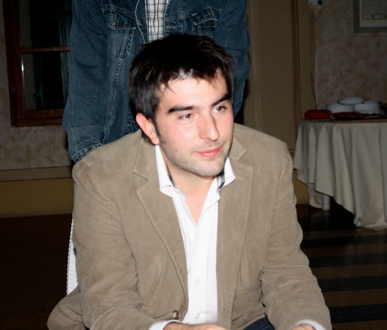 Stefano Debattisti合作论文数Dipartimento di Ingegneria dell'Informazione,Università degli Studi di Parma1




