Let E-/Q be an elliptic curve of conductor N and let f be the weight 2 newform on Gamma(0)(N) associated to it by modularity. Building on an idea of S. Zhang, an article by Darmon, Rotger, and Sols describes the construction of so-called Chow-Heegner points, P-T,P- f is an element of E((Q) over bar), indexed by algebraic correspondences T subset of X-0(N) x X-0(N). It also gives an analytic formula, depending only on the image of T in cohomology under the complex cycle class map, for calculating P-T,P- f numerically via Chen's theory of iterated integrals. The present work describes an algorithm based on this formula for computing the Chow-Heegner points to arbitrarily high complex accuracy, carries out the computation for all elliptic curves of rank 1 and conductor N < 100 when the cycles T arise from Hecke correspondences, and discusses several important variants of the basic construction.
It is known that innitely many number elds and function m over Fq(T ) with class number indivisible by an arbitrary prime '. We give an explicit description of those primes (and prime powers) q for which the result holds. For the special case where ' = 3 and m = 2, we recover Ichimura's result.
Let (T, M) be a complete local (Noetherian) ring such that dim T >= 2 and vertical bar T vertical bar = vertical bar T/M vertical bar and let {p(i)}(i is an element of J) be a collection of elements of T indexed by a set J so that vertical bar J vertical bar < vertical bar T vertical bar. For each i is an element of J, let C(i) := {Q(i1), ... , Q(ini)} be a set of nonmaximal prime ideals containing p(i) such that the Q(ij) are incomparable and p(i) is an element of Q(jk) if and only if i = j. We provide necessary and sufficient conditions so that T is the m-adic completion of a local unique factorization domain (A, m), and for each i is an element of J, there exists a unit t(i) of T so that p(i)t(i) is an element of A and C(i) is the set of prime ideals Q of T that are maximal with respect to the condition that Q boolean AND A = p(i)t(i)A.We then use this result to construct a (nonexcellent) unique factorization domain containing many ideals for which tight closure and completion do not commute. As another application, we construct a unique factorization domain A most of whose formal fibers are geometrically regular.
Let T be a complete local (Noetherian) ring with maximal ideal M, P a nonmaximal ideal of T, and C = {Q(1), Q(2),...} a (nonempty) finite or countable set of nonmaximal prime ideals of T. Let {p1, p2, ...} be a set of nonzero regular elements of T, whose cardinality is the same as that of C. Suppose that p(i) is an element of Q(j) if and only if i = j. We give conditions that ensure there is an excellent local unique factorization domain A such that A is a subring of T, the maximal ideal of A is M boolean AND A, the (M boolean AND A)-adic completion of A is T, and so that the following three conditions hold: (1) pi. A for every i; (2) A boolean AND P = (0), and if J is a prime ideal of T with J boolean AND A = (0), then J subset of P or J subset of Q(i) for some i; (3) for each i, p(i)A is a prime ideal of A, Q(i) boolean AND A = p(i)A, and if J is a prime ideal of T with J not subset of Q(i), then J boolean AND A not equal p(i)A.
 Susan Loepp合作论文数2
 Adam Boocher合作论文数University of Notre Dame2Natee Pitiwan合作论文数1
 Michael Rosen合作论文数1
 Mona Merling合作论文数Department of Mathematics, School of Arts & Sciences, University of Pennsylvania1
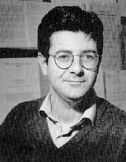 Henri Darmon合作论文数Department of Mathematics,McGill University1Paul A. Woodard合作论文数1Jaclyn Lang合作论文数1
 Allison M. Pacelli合作论文数1
 Víctor Rotger合作论文数Department of Mathematics, Universitat Politècnica de Catalunya1
 H. Lindo合作论文数1Ryan K. Johnson合作论文数1




