We present a comprehensive description of petrologic, chemical and spectroscopic features of thermally metamorphosed CI-like and CM (and CM-like) chondrites. Only two such CI chondrites have so far been discovered i.e. Y-86029 and Y-82162. Thermal metamorphism in these chondrites is apparent in their low contents of H2O, C and the most thermally labile trace elements, partial dehydration of matrix phyllosilicates and abundance of thermally decomposed Ca-Mg-Fe-Mn carbonates, which apparently resulted from heating of Mg-Fe carbonate precursors.The CM chondrites exhibit a wide range of aqueous and thermal alteration characteristics. This alteration was almost complete in Y-86720 and Y-86789, which also escaped alternating episodes of oxidation and sulfidization experienced by the others. Thermal metamorphism in the CM chondrites is apparent in loss of thermally labile trace elements and also in partial to almost complete dehydration of matrix phyllosilicates: heating was less uniform in them than in CI chondrites. This dehydration is also evident in strength and shapes of integrated intensities of the 3 mu m bands except in PCA 91008, which experienced extensive terrestrial weathering. Tochilinite is absent in all but Y-793321 probably due to heating. Textural evidence for thermal metamorphism is conspicuous in blurring or integration/fusion of chondrules with matrix in the more extensively heated (>= 600 degrees C) CM chondrites like PCA 91008 and B-7904. TEM and XRD analyses reveal that phyllosilicate transformation to anhydrous phases proceeds via poorly crystalline, highly desiccated and disordered 'intermediate' phases in the least and moderately heated (400-600 degrees C) carbonaceous chondrites like WIS 91600, PCA 91008 and Y-86029. These findings are significant in that they confirm that these phases occur in meteorites as well as terrestrial samples.Thermal alteration in these meteorites can be used to identify other carbonaceous chondrites that were thermally metamorphosed in their parent bodies. Combining RNAA trace element data for experimentally heated Murchison CM2 samples with petrographic and spectroscopic data, these thermally metamorphosed carbonaceous chondrites can be ordered by severity of open system heating as 400 degrees C <= Y-793321 < WIS91600 = EET90043 = A881655 < PCA91008 < B-7904 = Y-86029 < Y-82162 < Y-86720 = Y-86789 >= 700 degrees C. Nearly all heated carbonaceous chondrites discovered so far have been found in Antarctica, which is known to have sampled the flux of near-Earth material for much longer than exemplified by current falls. Published by Elsevier Ltd.
Oxygen isotope and trace element data for 13 samples of the Kaidun chondritic breccia reaffirm the complex polymict nature of this unique meteorite. Bulk Kaidun samples most closely resemble CR chondrites, but the matrix is CI-like. Two separated clasts are CR-like but have some properties that resemble CM, two clasts are enstatite chondrites (one EL and one EH), one clast is an aubrite-like metal-rich impact melt, and one clast is a unique layered olivine-bearing pyroxenite with the isotopic composition of an aubrite. Yet, although each clast resembles a known meteorite group, all deviate in some respect from the norms for those groups. Collectively, Kaidun has sampled materials not yet represented in the world meteorite collections and which greatly extend the definitions of known meteorite groups. Phyllosilicates in Kaidun span a very wide range in composition and vary from clast to clast, suggesting that the aqueous alteration experienced by the clasts predated assembly of the Kaidun parent body.
We report data for 14 mainly labile trace elements (Ag. Au, Bi, Cd, Cs, Ga, In, Rb, Sb, Se, Te, Tl, U, and Zn) in eight whole-rock lunar meteorites (Asuka [A-] 881757, Dar al Gani [DaG] 262, Elephant Moraine [EET] 87521, Queen Alexandra Range [QUE] 93069, QUE 94269 QUE 94281, Yamato [Y-] 793 169, and Y-981031), and Martian meteorite (DaG 476) and incorporate these into a comparative Study of basaltic meteorites from the Moon, Mars, and V-type asteroids. Multivariate Cluster analysis of data for these elements in 14 lunar, 13 Martian, and 34 howardite. eucrite, and diogenite (HED) meteorites demonstrate that materials from these three parents are distinguishable using these markers of late, low-temperature episodes. This distinguishability is essentially as complete as that based on markers of high-temperature igneous processes. Concentrations of these elements in 14 lunar meteorites are essentially lognormally distributed and generally more homogeneous than in Martian and HED meteorites. Mean siderophile and labile element concentrations in the 14 lunar meteorites indicate the presence of I CI-equivalent micrometeorite admixture of 2.6%. When only feldspathic samples are considered. Out data show I slightly higher value of 3.4% consistent with an increasing micrometeorite content in regolith samples of higher maturity. Concentrations of labile elements in the 8 feldspathic samples hint at the presence of a fractionated highly labile element component, possibly volcanic in origin, at I level comparable to the micrometeorite component. Apparently, the process(es) that contributed to establishing lunar meteorite siderophile and labile trace element Contents Occurred in a system open to highly labile element transport.
Meteorites, which come mainly from various asteroids but also from Mars and our Moon, provide otherwise unobtainable information about objects in the inner Solar System in both space and time. The presence of meteorites on Earth allows application of the full gamut of instrumentation able to analyze materials from the asteroids (minor planets), Mars and the Moon with state of the art sensitivity and accuracy. Many meteorites include material that condensed and accreted in the primitive Solar nebula and were subsequently unaltered: some contain evidence for pre-Solar nuclear processes. Information in meteorites tracks the evolution of their parent bodies, both interiors and surfaces, the impacts that ejected them and the nuclear radiation history that occurred as they travelled Earthward. Meteoritic material also allows the dating of all of these episodes and determination of the composition of the Sun's surface and the particles streaming from it. This chapter is a brief tutorial outlining this information and indicating how it is obtained.
We report RNAA results for Co, Au, Sb, Ga, Rb, Cs, Se, Ag, Te, Zn, In, Bi, Tl and Cd (in increasing order of metamorphic mobility) in 22 Antarctic unequilibrated ordinary chondrites (UOC). This brings to 38 the number of UOC for which data for highly volatile elements are known. For elements of lesser mobility (Co to Se, omitting Cs) overall variability in UOC are low, relative standard deviations (one sigma) being no more than a factor of two. For Ag, Te and Zn, relative standard deviations are 2–4×, while for Cs and the four most volatile elements, the variabilities are 8–110×. Elemental abundances do not vary with chemical type (H, L and LL) nor with UOC subtype (3.0–3.9). Contents of all elements reach levels up to, even exceeding, cosmic and all but Cd and the two alkalis, seem unaffected by post-accretionary processes. Contents of highly volatile elements are consistent with the idea that source regions producing contemporary falls and older Antarctic UOC differed in thermal histories. The presence or absence of carbide magnetite assemblages (CMA) generally accords with high or low Cd contents, respectively. This relationship accords with the prior suggestion that CMA formed by alteration of Fe–Ni metal by C–O–H-containing fluids at temperatures <700 K, generated by thermal metamorphism in parent body interiors. The absence of CMA in most UOC (and OC), may indicate that they were subsequently destroyed as metamorphic intensity increased. The high, often supercosmic, Rb and Cs levels in UOC may result from their high solubility in liquid water signalling their redistribution by C–O–H-containing fluid while in the liquid water field. Because of its uniquely high mobility, Cd could have been enriched by the C–O–H fluids and should have been lost from parent regions during later, higher temperature anhydrous metamorphism at temperatures in the 500–600 °C range.
Mineral grains and matrix of heated chondrites Yamato (Y)-82162, Belgica (B)-7904, Y-86720, and Asuka (A)-881655 were examined for major elements and, where appropriate, phyllosilicate and matrix samples were characterized by TEM. CM chondrites A-881655 and B-7904 were only partially aqueously altered before thermal metamorphism initiated dehydration and recrystallization. Tochilinite is absent in both A-881655 and B-7904 probably due to mild thermal metamorphism. Phyllosilicates in B-7904 are dehydrated but not completely recrystallized to olivine and pyroxene. Y-86720 experienced a history very different from other CM chondrites: its chondrules and other coarse-grained components were completely altered by aqueous fluids. Fine-grained olivine was subsequently replaced during an episode of thermal metamorphism producing compositions near Fo10 and complete destruction of serpentine occurred. Y-82162 comes from a CI parent and is characterized by complete destruction of preexisting anhydrous silicates during aque ous alteration. Subsequent heating at 600-700° C resulted in dehydration of phyllosilicates. The matrix contains abundant fine-grained olivine which would not likely survive the original aqueous alteration and therefore must have been formed by phyllosilicate metamorphism. Alternating episodes of oxidation and sulfidization following aqueous alteration are evident in all but Y-86720. Either Y-86720 escaped an oxidizing event or effects of such an event were obliterated by later sulfidization. Based on RNAA data for thermally mobile trace elements in them and in Murchison CM2 samples heated for one week at 500° , 600° , and 700° C under conditions reasonable for interiors of primitive parent bodies, the four thermally metamorphosed carbonaceous chondrites can be ordered by the severity of open-system heating as 500° ::::::A-88165S<B-7904 <Y-82162<Y-86720S700° C. Petrographic studies of these meteorites indicate that each bears the signature of a unique sequence of oxidation/reduction/hydration episodes followed by a late stage thermal metamorphic event which occurred in an asteroidal setting, on at least two separate asteroids (the CM and CI parent bodies). Thermal alterations in these meteorites can be used to identify other carbonaceous chondrites that experienced thermal metamorphism in their parent bodies. Interestingly, all thermally metamorphosed carbonaceous chondrites identified to date were found in Antarctica, mainly in Queen Maud Land, and none are observed falls. Apparently, carbonaceous chondrite parent sources sampled in near-Earth space in the past, differ from those being sampled by the Earth today. * To whom correspondence should be addressed.
Estimates of the oxygen fugacity of the source regions of martian shergottites are obtained from coexisting Fe-Ti oxides and from Fe3+/Fe2+ ratios in pyroxenes. These estimates are one to four log10 units lower than previously reported values, and indicate that the shergottite source region has an oxidation state about two or three orders of magnitude below the quartz-fayalite-magnetite (QFM) oxygen reference buffer. An approximation of the major element composition of the shergottite source region is obtained utilizing the MELTS petrologic modeling software. A bulk composition of the shergottite source region is derived, which is consistent with the generation of sher-gottites upon 3% partial melting at 10 kbar. This composition is decidedly less enriched in Na2O and FeOTot than previous estimates. When compared to the bulk composition of the terrestrial mantle, the source region of the shergottites is lower in CaO, Al2O3, Na2O and TiO2, and higher in MgO.
 Michael Zolensky合作论文数NASA Johnson Space Center, NASA Astrobiology Institute;NASA Stardust, Hayabusa and Spacecraft Microimpact Samples12
 minshu wang合作论文数8
 Harry Y. McSween合作论文数Department of Earth, Environmental, and Planetary Sciences, College of Arts and Sciences, The University of Tennessee, Knoxville7
 David W. Mittlefehldt合作论文数NASA Johnson Space Center6Ming-Sheng Wang合作论文数6
 Takahiro Hiroi合作论文数Department of Geological Sciences;Brown University6
 Eric Tonui合作论文数5Mohammed Ikramuddin合作论文数5Marilyn M. Lindstrom合作论文数5w p kaczaral合作论文数4Rm Verkouteren合作论文数4Ted J. Huston合作论文数4
 Stephen Frederic Wolf合作论文数4Stephen D. Matza合作论文数4Jane E. Dennison合作论文数4Patrick W. Kaczaral合作论文数4C.M Binz合作论文数4Robert T. Dodd合作论文数4e j dennison合作论文数3
 Carle M Pieters合作论文数Department of Earth, Environmental, and Planetary Sciences, Brown University3
 Mingsheng Wang (王鸣生)合作论文数College of Materials, Xiamen University;Pen-Tung Sah Institute of Micro-Nano Science and Technology , Xiamen University3Toshiko K. Mayeda合作论文数3Solomon Gartenhaus合作论文数3
 Robert W. Clayton合作论文数Geophysics, Division of Geological and Planetary Sciences, California Institute of Technology3T. E. Ferko合作论文数3
 Richard Sack合作论文数OFM Research, Inc.3Jennifer Mokos合作论文数2a v jain合作论文数2E. Michlovich合作论文数2r r martinez合作论文数2Sf Wolf合作论文数2Dw Lingner合作论文数2r hutchison合作论文数2l schultz合作论文数2Stephan Vogt合作论文数2
 Edward Anders合作论文数University of Chicago2
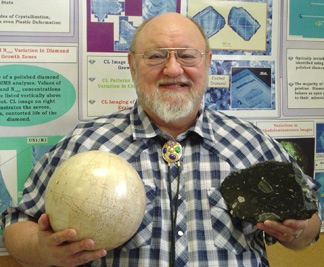 Lawrence A. Taylor合作论文数Department of Earth and Planetary Sciences, The University of Tennessee2
 D. Elmore合作论文数2Ian M. Steele合作论文数2Derek W. G. Sears合作论文数2Michail I. Petaev合作论文数2Jagdish C. Laul合作论文数2Gregory F. Herzog合作论文数2Edward J. Olsen合作论文数2
 Mark Ghiorso合作论文数Department of Earth and Space Sciences, College of the Environment, University of Washington2S. Vogt合作论文数2
 Everett Gibson合作论文数Department of Chemistry. Douglass College, Rutgers University2william a cassidy合作论文数2Roy S. Clarke合作论文数Division of Meteorites, Smithsonian Institution2




