This paper aims to present a framework for analysing network resource trading between operators. We present the results for the case of orthogonal inter-operator spectrum sharing as a sub-case of the network resource trading between operators. A two-operator, two-cell scenario has been considered. Operators share bandwidth orthogonally using standard LTE technology, detailed in the paper. An operator can post resources to a local market (neighbouring cells) for trading them with other operators. We were interested in identifying the duration of the resource trading contracts for trading, which would provide throughput gains. Simulations show up to 30% increase of user throughput and a more efficient use of spectrum if we do not consider any monetary cost or value in the model. In a separate idealised scenario, throughput gains of up to 80% are reported.
The IEEE Dynamic Spectrum Access (DSA) Networks Standards Committee (DySPAN-SC) and associated IEEE 1900 working groups are concerned with the standardization of aspects of DySPAN and related technologies such as DSA, Cognitive Radio, and TV white space (TVWS), among others. This chapter overviews IEEE DySPAN-SC and the IEEE 1900 standards working groups, as well as the underlying standards that have been or are being developed in those working groups. A particular aim is to provide detailed commentary on the scopes and purposes of the IEEE 1900 standards, as well as some of the underlying technical solutions that are assumed therein.
This article describes advances in regulation, standardization and research for Licensed Shared Access (LSA) in Europe and in USA. Different approaches for defining the spectrum sharing access system are taken by the European Standardization Institute (ETSI) focusing on a 2 tier access hierarchy and by the Federal Communications Commission (FCC) authority in USA focusing on a 3 tier access hierarchy. As shown in regard to the architecture design, LSA identifies a viable candidate for both approaches in that it supports different spectrum sharing modes such as static, semi-static and dynamic sharing.
This article presents the latest status and achievements of the IEEE Communication Society (ComSoc) Standards for Dynamic Spectrum Access Networks (DYSPAN), formerly IEEE Standards Coordinating Committee 41, that develops standards in the areas of dynamic spectrum access, cognitive radio, interference management, coordination of wireless systems, advanced spectrum management, and policy languages for next generation radio systems under the sponsorship of the IEEE communications society. The article also envisions future directions for the DYSPAN Committee. This paper represents the personal opinion of the authors, not the official opinion of the IEEE ComSoc DYSPAN standards committee.
This paper addresses the current regulatory framework, research activities and standardization efforts towards a shared use of radio spectrum in the European Union. Two main research streams are considered: The emerging concept of Licensed Shared Access that ensures a predictable Quality of Service for secondary users of spectrum and the opportunistic Device-to-Device communications that represent a recent and enormous socio-technological trend. The paper presents also research results that support the spectrum sharing standardization path in ETSI and 3GPP.
This paper addresses the current regulatory framework, main research activities and standardization efforts towards a shared use of radio spectrum in the European Union. A survey of emerging spectrum sharing applications and associated standardization paths is described. Remaining challenges for an effective participation of research projects in Cognitive Radio standards are discussed. A new coordination action funded by the European Commission that aims to boost standardization impact of research projects working on cognitive radio and spectrum sharing aspects is presented.
We study perfect error correcting codes in which the codewords are protected by Hamming spheres of distinct protective radii. These codes have been introduced by Cohen, Montaron and Frankl [3, 4, 10].We are interested in a special class of these codes, namely the strongly tactical ones, introduced in [6]. There are relations with uniformly packed codes [11]. We give conditions on the existence of strongly tactical codes, in particular a generalization of Lloyd's Theorem, and use these conditions to prove some characterization theorems. In particular, we shall characterize the punctured Golay codes and an infinite class of strongly tactical codes.
 Paulo Marques合作论文数Inst Politecn Castelo Branco IPCB5
 Dominique Noguet合作论文数5
 Jonathan Rodriguez合作论文数Faculty of Computing, Engineering and Science, University of South Wales;Instituto de Telecomunicações;University of Bradford4Philippe Delahaye合作论文数3
 Klaus Mößner合作论文数Technische Universität Chemnitz;University of Surrey3
 Simon Delaere合作论文数3
 Dionysia Triantafyllopoulou合作论文数Department of Informatics and Telecommunications, University of Athens3axel heinstein合作论文数2werner haeming合作论文数2stefan unland合作论文数2martin ludwig合作论文数2benoit lecroart合作论文数2Hiroshi Harada (原田浩)合作论文数Graduate School of Medical and Faculty of Medicine, Kyoto University2
 Albrecht Beutelspacher合作论文数Mathematisches Institut, Universität Gießen2
 Oliver Holland合作论文数Centre for Telecommunications Research;College London;University of London;King ' s College London, University of London2
 Seungwon Choi合作论文数Department of Electronic Engineering, College of Engineering, Hanyang University2
 Ayman Radwan合作论文数Queen's University2Bernd Bochow合作论文数Fraunhofer Institute for Open Communication Systems2Stanislav A. Filin合作论文数Natl Inst Informat & Commun Technol2
 Masayuki Ariyoshi合作论文数2
 Markus Mueck合作论文数2
 Shahid Mumtaz合作论文数Nottingham Trent University2Joan Triay合作论文数1Ben Smith合作论文数1michele berionne合作论文数1Marcello Pagnozzi合作论文数1Adrian Minder合作论文数1Wolfgang Krammer合作论文数1Francois Ambrosini合作论文数1IBIT Ambrosini合作论文数1Zhongfeng Zhang合作论文数1
 Daejin Kim合作论文数1Matthew Sherman合作论文数1Markwart, C.合作论文数1Hofmann, J.合作论文数1
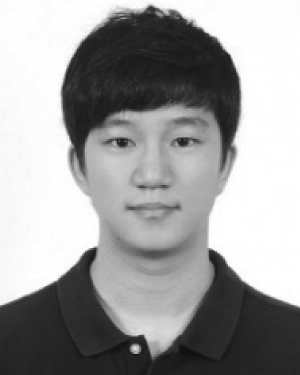 Heungseop Ahn合作论文数1
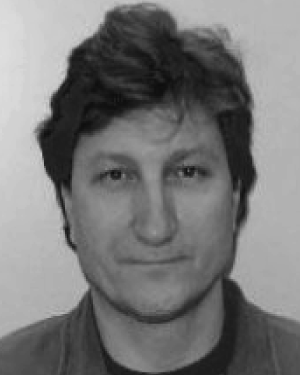 Vladimir Ivanov合作论文数1
 Matti Hämäläinen合作论文数Centre for Wireless Communications, University of Oulu;Faculty of Information Technology and Electrical Engineering, University of Oulu1Paul Bender合作论文数Qualcomm1
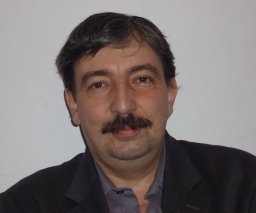 Bruno Chatras合作论文数Orange Labs1
 Lorenzo Mucchi合作论文数university of florence1Maximilian Riegel合作论文数1Yohannes Alemseged Demessie合作论文数1
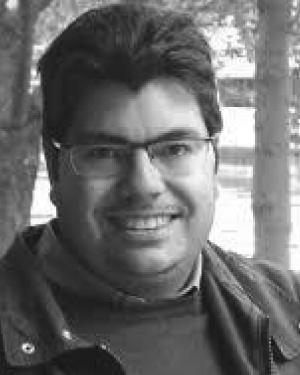 Marc Girod-Genet合作论文数Groupe des Ecoles des Télécommunications – Institut National des Télécommunications1
 Lynn M. Grande合作论文数General Dynamics C4 Systems1
 Tuomas Paso合作论文数1Ha Nguyen Tran合作论文数1Eiman Mohyeldin合作论文数1
 Adrian Kliks合作论文数Chair of Wireless Communications, Poznan University of Technology1




