This investigation centers on the dynamics of droplet breakup influenced by cavitation under high-velocity shock waves, utilizing detailed multiphase computations through Star-CCM+. The study specifically models the interaction of Mach 2.4 and Mach 5 shock waves with 2mm diameter droplets, employing the Volume-of-Fluid and Full Rayleigh-Plesset cavitation models. Two distinct simulation scenarios were examined: a cavitating scenario using a seed density of 1*10^12 m^-3 and a seed radius of 2.3*10^-5 m, and a non-cavitating scenario with a seed density of 1*10^7 m^-3 and a seed radius of 1*10^-7 m. The results indicate that at Mach 2.4, below the critical cavitation Mach number, the impact of cavitation on droplet breakup is minimal, with a cavitating volume fraction of merely 1.9*10^-3. In this regime, the breakup is primarily influenced by surface phenomena, such as sheet stripping. However, at Mach 5, above the critical threshold, the cavitation effect becomes substantial, with a maximum vapor volume fraction of 0.327, significantly altering the droplet's behavior. This scenario suggests the potential initiation of jetting processes, frequently observed in droplet cavitation applications. The study provides insights into the immediate consequences of shock wave-induced cavitation on droplets, elucidating the complex interplay between cavitation, droplet deformation, and breakup patterns. Future work will focus on increasing the cavitation volume fraction for a more accurate representation of droplet behavior during atmospheric entry. The model will be expanded to include a wider range of wave speeds and to examine interactions with both normal and oblique shocks. These advancements are expected to deepen the understanding of droplet-vehicle interactions in high-speed aerodynamic environments, particularly in the context of varying shock wave intensities and orientations.
The deformation and breakup of water droplets impacted by a shock wave has been largely attributed to surface mechanisms. This study investigates the possibility of cavitation-induced droplet breakup. Shock waves of Mach 4 are used in this study to impact groups of droplets, both groups of degassed droplets and a group of non-degassed droplets. Distilled water droplets on the order of 1-3 mm in diameter are introduced into the shock tube. High speed images and deformation plots are used to explore the existence of cavitation in the droplets, as well as how they deform comparatively.
High-speed projectiles can be severely damaged by raindrops, but the loading they experience can be decreased if the droplet breaks up when it is hit by the projectile’s shock wave. When the shock wave impacts a droplet, it creates a region of low pressure which can create conditions that drive cavitation. Such a phenomenon drives potential for a new droplet breakup mechanism. Our ongoing hypothesis involves that the cavitation bubbles can perturb the droplet interface and excite Kelvin-Helmholtz instabilities leading to faster breakup mechanisms. A compressible numerical model is developed to study the effects of bubble dynamics on the inception of Kelvin-Helmholtz-type interfacial instability. First, the bubble dynamics and Kelvin-Helmholtz instability wave growth are validated independently. Additionally, the interaction of the cavitating bubble with an interface are benchmarked using experimental data. Then, a velocity field is introduced to demonstrate the growth of a Kelvin-Helmholtz instability due to a cavitation bubble. The results indicate that a perturbation on an air-water interface caused by a cavitation bubble can lead to the development of Kelvin-Helmholtz instabilities.
The Dragonfly mission, aimed at exploring Titan's carbon chemistry and biosignatures, presents unique challenges due to Titan's distinct atmospheric conditions. This study contrasts Computational Fluid Dynamics (CFD) simulations with experimental data from NASA Langley's 14-By-22-Foot Subsonic Tunnel, focusing on a half-scale model of Dragonfly. Despite the efficacy of wind tunnels, replicating Titan's environment is complex, leading to reliance on CFD for comprehensive understanding. However, CFD faces limitations, including computational constraints and lack of existing validation data. This research aims to quantify CFD model uncertainties against wind tunnel experiments, enhancing model validation and informing engineering decisions to aid in the rapid development of the Dragonfly vehicle.
This effort aims to understand the complex dynamics of a hypersonic shock interacting with a cylindrical water column through numerical simulations using a commercial Computational Fluid Dynamics (CFD) code, STAR-CCM+. The planar shock was Mach 5 impacting a 22mm cylindrical water column. Utilizing the Schneer-Sauer cavitation model, the simulations compare scenarios with and without cavitation modeling. The research highlights how the formation of a vapor cloud alters the pressures inside a cylindrical water column.
This research explores the application of computational fluid dynamics (CFD) for simulating the impact of aerodynamic heating on design efforts. The initial investigation illustrates the efficacy of employing a computational approach to analyze various geometries and flow conditions. Specifically, CFD is utilized to examine the aerodynamics of a blunt cone, double cone, and hypersonic leading edge subjected to a varying heat source along the flow/body boundary. The study confirms that maximum thermal loading occurs at the stagnation point, consistent with prior findings. To compare results across cases, measurements are taken for boundary layer thickness and shock standoff distance at the stagnation point. Parameters such as temperature and pressure provide insights into shock and boundary layer distances, revealing how heat flux influences layer displacement from the body and narrows regions as the flow cools. In the case of the more intricate double cone geometry, adiabatic flow reveals two shocks. However, an increase in heat flux pushes the shock layer further from the body until the shocks merge, resulting in drag reduction across the body. This simulates a scenario akin to an ablative heat shield undergoing combustion. In summary, simpler designs are less susceptible to the influence of heat flux, while more complex designs and regions necessitate consideration of heat flux—potentially leveraging it to enhance aerodynamic design.
Aluminum powder has been commonly used as the energetic material in solid propellants due to its high energy density. However, in actual combustion scenarios, not all aluminum powder is able to completely burn before reaching the nozzle, owing to the complicated physics of aluminum combustion. Due to this complexity, many studies have relied on analytic solutions instead of directly solving the Navier-Stokes equations. These earlier studies exhibit limitations, such as the inability to explain mass and heat transfer occurring at the interface or simulate 3-D fluid dynamics. In this study, the Volume of Fluid (VOF) method was employed to conduct direct numerical simulations of aluminum droplet evaporation. Subsequently, the developed model was compared and assessed against the evaporation model provided by the Lagrangian solver.
Previous research has identified a potential link between the development of osteoporosis in microgravity conditions and a decrease in fluid shear stress, affecting nutrient distribution and bone remodeling within interstitial fluid. The focus of this study aims to explore the impact of microgravity on bone loss in astronauts, establishing the connection between the lack of mechanical loading and reduction of fluid stress. Computational Fluid Dynamics (CFD) techniques are used to analyze the behavior of the interstitial fluid in the trabecular bone and the transportation of nutrients in the canalicular system.
Transpiration cooling has renewed interest of study as a renewable system of thermal protection for atmospheric entry systems. The presence of coolant within the void space of a porous material changes its effective porosity and theorized to lend the external heatshield as a potential means of porous surface control. Effective porosity is explored in two forms: saturation of void space where exiting coolant creates 'blowing' over the surface, and partial evacuation of the void space where withdrawal of the coolant creates 'suction' on the surface. Thus this study evaluates using transpiration cooling as a as means of active aerodynamic control. The feasibility of the system is evaluated numerically using Reynolds-averaged Navier Stokes based computational fluid dynamics for the aerodynamic assessments by coding source terms of transpiration cooling products at a heat shield surface boundary at the wind side shoulder, creating an asymmetric scheme. Study results show induced moments about the pitch axis incurred following the source terms of a cooling fluid at a near-shoulder location on the heat shield. Lift and drag saw increasing modulation with increase in mass flux rate. Pitch moment was altered a total of 388 N-m between lowest and highest 'suction' rates and changed 194 N-m maximum between 'blowing' rates.
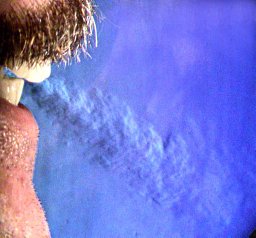
The present study explored the relationship between airborne transmission and the saliva fluid properties of a human sneeze. Specifically, we aimed to understand if altering the saliva and its relationship to droplet breakup and stability can affect its transmission characteristics. The study aimed to answer this question using computational fluid dynamics, specifically, a hybrid Eulerian–Lagrangian model with a Spalart–Allmaras, detached eddy simulation turbulence model. The effort focused on a scenario with a sneeze event within a ventilated room. The study found that for sneezes, secondary breakdown processes are important. Thicker saliva that increased the Ohnesorge number displayed a clear resistance to aerosolization due to stabilized secondary breakup, leading the bulk of the drops having high settling rates that are less likely to drive airborne transmission. For instance, the use of xanthum gum, which increased the saliva viscosity by 2000%, reduced the formation of aerosols. Additionally, another class of modifiers that reduce saliva content was studied, which was also effective in reducing airborne transmission drivers. Zingiber, which reduced the saliva content, reduced the formation of aerosols. However, when considering the overall reduction in droplet volume, saliva modifiers such as cornstarch, xanthum gum, and lozenges increased the mean droplet size by 50%, 25%, and 50%, respectively, while reducing the overall droplet volume by 71.6%, 71.2%, and 77.2%, respectively. Conversely, Zingiber reduced the mean droplet size by 50% but increased the overall droplet volume by 165.7%. Overall, for this type of respiratory event, this study provides insight into the potential for modifying saliva characteristics that may impact airborne transmission and could introduce new tools for reducing airborne pathogen transmission.
Sprayed liquid flap (SLF) is a novel powered-lift concept that utilizes an atomized liquid spray as a jet flap. Similar to a jet flap, SLFs modulate the flow and aerodynamics using a jet expelled on the pressure surface. However, SLFs differ through two mechanisms: 1) the liquid density is two orders of magnitude larger than the ambient air, and 2) the SLF medium has a porous-like character. The present effort explores SLFs using computational fluid dynamics at a state before experiments and therefore relies on benchmarks of underlying physics associated with a liquid-jet in crossflow. The studies evaluate flow rates, SLF positioning, and configurations spanning a range of flow conditions. The present investigation shows that SLFs can provide lift control combined with drag reduction with potential for application in aircraft. Additionally, the present study demonstrates that SLFs operate as a flow control device, not propulsion. Besides two-dimensional analysis, the SLF concept was investigated in three dimensions, which showed good consistency in potential applications despite three-dimensional effects on the SLF. Overall, this effort indicates the clear potential of a novel flow powered-lift control device useful for a range of aerodynamic applications.
Launching in highly constrained environments such as battlefields and undersea requires aerial vehicles to reconfigure rapidly and radically. Deployable structures present an effective solution to package aerodynamic surfaces for launch and expand midair for cruise without the need for actuation. Here, we propose to exploit an elastic instability adopted by insects in wing folding to achieve tight packaging and fast deployment in propeller blades. The instability is imparted into the blade structure by introducing slits and making the cross-section open. Through folding and deployment experiments, we demonstrate that open-section blades exhibit compliant post-buckling response that allows extensive folding and rapid unfolding behavior solely driven by strain energy. Propeller thrust test results show that the proposed blade retains sufficient stiffness in the pre-buckled state to resist aerodynamic loads and generates the same thrust performance as solid blades. These findings pave the way for next-generation aircraft that employ long-span deployable surfaces to enable flexible launching or take-off while achieving aerodynamically efficient flight.
CMAS, a category of atmospheric debris, causes erosion of thermal barrier coatings in aircraft engines. The CMAS melts, and infiltrates the microstructure of these coatings. Understanding this infiltration process is key to develop methods to prevent infiltration and mitigate damage to the coating. Conventional wisdom classifies the infiltration process as a capillary-driven flow. To evaluate this conventional wisdom, the process was directly resolved numerically using a finite-volume, multiphase, volume-of-fluid simulation. Results from this simulation method were compared to experiments and analytical models. Results show that the Ohnesorge Number drives the equilibrium point of the capillary-driven flow, where larger Ohnesorge Number lead to shorter infiltration depth. The results disagreed with experiments and the analytical pipe models, but agreed well with a differential equation model based on capillary flow in a rectangular microchannel, and a new proposed model that is tuned specifically for feathery coating geometries. This finding supports the idea that capillary flow is not the only dominant feature in the infiltration process, and other phenomenon, such as chemical processes, may have first-order effects on the flow physics. However, these findings highlight the fact that, if materials scientists can find a way to increase the effective viscosity of the infiltrating material, they can reduce infiltration depth, and preserve the coating for longer.
The Sprayed Liquid Flap (SLF) is a novel powered lift concept which relies on atomized liquid jets to modify the external aerodynamics about a lifting surface. Assessments of SLF to date have used an Euler-Euler model to provide initial performance predictions. Such a model may have inherent gaps in the detailed aerodynamic interactions associated with spray structure, droplet break-up/coalescence, and spray-wake dispersion. Such aerodynamic features are evaluated in this work. This research finds that when SLF concepts are explored with a higher fidelity Euler-Lagrange method, some of its benefits are reduced. Specifically, the results found that across a range of jet momentum coefficients, the aerodynamic lift is up to 3.7% reduced, and drag is up to an order of magnitude increased compared to the previously used Euler-Euler approach. Overall, the results continue to show that SLFs have potential as a powered lift concept and indicate promise in the device.
The Dragonfly mission has the scope of studying the surface of Titan, Saturn’s largest moon, using a rotorcraft lander. A mission-critical event in the timeline involves Dragonfly’s initial flight as it descends into Titan’s atmosphere. The preparation for this initial flight involves releasing the heat shield and utilizing the lander’s rotors to damp motion while still attached to the parachute-supported aeroshell to ensure a smooth release. The aerodynamics of this event are studied in Titan conditions using high-fidelity computational fluid dynamics (CFD). The CFD model is benchmarked using available experimental measurements relevant to subcomponents of the event and include: (1) an open backshell, (2) bluff bodies similar to the Dragonfly fuselage, and (3) a rotor-body interaction from a helicopter rotor. The CFD results correlate well with measurements to provide confidence in the present studies focused on Titan. The novel studies presented in this work focus on the rotor-based control of the lander-backshell combination and its ability to mitigate spinning about the main parachute support line. This effort finds that the relatively large fuselage combined with near-fuselage rotors (driven by aeroshell space limitations) drives an unexpected aerodynamic interaction between the rotor and fuselage. Specifically, we observe low-pressure zones on the fuselage adjacent to the rotor that create a “suction” force. This first-order force creates an unexpected aerodynamic interaction that demands careful attention. In this paper, this force is documented and solutions are proposed to mitigate undesirable control character.
 Jules W. Lindau合作论文数Applied Research Lab;Pennsylvania State University;Applied Research Lab, Pennsylvania State University34
 Robert Francis Kunz合作论文数Applied Research Lab;Pennsylvania State University;Applied Research Lab, Pennsylvania State University23
 George Loubimov合作论文数University of Central Florida18
 Douglas Hector Fontes合作论文数Univ Cent Florida, Orlando, FL 32816 USA17
 Mark D Maughmer合作论文数Department of Aerospace Engineering, The Pennsylvania State University10
 Sven Schmitz合作论文数Department of Mechanical and Aeronautical Engineering, University of California9
 Eric G. Paterson合作论文数Applied Research Laboratory;Pennsylvania State University;Dynaflow , Inc;Applied Research Laboratory, Pennsylvania State University9Caroline Anderson合作论文数8
 Reed William Forehand合作论文数8Jackson Asiatico合作论文数8
 José Luis Palacios合作论文数8Wayne Farrell合作论文数7Adam Lavely合作论文数7Melissa Fronzeo合作论文数7
 Kareem A. Ahmed合作论文数University of Central Florida, University of Central Florida7
 Melanie Coathup合作论文数College of Medicine, University of Central Florida7
 James Brasseur合作论文数Ann and H.J. Smead Department of Aerospace Engineering Sciences, College of Engineering and Applied Science, University of Colorado Boulder7
 G. Vijayakumar合作论文数Space Physics Laboratory, Vikram Sarabhai Space Centre7
 Sheryl Grace合作论文数Department of Aerospace and Mechanical Engineering, Boston University7
 Brendon Cavainolo合作论文数University of Central Florida6David R. Hanson合作论文数6Nicolas Berube合作论文数5Sydney Briggs合作论文数5
 Jonathan Reyes合作论文数5
 Mahmoud Omer合作论文数College of Medicine, University of Central Florida5
 Ivan Kirschner合作论文数5
 Michael Krane合作论文数5
 Ranajay Ghosh合作论文数Department of Mechanical and Aerospace Engineering, University of Central Florida5
 Subith S. Vasu合作论文数Mechanical Engineering Department, Stanford University5Richard E. Kreeger合作论文数5Christine M Brown合作论文数4
 Andri Rizhakov合作论文数4Jose Urcia合作论文数4Michael J. Moeny合作论文数4Juanpablo Delgado合作论文数4
 Jason K. Cornelius合作论文数4
 Justin David Valenti合作论文数The, Pennsylvania State University4
 Bernhard Stiehl合作论文数Dept Mech & Aerosp Engn, Univ Cent Florida4
 Regis Thedin合作论文数Natl Renewable Energy Lab, Natl Wind Technol Ctr4
 Rajendra Shrestha合作论文数Univ Cent Florida4
 Julia A. Cole合作论文数Appl Res Lab, Penn State Univ4
 Samik Bhattacharya合作论文数4Ralph W. Noack合作论文数4Leonard J. Peltier合作论文数Applied Research Lab;Pennsylvania State University;Applied Research Lab, Pennsylvania State University4christian m sarofeen合作论文数3Luis Amaya合作论文数3Aaron Foster合作论文数3Christopher Ngo合作论文数3
 Phu Khanh Nguyen合作论文数Department of Aeronautical and Space Engineering, Hanoi University of Science and Technology3




