The first synthesis of the proposed structure of spermidine derived macrocyclic alkaloid celacarfurine is described. A versatile synthetic strategy has been developed based on sequential cascade ring expansion reactions, with high dilution conditions not needed for any of the steps. The same general strategy was also used to generate a series of macrocyclic analogues. The physical properties and spectroscopic data obtained for our synthetic product do not match those reported for the isolated alkaloid.
We report the design, synthesis, and characterization of a novel class of all-peptide macrocycles, Cyclo-Polyprolines (CP). Exploiting the precision of Fmoc-based solid-phase peptide synthesis (SPPS) and head-to-tail macrocyclization, this platform grants unparalleled control over the macrocycle's primary sequence and secondary structure, offering a viable route toward exo-/endo-functionalization and addressing a bottleneck of traditional synthetic host macrocycles. The resulting CP scaffold is highly amphiphilic, exhibiting excellent solubility in both organic and aqueous media. Structural analysis via NMR spectroscopy and single-crystal x-ray diffraction reveals a distinct chameleonic character: the macrocycle shifts from an all-junctions-cis conformation in organic solvents to a predominantly all-junctions-trans isomer in water. We demonstrate that this transition is driven by a cooperative hydration effect, wherein water molecules stabilize the expanded framework through precise two-point hydrogen bonding. Demonstrating responsive host-guest capabilities, CP undergoes induced-fit isomerization to bind ligands, successfully forming, among other species, an all-peptide pseudo-rotaxane. This methodology establishes a robust platform for creating functionalized, proline-based hosts with significant potential in medicinal chemistry, drug delivery, and organocatalysis, thereby bridging the gap between supramolecular systems and enzyme mimetics.
Elastically deformable molecular crystals are attractive for sensors, actuators, and flexible photonic devices, yet conventional tests such as three-point bending and nanoindentation probe only their anisotropic stress response, overlooking hydrostatic and interfacial stresses relevant to device operation. Here, we combine in situ high-pressure single-crystal X-ray diffraction with dispersion-corrected density functional theory to map, with atomic precision, the stress-dissipation mechanisms in a herringbone-packed, emissive crystal that bends elastically at ambient-pressure and guides light as a low-optical-loss single-crystal waveguide. The crystal can also withstand hydrostatic pressures of up to 3.63 GPa, among the highest recorded for elastically deformable molecular crystals. The material exhibits multicolor luminescence, a pronounced piezochromic color change under compression and robust emission over multiple bending cycles. Stress-normalized crystallographic analysis reveals a mode-dependent deformation mechanism. Under uniaxial bending, molecular tilting and pi & centerdot;& centerdot;& centerdot;pi ("beams") interactions dissipate the added stress across the crystal (similar to 11.5%& centerdot;GPa-1), whereas under hydrostatic compression, the weak C & horbar;H & centerdot;& centerdot;& centerdot;pi and C & horbar;H & centerdot;& centerdot;& centerdot;Br short contacts ("joints") absorb most of the added stress (-3%& centerdot;GPa-1 to -4%& centerdot;GPa-1) with negligible molecular tilt (similar to 0.8%& centerdot;GPa-1). Together, these insights establish a "beam-and-joint" design principle that connects supramolecular interactions to the observed optical and mechanical behavior, enabling the rational design of stress-tolerant multifunctional molecular crystals for high-pressure optoelectronic applications.
A metal-organic framework (MOF), UoB-200, with a necklace topology that exhibits rare 1D → 1D parallel interpenetration is reported. UoB-200 exhibits significant negative linear compressibility (NLC) over a pressure range up to 3.44 GPa. When pressure is applied, elongation along the crystallographic c axis is observed via a wine-rack mechanism. The experimental results are modelled by simulations, which closely reproduce the mechanical response and suggest that the presence of solvent within the UoB-200 pores has minimal impact on the NLC behaviour at comparatively low pressures.
Rb-based metal halide materials possess large attenuation coefficients and bright luminescence making them suitable as scintillators for X-ray detection.
Rb-based metal halide materials possess large attenuation coefficients and bright luminescence making them suitable as scintillators for X-ray detection. Here, we present the first report of an optimised anti-solvent synthesis method enabling gram-scale preparation of phase-pure Rb2AgX3, (X = Cl, Br) metal halides, which show broadband emission centred at 585 nm and 514 nm, respectively. We have identified solvent selection criteria that are broadly applicable to the synthesis of a wider variety of perovskite materials. This approach offers several advantages: reduced reaction temperatures, shorter reaction times, enhanced purity, and increased yields. Collectively, these improvements contribute to a more sustainable and scalable synthesis route. Rb2AgX3, (X = Cl, Br) metal halides report fast radiative recombination with typical decay times of sub-10 ns. Optical and radioluminescence measurements revealed halide-specific emission pathways with Rb2AgCl3 displaying superior emission intensities, whereas Rb2AgBr3 consistently elicited a stronger X-ray induced response. High pressure XRD studies measured bulk crystal moduli indicating that the Rb2AgCl3 crystal structure has a stiffer lattice than the Rb2AgBr3 analogue. Compressing pellets of polycrystalline Rb2AgX3 over a range of pressures (both at room temperature and 70 degrees C) confirmed this lattice stiffness trend and allowed for improvements in material densification and optical clarity at thicknesses of >250 & micro;m. The X-ray response of these pellets improved with increasing pressure for the bromide analogue underscoring the importance of microstructural control in enhancing scintillation efficiencies.
The long-range internal order or crystals allows most to exhibit a well-known and long-exploited phenomenon: birefringence. The simple assessment of the interaction of crystals with a polarised light source has guided the hand of many crystallographers through history in matters of crystal selection. Adapting the use of polarised light microscopy to a modern, small-molecule optimised, high-throughput workflow can allow for the more efficient screening of crystallisation space. In turn alleviating the analysis bottleneck previously encountered in parallel crystallisation techniques, such as encapsulated nanodroplet crystallisation (ENaCt). Presented herein are developments to an existing open-source imaging robot, including the novel integration of a commercial imaging device, and a new software suite for analysis. The open-source program
Co-crystals are composed of two or more chemically inequivalent molecular species, excluding solvents, generally in a stoichiometric ratio. Co-crystals are particularly important in pharmaceutical development, where a suitable co-crystal can significantly improve the physiochemical and pharmacokinetic properties of an active pharmaceutical ingredient. However, co-crystal discovery remains both practically challenging and resource intensive, requiring the extensive searching of complex experimental space. Herein, we demonstrate a high-throughput (HTP) nanoscale co-crystallisation method for the rapid screening of large areas of co-crystallisation space with minimal sample requirements, based on Encapsulated Nanodroplet Crystallisation (ENaCt). HTP co-crystallisation screening by ENaCt allowed rapid access to all 18 possible binary co-crystal combinations of 3 small molecules and 6 co-formers (A/B), through the use of 3456 individual experiments exploring solvent, encapsulating oil and stoichiometry, including 10 novel binary co-crystal structures elucidated by single crystal X-ray diffraction (SCXRD). Higher-order co-crystal (HOC) discovery, accessing co-crystals containing three or more molecules, is one of the most challenging co-crystal research areas, due to the highly complex experimental landscape that must be navigated. Herein, we further exemplify the power of ENaCt co-crystallisation by application to HOC discovery. HTP ENaCt co-crystallisation screening of three component (A/B/C) and four component (A/B/C/D) combinations gave ready access to both ternary and quaternary HOCs, each containing three or four different molecular species respectively. In total, 13 056 individual ENaCt experiments are presented resulting in 54 co-crystal structures by SCXRD, including 17 novel binary co-crystals, 8 novel ternary co-crystals and 4 novel quaternary co-crystals. ENaCt co-crystallisation is thus demonstrated to be a highly impactful and efficient tool in the search for small molecule co-crystals, through the employment of parallelised HTP nanoscale experimental workflows.
PROTACs are new drug molecules in the beyond Rule of Five (bRo5) chemical space with extremely poor aqueous solubility and intrinsically poor crystallizability due to their structure, which comprises two distinct ligands covalently linked by a flexible linker. This makes PROTACs particularly challenging to understand from a solid-state preformulation perspective. While several X-ray structures have been reported of PROTACs in ternary complexes, to date no structures have been published of single component densely packed PROTACs, from which an understanding of PROTACs' intermolecular interactions, and therefore physical properties, can be developed. An extensive crystallization protocol was applied to grow single crystals of a cereblon-recruiting PROTAC "AZ1" resulting in structures of an anhydrous form and a nonstoichiometric p-xylene solvate using 3D electron diffraction and synchrotron X-ray crystallography, respectively. The lattice energies are dominated by dispersive interactions between AZ1 molecules despite the presence of multiple hydrogen-bond donors and acceptors and planar aromatic groups, and both structures are built on similar intermolecular interactions. Thermal and spectral characterization revealed another solvate form containing dichloromethane. Amorphous solids produced by mechanochemical grinding of anhydrous AZ1 crystals also differed in dissolution characteristics from an amorphous solid produced by desolvating the dichloromethane solvate crystals, indicating that AZ1 may demonstrate pseudo-polyamorphism. This study paves the way for solid form screening and understanding in pharmaceutical systems that are far bRo5.
Bespoke van der Waals (vdW) crystals provide command over the confinement and transport of charge, spin, and heat within and between two-dimensional (2D) layers. We report a novel functionality in vdW crystals by actuating valence changes through molecular alloying. The net materials Cr(pyrazine)2Br2 and Cr(pyrazine)2I2 are aliovalent, hosting Cr(III) and Cr(II), respectively, due to disparate crystal field potentials. Pressurizing and thereby strengthening of the crystal field compresses the Cr(pyrazine)2I2 layers significantly, but no Cr valence change is induced. However, alloyed Cr(pyrazine)2I2_xBrx phases exhibit hysteretic and tunable Cr (II) -><- Cr(III) interconversions with concomitant charge injection into the net. The valence switch manifests drastic changes to the magnetization and the electrical conductivity, which varies by up to five orders of magnitude during the valence conversion. This use of coordination chemistry addresses a gap in vdW and 2D materials science, where electronic structure engineering via valence change events has remained elusive.
Polymorphism, when a substance can exist in more than one crystalline form yet return to the same liquid or solution phase, is characterized by differences in packing or molecular conformation. Polymorphs often exhibit differing physical properties, and are therefore particularly important in the development of materials and pharmaceuticals. However, gaining a thorough understanding of the solid-state landscape of a molecule requires exhaustive experimental screening of crystallization conditions, a particular challenge when using classical crystallization methods. We show that high-throughput Encapsulated Nanodroplet Crystallization (ENaCt) can enable the rapid and efficient exploration of the solid-state landscape of highly polymorphic molecules, through an in-depth study of 5-methyl-2-((2-nitrophenyl)amino)thiophene-3-carbonitrile (ROY), the most polymorphic small molecule known. An ENaCt screen encompassing 1536 individual crystallization experiments, spanning 320 unique conditions, resulted in direct access to single crystals, suitable for X-ray diffraction analysis, for all six of the known polymorphs accessible from solution (Y, R, YN, ON, ORP and R18). In addition, two polymorphs (Y04 and Y19) previously accessed only via melt and heteroseeded melt experiments, and a new polymorph of ROY (O22) were obtained. Furthermore, ENaCt screening resulted in the identification of the first ROY solvate (ROY· methyl anthranilate) and the first example of a ROY dimer, formed via in situ oxidation. ENaCt is thus shown to be an impactful tool for the experimental mapping of the solid-state landscape of highly polymorphic molecules and, through the discovery of a new polymorph O22, has ensured that tetradecamorphic ROY retains the record for the most polymorphic small molecule.
Verticillins, epipolythiodioxopiperazine alkaloids that were first described over 50 years ago, have undergone extensive cytotoxic and pharmacological evaluations over the last decade. However, of the 27 verticillin analogues in the literature, the chemistry of verticillin D, which has two additional secondary hydroxy moieties, relative to verticillin A, has remained largely unexplored since its discovery in 1999. With the goal of advancing our understanding of verticillin D, there were three main objectives with this study: improving production, streamlining purification, and assigning absolute configuration via X-ray crystallography. To begin, the production of verticillin D was analyzed across seven fungal strains, and the top producer was further assessed under two fermentation conditions. Clonostachys rosea (strain MSX51257) biosynthesized the highest amount of verticillin D, with production peaking between 15 and 25 days on rice media. Interestingly, in contrast to similar studies that yield verticillin A, the biosynthesis of verticillin D was not accompanied by a suite of structurally related verticillin analogues. As such, the purification of verticillin D was more rapid and could be accomplished without the use of HPLC. These materials were used, in part, to determine the absolute configuration of verticillin D via X-ray crystallography, allowing for assignment of the asymmetric centers at both the 13 and 13' positions as R, which has never been accomplished. This is only the third report of an X-ray structure of a verticillin analogue.
Wheldone is a fungal metabolite isolated from the coculture of Aspergillus fischeri and Xylaria flabelliformis, displaying cytotoxic activity against breast, melanoma, and ovarian cancer cell lines. Initially, its structure was characterized as an unusual 5-methyl-bicyclo[5.4.0]undeca-3,5-diene scaffold with a 2-hydroxy-1-propanone side chain and a 3-(2-(1-hydroxyethyl)-2-methyl-2,5-dihydrofuran-3-yl)acrylic acid moiety. Upon further examination, minor inconsistencies in the data suggested the need for the structure to be revisited. Thus, the structure of wheldone has been revised using an orthogonal experimental-computational approach, which combines 1,1-HD-ADEQUATE NMR experiments, DFT-GIAO chemical shift calculations, and single-crystal X-ray diffraction (SCXRD) analysis of a semisynthetic p-bromobenzylamide derivative, formed via a Steglich-type reaction. The summation of these data now permits the unequivocal assignment of both the structure and absolute configuration of the natural product.
INTRODUCTION:Fungi biosynthesize chemically diverse secondary metabolites with a wide range of biological activities. Natural product scientists have increasingly turned towards bioinformatics approaches, combining metabolomics and genomics to target secondary metabolites and their biosynthetic machinery. We recently applied an integrated metabologenomics workflow to 110 fungi and identified more than 230 high-confidence linkages between metabolites and their biosynthetic pathways. OBJECTIVES:To prioritize the discovery of bioactive natural products and their biosynthetic pathways from these hundreds of high-confidence linkages, we developed a bioactivity-driven metabologenomics workflow combining quantitative chemical information, antiproliferative bioactivity data, and genome sequences. METHODS:The 110 fungi from our metabologenomics study were tested against multiple cancer cell lines to identify which strains produced antiproliferative natural products. Three strains were selected for further study, fractionated using flash chromatography, and subjected to an additional round of bioactivity testing and mass spectral analysis. Data were overlaid using biochemometrics analysis to predict active constituents early in the fractionation process following which their biosynthetic pathways were identified using metabologenomics. RESULTS:We isolated three new-to-nature stemphone analogs, 19-acetylstemphones G (1), B (2) and E (3), that demonstrated antiproliferative activity ranging from 3 to 5 µM against human melanoma (MDA-MB-435) and ovarian cancer (OVACR3) cells. We proposed a rational biosynthetic pathway for these compounds, highlighting the potential of using bioactivity as a filter for the analysis of integrated-Omics datasets. CONCLUSIONS:This work demonstrates how the incorporation of biochemometrics as a third dimension into the metabologenomics workflow can identify bioactive metabolites and link them to their biosynthetic machinery.
Bespoke van der Waals (vdW) crystals provide control over the generation, confinement, and transport of charge, spin, light, and heat within and between atomically precise two-dimensional (2D) layers. We report a novel functionality in vdW crystals by actuating valence changes in a metal-organic antiferromagnet through molecular alloying. The quadratic net materials Cr(pyz)2Br2 and Cr(pyz)2I2 (pyz = pyrazine) are aliovalent, with different Cr(III) and Cr(II) oxidation states due to disparate crystal field potentials induced by I– and Br–. Applying isotropic pressure compresses the layers in Cr(pyz)2I2 significantly (16% at 1.5 GPa), but no Cr valence change is induced by mechanical strengthening of the axial crystal field. However, the alloyed, solid solutions Cr(pyz)2I2–xBrx exhibit quantitative, hysteretic, and tunable Cr(II) ⇄ Cr(III) interconversions with concomitant charge injection into the organic scaffold. This valence change, driven by the larger chemical pressure exerted by Br– over I–, manifests drastic changes to the magnetization and electrical conductivity, which varies by up to five orders of magnitude across the transition. The use of reticular coordination chemistry addresses a current gap in vdW and 2D materials science, where electronic structure engineering via valence change events has remained elusive. The concept of molecular alloying in vdW crystals expands the functionalities for future magnetoelectronics with drastically different electronic and magnetic states interchangeable by mild external stimuli.
The benzyl-substituted phosphine-boranes PhCH2P(BH3)R-2 [R = iPr (1H), Ph (2H), Cy (3H)] are accessible through either the reaction between R2PCl and PhCH2MgBr, followed by treatment with BH3SMe2 or the reaction between R2P(BH)(3)Li and PhCH2Br. Treatment of 1H, 2H, or 3H with nBuLi, PhCH2Na, or PhCH2K gave the corresponding alkali metal complexes [{iPr(2)P(BH3)CHPh}Li(THF)](2) (1Li), [{Ph2P(BH3)CHPh}Li(OEt2)(2)] (2Li), [{Cy2P(BH3)CHPh}Li(TMEDA)] (3Li), [iPr(2)P(BH3)CHPh]Na (1Na), [{Ph2P(BH3)CHPh}Na(THF)(2)](2) (2Na), [Cy2P(BH3)CHPh]Na(THF)(0.5) (3Na), [{iPr(2)P(BH3)CHPh}K](infinity) (1K), [{Ph2P(BH3)CHPh}K(THF)](infinity) (2K), and [{Cy2P(BH3)CHPh}K.0.5PhMe](infinity) (3K). X-ray crystallography revealed that, while 2Li and 3Li crystallize as monomers, 1Li and 2Na crystallize as borane-bridged dimers. The potassium complexes 1K, 2K, and 3K all crystallize with polymeric structures, in which the monomer units are linked to each other through a range of both bridging BH3 groups and multihapto interactions between the potassium cations and the aromatic rings. The reactions between two equivalents of either 1Li or 3Li and Cp2Sn gave the corresponding dialkylstannylenes [{R2P(BH3)CHPh}(2)Sn] [R = iPr (1Sn), Cy (3Sn)]. These compounds were isolated as mixtures of the rac and meso diastereomers. X-ray crystallography reveals that rac-1Sn and rac-3Sn crystallize as discrete monomers each exhibiting two agostic-type B-HSn contacts.
A new teaching resource comprised of raw X-ray diffraction data sets from crystallography experiments has been compiled. The aim of this resource is to provide a tool with which to plug the teaching gap between crystals and chemical structures present at various levels of education, as well as providing examples for early stage researchers and institutions without the requisite instrumentation to use for training. The data sets mirror the contents of the highly successful CSD Teaching Subset and include examples that demonstrate the effects of wavelength, crystal quality, and collection temperature. As crystallography underpins our understanding of chemical structure, exposure to the technique will be beneficial to students in terms of providing understanding of where the structures in the CSD Teaching Subset originate as well as insights into many overlapping fields such as scattering theory and symmetry. The resource will be available through the CCDC Web site and will provide links to the software required for data processing and documentation describing its use. It is hoped that this resource will expand with contributions from users in terms of both data and teaching exercises.
 Judith Howard合作论文数Department of Chemistry, Durham University39
 Paul Waddell合作论文数School of Natural and Environmental Sciences, Faculty of Science, Agriculture & Engineering, Newcastle University32
 William Clegg合作论文数School of Natural and Environmental Sciences, Newcastle University19
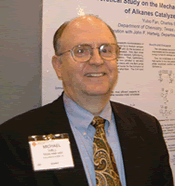 Michael B. Hall合作论文数Department of Chemistry, Texas A&M University19
 Andres E. Goeta合作论文数Department of Chemistry, University of Durham17Andy Whiting合作论文数11
 Rachael Lee合作论文数11
 Charles J McMonagle合作论文数European Synchrotron Radiat Facil, Swiss Norwegian Beamlines10
 Ross Harrington合作论文数School of Natural Sciences (Chemistry),, University of Newcastle10
 Lina Mardiana合作论文数Fac Math & Nat Sci FMIPA, Univ Indonesia9Dmitry S. Yufit合作论文数9Natalie T. Johnson合作论文数8j a coome合作论文数8
 Euan Brechin合作论文数School of Chemistry, University of Edinburgh8
 Simon Parsons合作论文数School of Chemistry, College of Science and Engineering, The University of Edinburgh8
 Corinne Wills合作论文数8
 Stephen A. Moggach合作论文数School of Chemistry, University of Edinburgh8Christopher H Woodall合作论文数7
 Nicholas H. Oberlies合作论文数Oberlies Research Group, Department of Chemistry and Biochemistry, The University of North Carolina at Greensboro7
 Keith Izod合作论文数Department of Chemistry, University of Newcastle7Eva Hevia合作论文数Department of Pure;Applied Chemistry;University of Strathclyde;Department of Pure, University of Strathclyde7
 Mark Murrie合作论文数School of Chemistry, University of Glasgow7
 Alan R. Kennedy合作论文数University of Strathclyde7
 Konstantin Kamenev合作论文数School of Engineering, The University of Edinburgh7Alexandra Longcake合作论文数6
 Joseph Cowell合作论文数Lab Inorgan Chem Biol, PSL Univ6Craig M. Robertson合作论文数5
 Ronnie Ragbirsingh合作论文数5Andrew R Tyler合作论文数5Rebecca Clulow合作论文数Dept Chem, Uppsala Univ5Joe Ridout合作论文数Chem, Newcastle Univ5
 Ram S. Katiyar合作论文数Department of Physics, College of Natural Sciences, University of Puerto Rico-Río Piedras Campus5Keith B. Dillon合作论文数5Richard L. Giles合作论文数Science Laboratories, University of Durham5
 Helena J. Shepherd合作论文数Université de Toulouse, Université de Toulouse5
 Finlay D. Morrison合作论文数Department of Engineering Materials, University of Sheffield5
 Gavin A Craig合作论文数5Paul Thaw合作论文数4Aurora Gherson合作论文数4Jonathan D. Sellars合作论文数4Lewis C H Maddock合作论文数4
 Dumitru Sirbu合作论文数Sch Math Stat & Phys, Newcastle Univ4
 Alice M Bumstead合作论文数Dept Mat Sci & Met, Univ Cambridge4Jonathan Gardner合作论文数School of Art, Edinburgh College of Art, The University of Edinburgh4
 Silvia Chiara Capelli合作论文数4
 Jeremy M Rawson合作论文数Department of Chemistry, University of Cambridge4
 Philip Lightfoot合作论文数School of Chemistry, University of St Andrews4
 Alexandra Slawin合作论文数School of Chemistry, University of St Andrews4
 Thomas Penfold合作论文数School of Chemistry, University of Newcastle4




