The Gulf of Lions in the northwestern Mediterranean is one of the few sites around the world ocean exhibiting deep open-ocean convection. Based on 6 year long (2009-2015) time series from a mooring in the convection region, shipborne measurements from repeated cruises, from 2012 to 2015, and glider measurements, we report evidence of bottom thick nepheloid layer formation, which is coincident with deep sediment resuspension induced by bottom-reaching convection events. This bottom nepheloid layer, which presents a maximum thickness of more than 2000 m in the center of the convection region, probably results from the action of cyclonic eddies that are formed during the convection period and can persist within their core while they travel through the basin. The residence time of this bottom nepheloid layer appears to be less than a year. In situ measurements of suspended particle size further indicate that the bottom nepheloid layer is primarily composed of aggregates between 100 and 1000 mm in diameter, probably constituted of fine silts. Bottom-reaching open ocean convection, as well as deep dense shelf water cascading that occurred concurrently some years, lead to recurring deep sediments resuspension episodes. They are key mechanisms that control the concentration and characteristics of the suspended particulate matter in the basin, and in turn affect the bathypelagic biological activity.
In order to calculate budgets of particulate matter and sediment-bound contaminants leaving the continental shelf of the Gulf of Lion (GoL), settling particles were collected in March 2011 during a major storm, using sediment traps. The collecting devices were deployed in the Cap de Creus submarine canyon, which represents the main export route. Particulate matter samples were analyzed to obtain mass fluxes and contents in organic carbon, Al, Cr, Co, Ni, Cu, Zn, Cd, Pb and La, Nd and Sm. The natural or anthropogenic origin of trace metals was assessed using enrichment factors (EFs). Results are that Zn, Cu and Pb appeared to be of anthropogenic origin, whereas Ni, Co and Cr appeared to be strictly natural. The anthropogenic contribution of all elements (except Cd) was refined by acid-leaching (HCl 1 N) techniques, confirming that Zn, Cu and Pb are the elements that are the most enriched. However, although those elements are highly labile (59-77%), they do not reflect severe enrichment (EFs <4). Most particles originate from the Rhone River. This has been confirmed by two different tracing procedures using rare earth elements ratios and concentrations of acid-leaching residual trace metals. Our results hence indicate that even in this western extremity of the GoL, storm events mainly export Rhone-derived particles via the Cap de Creus submarine canyons to the deep-sea environments. This export of material is significant as it represents about a third of the annual PTM input from the Rhone River.
The deep outer margin of the Gulf of Lions and the adjacent basin, in the western Mediterranean Sea, are regularly impacted by open-ocean convection, a major hydrodynamic event responsible for the ventilation of the deep water in the western Mediterranean Basin. However, the impact of open-ocean convection on the flux and transport of particulate matter remains poorly understood. The variability of water mass properties (i.e., temperature and salinity), currents, and particle fluxes were monitored between September 2007 and April 2009 at five instrumented mooring lines deployed between 2050 and 2350-m depth in the deepest continental margin and adjacent basin. Four of the lines followed a NW–SE transect, while the fifth one was located on a sediment wave field to the west. The results of the main, central line SC2350 ("LION") located at 42°02.5′ N, 4°41′ E, at 2350-m depth, show that open-ocean convection reached mid-water depth (≈ 1000-m depth) during winter 2007–2008, and reached the seabed (≈ 2350-m depth) during winter 2008–2009. Horizontal currents were unusually strong with speeds up to 39 cm s−1 during winter 2008–2009. The measurements at all 5 different locations indicate that mid-depth and near-bottom currents and particle fluxes gave relatively consistent values of similar magnitude across the study area except during winter 2008–2009, when near-bottom fluxes abruptly increased by one to two orders of magnitude. Particulate organic carbon contents, which generally vary between 3 and 5%, were abnormally low (≤ 1%) during winter 2008–2009 and approached those observed in surface sediments (≈ 0.6%). Turbidity profiles made in the region demonstrated the existence of a bottom nepheloid layer, several hundred meters thick, and related to the resuspension of bottom sediments. These observations support the view that open-ocean deep convection events in the Gulf of Lions can cause significant remobilization of sediments in the deep outer margin and the basin, with a subsequent alteration of the seabed likely impacting the functioning of the deep-sea ecosystem.
Cap de Creus Canyon (CCC) is known as a preferential conduit for particulate matter leaving the Gulf of Lion continental shelf towards the slope and the basin, particularly in winter when storms and dense shelf water cascading coalesce to enhance the seaward export of shelf waters. During the CASCADE (CAscading, Storm, Convection, Advection and Downwelling Events) cruise in March 2011, deployments of recording instruments within the canyon and vertical profiling of the water column properties were conducted to study with high spatial-temporal resolution the impact of such processes on particulate matter fluxes. In the context of the mild and wet 2010–2011 winter, no remarkable dense shelf water formation was observed. On the other hand, the experimental setup allowed for the study of the impact of E-SE storms on the hydrographical structure and the particulate matter fluxes in the CCC. The most remarkable feature in terms of sediment transport was a period of dominant E-SE winds from 12 to 16 March, including two moderate storms (maximum significant wave heights = 4.1–4.6 m). During this period, a plume of freshened, relatively cold and turbid water flowed at high speeds along the southern flank of the CCC in an approximate depth range of 150–350 m. The density of this water mass was lighter than the ambient water in the canyon, indicating that it did not cascade off-shelf and that it merely downwelled into the canyon forced by the strong cyclonic circulation induced over the shelf during the storms and by the subsequent accumulation of seawater along the coast. Suspended sediment load in this turbid intrusion recorded along the southern canyon flank oscillated between 10 and 50 mg L−1, and maximum currents speeds reached values up to 90 cm s−1. A rough estimation of 105 tons of sediment was transported through the canyon along its southern wall during a 3-day-long period of storm-induced downwelling. Following the veering of the wind direction (from SE to NW) on 16 March, downwelling ceased, currents inside the canyon reversed from down- to up-canyon, and the turbid shelf plume was evacuated from the canyon, most probably flowing along the southern canyon flank and being entrained by the general SW circulation after leaving the canyon confinement. This study highlights that remarkable sediment transport occurs in the CCC, and particularly along its southern flank, even during mild and wet winters, in absence of cascading and under limited external forcing. The sediment transport associated with eastern storms like the ones described in this paper tends to enter the canyon by its downstream flank, partially affecting the canyon head region. Sediment transport during these events is not constrained near the seafloor but distributed in a depth range of 200–300 m above the bottom. Our paper broadens the understanding of the complex set of atmosphere-driven sediment transport processes acting in this highly dynamic area of the northwestern Mediterranean Sea.
Higueras, M..-- 40th CIESM Congress: The largest Forum on Mediterranean and Black Sea Research, 28 October - 1 November 2013, Marseille, France.-- 1 page, 1 figure
The lipid content of seven samples of sinking particles collected with sediment traps moored at ~ 100 m depth in summer and fall across the Canadian Beaufort Shelf (Arctic Ocean) was investigated. Our main goal was to quantify and characterize the biotic and abiotic degradation processes that acted on sinking material during these periods. Diatoms, which dominated the phytoplanktonic assemblage in every trap sample, appeared to be remarkably sensitive to Type II (i.e. involving singlet oxygen) photodegradation processes in summer, but seemed to be relatively unaffected by biotic degradation at the same time. Hence, the relative recalcitrance of phytodetritus towards biodegradation processes during the Arctic midnight sun period was attributed to the strong photodegradation state of heterotrophic bacteria, which likely resulted from the efficient transfer of singlet oxygen from photodegraded phytoplanktonic cells to attached bacteria. In addition, the detection in trap samples of photoproducts specific to wax ester components found in herbivorous copepods demonstrated that zooplanktonic faecal material exported out of the euphotic zone in summer were affected by Type II photodegradation processes as well. By contrast, sinking particles collected during the autumn were not influenced by any light-driven stress. Further chemical analyses showed that photodegraded sinking particles contained an important amount of intact hydroperoxides, which could then induce a strong oxidative stress in underlying sediments.
Settling particles were collected using sediment traps deployed along three transects in the Lacaze-Duthiers and Cap de Creus canyons and the adjacent southern open slope from October 2005 to October 2006. The settling material was analyzed to obtain total mass fluxes and main constituent contents (organic matter, opal, calcium carbonate, and siliciclastics). Cascades of dense shelf water from the continental shelf edge to the lower continental slope occurred from January to March 2006. They were traced through strong negative near-bottom temperature anomalies and increased current speeds, and generated two intense pulses of mass fluxes in January and March 2006. This oceanographic phenomenon appeared as the major physical forcing of settling particles at almost all stations, and caused both high seasonal variability in mass fluxes and important qualitative changes in settling material. Fluxes during the dense shelf water cascading (DSWC) event ranged from 90.1 g m−2 d−1 at the middle Cap de Creus canyon (1000 m) to 3.2 g m−2 d−1 at the canyon mouth (1900 m). Fractions of organic matter, opal and calcium carbonate components increased seaward, thus diminishing the siliciclastic fraction. Temporal variability of the major components was larger in the canyon mouth and open slope sites, due to the mixed impact of dense shelf water cascading processes and the pelagic biological production. Results indicate that the cascading event remobilized and homogenized large amounts of material down canyon and southwardly along the continental slope contributing to a better understanding of the off-shelf particle transport and the internal dynamics of DSWC events.
In the framework of the European project Eurostrataform, an array of six near-bottom mooring lines was deployed in the heads of the major submarine canyons incising the continental slope of the Gulf of Lions (NW Mediterranean). All moorings were equipped with sediment traps, current meters and turbidity Optical Backscatters Sensors (OBS) situated at few meters above the bottom. Particulate mass fluxes were recorded weekly by the sediment traps between November 2003 and May 2004 and compared with horizontal export fluxes obtained from the turbidity and current meters.Results show that near-bottom vertical particulate mass fluxes generally increase along slope between the northeastern-most and the southwestern region of the Gulf of Lions. Horizontal export fluxes also show some increase southwestward with flux in the southwestern-most canyon up to two-orders of magnitude higher than in northeast canyons. Furthermore, most of the export flux is driven by energetic and short events such as marine storms and dense shelf water cascading. Although the consequence of storms and cascading was obvious from traps and OBS measurements, substantial differences between vertical and horizontal fluxes appeared. While sediment traps recorded the largest vertical flux during the autumn storm (4 December) with contributions from river discharge and resuspended material, horizontal flux as obtained from OBS data was highest in winter (21–24 February). We believe that such discrepancies are partly due to measurement artifacts originating from the particle size effects and/or the different height above the bottom occupied by the traps and OBS which complicate comparisons between vertical and horizontal fluxes. However, different water-column conditions (stratified versus unstratified) together with the hydrodynamic regime during the two periods appear as a likely explanation for the flux differences between fall and winter storms.
In the frame of the EU-funded ADIOS project, the aim of this paper is to present the results of the total mass and the major constituent (organic matter, calcium carbonate, opal and lithogenics) fluxes obtained in the central part of the Algero-Balearic Basin (ABB). Two identical mooring lines, named A and B were equipped with three automated sediment traps and three current meters at 250 m, 1440 m and 2820 m of water depth, and another one, named C, was equipped with five sediment trap-current meter pairs at the corresponding depths of 250 m, 845 m, 1440 m, 2145 m and 2820 m. The samples were collected during an annual period, from April 2001 to May 2002 over sampling periods of 15-30 days.The presented particle fluxes data constitute the first one-year experimental study carried out in the open ABB, a region in which the continental inputs are expected to be minimums. This fact explains why the values of the mean annual fluxes were the lowest found in the whole Western Mediterranean Sea, ranging from 11.30 mg.m(-2) day(-1) (2145 m; station C) to 112.75 mg m(-2) day(-1) (250 m; station A).The temporal evolution of the particle fluxes in the upper waters shows the dominance of the atmospherically derived particles during summer and autumn, and a clear biological control during winter related to the primary productivity pathway. Along the whole water column, the calcium carbonate appears as the main relative contributor of the biogenic material (26%-30%), and the opal content presents the lowest values (6%-8%), suggesting that the study area is a carbonate-dominated ecosystem.Otherwise, even if the particles are derived from the atmosphere or internally produced by biological processes, it is clear that their transference from the upper to the deeper ocean is controlled by the stabilization of the water column and the distribution of the water masses in the Western Mediterranean Sea. In this context, the input of the Tyrrhenian Deep Water (TDW) into the AB7B at 800-1500 m of water depth strongly affects the distribution of the particle fluxes in the basin, being responsible of the minimum concentration zone at intermediate depths. Furthermore, current meter and flux data indicate a high influence of the Gulf of Lions water mass formation by spreading of dense cold water along the whole ABB, leading up to a maximum of particulate matter at depths higher than 2000 m. (C) 2007 Elsevier B.V. All rights reserved.
An array of six time series sediment traps and current meters was deployed in water depths of 2300 and 3000 m on two bottom-mounted moorings along the axis of the Cap-Ferret Canyon, a large depression in the southeastern part of the Bay of Biscay (northeastern Atlantic), as part of the ECOMARGE Atlantic experiment ECOFER. The 14-month experiment consisted of three successive deployments during which particle fluxes were collected over sampling periods of 16–27 d. Two large-aperture traps also were deployed to measure fluxes at a faster sampling rate (4–7 d). The recovered samples were analyzed for total mass, concentration of major constituents (organic and inorganic carbon, opal), activity of 210Pb (Radakovitch O., Heussner S., 1999. Fluxes and budget of 210Pb on the continental margin of the Bay of Biscay (northeastern Atlantic). Deep-Sea Research II 46, 2175–2203) and coccoliths (Beaufort L., Heussner S., 1999. Coccolithophorids on the continental slope of the Bay of Biscay – production, transport and contribution to mass fluxes. Deep-Sea Research II 46, 2147–2174). The temporal pattern of the major constituent fluxes essentially matched that of the total mass, suggesting that, in general, particle transfer to the slope is largely driven by events acting on the same time scale. The temporal variability of the measured concentrations and fluxes lacked in any obvious connection with large-scale driving forces, either external (wind, river discharge) or internal (biological production), which all exhibited a marked seasonal signal. The rapid changes of particle transfer, largely non-seasonal, is in contrast with most other ocean margin trap experiments. On the other hand, indications were found that the variability of mass fluxes could be controlled by the along-slope current, and particularly by its short-term fluctuations. These dynamical processes could be responsible for significant changes in the dispersion of the settling particles and hence of the resultant flux changes. The spatial distribution of annual mean fluxes – from 498 (380 m) to 1477 mg m−2 d−1 (2250 m) at the shallower site, and from 328 (1900 m) to 459 mg m−2 d−1 (2950 m) at the deeper site – exhibited a linear increase with increasing depth and a seaward decrease at equivalent depth or distance from the bottom. Such a distribution, typical of continental slope environments, requires inputs of material through lateral advection. The increased homogeneity of the bulk chemical composition of settling particles with increasing water depth and total mass flux indicates that such inputs are largely provided by resuspended material with quite constant characteristics, largely originating from the Bay of Biscay's shelf and upper slope. Due to the general northward, along-slope current, the sources are preferentially located south of the Cap-Ferret Canyon. A particle transfer scenario for this region is proposed that, in particular, calls for a basic mechanism of upstream–downstream concentration gradients in the sources of settling particles to explain the increase in flux with depth.
 Serge Heussner合作论文数CNRS, University of Perpignan11
 Xavier Durrieu de Madron合作论文数UMR 5110 CNRS, University of Perpignan11
 Miquel Canals Artigas合作论文数Departament de Dinàmica de la Terra i de l'Oceà, Universitat de Barcelona7
 Antoni Calafat合作论文数5
 Anna Sanchez-Vidal合作论文数Dept. d'Estratigrafia, Paleontologia i Geociències Marines, Universitat de Barcelona5
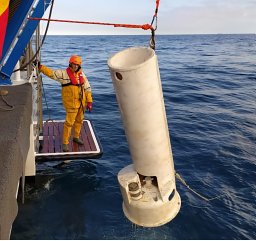 Pere Puig合作论文数Institut de Ciències del Mar (CSIC), Passeig Marítim de la Barceloneta, 37-49. E-08003 Barcelona, Spain5
 Loïc Houpert合作论文数OSE Engn4
 m higueras合作论文数3
 Jacobo Martin合作论文数Institut de Ciències del Mar, Consejo Superior de Investigaciones Científicas (ICM-CSIC),3
 Albert Palanques合作论文数Department of Marine Geosciences, Instituto de Ciencias del Mar, Consejo Superior De Investigaciones Cientificas3
 Kerherve Philippe合作论文数CEFREM-CNRS UMR 5110, Université de Perpignan3
 Pierre Testor合作论文数LOCEAN, Université Pierre and Marie Curie3J. Carbonne合作论文数3C. Menniti合作论文数2
 Patrick Marsaleix合作论文数2Christine Sotin合作论文数2
 Jean-Francois Ghiglione合作论文数Laboratoire d’Océanographie Microbienne (LOMIC),, Sorbonne Université2
 Tatiana Severin合作论文数Laboratoire d'Océanographie Microbienne, Observatoire Océanologique;UPMC Univ Paris 06, Sorbonne Universités;UPMC Univ Paris 06, Sorbonne Universités2
 Ramondenc Simon合作论文数2
 severine Martini合作论文数Mediterranean Institute of Oceanography (MIO),, Aix Marseille Université2
 Christian Curtil合作论文数CPPM – Centre de Physique des Particules de Marseille, CNRS/IN2P3 et Université de la Méditerranée2
 Leo Berline合作论文数College of Oceanic;Atmospheric Sciences;Oregon State University;College of Oceanic|Atmospheric Sciences, Oregon State University2Wolfgang Ludwig合作论文数Laboratory of Materials, Institut National Des Sciences Appliquees De Lyon2
 Andre Monaco合作论文数CEFREM, UMR—CNRS 5110, 52 av. P. Alduy, Perpignan 66860, France2
 Christian Tamburini合作论文数Centre d’Océanologie de Marseille, Université de la Méditerranée2
 Luc Beaufort合作论文数Centre Europeen de Recherche et d'Enseignement des Geosciences de l'Environnement2
 D. Zúñiga合作论文数Dept. d'Estratigrafia, Paleontologia i Geociències Marines, Universitat de Barcelona2Mireille Pujo-Pay合作论文数2Pierre Biscaye合作论文数Lamont-Doherty Earth Observatory, Columbia Climate School, Columbia University2Henri Etcheber合作论文数2
 Olivier Radakovitch合作论文数UMR 6635 CNRS-IRD-CDF, Aix-Marseille Université2
 Pascal Conan合作论文数faculté des sciences de Luminy, Centre d'océanologie de Marseille2L. Guidi合作论文数1A.M. Calafat合作论文数1G. Saragoni合作论文数1
 Lionel Guidi合作论文数1I Taupier Letage合作论文数1
 Marion Stabholz合作论文数1
 Anthony Bosse合作论文数Aix Marseille Univ, Univ Toulon1Pasqual Catalina合作论文数1
 Frederic Vaultier合作论文数1Petit Morgan合作论文数1
 Dominique Aubert合作论文数1Louis Fortier合作论文数Département de Biologie, Université Laval1J. Bonnin合作论文数1Bruno Charriere合作论文数1Alexis Khripounoff合作论文数1Joan Fabres合作论文数1Francois Bourrin合作论文数Laboratoire d'Océanographie de Villefranche, CNRS-Université Pierre et Marie Curie1




