The paper presents the innovative approach to a high-fidelity motorcycle riding simulator based on VR (Virtual Reality)-visualization, equipped with a Gough-Stewart 6-DOF (Degrees of Freedom) motion platform. Such a solution integrates a real-time tension sensor system as a source for highly realistic motion cueing control as well as the servomotor integrated into the steering system. Tension forces are measured at four points on the mock-up chassis, allowing a comprehensive analysis of rider interaction during various maneuvers. The simulator is developed to simulate realistic riding scenarios with immersive motion and visual feedback, enhanced with the simulation of external influences—headwind. This paper presents results of a validation study—pilot experiments conducted to evaluate selected riding scenarios and validate the innovative simulator setup, focusing on force distribution and system responsiveness to support further research in motorcycle HMI (Human–Machine Interaction), rider behavior, and training.
This study explores the development and evaluation of external humanmachine interfaces (eHMI) for communication between autonomous vehicles (AVs) and pedestrians. By employing advanced virtual reality (VR) simulations and leveraging behavioral data from 600 survey respondents, the research examines the intelligibility and effectiveness of seven eHMI prototypes. The experiments utilized eye-tracking and spatial analysis to measure pedestrian response to AV signals in realistic virtual environments. The findings emphasize the potential of LED strip-based communication interfaces, demonstrating their superiority in terms of visibility, clarity, and implementation cost. This research contributes to the broader field of artificial intelligence applications in transportation, with a focus on ensuring safety and trust in autonomous systems interacting with vulnerable road users.
The present paper focuses on vehicle simulator fidelity, particularly the effect of motion cues intensity on driver performance. The 6-DOF motion platform was used in the experiment; however, we mainly focused on one characteristic of driving behavior. The braking performance of 24 participants in a car simulator was recorded and analyzed. The experiment scenario was composed of acceleration to 120 km/h followed by smooth deceleration to a stop line with prior warning signs at distances of 240, 160, and 80 m to the finish line. To assess the effect of the motion cues, each driver performed the run three times with different motion platform settings–no motion, moderate motion, and maximal possible response and range. The results from the driving simulator were compared with data acquired in an equivalent driving scenario performed in real conditions on a polygon track and taken as reference data. The driving simulator and real car accelerations were recorded using the Xsens MTi-G sensor. The outcomes confirmed the hypothesis that driving with a higher level of motion cues in the driving simulator brought more natural braking behavior of the experimental drivers, better correlated with the real car driving test data, although exceptions were found.
Driving simulators are increasingly being incorporated by driving schools into a training process for a variety of vehicles. The motion platform is a major component integrated into simulators to enhance the sense of presence and fidelity of the driving simulator. However, less effort has been devoted to assessing the motion cues feedback on trainee performance in simulators. To address this gap, we thoroughly study the impact of motion cues on braking at a target point as an elementary behavior that reflects the overall driver’s performance. In this paper, we use an eye-tracking device to evaluate driver behavior in addition to evaluating data from a driving simulator and considering participants’ feedback. Furthermore, we compare the effect of different motion levels (“No motion”, “Mild motion”, and “Full motion”) in two road scenarios: with and without the pre-braking warning signs with the speed feedback given by the speedometer. The results showed that a full level of motion cues had a positive effect on braking smoothness and gaze fixation on the track. In particular, the presence of full motion cues helped the participants to gradually decelerate from 5 to 0 ms−1 in the last 240 m before the stop line in both scenarios, without and with warning signs, compared to the hardest braking from 25 to 0 ms−1 produced under the no motion cues conditions. Moreover, the results showed that a combination of the mild motion conditions and warning signs led to an underestimation of the actual speed and a greater fixation of the gaze on the speedometer. Questionnaire data revealed that 95% of the participants did not suffer from motion sickness symptoms, yet participants’ preferences did not indicate that they were aware of the impact of simulator conditions on their driving behavior.
The world is gradually moving towards green solutions in all industries. This is the case in the automotive industry as well and it is logical that vehicle simulators must follow this trend and functionally approach the increasingly widespread battery electric vehicles (BEVs). The differences in the parameters of vehicle simulators with alternative powertrains have already been covered. This paper deals with the modification of both the simulator hardware and software to improve the behavior of the physical vehicle model, representing all functions through a programmable human machine interface (HMI) and providing an approximation of the driving experience of a real vehicle. The topic of this paper first describes the functional scheme and physical model of the simulator adapted for HMI simulations of BEVs and hybrid electric vehicles (HEVs). A prototype design of the virtual cockpit is also described. Then, the design of the experiment is explained to validate the displayed and recorded values through a qualitative study by pilot testing on a vehicle simulator. A discussion of the measured results is concluded.
Autonomous Traffic Management (ATM) systems empowered with Machine Learning (ML) technics are a promising solution for eliminating traffic light and decreasing traffic congestion in the future. However, few efforts have focused on integrating pedestrians in ATM, namely the static programming-based cooperative protocol called Autonomous Pedestrian Crossing (APC). In this paper, we model a Markov Decision Process (MDP) to enable a Deep Reinforcement Learning (DRL)-based version of APC protocol that is able to dynamically achieve the same objectives (i.e. decreasing traffic delay at the crossing area). Using concrete state space, action set and reward functions, our model forces the Autonomous Vehicle (AV) to "think" and behave according to APC architecture. Compared to the traditional programming APC system, our approach permits the AV to learn from its previous experiences in non-signalized crossing and optimize the distance and the velocity parameters accordingly.
Urban comfort and safety go along with travel and traffic management for the cities. Facing automatization of transport brings necessity for the ITS solutions to provide efficient communication between vehicles, infrastructure and other traffic participants. Parking in the cities is a daily travel related task. Efficient automated parking solutions can contribute to individual time management as well as to reduction of traffic flow that is connected with parking spot search – especially in big cities. User acceptance of new technologies that arise with automated driving depends on their usability and interface. This paper presents a pilot demonstration of automated parking function with a mobile app interface. Observation of visual behavior (eye tracking) provide analyses of automated parking function and mobile app of modified electric prototype of e-vehicle "Skoda Rapid".
The contribution deals with problems of a passive safety of autonomous vehicles, focused on specifics of car-crash accident. The paper describes a non-standard side crash test of two passenger cars, during which the interior equipment and placement of test figurines inside car were accommodated to simulate an expected arrangement of future autonomous cars. Motion of the equipment inside the car interior was tracked during the test with the focus on its possible impact on passenger's safety. The contribution further deals with specifics of autonomous vehicle crew protection from the point of view of passive and integrated safety.
There is no methodical approach suitable for definition of the periodical or non-periodical, stationary or nonstationary curves of brain signals with a help of amplitude, frequency, phase etc. values. It is difficult to determinate the wave shape, i.e. the problem is how to solve the respective pattern recognition. Therefore, we tried to propose a simple method for praxis by help of measurement two main wave time components, interpreting a sinusoidal alpha wave as a triangle, where there is an anterior and a posterior part of wave ascending and descending abscissas in a hope that the sufficient measure are presented by the "legs" only or distances between upper and bottom peak of the wave. All the values of total ascendants are divided by all values of total descendants. For the method validity estimation it was made for this computation separately in two different psychical states - the relaxation and the calculation activity, both with eyes closed. Results are presented as quotient (quotus alpha) which means alpha waves symmetry. If the quotient is equal to 1, or is near to 1, is the alpha wave full or almost symmetrical. When the quotient is lower than 1 the ascendant is shorter than descendent, then alpha wave is asymmetric and has inclination to the left side. In contrary if the quotient is higher than 1 the ascendant is longer than descendent, alpha wave is again asymmetrical, but inclination is oriented to the right side. During mentation is usually quotient lower one and the ascendant is still more lover, alpha waves are sheer, the inclination to the left is more expressive.
Artificial systems play an extremely important role in human life. Each day, almost all people on the Earth have to interact with various complex systems, which are of a very different nature and target application. These all system structures and their whole sets can be of various degrees of complexity and can be discriminated into many categories. These three can be considered as their main kinds:
The article provides a study of driver fatigue experimental research on interactive driver simulator. Visually available face features, movements of eyes and facial expression are followed with the help of distant eye tracker. The driver behaviour of sleep deprived participants is observed and compared to that of the rested drivers. This research targets sparing the key features of driver behaviour for further implementation in detection methods of driver fatigue in the human-machine interface of modern and future cars.
This article states a set of problems associated with Human Machine Interface of future vehicles based on the technological and social trends of modern society. Smart Cities, Connected Cars, and new propulsion systems bring a new set of questions and problems for the HMI studies. This article tries to state these questions based on the history of the development and analysis of the modern in vehicle HMI from three layer Driver Vehicle interaction model. Additionally, future trends and technologies are considered and described.
In the last 30 years, there is visible trend of performing traffic experiments with use of Driving Simulator. As an example of such studies we can name researches focused on driver behavior in various traffic situations where safety and economic concerns significantly limit use of naturalistic driving studies. An inherent part of such experiments is proper design and implementation of experiment scenario, including surrounding traffic. In the following paper, the authors describe and compare the key properties of three most common approaches to the generation of surrounding vehicles for the needs of driving simulator experiments.
The article deals with parameter verification for an eCall unit Black box type that can be further used to estimate the consequences of a traffic accident. As the unit is mainly designed to be installed into older types of vehicles, it only uses an internal accelerometer located on a printed circuit to identify the moment of collision, but this can affect the resulting acceleration measurement. A series of measurements is described in the article (crash test and a test on acceleration unit) during which the acceleration signal from an eCall unit is compared with the external accelerometer signal and the correlation analysis of both signals was performed afterwards. Key-Words: eCall, crash test, correlation analysis, passive safety
The paper deals with problems of aggressive behavior of cars and motorcycles drivers. It describes an evaluation of such behavior from recordings obtained with use of so-called floating cars. It offers basic statistical analyzes based on almost 300 recordings from 11 thousand kilometers driven on various types of Czech roads. The paper presents some of the most interesting (and from a point of safety the most important) results. Key-Words: driving safety, aggressiveness behind the wheel, road rage, floating cars
This article deals with a Human Machine Interface of Electric vehicles starting from the history of Electric Vehicles HMI, describes currently used system elements and provide evaluation of their advantages and disadvantages. A new concept of Dynamic HMI for Electric Vehicles is introduced to improve EV efficiency in terms of energy consumption and range distance, and consequently increase their popularity among users. This interface is capable to adapt itself to user or system needs and changes dynamically based on EV battery State of Charge or reachability of desired destination. Such implementation of HMI address one of the main reason why users still prefer conventional vehicles with internal combustion engine to EV - range anxiety phenomena. This article aims to be a guideline for a design of new concept of HMI for EV, studies user requirements and propose a methodology of system development including concept definition and user acceptance validation methodology on vehicle driving simulator.
In 2013 a series of experiments was performed using the vehicle simulators available in the DSRG laboratory (Driving Simulation Research Group at Department of vehicles, Faculty of transportation sciences, CTU in Prague) to reveal the aggressive behavior stimuli at driving motorized vehicle principles Scenes in scenarios were designed to continuously initiate a situation to provoke aggressive, inadequate or offensive behavior of drivers, the scenes from real scenery were used as well. The verification was performed on a group of drivers tending to behave aggressively. Key-Words: Driving simulation, Aggressive driving, Driver’s Behavior Assessment
We address the problem of the introduction of car sharing systems for electric vehicles within big cities through simulation of such systems. Simulation is an important step in the early stages of the development of new technologies. In contrast to standard simulation techniques, this project deals with simulation through introduction of a virtual online system and building up a model of real consumers' behaviour based on their opinions from "pseudo real" experience.
 Stanislav Novotný合作论文数Faculty of Transportation Sciences, Czech Technical University25Roman Piekník合作论文数8
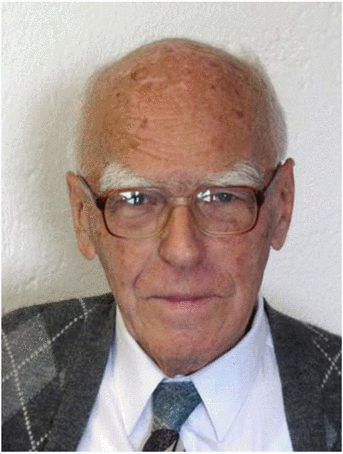 Mirko Novák合作论文数5Přemysl Toman合作论文数4
 Alina Mashko合作论文数Faculty of Transportation sciences, Czech Technical University in Prague4Jindrich Krasa合作论文数4Zuzana Belinova合作论文数4Václav Vodrážka合作论文数4Jakub Rajnoch合作论文数4Jan Pěkný合作论文数4Dmitry Rozhdestvenskiy合作论文数4Josef Mík合作论文数3Josef Svoboda合作论文数3
 Zdenek Votruba合作论文数3
 Sara El Hamdani合作论文数Faculty of Transportation Sciences, Czech Technical University in Prague3Josef Faber合作论文数3Jinřich Sadil合作论文数3JANA KADLECOVÁ合作论文数2
 K. K. Abishev合作论文数2Tereza Kunclova合作论文数2J. Faber合作论文数2Tomáš Tichý合作论文数2M. Novak合作论文数2Assylbek KASSENOV合作论文数1Tomas Tichy合作论文数1
 Jindrich Sadil合作论文数1David Lehet合作论文数1
 Michal Matowicki合作论文数1
 Petr Moos合作论文数1
 Ruslan B. Mukanov合作论文数1
 Salah Eddine Loudari合作论文数University Ibn Tofail in Kénitra1
 Miroslav Svitek合作论文数Faculty of Transportation Sciences, Czech Technical University in Prague1
 Nabil Benamar合作论文数1
 Ondrej Pribyl合作论文数1Martin Kozumplík合作论文数1Ondřej Sýkora合作论文数1
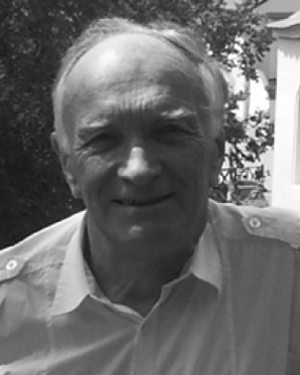 Marcel Jirina合作论文数Institute of Computer Science Pod vodarenskou vezi 2 182 07 Prague 8 Liben Czech Republic1Michal Hajný合作论文数1Roman Pěkník合作论文数1
 Václav Jirkovský合作论文数Faculty of Transportation Sciences, Czech Technical University1




