This paper presents an aero-vibro-acoustic modeling strategy to characterize sea-level engine test cell interior acoustic environments by combining scale-resolving computational fluid dynamics (CFD) simulations, distributed equivalent acoustic source models, and boundary element methods (BEM) and statistical energy analysis (SEA). The work is motivated by the need to redesign an existing sea-level engine test cell to accommodate a higher thrust engine. Wall-modeled large eddy simulations (WMLES) in both free-field and enclosed domains are generated to target the acoustic frequencies associated with large-scale mixing and shock-turbulent interaction sources. Free-field WMLES is probed in the jet near-field to decompose the fluctuating pressure into a plurality of partial acoustic fields at each frequency of interest. Partial fields are then fit to an equivalent acoustic source model using an inverse methodology. Source directivity is further improved through the use of test data. These sources are introduced into an acoustic tool that predicts interior noise levels through a combination of BEM and gradient SEA methods. At low frequencies, the BEM pressure spectra are first corrected to a WMLES simulation of interior noise levels with no noise control treatments. This helps to account for any effects the facility has on the jet sound source. The BEM analysis is then repeated with the corrections to examine the impact of noise control treatments which are characterized through impedance boundary conditions (BCs). At high frequencies, a directional point source (DPS) is used in a gradient SEA model to capture high-frequency roll-off. Results demonstrate how the modification of acoustic impedance and absorptivity on the test cell walls may be used to quantitatively predict the effectiveness of noise control treatment (NCT) solutions. In addition to describing a novel but practical, CFD-based methodology to characterize acoustic environments and perform trade studies of noise control solutions in engine test cells, the paper discusses some of the inherent challenges associated with defining approximate acoustic source models using free-field CFD alone. Specifically, the paper will discuss the possibility of strong fluid dynamic-acoustic coupling, or "lock-in/super resonance," which may result in catastrophic resonant feedback under certain conditions. The understanding of such resonant responses is crucial to test cell facility design, demonstrating the need for a multidisciplinary approach for the design of future test cells which combines aerodynamic and acoustic prediction methods, anchored to test measurements.
Scanning beamforming arrays are powerful tools for high-resolution acoustic imaging, but cross spectral matrix (CSM)-based methods are slow when applied to the large synthetic CSMs created by scanning arrays. Modified forms of frequency-domain beamforming (FDBF) and CLEAN-SC deconvolution have been developed that directly use partial field matrices, increasing computational efficiency while retaining the benefits of a full spectral matrix. Here these partial field techniques are implemented and tested in MATLAB R2023a. FDBF performance is improved by up to three orders of magnitude and CLEAN-SC performance is improved by up to one order of magnitude. GPU acceleration is implemented for FDBF and achieves another order of magnitude performance improvement. An experimental demonstration is conducted in the Texas A&M University 3 ft x 4 ft low-speed wind tunnel using a hybrid anechoic section and a 31-channel scanning acoustic array. Partial field FDBF and CLEAN-SC algorithms are applied and compared to the original algorithms, and acoustic imaging is shown to be effective.
A recently developed indirect eigenvalue method is applied to propeller whirl flutter stability using computational fluid dynamics. The use of computationally efficient actuator disc models is compared to actuator blade and wall-resolved models. Actuator disc and blade results are confirmed to be both mesh and time-step independent. Actuator disc models produce stability results that closely emulate analytic quasi-steady approximations, whereas actuator blade models are observed to most closely resemble analytic unsteady approximations. The wall-resolved model of the propeller produces the most accurate results but is between three to four orders of magnitude more computationally expensive than the actuator disc model. It is concluded that actuator disc models could be used in concert with the indirect eigenvalue method to compute eigenvalues of low-frequency modes with reasonable accuracy, especially in situations with complicated fluid dynamics and disparate time scales where wall-resolved models are currently computationally infeasible.
This presentation will cover recent progress in the development of continuous-scan acoustic measurement (CSAM) methods for imaging, reconstruction, and localization of spatially complex sound fields. CSAM comprises an acoustic array of slowly moving and fixed sensors coupled with position tracking to enable high-spatial-resolution partial field measurements for visualization and source characterization. In previous work, ATA has developed and demonstrated the use of a rotating array for beamforming and acoustical holography. This presentation will focus on one or more advanced applications of CSAM. Examples may include (1) quantifying spatial coherence from sound fields generated by multiple uncorrelated sources, (2) combining multiple test runs to visualize larger 2D spatial apertures and/or 3D sound fields, (3) combining high-resolution measurements with vibroacoustic models to predict scattered sound fields, and (4) exploring alternate array configurations (e.g., a spherical-surface measurement aperture).
Mid-Air Helicopter Delivery (MAHD) is a new Entry, Descent and Landing (EDL) architecture for enabling future Martian helicopter-only missions (e.g., Mars Science Helicopter (MSH)), that offer much greater in situ mobility compared to traditional rover missions at lower cost. This EDL concept utilizes a delivery jetpack to slow down the rotorcraft free fall after separation from the parachuting backshell, thus avoiding unfavorable rotorcraft descent aerodynamics, and provides suitable aerodynamic conditions for helicopter take-off in mid air. While Martian rotorcraft operation has been successfully demonstrated by the Ingenuity system, the mid-air helicopter take-off from a self-propelled jetpack platform has been identified as one of the critical aspects of this EDL strategy. This paper presents the development of an experimental sub-scale test-bench to assess the aerodynamic interactions between the MSH, a jetpack analogue system, and the wind to evaluate the technical feasibility of MAHD. Aerodynamic measurements and various qualitative and quantitative flow visualizations were performed in a (1 atm / 1 g) environment and compared to computational fluid dynamics (CFD) simulation for validation. We also demonstrate in-flight capabilities of wind sensing as well as active trimming of the rotorcraft under relative crosswinds using an integrated force-torque sensor to be placed between rotorcraft and jetpack.
A combined linear and rotary continuous-scan acoustic beamforming array is presented in this work. Conventional beamforming arrays use a set of stationary microphones to localize sources while a scanning array uses moving microphones with stationary microphones for phase referencing. This scanning approach increases the effective number of sensors, providing high resolution and dynamic range while limiting the sensor budget. A scanning phased acoustic array utilizing 62 physical sensors has been designed, fabricated, and experimentally validated at Texas A&M University at a hardware cost under $15,000. Initial results from the scanning array show improved source localization compared to stationary beamforming with the same equipment and promising performance compared to a commercially-available acoustic beamforming array.
This paper will present follow-on work to the outdoor acoustic measurements that were presented at the May 2022 ASA conference for a static hot fire test of a rocket engine. The focus is on scaling the measured sound pressure levels to predict the acoustic performance of a different sized engine. Source models were developed based on the near field acoustic measurements and compared to far field measurements.
ATA Engineering, Inc. designed, fabricated, and tested a novel circular aperture acoustic array for continuous-scan beamforming and acoustical holography applications. The array comprises an outer perimeter of stationary reference sensors coupled to a multi-arm inner rotating array that samples the entire aperture plane. The unique architecture allows the user to perform both fixed-receiver and continuous-scan beamforming with a single array with the latter method also enabling high-spatial-resolution partial field visualization. The presentation will show results from far- and near-field partial field visualizations over the rotating array circular aperture taken at different orientations. The presentation will also describe the use of the array to measure and model isolated sources, and experimentally verify their boundary element method-predicted sound fields in the presence of a scattering body.
The objective of this work is the development of computational models and analysis of the coupled fluid-structure response of a slat gap filler (SGF) noise treatment applied to the leading-edge slat component of a high-lift system typical of modern transport aircraft. The representative airframe chosen for this work is the NASA-Boeing High-Lift Common Research Model (CRM-HL) in a baseline high-lift configuration. Superelastic shape memory alloys (SMAs) have been identified as enabling materials for these structural treatments. Since the technology elements rely upon having a highly reconfigurable structure, designs must be assessed for static aeroelastic deflection as well as dynamic aeroelastic stability using coupled computational fluid dynamics (CFD) and nonlinear computational structural dynamics (NL-CSD) tools. The technical approach consists of solving for the flow field around the entire vehicle using a global CFD model, followed by extraction of relevant local subdomain data for CFD and NL-CSD cosimulations. The SGF design is assessed using both 2D and 3D co-simulations to predict quasi-static aeroelastic deformations and to assess dynamic aeroelastic stability.
The primary focus of this paper is to present the results from outdoor acoustic measurements from a rocket engine hot fire test. The two objectives of the test were to quantify the overall sound pressure level at large distances from engine to quantify the impact of the events on the surrounding community, and to better understand the source distribution in the engine plume. Microphone arrays were positioned around the property to be able to capture the sound propagation, estimate source levels, and conduct phased array-based plume source localization.
This paper describes a recent laboratory demonstration of a test- and analysis-driven propulsion airframe aeroacoustic (PAA) predictive capability aimed at improving the quality of test data and analysis models for highly integrated airframe/propulsion systems. The overarching goal is to demonstrate the efficient prediction of a boundary element method (BEM) scattering problem for PAA using source models derived from high-resolution continuous-scan (CS) experiments. The technical approach involved three key steps. First, high-resolution CS measurements were taken on isolated and installed configurations. Second, source models were defined using the isolated measured data. Finally, BEM scattering simulations were performed using these models to predict PAA effects, and the predictions were compared to the installed measurements. Validation cases used speaker sources tested in an acoustic chamber with a 2D rotating array, as well as a ducted fan rig tested with a 1D linear CS array.
Steady and time-accurate computational fluid dynamics (CFD) simulations were used in support of a planned aircraft hangar expansion at a regional airport. The goal of the computational analysis was to quantify the impact of the proposed expanded hangar’s wake on the operation of landing aircraft on a nearby runway. Computed quantities of interest included generated wind deficits, wind shears, and turbulent velocity fluctuation magnitudes that aircraft may encounter when flying through the wake. Several approach trajectories were considered for a range of wind headings on the runway of interest. Steady Reynolds-averaged Navier-Stokes (RANS) CFD analysis provided the time-mean impact of the hangar and identified the worst-case direction for the approach velocity field. Scale-resolving, unsteady CFD analysis demonstrated generally similar time-mean wind velocity deficits as steady RANS, although instantaneous changes in velocity within the hangar wake obtained in scale-resolving simulations were significant relative to stall margin and allowable crosswind speeds. The larger hangar structure and closer dimensionless spacing from the runway were found to potentially exacerbate wake effects relative to the original structure. Methods are put forth to use data from scale-resolving simulations to quantify perceived changes in headwinds, crosswinds, and downwash for arriving aircraft under conventional and worst-case conditions.
The goal of this paper is to apply a multi-reference, continuous-scan (MRCS) acoustic measurement technique to the characterization of high-speed jet noise. The work is based on a set of methods developed to construct high-spatial resolution spectral matrices of a sound field along a linear (1D) scan aperture traversed by a moving microphone, with phase referencing support from a plurality of stationary microphones. Using transfer matrix reconstruction between the two sets of sensors (moving and stationary) at a number of scan sectors that are subsets of the overall traverse path, a set of partial fields are constructed and used to both visualize the measured sound field, and reconstruct a source distribution along the jet axis. The paper explores both MRCS beamforming (MRCSBF) and direct source estimation using a generalized inverse of a propagation matrix. For several different jet cases, the paper highlights the utility of a number of powerful processing methods that address issues such as (1) non-stationarity and sufficient averaging when deploying moving sensors, (2) the effect of jet directivity over the scan array aperture, and (3) imaging of both broadband and harmonic content, as identified by the rank of the array spectral matrix.
Four computational models of propellers are applied to the Workshop for Integrated Propeller Prediction (WIPP) dataset at Mach 0.08 conditions with a propeller thrust coefficient of 0.40 using the NASA Langley FUN3D solver: a uniform actuator disk, a radially distributed actuator disk, a second radially distributed actuator disk that includes swirl effects, and discrete moving overset blades. Results clearly indicate that swirl effects are essential for the accurate prediction of wing aerodynamic properties in the vicinity of the propeller, especially at low angles of attack. At higher angles of attack, the effects of swirl were observed to diminish.
Brooke Leave Home is a personalized film designed to engage a non-expert audience with open data about the support young adults receive when leaving the care system in England. The film draws upon a range of video-based data storytelling techniques to present each viewer with a personalized perspective on the topic based on data from their own local area. We present the film's design and describe how its storytelling techniques were developed to support viewers in understanding, and fostering empathic connections with, the data sources featured and the implications they have for care leavers. We also present a study with 47 viewers, which explores how these techniques were experienced and how effective they were in aiding engagement with the data included and its meaning.
The paper presents a methodology for the direct estimation of the spatiospectral distribution of an acoustic source from microphone measurements that comprise fixed and continuously scanning sensors. The nonstationarity introduced by the sensor motion is quantified by means of the Wigner-Ville spectrum. Its strongest effect is on the correlations of the sensor signals. Suppression of the nonstationarity in the signal processing involves division of the signals into blocks and application of a frequency-dependent window within each block. The direct estimation approach entails the inversion of an integral that connects the source distribution to the measured coherence of the acoustic field. A Bayesian estimation approach is developed that allows for efficient inversion of the integral and performs similarly to the much costlier conjugate-gradient method. The methodology is applied to acoustic fields emitted by impinging jets approximating a point source and an overexpanded supersonic jet. The measurement setup comprises one continuously scanning microphone and a number of fixed microphones, which are all arranged on a linear array. Comparisons are made between array configurations with fixed microphones only and with the scanning microphone: all having the same sensor count. The noise source maps with the scanning microphone have improved spatial fidelity and suppressed side lobes. The ability of the continuous-scan paradigm to provide high-definition noise source maps with a low sensor count is demonstrated.
Continuous scan beamforming (CSBF) is a novel approach that can improve the dynamic range of a microphone array used for source localization. In the conventional beamforming approach in which spatially fixed sensors are used, the number of sensors employed determines the dynamic range of the array. Whereas, in the CSBF approach, by employing moving sensors in a prescribed motion, the effective number of sensors (so-called virtual sensors) used for the beamforming process can be greatly increased, and therefore, it can provide enhanced dynamic ranges close to the theoretical limit. In the CSBF process, for reconstruction of the time data acquired by moving sensors, stationary microphones are used for phase referencing. At ATA Engineering, Inc., a rotating, planar configuration array of 60 microphones was built and tested in a soundproof chamber with spatially distributed acoustic sources inside. The results showed that CSBF has much better performance than the conventional beamforming that employs fixed sensors; CSBF is able to discriminate tested sources that are almost 20 dB apart, which is not possible with the conventional approach. Due to the enhanced dynamic range, CSBF provides much cleaner mapping of the distribution of sources without physically increasing the number of sensors.
Continuous scan beamforming (CSBF) is a novel approach that employs virtual sensors to improve array performance without increasing the physical number of sensors. Previous CSBF demonstrations (at the Spring 2019 ASA meeting in Louisville, KY) showed the capability to perform high resolution mapping of acoustic sources and identify almost an 18 dB difference in source level, which was not possible using conventional beamforming with an equal sensor budget. The current work investigated the capability of CSBF combined with CLEAN-SC for conducting source localization with significantly reduced sensor budgets (on the order of ten sensors), in which conventional beamforming is practically impossible to obtain appreciable results. Results of a four-speaker noise test showed that CSBF can perform accurate identification of the locations and levels of the sources with such restricted sensor counts, and can provide an accurate input to CLEAN-SC for further enhancement of the source map.
 christophe ageorges合作论文数8
 Zoltán S. Spakovszky合作论文数Department of Aeronautics and Astronautics, School of Engineering, Massachusetts Institute of Technology;Gas Turbine Laboratory, Massachusetts Institute of Technology8Havard Vold合作论文数7
 Girish Sharma合作论文数North Caucasian Research Center of Horticulture, Viticulture, Vinemaking6
 Dimitri Papamoschou合作论文数Department of Mechanical and Aerospace Engineering, Henry Samueli School of Engineering, University of California6Dan Hensley合作论文数5John McShane合作论文数4mike w j arun合作论文数4Peter Kerrian合作论文数4Michael Yang合作论文数4christian mayer合作论文数4
 Eric Blades合作论文数4
 Paul G. Bremner合作论文数4Albert Robinson合作论文数3Nicolas Reveles合作论文数3Anoop Chawla合作论文数2Michael Nucci合作论文数2Ravi Kiran Chitteti合作论文数2Pronoy Ghosh合作论文数2TH SHER合作论文数2
 Darren John Hartl合作论文数2
 Kevin Lieb合作论文数2Laura Schweizer合作论文数2gyanadutta swain合作论文数2
 David Morata合作论文数2Christian Mayer合作论文数2
 Robert Hostoffer合作论文数University Hospitals;Allergy/Immunology Associates2Mukherjee Sudipto合作论文数2
 Philip J. Morris合作论文数Department of Aerospace Engineering, College of Engineering, Penn State University2Howard Meyerson合作论文数2
 D. Keith Walters合作论文数Department of Mechanical Engineering, Mississippi State University2
 Edward A. Luke合作论文数Department of Computer Science and Engineering, Mississippi State University2Michael Ying Yang合作论文数2R. S. Miskovish合作论文数2D. D. Mobed合作论文数2d fressmann合作论文数1Paul Blelloch合作论文数1Douglas Bernard合作论文数1Ed Luke合作论文数1wright patterson合作论文数1jeremy veltin合作论文数1Jl Kerrebrock合作论文数1
 Larry A. Young合作论文数1
 Marcel Veismann合作论文数1
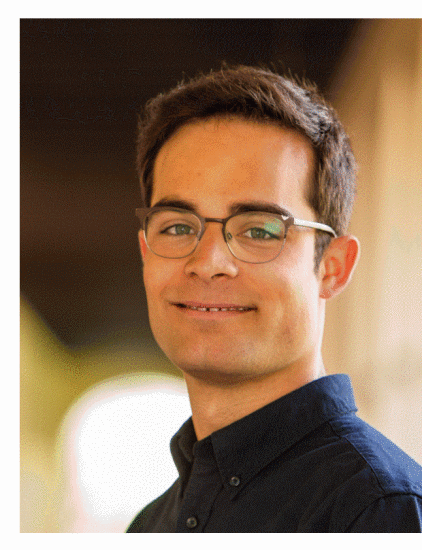 Julius Wanner合作论文数1
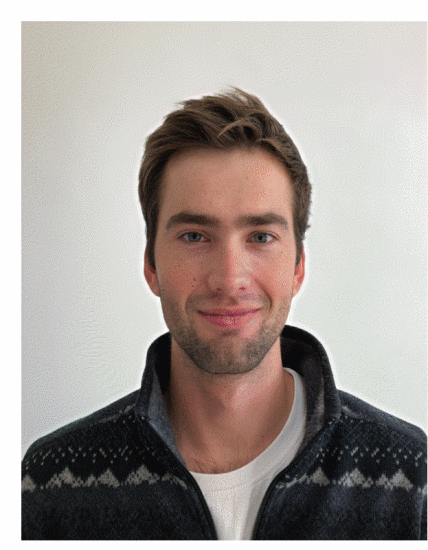 Jan Raffel合作论文数1
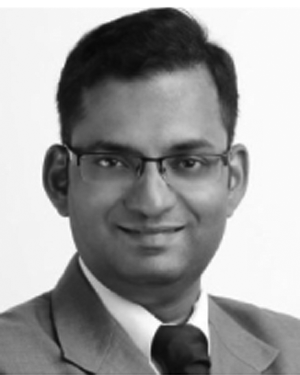 Amit Kumar Gupta合作论文数1Andrew White合作论文数1Ez Hassan合作论文数1




