In recent years, object detection models have been extensively applied across various industries, leveraging learned samples to recognize and locate objects. However, industrial environments present unique challenges, including complex backgrounds, dense object distributions, object stacking, and occlusion. To address these challenges, we propose the Global Dynamic Matching Transformer Network (GMTNet). GMTNet partitions images into blocks and employs a sliding window approach to capture information from each block and their interrelationships, mitigating background interference while acquiring global information for dense object recognition. By reweighting key-value pairs in multi-scale feature maps, GMTNet enhances global information relevance and effectively handles occlusion and overlap between objects. Furthermore, we introduce a dynamic sample matching method to tackle the issue of excessive candidate boxes in dense detection tasks. This method adaptively adjusts the number of matched positive samples according to the specific detection task, enabling the model to reduce the learning of irrelevant features and simplify post-processing. Experimental results demonstrate that GMTNet excels in dense detection tasks and outperforms current mainstream algorithms. The code will be available at http://github.com/yikuizhai/GMTNet.
The increased complexity of artificial intelligence (AI), machine learning (ML) and deep learning (DL) methods, models, and training data to satisfy industrial application needs has emphasised the need for AI model providing explainability and interpretability.Model Explainability aims to commu nicate the reasoning of AI/ML/DL technology to end users, while model interpretability focuses on in-powering model transparency so that users will understand precisely why and how a model generates its results.Edge AI, which combines AI, Internet of Things (IoT) and edge com puting to enable real-time collection, processing, analytics, and decisionmaking, introduces new challenges to acheiving explainable and interpretable methods.This is due to the compromises among performance, constrained resources, model complexity, power consumption, and the lack of bench marking and standardisation in edge environments.This chapter presents the state of play of AI explainability and inter pretability methods and techniques, discussing different benchmarking approaches and highlighting the state-of-the-art development directions.
With the advancement of deep learning (DL) technologies, remarkable progress has been achieved in change detection (CD). Existing DL-based methods primarily focus on the discrepancy in bitemporal images, while overlooking the commonality in bitemporal images. However, one of the reasons hindering the improvement of CD performance is the inadequate utilization of image information. To address the above issue, we propose a Deeply Supervised Hybrid Feature Aggregation Network (DS-HyFA-Net). This network predicts changes by integrating the distinctness and the commonality in bitemporal images. Specifically, the DS-HyFA-Net primarily consists of a set of encoders and a Hybrid Feature Aggregation (HyFA) module. It uses a Siamese encoder (or Encoder I) and a specialized encoder (or Encoder II) to extract distinct and common features (CFs) in bitemporal images, respectively. The HyFA module efficiently aggregates distinct and common features (or hybrid features) and generates a change map using a predictor. In addition, a common feature learning strategy (CFLS) is introduced, based on deeply supervised (DS) techniques, to guide Encoder II in learning CFs. Experimental results on three well-recognized datasets demonstrate the effectiveness of the innovative DS-HyFA-Net, achieving F1-Scores of 93.33% on WHU-CD, 90.98% on LEVIR-CD, and 81.14% on SYSU-CD. Our code is available at https://github.com/yikuizhai/DS-HyFA-Net.
Explainable methods for understanding deep neural networks are currently being employed for many visual tasks and provide valuable insights about their decisions. While post-hoc visual explanations offer easily understandable human cues behind neural networks’ decision-making processes, comparing their outcomes still remains challenging. Furthermore, balancing the performance-explainability trade-off could be a time-consuming process and require a deep domain knowledge. In this regard, we propose a novel auxiliary module, built upon convolutional-based encoders, which acts on the final layers of convolutional neural networks (CNNs) to learn orthogonal feature maps with a more discriminative and explainable power. This module is trained via a disentangle loss which specifically aims to decouple the object from the background in the input image. To quantitatively assess its impact on standard CNNs, and compare the quality of the resulting visual explanations, we employ metrics specifically designed for semantic segmentation tasks. These metrics rely on bounding-box annotations that may accompany image classification (or recognition) datasets, allowing us to compare both ground-truth and predicted regions. Finally, we explore the impact of various self-supervised pre-training strategies, due to their positive influence on vision tasks, and assess their effectiveness on our considered metrics.
Remote sensing change detection (RSCD) aims to identify changes within bi-temporal registered images. However, existing deep learning (DL)-based RSCD networks often suffer from large numbers of parameters, high computational complexity, and low inference speed, making it challenging to achieve efficient inference in real-world deployments. In addition, current models lack robust feature-fitting capabilities, necessitating the development of an efficient and powerful RSCD model to address this issue. Therefore, we propose a novel RSCD network named efficient adjacent feature harmonizer network (EAFH-Net) with fast computational speed and lightweight design. It is based on MobileNetV2, considering that change maps of different sizes contain temporal information of bitemporal features and spatial information at various scales, we introduce a multiscale feature neighbor fusion module (MFNFM) to address the lack of interaction between sophisticated-level and elementary-level features, and spatial and channel feature harmonizer module (SCFHM) to harmonize the spatiotemporal information of the change maps. Moreover, data-driven DL algorithms face another challenge due to insufficient granularity and the need for more practical datasets. Therefore, we present unmanned aerial vehicle (UAV)-CD+, a dataset comprising 2002 pairs of bi-temporal UAV low-altitude images, each sized at 1024 x 1024. We performed experiments on three publicly accessible datasets in conjunction with UAV-CD+, comparing the results with other state-of-the-art (SOTA) methods. EAFH-Net attains the utmost precision, obtaining 91.74% on LEVIR-CD, 84.28% on SYSU-CD, 95.07% on WHU-CD, 79.12% on CLCD, and 70.12% on UAV-CD+. We have our model code available at the following link: https://github.com/yikuizhai/UCSFH-Net.
Synthetic defect generation is an important aid for advanced manufacturing and production processes. Industrial scenarios rely on automated image-based quality control methods to avoid time-consuming manual inspections and promptly identify products not complying with specific quality standards. However, these methods show poor performance in the case of ill-posed low-data training regimes, and the lack of defective samples, due to operational costs or privacy policies, strongly limits their large-scale applicability.To overcome these limitations, we propose an innovative architecture based on an unpaired image-to-image (I2I) translation model to guide a transformation from a defect-free to a defective domain for common industrial products and propose simultaneously localizing their synthesized defects through a segmentation mask. As a performance evaluation, we measure image similarity and variability using standard metrics employed for generative models. Finally, we demonstrate that inspection networks, trained on synthesized samples, improve their accuracy in spotting real defective products.
Image-to-image (I2I) translation models typically refer to a class of adversarial architectures aiming to transfer an image content from a source domain to a target domain. To increase the image quality, data augmentation techniques or collecting new samples represent valid options yet lack of diversity and overfitting may negatively impact on the final results. In this regard, several practical scenarios do not permit to include new samples, or to employ powerful hardware, due to privacy policies or insufficient financial resources, leading to use imbalanced sets of images and favoring the more populated domain. To overcome these issues, we propose a simple and effective procedure to take advantage of the combination of critical learning parameters and demonstrate that averaging weights of multiple pre-trained $\mathrm{I}2\mathrm{I}$ models is beneficial for increasing model performance, which can be optimized for edge computing without hurting the quality of synthesized images. To this end, we define a tree-based structure, including multiple $\mathrm{I}2\mathrm{I}$ translation models, that outputs a single and more reliable network. We demonstrate that this strategy increases image quality and also show that our binary-tree learning procedure has a beneficial impact on edge devices, and it can be easily applied to architectures trained on different domains.
Image-to-image (I2I) translation models are widely employed in several fields, e.g., computer vision, security or medicine. Their goal is to map images from a source domain to a target domain while preserving content information. Despite their success, these models suffer from multiple weaknesses. For example, many practical scenarios do not consent to collect a sufficient amount of images, leading to imbalanced domains. Furthermore, mode collapse and training instability require a careful design and further discourage their deployment on edge devices. Finally, I2I models need an intensive computation to learn conditional probability distributions and are difficult to adapt to different contexts. These drawbacks mainly limit their large scale applicability. In this work, we want to shed light on the main solutions adopted to overcome the above issues and their impact on the performance. We also investigate several approaches to deploy these models on low-powered devices and weight sharing techniques to reduce the number of parameters and resources used.
Human trajectory forecasting is a key component of autonomous vehicles, social-aware robots and advanced video-surveillance applications. This challenging task typically requires knowledge about past motion, the environment and likely destination areas. In this context, multi-modality is a fundamental aspect and its effective modeling can be beneficial to any architecture. Inferring accurate trajectories is nevertheless challenging, due to the inherently uncertain nature of the future. To overcome these difficulties, recent models use different inputs and propose to model human intentions using complex fusion mechanisms. In this respect, we propose a lightweight attention-based recurrent backbone that acts solely on past observed positions. Although this backbone already provides promising results, we demonstrate that its prediction accuracy can be improved considerably when combined with a scene-aware goal-estimation module. To this end, we employ a common goal module, based on a U-Net architecture, which additionally extracts semantic information to predict scene-compliant destinations. We conduct extensive experiments on publicly-available datasets (i.e. SDD, inD, ETH/UCY) and show that our approach performs on par with state-of-the-art techniques while reducing model complexity.
Anticipating human motion is an essential requirement for autonomous vehicles and robots in order to primary guarantee people’s safety. In urban scenarios, they interact with humans, the surrounding environment, and other vehicles relying on several cues to forecast crossing or not crossing intentions. For these reasons, this challenging task is often tackled using both visual and non-visual features to anticipate future actions from 2 s to 1 s earlier the event. Our work primarily aims to revise this standard evaluation protocol to forecast crossing events as early as possible. To this end, we conceive a solution upon an extensively used model for egocentric action anticipation (RU-LSTM), proposing to envision future features, or modalities, that can better infer human intentions using a properly attention-based fusion mechanism. We validate our model against JAAD and PIE datasets and demonstrate that an intent prediction model can benefit from these additional clues for anticipating pedestrians crossing events.
Accurate prediction of future human positions is an essential task for modern video-surveillance systems. Current state-of-the-art models usually rely on a "history" of past tracked locations (e.g., 3 to 5 seconds) to predict a plausible sequence of future locations (e.g., up to the next 5 seconds). We feel that this common schema neglects critical traits of realistic applications: as the collection of input trajectories involves machine perception (i.e., detection and tracking), incorrect detection and fragmentation errors may accumulate in crowded scenes, leading to tracking drifts. On this account, the model would be fed with corrupted and noisy input data, thus fatally affecting its prediction performance. In this regard, we focus on delivering accurate predictions when only few input observations are used, thus potentially lowering the risks associated with automatic perception. To this end, we conceive a novel distillation strategy that allows a knowledge transfer from a teacher network to a student one, the latter fed with fewer observations (just two ones). We show that a properly defined teacher supervision allows a student network to perform comparably to state-of-the-art approaches that demand more observations. Besides, extensive experiments on common trajectory forecasting datasets highlight that our student network better generalizes to unseen scenarios.
Anticipating human motion in crowded scenarios is essential for developing intelligent transportation systems, social-aware robots and advanced video surveillance applications. A key component of this task is represented by the inherently multi-modal nature of human paths which makes socially acceptable multiple futures when human interactions are involved. To this end, we propose a generative architecture for multi-future trajectory predictions based on Conditional Variational Recurrent Neural Networks (C-VRNNs). Conditioning mainly relies on prior belief maps, representing most likely moving directions and forcing the model to consider past observed dynamics in generating future positions. Human interactions are modelled with a graph-based attention mechanism enabling an online attentive hidden state refinement of the recurrent estimation. To corroborate our model, we perform extensive experiments on publicly-available datasets (e.g., ETH/UCY, Stanford Drone Dataset, STATS SportVU NBA, Intersection Drone Dataset and TrajNet++) and demonstrate its effectiveness in crowded scenes compared to several state-of-the-art methods.
Action anticipation in egocentric videos is a difficult task due to the inherently multi-modal nature of human actions. Additionally, some actions happen faster or slower than others depending on the actor or surrounding context which could vary each time and lead to different predictions. Based on this idea, we build upon RULSTM architecture, which is specifically designed for anticipating human actions, and propose a novel attention-based technique to evaluate, simultaneously, slow and fast features extracted from three different modalities, namely RGB, optical flow, and extracted objects. Two branches process information at different time scales, i.e., frame-rates, and several fusion schemes are considered to improve prediction accuracy. We perform extensive experiments on EpicKitchens-55 and EGTEA Gaze+ datasets, and demonstrate that our technique systematically improves the results of RULSTM architecture for Top-5 accuracy metric at different anticipation times.
Images represent a commonly used form of visual communication among people. Nevertheless, image classification may be a challenging task when dealing with unclear or non-common images needing more context to be correctly annotated. Metadata accompanying images on social-media represent an ideal source of additional information for retrieving proper neighborhoods easing image annotation task. To this end, we blend visual features extracted from neighbors and their metadata to jointly leverage context and visual cues. Our models use multiple semantic embeddings to achieve the dual objective of being robust to vocabulary changes between train and test sets and decoupling the architecture from the low-level metadata representation. Convolutional and recurrent neural networks (CNNs-RNNs) are jointly adopted to infer similarity among neighbors and query images. We perform comprehensive experiments on the NUS-WIDE dataset showing that our models outperform state-of-the-art architectures based on images and metadata, and decrease both sensory and semantic gaps to better annotate images.
Human capability to anticipate near future from visual observations and non-verbal cues is essential for developing intelligent systems that need to interact with people. Several research areas, such as human-robot interaction (HRI), assisted living or autonomous driving need to foresee future events to avoid crashes or help people. Egocentric scenarios are classic examples where action anticipation is applied due to their numerous applications. Such challenging task demands to capture and model domain's hidden structure to reduce prediction uncertainty. Since multiple actions may equally occur in the future, we treat action anticipation as a multi-label problem with missing labels extending the concept of label smoothing. This idea resembles the knowledge distillation process since useful information is injected into the model during training. We implement a multi-modal framework based on long short-term memory (LSTM) networks to summarize past observations and make predictions at different time steps. We perform extensive experiments on EPIC-Kitchens and EGTEA Gaze+ datasets including more than 2500 and 100 action classes, respectively. The experiments show that label smoothing systematically improves performance of state-of-the-art models for action anticipation.
In complex contexts, people need to adapt their behavior to interact with the surrounding environment to reach the intended destination or avert collisions. Motion dynamics should therefore include both social and kinematic rules. The proposed analysis aims at defining a linear dynamic model to predict future positions of different types of agents, namely pedestrians and cyclists, observing a limited number of frames. The dynamics are defined in terms of artificial potentials fields (APFs) obtained by static (e.g., walls, doors or benches) and dynamic (e.g, other agents) elements to produce attractive and repulsive forces that influence the motion. A linear combination of such forces affects the resulting behavior. We exploit the context using a semantic scene segmentation to derive static forces while the interactions between agents are defined in terms of their reciprocal physical distances. We conduct experiments both on synthetic and on subsets of publicly available datasets to corroborate the proposed model.
Mimicking human ability to forecast future positions or interpret complex interactions in urban scenarios, such as streets, shopping malls or squares, is essential to develop socially compliant robots or self-driving cars. Autonomous systems may gain advantage on anticipating human motion to avoid collisions or to naturally behave alongside people. To foresee plausible trajectories, we construct an LSTM (long short-term memory)-based model considering three fundamental factors: people interactions, past observations in terms of previously crossed areas and semantics of surrounding space. Our model encompasses several pooling mechanisms to join the above elements defining multiple tensors, namely social, navigation and semantic tensors. The network is tested in unstructured environments where complex paths emerge according to both internal (intentions) and external (other people, not accessible areas) motivations. As demonstrated, modeling paths unaware of social interactions or context information, is insufficient to correctly predict future positions. Experimental results corroborate the effectiveness of the proposed framework in comparison to LSTM-based models for human path prediction.
We propose an unsupervised procedure to automatically extract a graph-based model of commercial maritime traffic routes from historical Automatic Identification System (AIS) data. In the proposed representation, the main elements of maritime traffic patterns, such as maneuvering regions and sea-lanes, are represented, respectively, with graph vertices and edges. Vessel motion dynamics are defined by multiple Ornstein-Uhlenbeck processes with different long-run mean parameters, which in our approach can be estimated with a change detection procedure based on Page's test, aimed to reveal the spatial points representative of velocity changes. A density-based clustering algorithm is then applied to aggregate the detected changes into groups of similar elements and reject outliers. To validate the proposed graph-based representation of the maritime traffic, two performance criteria are tested against a real-world trajectory dataset collected off the Iberian Coast and the English Channel. Results show the effectiveness of the proposed approach, which is suitable to be integrated at any level of a JDL system.
Inspired by the fair regularity of the motion of ships, we present a method to derive a representation of the commercial maritime traffic in the form of a graph, whose nodes represent way-point areas, or regions of likely direction changes, and whose edges represent navigational legs with constant cruise velocity. The proposed method is based on the representation of a ship's velocity with an Ornstein-Uhlenbeck process and on the detection of changes of its long-run mean to identify navigational way-points. In order to assess the graph representativeness of the traffic, two performance metrics are introduced, leading to distinct graph construction criteria. Finally, the proposed method is validated against real-world Automatic Identification System data collected in a large area.
 Lamberto Ballan合作论文数Department of Mathematics “Tullio Levi-Civita”, University of Padova;Human Inspired Technology Research Centre, University of Padova11
 Angelo Genovese合作论文数9
 Fabio Scotti合作论文数Industrial, Environmental, and Biometrics Informatics Laboratory, Dipartimento di Informatica, Universita Degli Studi di Milano8
 Vincenzo Piuri合作论文数Dipartimento di Informatica, Universita degli Studi di Milano7
 Francesco Palmieri合作论文数Department of Computer Science, University of Salerno6
 Guglielmo Camporese合作论文数RWTH Aachen University3
 Francesco Castaldo合作论文数Dipt. di Ing. Ind. e dell'Inf., Seconda Univ. degli Studi di Napoli;c;Dipt. di Ing. Ind. e dell'Inf., Seconda Univ. degli Studi di Napoli3
 Simone Calderara合作论文数University of Modena and Reggio Emilia3
 Rita Cucchiara合作论文数Dipartimento di Ingegneria “Enzo Ferrari”, Università di Modena e Reggio Emilia3
 Alexandre Alahi合作论文数École Polytechnique Fédérale De Lausanne3
 Yikui Zhai合作论文数Wuyi University, Wuyi Univ3
 Silvio Savarese合作论文数Salesforce;Institute for Human-Centered Artificial Intelligence, Stanford University3
 Tingfeng Xian合作论文数2
 Nada Osman合作论文数University of Padova, Italy2
 Leonardo M Millefiori合作论文数NATO2
 Peter Willett合作论文数Department of Electrical and Computer Engineering, School of Engineering, University of Connecticut2
 Paolo Braca合作论文数Centre for Maritime Research and Experimentation, NATO Science and Technology Organization2Francesco Rundo合作论文数1Jianhong Zhou合作论文数1
 Enrico Cancelli合作论文数Human Inspired Technology Research Centre, Università degli Studi di Padova1Chaojun Dong合作论文数1
 Alessia Bertugli合作论文数Dipartimento di Ingegneria e Scienza dell’Informazione, Universitá degli Studi di Trento1Sourav Das合作论文数1
 Luigi Filippo Chiara合作论文数1Matteo Lisotto合作论文数1Xudong Jia合作论文数1
 Angelo Porrello合作论文数Aimage Lab, Department of Engineering "Enzo Ferrari", University of Modena and Reggio Emilia1
 Antonino Furnari合作论文数Department of Mathematics and Computer Science, University of Catania1
 Alessio Monti合作论文数Egicon S.R.L1
 Giovanni Maria Farinella合作论文数Department of Mathematics and Computer Science, University of Catania1Hongsheng Zhang (张鸿生)合作论文数1
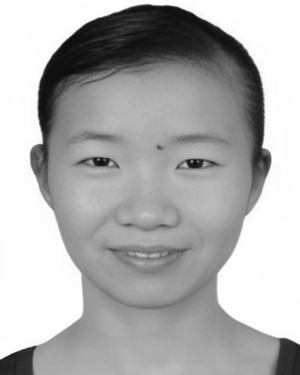 Ying Xu合作论文数1
 Alberto Cavallo合作论文数Department of Engineering of Informations, Second University of Naples1
 C. L. Philip Chen (陈俊龙)合作论文数School of Computer Science & Engineering, South China University of Technology;International Center for informatics Research, Beijing Jiaotong University1
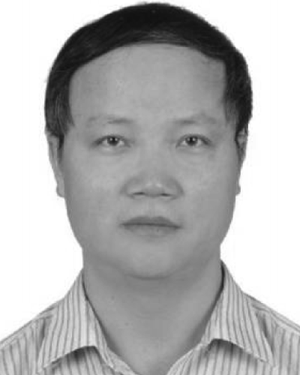 Zilu Ying合作论文数1
 Ruggero Donida Labati合作论文数Università di Milano1




