Viscous computational fluid dynamics based on Reynolds averaged Navier-Stokes (RANS) equations have been used to simulate flow around typical mast-sail geometries. It is shown how these advanced numerical methods are relevant to investigate the complexity of such strongly separated flows. Detailed numerical results have been obtained and compared to experimental ones. Comparative analysis has shown that RANS methods are able to capture the main flow features, such as mast-flow separation, recirculation bubble, bubble reattachment through a laminar-turbulent transition process, and trailing-edge separation. A second part has been devoted to the comparative behavior of these flow features through parameters variations to evaluate the qualitative and quantitative capabilities of RANS methods in mastsail design optimization. The last part illustrates through two examples how RANS methods may be used to optimize the design of mast-sail geometries and evaluate their relative performances.
We derive the distribution of the center of mass $S$ of the integrated superBrownian excursion (ISE) {from} the asymptotic distribution of the Wiener index for simple trees. Equivalently, this is the distribution of the integral of a Brownian snake. A recursion formula for the moments and asymptotics for moments and tail probabilities are derived.
Odlyzko [Random Structures Algorithms 6 (1995) 275-295] exhibited an asymptotically optimal algorithm, with respect to the average cost, among algorithms that find the maximum of a random walk by using only probes and comparisons. We extend Odlyzko's techniques to prove that his algorithm is indeed asymptotically optimal in distribution (with respect to the stochastic order). We also characterize the limit law of its cost. Computing its moments in two ways allows us to recover a surprising identity concerning Euler sums.
In this paper, we consider hashing with linear probing for a hashing table with m places, n items (n < m), and l = m<n empty places. For a non computer science-minded reader, we shall use the metaphore of n cars parking on m places: each car chooses a place at random, and if this place k is occupied, the car tries successively k+1, k+2, ... until it finds an empty place (with the convention that place m+1 is actually place 1). Pittel [42] proves that when l/m goes to some positive limit a < 1, the size of the largest block of consecutive cars is O(log m). In this paper we examine at which level for n a phase transition occurs for the largest block of consecutive cars between o(m) and O(m). The intermediate case reveals an interesting behaviour of sizes of blocks, related to the standard additive coalescent in the same way as the sizes of connected components of the random graph are related to the multiplicative coalescent.
We describe a Vervaat-like path transformation for the reflected Brownian bridge conditioned on its local time at 0: up to random shifts, this process equals the two processes constructed from a Brownian bridge and a Brownian excursion by adding a drift and then taking the excursions over the current minimum. As a consequence, these three processes have the same occupation measure, which is easily found. The three processes arise as limits, in three different ways, of profiles associated to hashing with linear probing, or, equivalently, to parking functions.
The limit law of the couple height-width for simple trees can be seen as a consequence of deep results of Aidous, Drmota and Gittenberger, and Jeulin. We give here an, elementary proof in the case of binary trees.
In 70's Donaldson proved a conjecture of Zassenhaus and Ford: \Lattices of the uniform model and with a xed dimension are almost surely reduced (in the sense of Minkowski), as the dimension of the ambient space tends to innnity." Then he deduces some more eecient heuristic for nding a Minkowski reduced basis in a lattice. Our talk shows (in a more precise sense) an analogous phenomenon, for the Lovasz (LLL) reduction. In particular, our method exhibits some sharp threshold phenomenon concerning lattices of the uniform model. Then we present and analyze two new lattice reduction algorithms. These algorithms, called the Schmidt reduction and the Gram reduction, are obtained by relaxing some of the constraints of the classical LLL algorithm. Analyzing the worst case behavior and the average case behavior in a tractable model, proves that the new algorithms still produce \good" reduced basis while requiring fewer steps on average. In addition, these results (about the relative behavior of the diierent reduction algorithms) are connrmed by empirical tests on random lattices coming from applications. We discuss a general question and a speciic question. To motivate the general question, consider the TSP on n random points in the square. The optimal tour is trivially a.s. unique. But there's a deeper uniqueness question. One can perturb the optimal tour by changing a proportion of edges used, to create a sub-optimal tour whose length is (1 + ") times optimal. Is the converse true? That is, given a sub-optimal tour whose length is (1 + ") times optimal, is it necessarily a perturbation of the optimal tour which changes a proportion of edges, where (") ! 0 as " ! 0? This asymptotic essential uniqueness (AEU) question can be posed for most continuous-valued optimization-over-random-data problems. It is easy to see, for instance, that AEU holds for the minimal spanning tree problem but not for a continuous version of maximal clique in random graph. Resolving AEU for the TSP is a major challenge for the 21st century. More approachable today is the random assignment (RA) or bipartite matching problem which studies A n = min n X i=1 c i;;(i) 1 for a n n matrix (c ij) with independent exponential(1) entries. It has long been conjectured 4] that EA n ! 2 =6 and indeed that () EA n = n X i=1 i ?2 : See 2] for recent rigorous work. Perhaps (*) …
 Marc Yor合作论文数3
 Svante Janson合作论文数Department of Mathematics, Uppsala University2Jean-François Marckert合作论文数LaBRI2Dominique Gouyou-Beauchamps合作论文数1Dani ele GARDY合作论文数1Mireille Bousquet-M Elou合作论文数1
 Laurent Joly合作论文数1
 Alain Denise合作论文数Universite Paris-Sud1
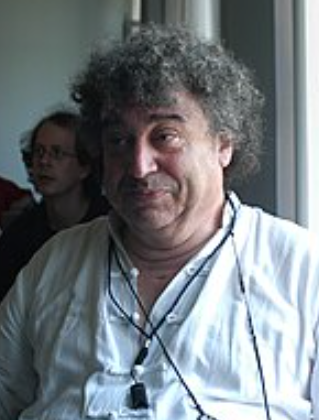 Philippe Flajolet合作论文数INRIA1
 Stephane Jamme合作论文数1L. Bretonnet合作论文数1Cyril Banderier合作论文数in the University of Paris Nord.
From 1998 to 2001, I have taught Theoretical and Practical Computer Science in University of Paris Nord. Here are the courses1Guy Louchard合作论文数ULB1Ali Akhavi合作论文数1
Stephane Jamme合作论文数1L. Bretonnet合作论文数1Cyril Banderier合作论文数in the University of Paris Nord.
From 1998 to 2001, I have taught Theoretical and Practical Computer Science in University of Paris Nord. Here are the courses1Guy Louchard合作论文数ULB1Ali Akhavi合作论文数1




