We present a semi-analytical model of optical coherence tomography (OCT) taking into account multiple scattering. The model rests on the assumptions that the measured portion of the backscattercd sample field is spatially coherent and that the sample is motionless relative to measurement time. This allows modeling an OCT signal as a sum of spatially coherent fields with random phase arguments - constant during measurement time - caused by multiple scattering. We calculate the mean OCT signal from classical results of statistical optics and a Monte Carlo simulation. Our model is shown to be in very good agreement with a whole range of experimental data gathered in a comprehensive study of cross-talk in wide-field OCT realized with spatially coherent illumination. The study consists of depth scan measurements of a mirror covered with an aqueous suspension of microspheres. We investigate the dependence of cross-talk on important optical system parameters, as well as on some relevant sample properties. We discuss the more complex OCT models based on the extended Huygens-Fresnel principle, which rest on different assumptions since they assume partially coherent interfering fields.
We present a comprehensive study of multiple-scattering effects in wide-field optical coherence tomography (OCT) realized with spatially coherent illumination. Imaging a sample made of a cleaved mirror embedded in an aqueous suspension of microspheres revealed that, despite temporal coherence gating, multiple scattering can induce significant coherent optical cross talk. The latter is a serious limitation to the method, since it prevents shot-noise-limited detection and diffraction-limited imaging in scattering samples. We investigate the dependence of cross talk on important system design parameters, as well as on some relevant sample properties. The agreement between theoretical and experimental results for the wide range of parameters investigated was very good, in both the lateral and the axial dimensions. This further confirms the validity of the model developed in our companion paper [J. Opt. Soc. Am. A 22, 1369-1379 (2005)].
We present a new model of optical coherence tomography (OCT) taking into account multiple scattering. A theoretical analysis and experimental investigation reveals that in OCT, despite multiple scattering, the field backscattered from the sample is generally spatially coherent and that the resulting interference signal with the reference field is stationary relative to measurement time. On the basis of this result, we model an OCT signal as a sum of spatially coherent fields with random-phase arguments--constant during measurement time--caused by multiple scattering. We calculate the mean of such a random signal from classical results of statistical optics and a Monte Carlo simulation. OCT signals predicted by our model are in very good agreement with a depth scan measurement of a sample consisting of a mirror covered with an aqueous suspension of microspheres. We discuss other comprehensive OCT models based on the extended Huygens-Fresnel principle, which rest on the assumption of partially coherent interfering fields.
Comparison of two illumination modes for wide-field optical coherence tomography has revealed that spatially coherent illumination generates coherent cross talk, causing significant image degradation, and that spatially incoherent illumination, with an adequate interferometer design, provides an efficient mechanism for suppression of coherent cross talk. This is shown by comparison of a pulsed laser with a thermal light source for a U.S. Air Force resolution target covered with a scattering solution made from microbeads as well as for an ex vivo tooth.
We measure the spectral reflectivity of a Cat (so named because its first conjugated image was that of a cat) self-pumped conjugator. We find that the transmission and the phase-conjugate reflectivity of the conjugator always vary periodically with wavelength and that the periodicity is caused by a resonator loop that springs up and self-adjusts inside the crystal. Depending on the spectral width of the incident beam, the conjugator will have either a minimum or a maximum reflectivity at the center of the writing spectrum. We show that the sign of the coherence function after one round trip of the internal resonator determines the spectral behavior of the conjugator, and we experimentally map out the dependence of the conjugator’s reflectivity and transmission on the spectral content of the incident beam.
Focusing an intense laser beam and its second harmonic into a glass fiber transforms the fiber into a frequency doubler. We measure the temporal evolution of both the amplitude and the phase of the second-harmonic light produced by a germanium-doped fiber and so determine the initial phase of the second-harmonic light to be Deltatheta= -71 degrees +/- 3 degrees . We demonstrate that the fiber-produced green light can exceed the seeding green light even if these two beams are 90 degrees out of phase. We also show that cross-phase modulation in the fiber can limit the maximum useful interaction length and consequently the ultimate efficiency of second-harmonic generation in fibers.
Focusing an intense laser beam and its second harmonic into a SK5 glass slab transforms the glass into a frequency doubler. We present a new method to measure the optical phase between the second-harmonic beam that transformed the glass and the second-harmonic beam subsequently generated by the glass. We find this phase shift to be Deltatheta= -90 degrees +/- 7 degrees . A spatial map of this phase confirms that the internal dc electric field locked inside the glass resembles a dipole electric field.
 Markus Laubscher合作论文数4Boris Karamata合作论文数4
 Theo Lasser合作论文数BM 5143 (Btiment BM), Station 17, 1015 Lausanne, Switzerland4
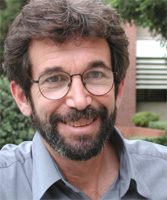 Jack Feinberg合作论文数Department of Physics & Astronomy, University of Southern California3
 Marcel Leutenegger合作论文数Max Planck Institute for Multidisciplinary Sciences3Stephane Bourquin合作论文数3V Dominic合作论文数1Dmitry Noraev合作论文数1




