Benchmarks are essential in the design of modern HPC installations, as they define key aspects of system components. Beyond synthetic workloads, it is crucial to include real applications that represent user requirements into benchmark suites, to guarantee high usability and widespread adoption of a new system. Given the significant investments in leadership-class supercomputers of the exascale era, this is even more important and necessitates alignment with a vision of Open Science and reproducibility. In this work, we present the JUPITER Benchmark Suite, which incorporates 16 applications from various domains. It was designed for and used in the procurement of JUPITER, the first European exascale supercomputer. We identify requirements and challenges and outline the project and software infrastructure setup. We provide descriptions and scalability studies of selected applications and a set of key takeaways. The JUPITER Benchmark Suite is released as open source software with this work at github.com/FZJ-JSC/jubench.
The Human Brain Project (HBP) ( https://humanbrainproject.eu/ ) is a large-scale flagship project funded by the European Commission with the goal of establishing a research infrastructure for brain science. This research infrastructure is currently being realised and will be called EBRAINS ( https://ebrains.eu/ ). The wide ranging EBRAINS services for the brain research communities require diverse access, processing and storage capabilities. As a result, it will strongly rely on e-infrastructure services. The HBP led to the creation of Fenix ( https://fenix-ri.eu/ ), a collaboration of five European supercomputing centres, who are providing a set of federated e-infrastructure services to EBRAINS. The Fenix architecture has been designed to uniquely address the need for a wide spectrum of services, from high performance computing (HPC) to on-demand cloud technologies to identity and access federation, for facilitating ease of access and usage of distributed e-infrastructure resources. In this article we describe the underlying concepts for an audience of computational science end-users and developers of domain-specific applications, workflows and platforms services. To exemplify the use of Fenix, we will discuss selected use cases demonstrating how brain researchers can use the offered infrastructure services and describe how access to these resources can be obtained.
Changes in modern economic spaces of different countries of the world, global challenges stimulate interest in the goals in the field of sustainable development of territories. Elements of the theory of innovative industries are used to solve problems in classical segments of the economy associated with ensuring their growth and development. This theory is built on concept of orange economy where creative and intellectual potential are the main resources. The purpose of the article is to analyze the experience of UrFU in solving problems in the field of sustainable development and developing the concept of a “green university” and “green campus”, which imply an improvement in the quality of the environment. Methods of content analysis, qualitative and quantitative research methods were used in the work such as methods of systematization, analysis of documents and statistical information, foresight session. We have identified the main goals of the university campus policy; identified and substantiated the main categories that meet the challenges of the future orange economy. The authors analyzed the results of a foresight session with experts in the field of sustainable development and creative economics, which made it possible to develop forecasts for the development of the university with a planning horizon till 2030 for the implementation of a new campus policy aimed at creating a green university. The article discusses a predictive model for creating a university campus on the example of the Ural Federal University with possible development as part of the orange economy concept.
Five European supercomputing centres, namely BSC (Spain), CEA (France), CINECA (Italy), CSCS (Switzerland), and JSC (Germany), agreed to align their high-end computing and storage services to facilitate the creation of the Fenix Research Infrastructure. In addition to the traditional extreme-scale computing and data services, Fenix provides a set of Cloud-type services as well as services needed for federation. In this paper, we describe the architecture of the Fenix infrastructure and how it can be used for representative workflows from the Human Brain Project (HBP). The concept of the Active Data Repository (ACD) is chosen to highlight demarcation between HPC and Cloud access models.
 Andreas Herten合作论文数3
 Benedikt Von St. Vieth合作论文数3
 Giuseppe Fiameni合作论文数NVIDIA AI Technol Ctr2Anne Nahm合作论文数2
 Michele Carpene合作论文数2Dorian Krause合作论文数2Sanzio Bassini合作论文数2Debora Testi合作论文数2Stefano Gorini合作论文数2Wouter Klijn合作论文数Simulat & Data Lab Neurosci, JARA2Frederic Combeau合作论文数2Javier Bartolome合作论文数2Colin McMurtrie合作论文数2
 Thomas Lippert合作论文数Forschungszentrum Julich, Julich Supercomp Ctr2
 Dirk Pleiter合作论文数John von Neumann-Institut fur Computing2
 Sadaf Alam合作论文数Swiss National Supercomputing Centre, ETH Zurich2
 Bjorn Hagemeier合作论文数2Sergi Girona合作论文数Technical University of Catalonia2Thomas Leibovici合作论文数CEA/DAM2
 Thomas C. Schulthess合作论文数Institute for Theoretical Physics, ETH Zurich;Dep. of Physics, ETH Zurich2
 Mirko Cestari合作论文数Dipartimento di Scienze Chimiche via Marzolo, Università di Padova2Jacques-Charles Lafoucriere合作论文数2Boris Orth合作论文数2Thorsten Hater合作论文数2Achilles Sebastian合作论文数1Stepan Nassyr合作论文数1Irina Pelymskaya合作论文数1
 Mehdi Cherti合作论文数1
 Jayesh Badwaik合作论文数Department of Mathematics, University of Würzburg1c meyer合作论文数1
 Zaitseva Ekaterina合作论文数1
 Dennis Willsch合作论文数Julich Supercomp Ctr, Forschungszentrum Julich1Mathis Bode合作论文数Rhein Westfal TH Aachen, Inst Combust Technol, Aachen, Germany1
 Olaf Stein合作论文数1Natalia Goncharova合作论文数1
 Daniel Caviedes-Voullieme合作论文数1
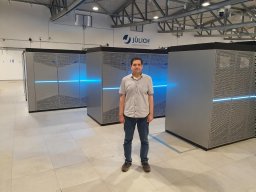 Kaveh Haghighi Mood合作论文数Faculty of Sciences, Shahid Beheshti University1
 Jan H. Meinke合作论文数Department of Physics;Syracuse University;Department of Physics, Syracuse University1
 Estela Suarez合作论文数Jülich Supercomputing Centre1
 Jenia Jitsev合作论文数LAION;Ontocord.ai1Wolfgang Frings合作论文数1Ilya Zhukov合作论文数1Salem El Sayed合作论文数1




