•No degradation is induced on module A for voltages up to IEC 61730-2 limits.•Module A withstands voltage up to 35kV following the steps of IEC 61730-2.•Tests in rod-to-module gap showed that 144kV is needed for module’s destruction.
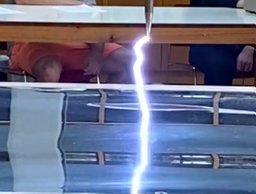
Scope of the current study is to examine the electrical characteristics of photovoltaic (PV) modules after being subjected to high impulse voltages, which are usually generated by lightning or switching surges. Tests were conducted at the High Voltage Laboratory of the University of Patras in Greece on PV modules of 5 and 195W(p) derived from different manufacturers, by performing various stress scenarios. The I-V and P-V characteristic curves of the examined modules, before and after the impulse voltage stress tests, are compared with each other considering the modules' ability to maintain their nominal electrical characteristics. After certain periods of time, the electrical performances of the stressed modules are examined again in order to ensure whether they regain some or all of their properties in case of prior differentiation. The experimental results are compared with theoretical estimations, so as to confirm the rightness of the presented procedure.
The objective of this work is to present how modules react in case of lightning strikes and overvoltages. The experimental process included the application of impulse voltages within the limits specified by the standards as well as, beyond these limits After each impulse voltage stress, the properties of the stressed photovoltaic module were compared with those of one with identical characteristics unstressed module in order to evaluate possible modifications in the stressed module properties. The measurements were gathered with the use of a PVPM power measuring device. The conclusions were extracted after completion of an extensive series of tests. The results confirmed that, after the completion of the tests, the tested module had not undergone power degradation, had not shown any evidence of surface defects and continued to operate reliably.
This work evaluates the influence of temperature and irradiation on the behavior of mono-crystalline silicon, poly-crystalline silicon, and Copper Indium diselenide (CIS), modules which have been exposed to real conditions. An outdoor experimental setup has been installed, at a Mediterranean site in north latitude 38 °, in order to collect results from current-voltage measurements that corresponded at constant radiation level in order to evaluate the effect of temperature and results from measurements realized at about the same temperature in order to study the effect of irradiation. The results present that the daily generated power normalized to the manufacturer's value is positively influenced by the irradiation and not by the negative effect of temperature. The performance of mono and poly Si appears superior to that of CIS early in the morning, while this advantage is diminished during midday, when the temperature and irradiance are highest, as CIS performance becomes comparable to the other two. However, the temperature affects the efficiency and fill factor for the mono and poly-Si modules recording the lower values on higher temperatures, while it does not the same for the CIS modules. This experimental study can provide information for locations with similar climatic conditions because it helps to take into account variation in temperatures together with variation in radiation and to avoid under-designing of photovoltaic systems and system malfunction.
This work evaluates the variations of photovoltaic properties of epitaxial silicon solar cells, fabricated on UMG-Si substrates, as a function of the epilayer thickness for different recombination velocities and doping concentrations. Device simulation and optimization software, developed in a previous paper, has been extended and adapted to n+pp+ type epitaxial solar cells.
An important requirement in the employment of the different existing PV technologies is the understanding of the performance exhibited by each technology, once installed outdoors. Such records are necessary since the outdoor PV electrical characteristics are different from those corresponding to STC (which rarely occurs outdoors) information listed in manufacturer data-sheets. Therefore the PV monitoring and evaluations, under different environmental conditions, are indispensable for the architects and PV systems installers, in order to accurately size the installations. In this paper the influence of temperature on the photovoltaic parameters of amorphous silicon (a-Si) and copper indium diselenide (CIS) thin film modules has been investigated, as well as the energy produced under actual operating conditions. The cur-rent-voltage characteristics and maximum power have been recorded at regular intervals, for one year in the Mediterranean climate city of Patras, Greece (latitude 380). Patras averages over 4.2 peak sun hours (PSH) per day and module working temperatures between 16 0C and 600C. Our results have shown that, the percentage reduction of the open circuit voltage with temperature increase is greater for the CIS than for the a-Si modules. The short circuit current temperature coefficient for the CIS modules is positive at low and medium temperatures, though over the entire range of working temperature remains approximately constant with a slight tendency to reduce. The maximum power decreases almost linearly, while the efficiency for temperatures higher than 50oC reduces sharply. It is remarkable that with respect to the temperature increase the a-Si modules efficiency remains very near to the rated value, and the short circuit current temperature coefficient and the power coefficient are positive. The fill factor for these modules decreases linearly and equally as a function of temperature. The series and parallel resistance for the a-Si decrease slightly with temperature increase, whereas for the CIS the series resistance increases and the parallel resistance decreases in a more pronounced way. Maximum year-round energy production corresponds to the tilt angles of about 20 and 50 degrees in the summer and winter respectively.
This work presents a study of n(+)pp(+) type epitaxial solar cells developed on different wafers derived from an ingot UMG-Si recrystallized by HEM method with efficiencies of about 10%. More precisely it focuses on the development of software adapted to this type of cells, which expresses the variations of photovoltaic parameters as a function of epilayer thickness calculated for different values of recombination velocity and doping concentration, in order to optimize the epilayer thickness and efficiency of the cells.For this purpose, the one-dimensional (1D) model is evaluated through a simulation program which takes into account the interaction between several parameters as well as the restrictions between them. By modelling short circuit current density, open circuit voltage and efficiency, cells of different grain sizes have been studied. In cases of low recombination velocity calculated results have shown that the photocurrent density and conversion efficiency (J(sc)similar to 30 mA/cm(2), eta similar to 13.8%) saturate when epilayer thickness values are higher than similar to 65 mu m and the gain is minimal, while they are heavily affected from epilayer thickness in cases of high recombination velocity. Calculated results also show that in cases of low doping concentration values photocurrent density and efficiency saturate for epilayer thickness values higher than 65 mu m. However, for higher values of doping concentration higher photocurrent density and efficiency can be achieved by thinner epilayers.This study also suggests a second best value of epilayer thickness (<= 50 mu m), which is significantly lower and induces minor reductions in photocurrent density and efficiency values. A further comparison between simulated and experimental curves of quantum efficiency under 1000 W/m(2) illumination shows good agreement for wavelengths longer than 0.8 mu m. However, near the blue part of the solar spectrum the measured quantum efficiency is significantly lower than the simulated one, due to the absence of surface passivation and the differences in the reflection coefficient between experimental and simulated devices. (C) 2010 Elsevier B.V. All rights reserved.
A three-dimensional (3D) analytical model based on the Green's Function method, is applied on n+pp+ type epitaxial solar illuminated on the front side. This model is implemented through a simulation program in order to determine the device parameters, which optimize the cell's efficiency. A number of cells fabricated on low-cost UMG substrate have been studied and their spectral response is evaluated. The basic design parameter selected for optimization of these cells is the epitaxial layer thickness, through variation of grain size and grain boundary recombination velocity. In addition, 3D spectral response results are compared with experimental data and the 1D model.
 Eleftheria Pyrgioti合作论文数4
 Ioannis.A. Naxakis合作论文数4
 G. Revel合作论文数2M. Barbe合作论文数2Jeaneric Bouree合作论文数2Michel Rodot合作论文数2J.-L. Pastol合作论文数2
 E. Tselepis合作论文数University of Ottawa2R. Kishore合作论文数2Matty Caymax合作论文数2m eyckmans合作论文数1R. Mertens合作论文数1
 Panagiotis Kounavis合作论文数Institute of Chemical Engineering and High Temperature Chemical Processes, P.O. Box 1239, 26110 Patra, Greece1Konstantinos Kotsovos合作论文数1
 Christos Christodoulou合作论文数School of Electrical and Computer Engineering, National Technical University of Athens1




