Combinatorics is a thriving branch of Mathematics with strong links to other areas of Mathematics and the sciences. Many of the modern techniques employed in Combinatorics draw on diverse ideas from Probability, Analysis, Geometry, Topology, and conversely, combinatorial approaches often lead to new insights in these other areas, and in the broader scientific arena (particularly Theoretical Computer Science). The most recent years in Combinatorics have been particularly exciting with spectacular solutions of many longstanding open problems, via an array of new ideas that promise to have many future applications. Leading experts and new talents came together to share and further develop these exciting ideas. Talks emphasized recent breakthroughs in discrete geometry, graph theory, combinatorial applications in Fourier analysis, group theory, combinatorial probability, Ramsey theory, nonabelian additive combinatorics, and design theory.
Motivated by the Polynomial Freiman-Ruzsa (PFR) Conjecture, we develop a theory of locality in sumsets, with several applications to John-type approximation and stability of sets with small doubling. One highlight shows that if $A \sub \mb{Z}$ with $|A+A| \le (1-\eps) 2^d |A|$ is non-degenerate then $A$ is covered by $O(2^d)$ translates of a $d$-dimensional generalised arithmetic progression ($d$-GAP) $P$ with $|P| \le O_{d,\eps}(|A|)$; thus we obtain one of the polynomial bounds required by PFR, under the non-degeneracy assumption that $A$ is not efficiently covered by $O_{d,\eps}(1)$ translates of a $(d-1)$-GAP. We also prove a stability result showing for any $\eps,\aA>0$ that if $A \sub \mb{Z}$ with $|A+A| \le (2-\eps)2^d|A|$ is non-degenerate then some $A' \sub A$ with $|A'|>(1-\aA)|A|$ is efficiently covered by either a $(d+1)$-GAP or $O_{\aA}(1)$ translates of a $d$-GAP. This `dimension-free' bound for approximate covering makes for a surprising contrast with exact covering, where the required number of translates not only grows with $d$, but does so exponentially. Another highlight shows that if $A \sub \mb{Z}$ is non-degenerate with $|A+A| \le (2^d + \ell)|A|$ and $\ell \le 0.1 \cdot 2^d$ then $A$ is covered by $\ell+1$ translates of a $d$-GAP $P$ with $|P| \le O_d(|A|)$; this is tight, in that $\ell+1$ cannot be replaced by any smaller number. The above results also hold for $A \sub \mb{R}^d$, replacing GAPs by a suitable common generalisation of GAPs and convex bodies, which we call generalised convex progressions. In this setting the non-degeneracy condition holds automatically, so we obtain essentially optimal bounds with no additional assumption on $A$. Here we show that if $A\subset\mathbb{R}^k$ satisfies $|\frac{A+A}{2}|\leq (1+\delta)|A|$ with $\delta\in(0,1)$, then $\exists A'\subset A$ with $|A'|\geq (1-\delta)|A|$ so that $|\co(A')|\leq O_{k,1-\delta}(|A|)$. This is a dimensionally independent sharp stability result for the Brunn-Minkowski inequality for equal sets, which hints towards a possible analogue for the Pr\'ekopa-Leindler inequality. These results are all deduced from a unifying theory, in which we introduce a new intrinsic structural approximation of any set, which we call the `additive hull', and develop its theory via a refinement of Freiman's theorem with additional separation properties. A further application that will be published separately is a proof of Ruzsa's Discrete Brunn-Minkowski Conjecture \cite{Ruzsaconjecture}.
We determine the limiting density of the largest sum-free subset of the lattice cube {1,2,…,n}^d for all d, thus resolving the natural conjecture that it is constructed by two appropriate hyperplane slices.
For integers 1< k < d-1 and r ⩾ k+2 , we establish new lower bounds on the maximum number of points in [n]^d such that no r lie in a k-dimensional affine (or linear) subspace. These bounds improve on earlier results of Sudakov-Tomon and Lefmann. Further, we provide a randomised construction for the no-four-on-a-circle problem posed by Erdős and Purdy, improving Thiele’s bound. We also consider the random construction in higher dimensions, and improve the bound of Suk and White for d ⩾ 4 . In each case, we apply the deletion method, using results from number theory and incidence geometry to solve the associated counting problems.
We consider an interacting particle system where equal-sized populations of two types of particles move by random walk steps on a graph, the two types may have different speeds, and meetings of opposite-type particles result in annihilation. The key quantity of interest is the expected extinction time. Even for the mean-field setting of complete graphs, the correct order of magnitude was not previously known. Under essentially optimal assumptions on the starting configuration, we determine not only the order of magnitude but also the asymptotics: the expected extinction time on K_2n is (2+o(1))nlog n, independently of the relative speeds of the two types.
We consider the algorithmic decision problem that takes as input an n-vertex k-uniform hypergraph H with minimum codegree at least m-c and decides whether it has a matching of size m. We show that this decision problem is fixed parameter tractable with respect to c. Furthermore, our algorithm not only decides the problem, but actually either finds a matching of size m or a certificate that no such matching exists. In particular, when m = n/k and c = O (log n), this gives a polynomial-time algorithm that, given any n-vertex k-uniform hypergraph H with minimum codegree at least n/k-c, finds either a perfect matching in H or a certificate that no perfect matching exists.
Our main result is a robust generalisation of the Cockayne-Lorimer theorem on the multicolour Ramsey number of matchings. It is moreover a generalisation of the transference generalisation of Cockayne-Lorimer, which (informally) says that the random graph G ∼ G(n,p) with np →∞ has, with high probability, essentially the same Ramsey matching properties as the complete graph K_n. We show, somewhat surprisingly, that the same is true under the rather weak robustness assumption that G is an s-connector (i.e. G is K_s,s-free) with s=o(n). Moreover, we show that such G has only an additive O(s) loss with respect to K_n for monochromatic matchings, which is essentially sharp. Our proof adapts a compression algorithm based on Gallai-Edmonds decompositions that we developed previously for generalised Ramsey-Turán problems.
We consider two questions of Ruzsa on how the minimum size of an additive basis B of a given set A depends on the domain of B. To state these questions, for an abelian group G and A subset of D subset of G we write l(D)(A) := min {|B|: B subset of D, A subset of B + B}. Ruzsa asked how much larger than l(Q)(A) can l(Z)(A) be for A subset of Z, and how much larger than l(Z)(A) can l(N)(A) be for A subset of N. For the first question we show that if l(Q)(A) = n then l(Z)(A) <= 2n, and this is tight up to an additive error of at most O(root n). For the second question, we show that if l(Z)(A) = n then l(N)(A) < O(n log n), and this is tight up to the constant factor. We also consider these questions for higher order bases. Our proofs use some ideas that are unexpected in this context, including linear algebra and Diophantine approximation.
In 1996, in his last paper, Erdős asked the following question that he formulated together with Faudree: is there a positive c such that any (n+1)-regular graph G on 2n vertices contains at least c 2^2n distinct vertex-subsets S that are cyclic, meaning that there is a cycle in G using precisely the vertices in S. We answer this question in the affirmative in a strong form by proving the following exact result: if n is sufficiently large and G minimises the number of cyclic subsets then G is obtained from the complete bipartite graph K_n-1,n+1 by adding a 2-factor (a spanning collection of vertex-disjoint cycles) within the part of size n+1. In particular, for n large, this implies that the optimal c in the problem is precisely 1/2.
We prove a generalised Ramsey–Turán theorem for matchings, which (a) simultaneously generalises the Cockayne–Lorimer Theorem (Ramsey for matchings) and the Erdős–Gallai Theorem (Turán for matchings), and (b) is a generalised Turán theorem in the sense that we can optimise the count of any clique (Turán-type theorems optimise the count of edges). More precisely, for integers q ≥ 1, n ≥ℓ≥ 2, and t_1,…,t_q ≥ 1 we determine the maximum number of ℓ-vertex complete subgraphs in an n-vertex graph that admits a q-edge-colouring in which, for each j=1,…,q, the j-coloured subgraph has no matching of size t_j. We achieve this by identifying two explicit constructions and applying a compression argument to show that one of them achieves the maximum. Our compression algorithm is quite intricate and introduces methods that have not previously been applied to these types of problems: it employs an optimisation problem defined by the Gallai–Edmonds decompositions of each colour.
We prove a conjecture by Ruzsa from 2006 on a discrete version of the Brunn-Minkowski inequality, stating that for any $A,B\subset\mathbb{Z}^k$ and $\epsilon>0$ with $B$ not contained in $n_{k,\epsilon}$ parallel hyperplanes we have $|A+B|^{1/k}\geq |A|^{1/k}+\left(1-\epsilon\right)|B|^{1/k}$.
Suppose is a finite abelian group, is not contained in any strict coset in , and are dense subsets of such that the sumset avoids . We show that and are almost entirely contained in sets defined by a bounded number of coordinates, that is, sets and , where the size of is non-zero and independent of , and are subsets of such that avoids . Furthermore, we show that this result extends to any finite group and summands for any .
We prove the existence of subspace designs with any given parameters, provided that the dimension of the underlying space is sufficiently large in terms of the other parameters of the design and satisfies the obvious necessary divisibility conditions. This settles an open problem from the 1970s. Moreover, we also obtain an approximate formula for the number of such designs.
We prove that any quasirandom graph with $n$ vertices and $rn$ edges can be decomposed into $n$ copies of any fixed tree with $r$ edges. The case of decomposing a complete graph establishes a conjecture of Ringel from 1963.
We consider a general framework for multi-type interacting particle systems on graphs, where particles move one at a time by random walk steps, different types may have different speeds, and may interact, possibly randomly, when they meet. We study the equilibrium time of the process, by which we mean the number of steps taken until no further interactions can occur. Under a rather general framework, we obtain high probability upper and lower bounds on the equilibrium time that match up to a constant factor and are of order nlog n if there are order n vertices and particles. We also obtain similar results for the balanced two-type annihilation model of chemical reactions; here, the balanced case (equal density of types) does not fit into our general framework and makes the analysis considerably more difficult. Our models do not admit any exact solution as for integrable systems or the duality approach available for some other particle systems, so we develop a variety of combinatorial tools for comparing processes in the absence of monotonicity.
We obtain new results on the Turán number of any bounded degree uniform hypergraph obtained as the expansion of a hypergraph of bounded uniformity. These are asymptotically sharp over an essentially optimal regime for both the uniformity and the number of edges and solve a number of open problems in Extremal Combinatorics. Firstly, we give general conditions under which the crosscut parameter asymptotically determines the Turán number, thus answering a question of Mubayi and Verstraëte. Secondly, we refine our asymptotic results to obtain several exact results, including proofs of the Huang–Loh–Sudakov conjecture on cross matchings and the Füredi–Jiang–Seiver conjecture on path expansions. We have introduced two major new tools for the proofs of these results. The first of these, Global Hypercontractivity, is used as a ‘black box’ (we present it in a separate paper with several other applications). The second tool, presented in this paper, is a far-reaching extension of the Junta Method, which we develop from a powerful and general technique for finding matchings in hypergraphs under certain pseudorandomness conditions.
What minimum degree of a graph G on n vertices guarantees that the union of G and a random 2-factor (or permutation) is with high probability Hamiltonian? Girão and Espuny Díaz showed that the answer lies in the interval [15 log n, n^3/4+o(1)]. We improve both the upper and lower bounds to resolve this problem asymptotically, showing that the answer is (1+o(1))√(nlog n/2). Furthermore, if G is assumed to be (nearly) regular then we obtain the much stronger bound that any degree growing at least polylogarithmically in n is sufficient for Hamiltonicity. Our proofs use some insights from the rich theory of random permutations and a randomised version of the classical technique of Pósa rotation adapted to multiple exposure arguments.
Thomasse conjectured the following strengthening of the well-known Caccetta-Haaggkvist conjecture: any digraph with minimum out-degree delta and girth g contains a directed path of length delta(g - 1). Bai and Manoussakis [SIAM J. Discrete Math., 33 (2019), pp. 2444-2451] gave counterexamples to Thomasse's conjecture for every even g >= 4. In this note, we first generalize their counterexamples to show that Thomasse's conjecture is false for every g >= 4. We also obtain the positive result that any digraph with minimum out-degree delta and girth g contains a directed path of 2(1 - 2/g). For small g we obtain better bounds; e.g., for g = 3 we show that oriented graph with minimum out-degree delta contains a directed path of length 1.5 delta. Furthermore, we show that each d-regular digraph with girth g contains a directed path of length Omega (dg/ log d). Our results give the first nontrivial bounds for these problems.
We show for A , B ⊂ R d $A,B\subset \mathbb {R}^d$ of equal volume and t ∈ ( 0 , 1 / 2 ] $t\in (0,1/2]$ that if | t A + ( 1 − t ) B | < ( 1 + t d ) | A | $|tA+(1-t)B|< (1+t^d)|A|$ , then (up to translation) | co ( A ∪ B ) | / | A | $|\operatorname{co}(A\cup B)|/|A|$ is bounded. This establishes the sharp threshold for the quantitative stability of the Brunn–Minkowski inequality recently established by Figalli, van Hintum, and Tiba, the proof of which uses our current result. We additionally establish a similar sharp threshold for iterated sumsets.
We prove that any bounded degree regular graph with sufficiently strong spectral expansion contains an induced path of linear length. This is the first such result for expanders, strengthening an analogous result in the random setting by Dragani\'c, Glock and Krivelevich. More generally, we find long induced paths in sparse graphs that satisfy a mild upper-uniformity edge-distribution condition.
 Benny Sudakov合作论文数Mathematics at UCLA27
 Eoin Long合作论文数School of Mathematics, College of Engineering and Physical Sciences, University of Birmingham13
 Dhruv Mubayi合作论文数Department of Mathematics, Statistics, and Computer Science, College of Liberal Arts and Sciences, University of Illinois at Chicago8
 Liana Yepremyan合作论文数7
 Peter van Hintum合作论文数Dept Pure Maths & Math Stat, Univ Cambridge6
 Noam Lifshitz合作论文数Einstein institute of Mathematics, Hebrew University of Jerusalem6
 Dor Minzer合作论文数Department of Mathematics, Massachusetts Institute of Technology5
 Daniela Kühn合作论文数School of Mathematics, University of Birmingham5
 Matthew Jenssen合作论文数School of Mathematics, College of Engineering and Physical Sciences, University of Birmingham5
 Jacques Verstraete合作论文数Department of Mathematics, Division of Physical Sciences, University of California, San Diego4
 Richard Mycroft合作论文数School of Mathematics, College of Engineering and Physical Sciences, University of Birmingham4
 Demetres Christofides合作论文数4
 Long Jason合作论文数3
 Deryk Osthus合作论文数School of Mathematics, College of Engineering and Physical Sciences, University of Birmingham3Wojciech Samotij合作论文数Sch Math Sci, Tel Aviv Univ3
 Jozsef Balogh合作论文数Department of Mathematics, College of Liberal Arts and Sciences, University of Illinois at Urbana-Champaign3Nemanja Draganić合作论文数Dept Math, ETH2
 Jacob Fox合作论文数Department of Mathematics, Stanford Unversity2
 D. Osthus合作论文数Birmingham University2
 John Haslegrave合作论文数2Katherine Staden合作论文数2
 Tom Bohman合作论文数Mathematical Sciences, Mellon College of Science, Carnegie Mellon University2Bill Jackson合作论文数School of Mathematical Sciences Queen Mary, University of London2
 Will Perkins合作论文数University of Birmingham2
 Dan Hefetz合作论文数Institute of Theoretical Computer Science, ETH Zurich2Yangyang Cheng合作论文数1Katie Clinch合作论文数School of Mathematical Sciences, Queen Mary, University of London1
 Peleg Michaeli合作论文数Sch Math Sci, Tel Aviv Univ1
 Adam Zsolt Wagner合作论文数Tel Aviv Univ1Felix Dräxler合作论文数1Fiachra Knox合作论文数1William Lochet合作论文数Universite de Nice Sophia Antipolis1
 Matthew Coulson合作论文数Universitat Politècnica de Catalunya1
 Ashwin Sah合作论文数Dept Math, MIT1Mehtaab Sawhney合作论文数MIT, 77 Massachusetts Ave, Cambridge, MA 02139 USA1
 Neil O'Connell合作论文数University College Dublin1
 Thomas Lam合作论文数Department of Mathematics, College of Literature, Science, and the Arts, University of Michigan1
 Ku Cheng Yeaw合作论文数Division of Mathematical Sciences, School of Physical and Mathematical Sciences, College of Science, Nanyang Technological University1
 Alexey Pokrovskiy合作论文数Department of Mathematics, University College London1
 Jozef Skokan合作论文数Department of Mathematics, London School of Economics and Political Science1
 Michael Saks合作论文数Department of Mathematics, School of Arts and Sciences, Rutgers University1
 Joshua Erde合作论文数1Masaaki Harada合作论文数Department of Mathematical Sciences, Yamagata University1John Lenz合作论文数1
 Yi Zhao合作论文数1
 Jie Han合作论文数1
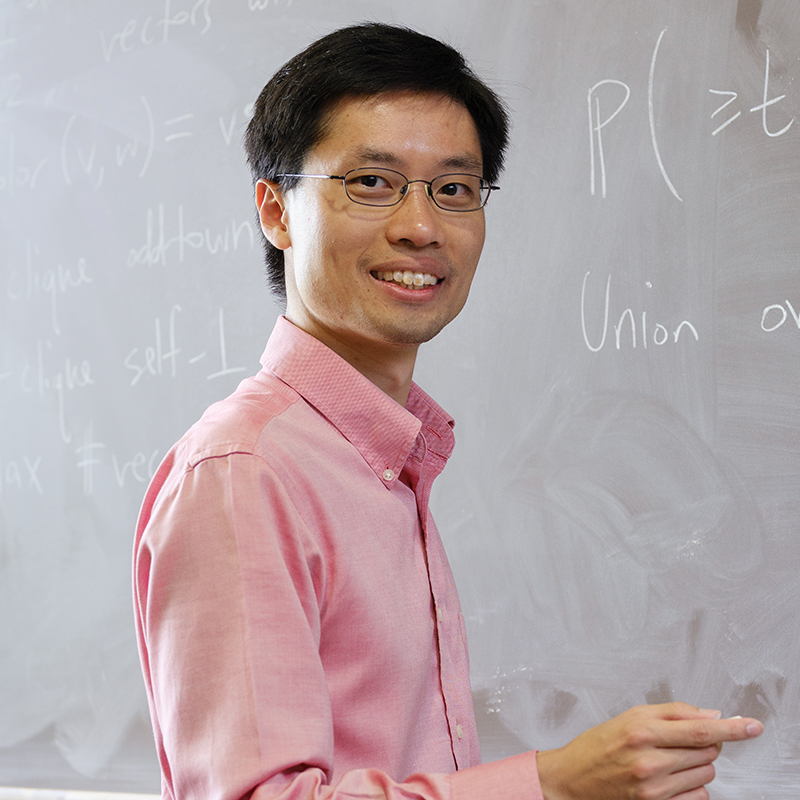 Po-Shen Loh合作论文数Mathematical Sciences, Mellon College of Science, Carnegie Mellon University1
 David Ellis合作论文数Queen Mary, University of London1
 Richard M. Wilson合作论文数Division of Physics, Mathematics and Astronomy, California Institute of Technology1




