Terawatt x-ray free-electron lasers (XFELs) represent the frontier in further development of x-ray sources and require high current densities with strong transverse focusing. In this paper, we investigate the implications/potentialities of TW XFELs on the generation of variable polarization states. The simulations indicate that significant power levels are possible with polarizations ranging from planar to circular and at high harmonics of the XFEL resonance across this range of polarizations. These XFELs can be an important coherent source of hard x-rays through the gamma ray spectrum. For this purpose, we use the MINERVA simulation code. Simulations indicate that, for the parameters under consideration, peak powers of the order 1 TW at the fundamental are possible over the entire range of polarizations.
Useful models of quantum efficiency (QE) for growth characterization but also simulation require material and optical parameters that exhibit complex dependencies on frequency and composition. We combine a Moments model of QE with a Lorentz-Drude-Resonant (LDR) model for metals and its extension to an Adachi-Drude-Resonant (ADR) model for semiconductors for the optical parameters based on density functional theory (DFT) simulations. A rapid numerical implementation is developed for characterization studies that will be advantageous in simulating particle accelerators and Free Electron Lasers using particle-in-cell codes. Changes in stoichiometry are then related to variations in QE, reflectivity, and laser penetration depth as governed by the ADR parameterization for alkali antimonide materials compared to a baseline DFT simulation of Cs3Sb. The correlation between LDR/ADR parameters and stoichiometry allows for an modifiable parameter library enabling user alterations for simulations to explore the effects of changes in composition or to compare/contrast different photocathode bulk materials in beam optics codes.
Simulating the quantum efficiency (QE) from photocathodes used in accelerators and photoinjectors requires accounting for the properties of the photoemissive material, the optical properties, scattering coefficients, and doping concentrations of which are dependent upon the stoichiometry. We present a rapid and flexible optical model that can be used to investigate the consequences of changes in the dielectric properties and their impact on the QE through such factors as reflectivity and laser penetration depth. Differences in materials can then be characterized by changes to parameters used to evaluate the dielectric function in a Lorentz–Drude–Resonant model. A method to characterize data is motivated by the example of copper and vetted by application to an exact analytical model. The effects of changes in parameters describing the resonant terms, which aggregate in the visible and UV regions of the spectrum, are shown.
Accurate knowledge of the phase space at beam creation is essential for understanding and predicting beam dynamics to extract or suppress phase space structures without causing avoidable emittance growth. Both first-principles models-which do not account for beam structure-and simulations using ideal phase space distribution may prove unable to capture unique beam structures. Here, we initialize the phase space distribution in first-principles simulations with velocity-space data measured using a pinhole scan. We show that the evolution of internal beam structure is highly sensitive to these initial conditions; tuning them within their experimental measurement error allows for remarkably accurate replication of the experimental beam evolution, including the emergence of a characteristic cruciform shape. (c) 2025 Author(s). All article content, except where otherwise noted, is licensed under a Creative Commons Attribution (CC BY) license
Recent progress in short wavelength free-electron lasers extending from the extreme ultraviolet through the x-ray regime have opened new avenues for industrial and research applications. A high-gain/low-Q oscillator, i.e., a regenerative amplifier free-electron laser (RAFEL), is one possible concept. In this paper, we present the first analysis of efficiency enhancement in a RAFEL with a long, tapered undulator line. For the present analysis, we consider a high average power EUV RAFEL at 13.5 nm and show that the performance exceeds that of single-pass, tapered self-amplified spontaneous emission. This points the way to high power tapered undulator x-ray RAFELs.
Terawatt x-ray free-electron lasers (XFELs) require high current densities with strong transverse focusing. The implications on harmonic generation are discussed using the MINERVA simulation code which self-consistently includes harmonic generation. We consider helical and planar undulators where the fundamental is at 1.5 Angstrom and study the associated harmonic generation. While tapered undulators are needed to reach TW powers at the fundamental, the taper does not enhance the harmonics because the taper must start before saturation of the fundamental, with the harmonics saturating earlier. Nevertheless, the harmonics reach substantial powers and enable enhanced applications.
Dielectric materials are foundational to our modern-day communications, defense, and commerce needs. Although dielectric breakdown is a primary cause of failure of these systems, we do not fully understand this process. We analyzed the dielectric breakdown channel propagation dynamics of two distinct types of electrical trees. One type of these electrical trees has not been formally classified. We observed the propagation speed of this electrical tree type to exceed 10 million meters per second. These results identify substantial gaps in the understanding of dielectric breakdown, and filling these gaps is paramount to the design and engineering of dielectric materials that are less susceptible to electrostatic discharge failure.
High peak and average power free-electron lasers (FELs) in the terahertz region (THz) require small diameter, low-emittance, and high voltage electron beams. This paper presents two 1.5-2 MV, 100-200 A, thermionic cathode electron source approaches for compact megawatt range peak power, multi-kilowatt average power, high repetition rate, THz FELs. The preferred beam generation system includes grading electrodes and is quite compact compared to the other standard diode gun approaches. Both provide highly compressed beams at the waist having low values of normalized rms emittance. In particular, the new injector approach with grading electrodes, operating at a body voltage of 1.5-2 MV and 100 A, has a normalized rms emittance of roughly 10 mm-mrad at the beam waist. Power supply switching considerations are considered in the paper as well as considerations for very high-voltage multi-stage depressed collectors for device efficiency enhancement. Based on these designs, we provide performance estimates for FELs operating in the THz spectral region.
Interest is increasing in high-power terahertz (THz) sources of radiation. The terminology is fluid, but researchers in the field typically refer to frequencies ranging from about 300 GHz to 10 THz as THz radiation. In this article, we present a description of design considerations for a compact, high-average power free-electron laser. At present, THz radiation is generated by a variety of mechanisms, including laser-based sources and electron-beam-based sources. We provide a short description of current THz source technology to give background against which to compare the present concept; however, this should not be considered a comprehensive discussion of such technologies.
The University of Maryland Electron Ring (UMER) is a unique machine that uses scaled electron beams at nonrelativistic energies (10keV) to inexpensively model GeV beams of heavy ions over long path lengths (kilometers of transport distance). The UMER beam parameters correspond to space charge tune depressions, at injection, adjustable in the range of 0.14–0.85. Although a ring, many of the intense beam studies on UMER are applicable to linacs. This paper reviews the UMER program, which contains experimental, computational, and theoretical components. We outline the research areas of interest, recent accomplishments, and future plans, emphasizing the relevance to heavy ion drivers. Specific topics include longitudinal induction focusing and beam manipulations; generation and propagation of space charge waves, including large-amplitude solitons; bunch end interpenetration and observation of a multi-stream instability; beam halo studies; and diagnostic development.
The first experimental observation of a Korteweg-de Vries-type soliton wave train in intense electron beams is reported. A narrow, large-amplitude perturbation on a long-pulse beam is observed to steepen and spawn a soliton wave train. The pulse width and amplitude of each peak remain unchanged over a long propagation distance, and the amplitude is inversely proportional to the square of the width. Two such pulses are seen to pass through each other, emerging from the collision unchanged. The experimental results are reproduced by particle-in-cell simulations.
The characterization of the transverse phase space of beams is a fundamental requirement for particle accelerators. As accelerators shift toward higher intensity beam regimes, the transverse dynamics of beams becomes more influenced by interparticle forces known as the space charge forces. Therefore, it is increasingly important to take space charge into account in studying the beam dynamics. In this thesis, two novel approaches are presented for measurement of transverse emittance for beams with space charge, an important quality indicator of transverse phase space. It is also discussed the experimental work on orbit characterization and control done for space charge dominated beams of the University of Maryland Electron Ring (UMER). The first method developed for measuring the emittance, utilizes a lens-drift-screen setup similar to that of a conventional quadrupole scan emittance measurement. Measurements of radius and divergence that can be obtained from beam produced radiation, e.g. optical transition, are used to calculate the beam cross correlation term and therefore the rms emittance. A linear space charge model is used in the envelope equations; hence the errors in the measurement relate to the non-uniformity of the beam distribution. The emittance obtained with our method shows small deviation from those obtained by WARP simulations for beams with high space charge, in contrast to other techniques. In addition, a second method is presented for determining emittance that works for beams with intense space charge and, theoretically, does not require an a priori assumption about the beam distribution. In this method, the same lens-drift-screen setup as the previous method is used, except that the beam size and divergence are scanned to find the minimum of product of the measured quantities. Such minimum is shown to be equal to the rms emittance under specific conditions that usually can be satisfied by adjusting the experiment parameters such as the drift length. The result of numerical analysis of the method done for a realistic accelerator confirms the applicability of method for intense beams with nonuniform distribution. Finally, the experimental work for characterization and control of beam centroid motions in UMER are discussed. Such work is important because at high space charge intensities, the nonlinearities of the lenses impose stricter constraints on the swing of beam centroid in the pipe. On the characterization side, we show new methods for more accurate measurements of the average orbit of particles, including inside the quadrupoles where there is no monitor. Based on this more precise orbit information, the beam orbit is corrected and its result is presented.
A novel self-healing hybrid-diffuser cesium reservoir photocathode is demonstrated. The model-driven design optimizes operating temperature to match diffusion and evaporation rates and maximize quantum efficiency of the cesiated tungsten surface. A sintered-wire tungsten emitter promotes surface uniformity. Cesium loss is less than 0.023 mu g/cm(2)/hr at 125 degrees C, and conservatively extrapolated reservoir lifetime exceeds 30,000 hours. Contamination robustness to a direct atmospheric leak with room-temperature contamination by over 200 Langmuirs of oxidizing gases is excellent, with 90% of maximum QE repeatedly restored via in situ self-healing recesiation under gentle 90 degrees C heating.
An induction cell has successfully been demonstrated to longitudinally confine a space-charge dominated bunch for over a thousand turns (>11.52 km) in the University of Maryland Electron Ring [Haber et al., Nucl. Instrum. Methods Phys. Res. A 606, 64 (2009) and R. A. Kishek et al., Int. J. Mod. Phys. A 22, 3838 (2007)]. With the use of synchronized periodic focusing fields, the beam is confined for multiple turns overcoming the longitudinal space-charge forces. Experimental results show that an optimum longitudinal match is obtained when the focusing frequency for containment of the 0.52 mA beam is applied at every fifth turn. Containment of the beam bunch is achievable at lower focusing frequencies, at the cost of a reduction in the transported charge from the lack of sufficient focusing. Containment is also obtainable, if the confinement fields overfocus the bunch, exciting multiple waves at the bunch ends, which propagate into the central region of the beam, distorting the overall constant current beam shape. (C) 2011 American Institute of Physics. [doi: 10.1063/1.3537820]
We apply the Venturini-Reiser (V-R) envelope-dispersion equations [M. Venturini and M. Reiser, Phys. Rev. Lett. 81, 96 (1998)] to a continuous beam in a uniform focusing/bending lattice to study the combined effects of linear dispersion and space charge. Within this simple model we investigate the scaling of average dispersion and the effects on beam dimensions and show that the V-R equations lead to the correct zero-current limits. We also introduce a generalization of the space charge intensity parameter and apply it to the University of Maryland Electron Ring and other machines. In addition, we present results of calculations to test the smooth approximation by solving the V-R original equations and also through simulations with the matrix code ELEGANT.
Photoemission predictions are often based on a Three Step (absorption, transport, emission) model. The transport calculation therein generally assumes that scattering events are fatal to electron emission. Using Monte Carlo and material dependent scattering terms for metals and semiconductors, the “fatal approximation” is assessed. Photoemission data from cesiated tungsten dispenser photocathodes is reexamined with respect to the new models. The emitted current is segregated into two groups: electrons which do not scatter before emission and those that do. Each has a characteristic time response for which simple models are developed. A simple extension to semiconductors will be proposed in the presentation.
An oft used approximation to predict quantum efficiency (QE) from bare metals or those with a low work function coating such as cesium is to assume that photo-excited electrons have not scattered prior to their emission. Monte Carlo simulations are used to assess that approximation, and show that, while good for bare metals, for cesiated metals a photoexcited electron may undergo several scattering events and yet be emitted. Neglecting scattered electrons therefore underestimates QE. Emitted electrons that have undergone scattering before emission elongate the response time by giving rise to a long time tail, low energy contribution to the faster non-scattered emission, for which a model is developed. The theory is applied to study variations in QE as a function of wavelength measured from cesiated metal surfaces. The extension of the findings to semiconductor photocathodes is briefly discussed.
Computer simulations are used to investigate the evolution of longitudinal density and energy modulations of an electron beam in a linear accelerator system. This study examines the effect of initial energy spread on the modulations as the beam is accelerated in the electron gun.
The University of Maryland Electron Ring (UMER) is a machine designed to study high-intensity beam physics. With the application of axial fields to the bunch ends, we are able to keep a beam with an injected tune shift of 1.0, bunched over multiple turns. This is feasible with the application of tailored fields to optimally match the space-charge self-fields while minimizing the excitation of longitudinal space-charge waves. With this scheme, we have been able to extend the number of turns at the University of Maryland Electron Ring (UMER) by a factor of ten. Without the use of longitudinal focusing, head and tail effects begin to dominate, especially with the higher current beams. Time resolved measurements of the peak correlated energy spread have shown in some cases a change in the overall spread of 1.8% for the 0.6 mA beam, from the injected beam energy.
We apply the Venturini-Reiser envelope-dispersion equations [1] to a continuous beam in a uniform focusing/bending lattice to study the combined effects of linear dispersion and space charge. Within this simple model we investigate the scaling of average dispersion and the effects on beam dimensions; we also introduce a generalization of the space-charge intensity parameter defi ned in [2] and apply it to the University of Maryland Electron Ring (UMER) and other machines. In addition, we present results of calculations to test the smooth approximation by solving the Venturini-Reiser original equations and also through simulations with the code ELEGANT [3].
 Rami A. Kishek合作论文数University of Maryland103
 M. Reiser合作论文数90
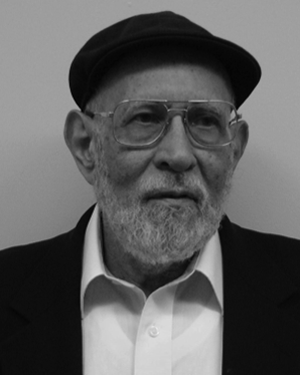 I. Haber合作论文数85
 Santiago Bernal合作论文数78d w feldman合作论文数46Brian L. Beaudoin合作论文数University of Maryland37
 K.L. Jensen合作论文数ESTD, Naval Research Laboratory36
 Bryan Quinn合作论文数35M. Walter合作论文数32
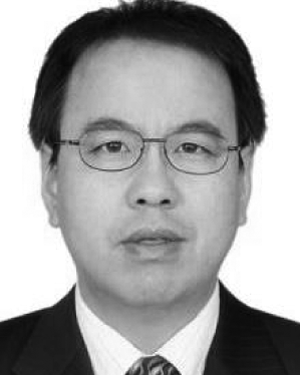 K. Tian合作论文数24Y. Zou合作论文数22d stratakis合作论文数21d sutter合作论文数20
 Christos Papadopoulos合作论文数University of Maryland18
 Nathan A Moody合作论文数Los Alamos National Laboratory18
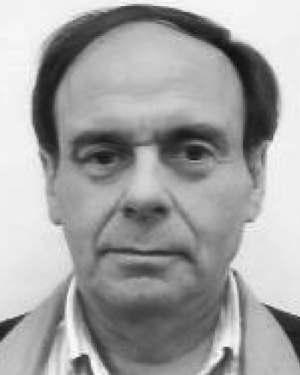 H.P. Freund合作论文数Science Applications International Corporation17R. B. Fiorito合作论文数17D. Feldman合作论文数16Eric J Montgomery合作论文数16
 Jayakar Charles Tobin Thangaraj合作论文数15J. Harris合作论文数Institute for Research in Electronics and Applied Physics, University of Maryland15Yong Cui合作论文数Institute for Research in Electronics and Applied Physics;University of Maryland14
 Ralph Fiorito合作论文数14
 Agust Valfells合作论文数13t f godlove合作论文数12Guodong Bai合作论文数12
 T. W. Koeth合作论文数Rutgers University12H. Li合作论文数11
 Chixing wu合作论文数10Anatoly Shkvarunets合作论文数10
 Charles Neuman合作论文数10
 Karen Fiuza合作论文数9
 Terry. F. Godlove合作论文数9j g neumann合作论文数9
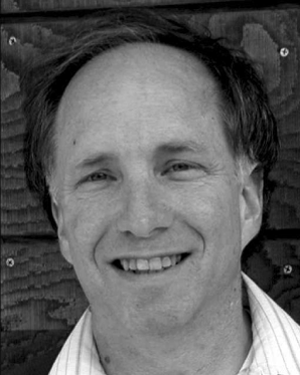 A. Friedman合作论文数Lawrence Livermore National Laboratory8Ronen Feldman合作论文数8D. P. Grote合作论文数8M Virgo合作论文数8
 Jonathan L Shaw合作论文数7
 J.-L. Vay合作论文数Lawrence Berkeley National Laboratory7Diktys Stratakis合作论文数7JMJ Madey合作论文数6Yijie Huo合作论文数Dept Elect Engn, Stanford Univ6J. Yater合作论文数6
 William W. Graves合作论文数St. Louis6M. Cornacchia合作论文数5
 Bruce Carlsten合作论文数Los Alamos National Laboratory5John R. Harris合作论文数4H. Loos合作论文数4




