The ‘missing data’ approach to robust Automatic Speech Recognition assumes that when the speech is one of several sound sources, some spectral-temporal regions will remain uncorrupted and can be used as ’reliable evidence’ for recognition. Identification of these regions can be thought of as placing a ‘mask’ over the spectral data. Arguments for the missing data premise can be found in [6] and are summarised in [10]. The authors have developed and applied techniques for adapting ContinuousDensity Hidden Markov Model recognisers to the incomplete data case [6, 20, 11, 1, 2]. Several other groups have reported related work [17, 12, 16]. In this paper we briefly review the technique, and show how softening the decision about which regions are deemed to be reliable improves results. In the work reported up to this point, simple noise estimates have bee using to estimate local signalto noise ratio, and this estimate has been used to define the masks. We now introduce harmonicity constraints as an additional cue (motivated by auditory scene analysis [3, 7, 5]) for identifying sourcespecific regions. Results are reported on the AURORA task [14]. We also discuss the idea of ‘multi-source decoding’, which generalises recognition algorithms for the case where initial grouping processes identify spectral temporal regions dominated by a single source but do not decide on the identity of the source.
In this paper, we propose a novel algorithm called multiview temporal alignment by dependence maximisation in the latent space (TRANSIENCE) for the alignment of time series consisting of sequences of feature vectors with different length and dimensionality of the feature vectors. The proposed algorithm, which is based on the theory of multiview learning, can be seen as an extension of the well-known dynamic time warping (DTW) algorithm but, as mentioned, it allows the sequences to have different dimensionalities. Our algorithm attempts to find an optimal temporal alignment between pairs of nonaligned sequences by first projecting their feature vectors into a common latent space where both views are maximally similar. To do this, powerful, nonlinear deep neural network (DNN) models are employed. Then, the resulting sequences of embedding vectors are aligned using DTW. Finally, the alignment paths obtained in the previous step are applied to the original sequences to align them. In the paper, we explore several variants of the algorithm that mainly differ in the way the DNNs are trained. We evaluated the proposed algorithm on a articulatory-to-acoustic (A2A) synthesis task involving the generation of audible speech from motion data captured from the lips and tongue of healthy speakers using a technique known as permanent magnet articulography (PMA). In this task, our algorithm is applied during the training stage to align pairs of nonaligned speech and PMA recordings that are later used to train DNNs able to synthesis speech from PMA data. Our results show the quality of speech generated in the nonaligned scenario is comparable to that obtained in the parallel scenario.
This work has been funded by the Agencia Estatal de Investigaci´on ref.PID2019-108040RBC21/ AEI/10.13039/501100011033 and PID2019-108040RAC22/AEI/10.13039/501100011033. Jose A. Gonzalez-Lopez holds a Juan de la Cierva-Incorporation Fellowship from the Spanish Ministry of Science, Innovation and Universities (IJCI-2017-32926).
Articulatory-to-acoustic (A2A) synthesis refers to the generation of audible speech from captured movement of the speech articulators. This technique has numerous applications, such as restoring oral communication to people who cannot longer speak due to illness or injury. Most successful techniques so far adopt a supervised learning framework, in which time-synchronous articulatory-and-speech recordings are used to train a supervised machine learning algorithm that can be used later to map articulator movements to speech. This, however, prevents the application of A2A techniques in cases where parallel data is unavailable, e.g., a person has already lost her/his voice and only articulatory data can be captured. In this work, we propose a solution to this problem based on the theory of multi-view learning. The proposed algorithm attempts to find an optimal temporal alignment between pairs of non-aligned articulatory-and-acoustic sequences with the same phonetic content by projecting them into a common latent space where both views are maximally correlated and then applying dynamic time warping. Several variants of this idea are discussed and explored. We show that the quality of speech generated in the non-aligned scenario is comparable to that obtained in the parallel scenario.
Stuttering is a speech disorder that, if treated during childhood, may be prevented from persisting into adolescence. A clinician must first determine the severity of stuttering, assessing a child during a conversational or reading task, recording each instance of disfluency, either in real time, or after transcribing the recorded session and analysing the transcript. The current study evaluates the ability of two machine learning approaches, namely conditional random fields (CRF) and bi-directional long-short-term memory (BLSTM), to detect stuttering events in transcriptions of stuttering speech. The two approaches are compared for their performance both on ideal hand-transcribed data and also on the output of automatic speech recognition (ASR). We also study the effect of data augmentation to improve performance. A corpus of 35 speakers' read speech (13K words) was supplemented with a corpus of 63 speakers' spontaneous speech (11K words) and an artificially-generated corpus (50K words). Experimental results show that, without feature engineering, BLSTM classifiers outperform CRF classifiers by 33.6%. However, adding features to support the CRF classifier yields performance improvements of 45% and 18% over the CRF baseline and BLSTM results, respectively. Moreover, adding more data to train the CRF and BLSTM classifiers consistently improves the results. (C) 2019 Elsevier Ltd. All rights reserved.
Individuals who have lost their voice following a laryngectomy as a treatment for cancer will inevitably struggle with their daily communication. Unfortunately, the current methods for speaking after laryngectomy all have limitations, either because of the poor acoustics generated by these methods or because they are potentially harmful. The aim of this work is thus to explore an alternative method for post-laryngectomy voice restoration in which the movement of the intact articulators is captured and then converted into audible speech using machine learning techniques. To demonstrate the feasibility of speech generation from captured articulator movement, 6 healthy adults were recruited. For each subject, both the speech acoustics and the subject's articulator movements were recorded simultaneously. Articulator movements were captured using a technique known as permanent magnet articulography (PMA), in which small magnets are attached to the articulators (typically tongue and lips) and the magnetic field generated by the magnets is captured with sensors located close to the mouth. Deep artificial neural networks were then used to model the mapping between the sensor data and the speech acoustics, thus, enabling the synthesis of speech from captured articulatory data. The proposed silent speech system is able to generate speech that sounds natural, resembles the subject's own voice and is fairly intelligible (up to 92% intelligibility for some speakers on a phonetically-rich corpus). With further research, the proposed system could in future be a real option to restore lost voice after laryngectomy. Aquellas personas que han perdido su voz después de una laringectomía se ven limitadas irremediablemente en su comunicación diaria. A pesar de existir en la actualidad métodos para recuperar el habla tras la laringectomía, todos ellos presentan limitaciones. El objetivo de este trabajo es explorar un método alternativo para hablar tras la laringectomía, en el que el movimiento de los órganos de la voz se transforma en una señal acústica utilizando técnicas de aprendizaje automático. En esta investigación participaron 6 adultos sanos. Para cada sujeto se grabó tanto su voz como los movimientos de sus labios y lengua. Los movimientos de los órganos del habla fueron capturados usando una técnica conocida como Articulografía de Imán Permanente (PMA), en la cual pequeños imanes se colocan sobre estos órganos y el campo magnético generado por los imanes se captura usando unos sensores sensibles al campo magnético. Se utilizaron redes neuronales artificiales profundas para modelar la transformación entre los datos de los sensores y la acústica de la voz. El sistema de habla silenciosa propuesto es capaz de generar voz que suena natural, se asemeja a la propia voz del sujeto y es inteligible (hasta un 92% de inteligibilidad para algunos sujetos). El sistema propuesto podría ser en el futuro una opción viable para restaurar la voz tras una laringectomía total.
Dysarthria is a neurological speech impairment, which usually results in the loss of motor speech control due to muscular atrophy and incoordination of the articulators. As a result the speech becomes less intelligible and difficult to model by machine learning algorithms due to inconsistencies in the acoustic signal and data sparseness. This paper presents phase-based feature representations for dysarthric speech that are exploited in the group delay spectrum. Such representations are found to be better suited to characterising the resonances of the vocal tract, exhibit better phone discrimination capabilities in dysarthric signals and consequently improve ASR performance. All the experiments were conducted using the UASPEECH corpus and significant ASR gains are reported using phase-based cepstral features in comparison to the standard MFCCs irrespective of the severity of the condition.
Every year, some 17,500 people in Europe and North America lose the power of speech after undergoing a laryngectomy, nor-mally as a treatment for throat cancer. Several research groups have recently demonstrated that it is possible to restore speech to these people by using machine learning to learn the transformation from articulator movement to sound. In our project articulator movement is captured by a technique developed by our collaborators at Hull University called Permanent Magnet Articulography (PMA), which senses the changes of magnetic field caused by movements of small magnets attached to the lips and tongue. This solution, however, requires synchronous PMA-and-audio recordings for learning the transformation and, hence, it cannot be applied to people who have already lost their voice. Here we propose to investigate a variant of this technique in which the PMA data are used to drive an articulatory synthesiser, which generates speech acoustics by simulating the airflow through a computational model of the vocal tract. The project goals, participants, current status, and achievements of the project are discussed below.
The paper introduces CloudCAST, a novel solution for making speech technology tools available to developers of speech-enabled applications, including intelligent tutoring systems (ITSs). The historical goal of fully integrating speech into ITSs is considered in the current context. Benefits of speech technology as they relate to ITSs are highlighted and a method for making these tools available to users with no speech technology expertise, through a remotely-located cloud-based platform is proposed. The challenges and opportunities are discussed with a view to reviving the interest of the developers of ITSs.
In speech pathology, new assistive technologies using ASR and machine learning approaches are being developed for detecting speech disorder events. Classically-trained ASR model tends to remove disfluencies from spoken utterances, due to its focus on producing clean and readable text output. However, diagnostic systems need to be able to track speech disfluencies, such as stuttering events, in order to determine the severity level of stuttering. To achieve this, ASR systems must be adapted to recognise full verbatim utterances, including pseudo-words and non-meaningful part-words. This work proposes a training regime to address this problem, and preserve a full verbatim output of stuttering speech. We use a lightly-supervised approach using task-oriented lattices to recognise the stuttering speech of children performing a standard reading task. This approach improved the WER by 27.8% relative to a baseline that uses word-lattices generated from the original prompt. The improved results preserved 63% of stuttering events (including sound, word, part-word and phrase repetition, and revision). This work also proposes a separate correction layer on top of the ASR that detects prolongation events (which are poorly recognised by the ASR). This increases the percentage of preserved stuttering events to 70%.
The CloudCAST platform provides a series of speech recognition services that can be integrated into assistive technology applications. The platform and the services provided by the public API are described. Several exemplar applications have been developed to demonstrate the platform to potential developers and users.
The main aim of the project described in this paper is to develop an experimental low cost system for environmental control through simplified user interfaces and voice control, to better respond to the needs of users with motor speech impairments (dysarthria). The project is actually being conducted by Area Ausili, a department of Polo Tecnologico Regionale Corte Roncati in Italy, in collaboration with AIAS AT Team and the CloudCAST project. The prototype, that has been implemented in an experimental smart home in Italy, integrates a completely hands free commands recognition function based on the cloud-based voice recognition system developed within the CloudCAST project. The target of the project is to create a tool that is able to overcome the limits of some actual assistive technologies, and to take advantage from the evolution of home automation and internet of things technologies. Future developments of the projects and expected results are discussed.
Stuttering is a common speech disfluency that may persist into adulthood if not treated in its early stages. Techniques from spoken language understanding may be applied to provide auto-mated diagnoses of stuttering from voice recordings; however,there are several difficulties, including the lack of training data involving young children and the high dimensionality of these data. This study investigates how automatic speech recognition(ASR) could help clinicians by providing a tool that automatically recognises stuttering events and provides a useful written transcription of what was said. In addition, to enhance the performance of ASR and to alleviate the lack of stuttering data, this study examines the effect of augmenting the language model with artificially generated data. The performance of the ASR tool with and without language model augmentation is com-pared. Following language model augmentation, the ASR tool’s performance improved recall from 38% to 62.2% and precision from 56.58% to 71%. When mis-recognised events are more coarsely classified as stuttering/ non-stuttering events, the performance improves up to 73% in recall and 84% in precision.Although the obtained results are not perfect, they map to fairly robust stutter/ non-stutter decision boundaries.
In this work, we present a silent speech system that is able to generate audible speech from captured movement of speech articulators. Our goal is to help laryngectomy patients, i.e. patients who have lost the ability to speak following surgical removal of the larynx most frequently due to cancer, to recover their voice. In our system, we use a magnetic sensing technique known as Permanent Magnet Articulography (PMA) to capture the movement of the lips and tongue by attaching small magnets to the articulators and monitoring the magnetic field changes with sensors close to the mouth. The captured sensor data is then transformed into a sequence of speech parameter vectors from which a time-domain speech signal is finally synthesised. The key component of our system is a parametric transformation which represents the PMA-to-speech mapping. Here, this transformation takes the form of a statistical model (a mixture of factor analysers, more specifically) whose parameters are learned from simultaneous recordings of PMA and speech signals acquired before laryngectomy. To evaluate the performance of our system on voice reconstruction, we recorded two PMA-and-speech databases with different phonetic complexity for several non-impaired subjects. Results show that our system is able to synthesise speech that sounds as the original voice of the subject and also is intelligible. However, more work still need to be done to achieve a consistent synthesis for phonetically-rich vocabularies.
Silent Speech Interfaces (SSIs) are alternative assistive speech technologies that are capable of restoring speech communication for those individuals who have lost their voice due to laryngectomy or diseases affecting the vocal cords. However, many of these SSIs are still deemed as impractical due to a high degree of intrusiveness and discomfort, hence limiting their transition to outside of the laboratory environment. We aim to address the hardware challenges faced in developing a practical SSI for post-laryngectomy speech rehabilitation. A new Permanent Magnet Articulography (PMA) system is presented which fits within the palatal cavity of the user’s mouth, giving unobtrusive appearance and high portability. The prototype is comprised of a miniaturized circuit constructed using commercial off-the-shelf (COTS) components and is implemented in the form of a dental retainer, which is mounted under roof of the user’s mouth and firmly clasps onto the upper teeth. Preliminary evaluation via speech recognition experiments demonstrates that the intraoral prototype achieves reasonable word recognition accuracy and is comparable to the external PMA version. Moreover, the intraoral design is expected to improve on its stability and robustness, with a much improved appearance since it can be completely hidden inside the user’s mouth.
This paper describes a technique that generates speech acoustics from articulator movements. Our motivation is to help people who can no longer speak following laryngectomy, a procedure that is carried out tens of thousands of times per year in the Western world. Our method for sensing articulator movement, permanent magnetic articulography, relies on small, unobtrusive magnets attached to the lips and tongue. Changes in magnetic field caused by magnet movements are sensed and form the input to a process that is trained to estimate speech acoustics. In the experiments reported here this “Direct Synthesis” technique is developed for normal speakers, with glued-on magnets, allowing us to train with parallel sensor and acoustic data. We describe three machine learning techniques for this task, based on Gaussian mixture models, deep neural networks, and recurrent neural networks (RNNs). We evaluate our techniques with objective acoustic distortion measures and subjective listening tests over spoken sentences read from novels (the CMU Arctic corpus). Our results show that the best performing technique is a bidirectional RNN (BiRNN), which employs both past and future contexts to predict the acoustics from the sensor data. BiRNNs are not suitable for synthesis in real time but fixed-lag RNNs give similar results and, because they only look a little way into the future, overcome this problem. Listening tests show that the speech produced by this method has a natural quality that preserves the identity of the speaker. Furthermore, we obtain up to 92% intelligibility on the challenging CMU Arctic material. To our knowledge, these are the best results obtained for a silent-speech system without a restricted vocabulary and with an unobtrusive device that delivers audio in close to real time. This work promises to lead to a technology that truly will give people whose larynx has been removed their voices back.
To help people who have lost their voice following total laryngectomy, we present a speech restoration system that produces audible speech from articulator movement. The speech articulators are monitored by sensing changes in magnetic field caused by movements of small magnets attached to the lips and tongue. Then, articulator movement is mapped to a sequence of speech parameter vectors using a transformation learned from simultaneous recordings of speech and articulatory data. In this work, this transformation is performed using a type of recurrent neural network (RNN) with fixed latency, which is suitable for realtime processing. The system is evaluated on a phoneticallyrich database with simultaneous recordings of speech and articulatory data made by non-impaired subjects. Experimental results show that our RNN-based mapping obtains more accurate speech reconstructions (evaluated using objective quality metrics and a listening test) than articulatory-to-acoustic mappings using Gaussian mixture models (GMMs) or deep neural networks (DNNs). Moreover, our fixed-latency RNN architecture provides comparable performance to an utterance-level batch mapping using bidirectional RNNs (BiRNNs).
Total removal of the larynx may be required to treat laryngeal cancer: speech is lost. This article shows that it may be possible to restore speech by sensing movement of the remaining speech articulators and use machine learning algorithms to derive a transformation to convert this sensor data into an acoustic signal. The resulting "silent speech," which may be delivered in real time, is intelligible and sounds natural. The identity of the speaker is recognisable. The sensing technique involves attaching small, unobtrusive magnets to the lips and tongue and monitoring changes in the magnetic field induced by their movement.
Stuttering is a common problem in childhood that may persist into adulthood if not treated in early stages. Techniques from spoken language understanding may be applied to provide automated diagnosis of stuttering from children speech. The main challenges however lie in the lack of training data and the high dimensionality of this data. This study investigates the applicability of machine learning approaches for detecting stuttering events in transcripts. Two machine learning approaches were applied, namely HELM and CRF. The performance of these two approaches are compared, and the effect of data augmentation is examined in both approaches. Experimental results show that CRF outperforms HELM by 2.2% in the baseline experiments. Data augmentation helps improve systems performance, especially for rarely available events. In addition to the annotated augmented data, this study also adds annotated human transcriptions from real stuttered children’s speech to help expand the research in this field.
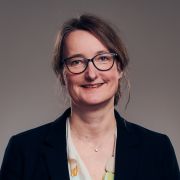 Heidi Christensen合作论文数Department of Computer Science, Faculty of Engineering, The University of Sheffield28
 Martin Cooke合作论文数Department of Computer Science;University of Sheffield;Department of Computer Science, University of Sheffield25
 Stuart Cunningham合作论文数Division of Human Communication Sciences, Health Sciences School, Faculty of Medicine, Dentistry & Health, The University of Sheffield23
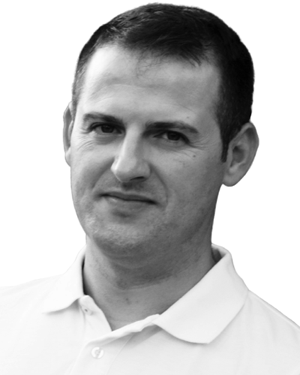 Jose A. Gonzalez Lopez合作论文数18
 Roger K. Moore合作论文数Department of Computer Science, Faculty of Engineering, The University of Sheffield18James M. Gilbert合作论文数School of Engineering, University of Hull18
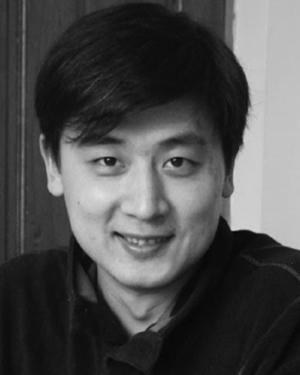 Ning Ma合作论文数Dept Comp Sci, Speech & Hearing Res Grp, Univ Sheffield16Stephen R. Ell合作论文数16
 Jon Barker合作论文数Department of Computer Science, Faculty of Engineering, The University of Sheffield14Lam A. Cheah合作论文数14
 Thomas Hain合作论文数School of Computer Science, The University of Sheffield13Jie Bai合作论文数9
 Mark S Hawley合作论文数University of Sheffield7
 Iñigo Casanueva合作论文数University of Cambridge6
 Pamela Mary Enderby合作论文数School of Health and Related Research, University of Sheffield6
 James Nathaniel Carmichael合作论文数6
 Andre Coy合作论文数Department of Computer Science, University of Sheffield6
 Ljubomir Josifovski合作论文数6Athanassios Hatzis合作论文数6Ed Holdsworth合作论文数Pract Control Ltd, Sheffield, S Yorkshire, England5
 Massimiliano Malavasi合作论文数WeCareMore Centre for Innovation and Research of AIAS Bologna onlus5
 Lorenzo Desideri合作论文数5
 Ricard Marxer合作论文数Music Technology Group, Universitat Pompeu Fabra5
 Mark Parker合作论文数Mathematics Department, Eastern Oregon State College5
 Rebecca Palmer合作论文数Institute of General Practice and Primary Care;University of Sheffield;Institute of General Practice and Primary Care, University of Sheffield5M. D. Crawford合作论文数4
 Peter O'Neill合作论文数4Sadeen Alharbi合作论文数Univ Sheffield, Dept Comp Sci, Sheffield, S Yorkshire, England4Andrew C. Morris合作论文数4Ascension Vizinho合作论文数4Sarah Creer合作论文数4
 Mauro Nicolao合作论文数Istituto di Scienze e Tecnologie della Cognizione - Sede di Padova, Consiglio Nazionale delle Ricerche4Shelagh Brumfitt合作论文数4
 Guy Brown合作论文数Department of Computer Science, Faculty of Engineering, The University of Sheffield4Shahla Parveen合作论文数3
 José Joaquín Atria合作论文数CV Lib Ltd3Siddharth Sehgal合作论文数3
 Frank Rudzicz合作论文数Dalhousie University;Department of Computer Science, University of Toronto3
 Madina Hasan合作论文数3
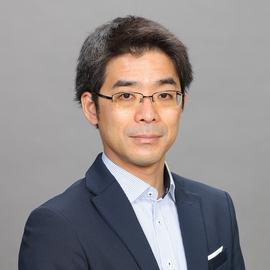 Junichi Yamagishi (山岸順一)合作论文数Digital Content and Media Sciences Research Division, National Institute of Informatics;The Graduate University for Advanced Studies;Speech Processing Laboratory, Nagoya Institute of Technology3
 Anthony Simons合作论文数Department of Computer Science, Faculty of Engineering, The University of Sheffield3
 Anthony J. H. Simons合作论文数Department of Computer Science, University of Sheffield3Dave Abberley合作论文数3Sergey I. Rybchenko合作论文数Institute of Solid State Physics, Russian Academy of Sciences3
 José L. Pérez-Córdoba合作论文数3Fabio Tamburini合作论文数f.tamburinicilta.unibo.it CILTA - University of Bologna3Robin Hofe合作论文数3
 Michael Fagan合作论文数Medical Engineering;Department of Engineering;University of Hull;Department of Engineering, University of Hull3L Josifovski合作论文数3




