The ene-type reaction between (dithio)carboxylic acids and alkenes has been studied computationally by DFT and topological (analysis of the electron localization function, ELF) methods. The reaction proceeds under kinetic control and the observed differences in regioselectivity are well-explained by the relative stability of the different transition structures. In agreement with experimental observations, electron-rich alkenes lead to Markownikoff adducts while electron-poor alkenes lead to Michael adducts. In all cases the reaction proceeds through an only transition structure (one kinetic step) although a different synchronicity was observed depending on the alkene electronics. The ELF analysis of the reactions corroborates the existence of a transient carbocation (hidden intermediate) in the reactions with electron-rich alkenes. On the other hand, electron-poor alkenes proceed through a more synchronous concerted mechanism. It can be predicted that with electron-rich alkenes bearing highly donating the transient carbocations might be captured by a nucleophile.
The thionation reaction of carbonyl compounds with Lawesson's reagent (LR) has been studied using density functional theory methods and topological analyses. After dissociation of LR, the reaction takes place through a two-step mechanism involving (i) a concerted cycloaddition between one monomer and the carbonyl compound to form a four-membered intermediate and (ii) a cycloreversion leading to the thiocarbonyl derivative and phenyl(thioxo)phosphine oxide. Topological analyses confirmed the concertedness and asynchronicity of the process. The second step is the rate-limiting one, and the whole process resembles the currently accepted mechanism for the lithium salt-free Wittig reaction. No zwitterionic intermediates are formed during the reaction, although stabilizing electrostatic interactions are present in initial stages. Phenyl(thioxo)phosphine oxide formed in the thionation reaction is capable of performing a second thionation, although with energy barriers higher than the first one. The driving force of the thionation reactions is the formation of trimers from the resulting monomers. In agreement with experimental observations, the amides are the most reactive when compared with esters, aldehydes, and ketones and the reaction is slightly influenced by the polarity of the solvent. Whereas for amides and esters substituents have little effect, aldehydes and ketones are influenced by both steric and electronic effects.
The molecular and crystal structures of 3,8-diphenyl-3a,4,5,5a,8a,8b-hexahydro-benzo[1,2-d: 3,4-d′]diisoxazole have been XRD determined. The compound crystallizes in the monoclinic system (space group P21/c) with cell dimensions a=15.278(1), b=9.839(1), c=10.912(2) Å, β=92.15(1)°. The structure was solved from 2193 reflections with I≥2σ(I). The final R was 0.039 for 289 variables.DFT calculations at the B3LYP/6-31G* level afforded a twist-boat conformer almost identical with the X-ray structure as well as a less stable half-chair conformer which lies 9.7kJ/mole higher in enthalpy.The near planarity of the two fused isoxazoline rings destabilizes the staggered cyclohexane chair and forces the cyclohexane ring to adopt uncommon conformations.
The three potential energy surfaces of the trans-trans, cis-trans, and cis-cis divinyltetramethylene diradicals have been located with DFT calculations at the BPW91/6-311+G** levels. The three surfaces account well for the experimental results reported for the thermolysis of optically active trans-1,2-divinylcyclobutane and optically active and deuterated 4-vinylcyclohexene. The surfaces account also for the outcome of the dimerization of butadiene and the thermolysis of cis,cis-1,5-cyclooctadiene. The three diradical intermediates are connected to the cyclization and dissociation products through conformations that are explored fully here.
The synthesis of 1,2,4-oxadiazole-4-oxides on polystyrenic solid phase docked at the position 3 of the heterocyclic ring has been performed through the cycloaddition of stable supported nitrile oxides to amidoximes. The photochemical cycloreversion of these heterocycles afforded the free nitrosocarbonyl intermediates that were trapped by suitable dienes or enes. The method is proposed as a clean and environmental friendly approach to the fleeting nitrosocarbonyl intermediates, which afford valuable adducts for various synthetic applications. The isomeric heterocycles docked at the position 5 of the ring have also been obtained by cycloaddition of nitrile oxides to supported amidoximes. Their photolysis afforded resin-bound nitrosocarbonyls that were trapped with dienes affording valuable supported adducts suitable for further elaboration on solid-phase chemistry.
A rapid access to carbocyclic nucleosides containing a fused isoxazoline ring is proposed starting from cyclopentadiene. The route involves an hetero Diels–Alder cycloaddition reaction of nitrosocarbonylbenzene followed by a 1,3-dipolar cycloaddition of nitrile oxides, cleavage of the N–O tether and elaboration of the heterocyclic aminols into nucleosides via linear construction of purine and pyrimidine heterocycles.
Density functional theory calculations at the B3LYP/6-31G* level on the dimerization reactions of acetonitrile oxide and para-chlorobenzonitrile oxide to form furoxans indicate that these processes are stepwise involving dinitrosoalkene intermediates that have considerable diradical character. The rate-determining steps for these two reactions correspond to C-C bond formation. The retardation of dimerization in aromatic nitrile oxides arises from the interruption of conjugation between the nitrile oxide and aryl groups in the C-C bond formation step. The present study also suggests that the isomerization of single-ring furoxans occurs via a diradical intermediate mechanism.
B3LYP/6-31G calculations account for the enhanced reactivity and endo stereoselectivity in the dimerization of the fleeting antiaromatic cyclopentadienone. Secondary orbital interactions promote endo stereoselectivity and a full merging of 4+2 and 2+4 allowed paths in an endo bispericyclic transition structure. Electrostatic effects increase reactivity and selectivity but the driving force to enhanced reactivity is the loss of antiaromaticity in the dimerization TSs while enhanced selectivity derives from the more efficient relief of antiaromaticity in the bispericyclic array.
The dimerization of butadiene has been explored by using DFT methods at the B3LYP level with the 6-311+G** basis set. A concerted bispericyclic TS for the endo pathway and a concerted pericyclic TS for the exo pathway are the lowest passes for the dimerization and occur at almost the same energy thus accounting for the lack of stereochemical preferences in the dimerization. Diradical paths involving two unswitched transoid butadiene moieties are competing and account for the formation of minor amounts of trans-1,2-divinyl cyclobutane and 1,5-cycloctadiene.
Cycloadditions between nitrile oxides and cis-4-benzoylamino-2-cyclopenten-1-ol offer an example in which a strong intramolecular hydrogen bond completely offsets the syn-directing ability of the cyclopentene substituents. Solvents affected the conformational equilibrium of the cyclopentene dipolarophile but did not sizeably influence the cycloaddition selectivity, showing the absence of directing effects between the addends. Removal of the intramolecular hydrogen bond by OH protection or oxidation activated the syn-directing ability of the amido substituent and provided a convenient route to syn stereoselection. (© Wiley-VCH Verlag GmbH, 69451 Weinheim, Germany, 2002)
The stereospecific endo dimerization of cyclopentadiene takes place through an asynchronous and symmetrical bispericyclic transition structure, which shows a merging of the 4+2 and 2+4 cycloaddition paths. The shape of the transition structure testifies to the presence of attractive Salem/Houk secondary orbital interactions assisting the endo approach.
Non-classical (bridging) and classical (Woodward–Hoffmann) secondary orbital interactions as well as a favourable electrostatic interaction are involved in the stabilization of the two lowest transition passes of the acrolein dimerization. The heteroatoms provide anchimeric assistance to the hetero Diels–Alder reaction through a neighbouring-group mechanism.
The regiospecific dimerization of methacrolein takes place through a very asynchronous and symmetrical transition structure, which shows a merging of the 4+2 and 2+4 cycloaddition paths. The geometrical features of the transition structures correspond well to a case of diradical formation. A cage of secondary orbital interactions restricts the flexibility of the diradical transition structure and stabilizes it.
N-Acyl-2-oxa-3-azanorborn-5-enes are highly reactive dipolarophiles in cycloadditions with nitrile oxides. The cycloadducts can be easily elaborated to various functionalized structures that are not directly accessible by 1,3-dipolar cycloadditions.
The regiochemistry of the cycloadditions of nitrile oxides to crotonaldehyde and cinnamaldehyde has been determined and is dictated by frontier orbital interactions and secondary orbital interactions as well. In cycloadditions to α,β-unsaturated compounds the directive effect of the frontier orbital interactions can be diverted by steric drifts and secondary orbital interactions.
1,2,4-Oxadiazole-4-oxides undergo clean thermal cleavage in refluxing chlorobenzene or xylene to nitriles and nitrosocarbonyl intermediates, which are either trapped with suitable olefins to afford ene adducts or dimerize and rearrange to anhydrides.
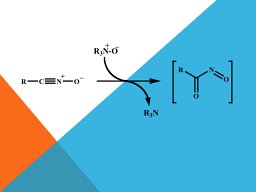
Nitrile oxides are oxidized by tertiary amine N-oxides in different solvents at room temperature to afford in the presence of dienes nitrosocarbonyl adducts in fair yields. The mild conditions used in oxidizing a variety of nitrile oxides promise a wide application of this method in synthetic processes.
The regiochemistry of the cycloadditions of nitrile oxides to α,β-unsaturated amides is determined by frontier orbital interactions and by a regiochemical drift due to steric effects. Cycloadditions to α,β-unsaturated lactames afford mainly 4-carboxamido-isoxazolines with high regioselectivity. In cycloadditions to acyclic α,β-unsaturated amides the regioselectivity relaxes and finally reverses in the case of N,N-disubstituted derivatives, because of the increasing steric congestion at the amine nitrogen.
Nitroscarbonyl intermediates are photochemically generated from 1,2,4-oxadiazole-4-oxides and efficiently trapped with enes and dienes.
Nitrosocarbonyl intermediates, generated at r.t. by the mild oxidation of nitrile oxides, undergo clean ene reactions with tetramethyl- and trimethyl-ethylene and with cyclohexene. With less substituted ethylenes the ene pathway is still active but the oxidation step of the nitrile oxides competes with the cycloadditions to the olefins.
 Kendall N. Houk (肯德尔·霍克)合作论文数Houk Research Group, Department of Chemistry and Biochemistry, Division of Physical Sciences, University of California, Los Angeles22
 Paolo Quadrelli合作论文数Dipartimento di Scienze Chimiche, Università di Catania;Viale A. Doria;Dipartimento di Scienze Chimiche, Università di Catania21
 Fm Albini合作论文数20Antonino Corsaro合作论文数18T. Bandiera合作论文数15F. Marinone Albini合作论文数11Giancarlo Perrini合作论文数11E. Albini合作论文数8Gian Piero Cellerino合作论文数8
 Lucio Toma合作论文数Dipartimento di Chimica Organica, Universita di Pavia8Paolo Grunanger合作论文数8Anna Gamba Invernizzi合作论文数6Nelson G. Rondan合作论文数Department of Chemistry, University of Pittsburgh Pittsburgh6Mariella Mella合作论文数Dipartimento di Chimica Organica, Università5Ugo Chiacchio合作论文数Dipartimento di Scienze Chimiche, Università5P. GRUENANGER合作论文数5D. Vitali合作论文数4A. Corsico Coda合作论文数4Giovanni Purrello合作论文数4Silvano Romano合作论文数Istituto Nazionale per la Fisica della Materia e Dipartimento di Fisica ‘A. Volta’, Università degli Studi di Pavia4Ac Coda合作论文数3Ph Mazzocchi合作论文数3
 Yundong Wu (吴云东)合作论文数College of Chemistry and Molecular Engineering, Peking University;Lab of Computational Chemistry and Drug Design, Peking University3P. Bianchessi合作论文数3A. Mascherpa合作论文数2P. Ceva合作论文数2Cielo Santiago合作论文数2A. COMPAGNINI合作论文数2R. DE FRANCO合作论文数2Mario Falzoni合作论文数2D. Del Monte合作论文数2C. G. DEVILLE合作论文数2Paddon-Row Michael N合作论文数2
 Pedro Merino Filella合作论文数Department of Organic Chemistry & Unit of Glycobiology, Institute of Biocomputation and Physics of Complex Systems, University of Zaragoza2
 Tomas Tejero合作论文数ICMA, Universidad de Zaragoza-CSIC2A. Gamba合作论文数2R. Metelli合作论文数2Ruth Wells Gandour合作论文数2Maria Assunta Chiacchio合作论文数2Linda N Domelsmith合作论文数2R. W. Strozier合作论文数2Paul H. Mueller合作论文数2Roberto Scrocchi合作论文数2Janet A. Hall合作论文数2Laura Legnani合作论文数2B. BOVIO合作论文数1Shigeru Nagase合作论文数1I. Delso合作论文数1Daniela Reami合作论文数1




