Based on recent ideas, stemming from the use of bubbles, we discuss an algorithm for the numerical simulation of the cubic nonlinear Schrödinger equation with harmonic potential in any dimension, which could be easily extended to other polynomial nonlinearities. For the linear part of the equation, the algorithm consists in discretizing the initial function as a sum of modulated complex functions, each one having its own set of parameters, and then updating the parameters exactly so that the modulated function remains a solution to the equation. When cubic interactions are introduced, the Dirac-Frenkel-MacLachlan principle is used to approximate the time evolution of parameters. We then obtain a grid-free algorithm in any dimension, and it is compared to a spectral method on numerical examples.
We introduce specific solutions to the linear harmonic oscillator, named bubbles. They form resonant families of invariant tori of the linear dynamics, with arbitrarily large Sobolev norms. We use these modulated bubbles of energy to construct a class of potentials which are real, smooth, time dependent and uniformly decaying to zero with respect to time, such that the corresponding perturbed quantum harmonic oscillator admits solutions which exhibit a logarithmic growth of Sobolev norms. The resonance mechanism is explicit in space variables and produces highly oscillatory solutions. We then give several recipes to construct similar examples using more specific tools based on the continuous resonant (CR) equation in dimension two.
In this paper, which continues our investigation of strong singularity formation in compressible fluids, we consider the compressible three-dimensional Navier-Stokes and Euler equations. In a suitable regime of barotropic laws, we construct a set of finite energy smooth initial data for which the corresponding solutions to both equations implode (with infinite density) at a later time at a point, and completely describe the associated formation of singularity. An essential step in the proof is the existence of C-infinity smooth self-similar solutions to the compressible Euler equations for quantized values of the speed constructed in our companion paper (part I). All blow up dynamics obtained for the Navier-Stokes problem are of type II (non self-similar).
In this paper and its sequel, we construct a set of finite energy smooth initial data for which the corresponding solutions to the compressible three-dimensional Navier-Stokes and Euler equations implode (with infinite density) at a later time at a point, and we completely describe the associated formation of singularity. This paper is concerned with existence of smooth self-similar profiles for the barotropic Euler equations in dimension d >= 2 with decaying density at spatial infinity. The phase portrait of the nonlinear ODE governing the equation for spherically symmetric self-similar solutions has been introduced in the pioneering work of Guderley. It allows us to construct global profiles of the self-similar problem, which however turn out to be generically non-smooth across the associated acoustic cone. In a suitable range of barotropic laws and for a sequence of quantized speeds accumulating to a critical value, we prove the existence of non-generic C-infinity self-similar solutions with suitable decay at infinity. The C(infinity )regularity is used in a fundamental way in our companion paper (part II) in the analysis of the associated linearized operator and leads, in turn, to the construction of finite energy blow up solutions of the compressible Euler and Navier-Stokes equations in dimensions d = 2, 3.
We construct radially symmetric self-similar blow-up profiles for the mass supercritical nonlinear Schrödinger equation $$\text {i}\partial _t u + \Delta u + |u|^{p-1}u=0$$ on $$\mathbb {R}^d$$ , close to the mass critical case and for any space dimension $$d\ge 1$$ . These profiles bifurcate from the ground-state solitary wave. The argument relies on the classical matched asymptotics method suggested in Sulem and Sulem (The nonlinear Schrödinger equation. Self-focusing and wave collapse. Applied mathematical sciences, 139, Springer, New York, 1999) which needs to be applied in a degenerate case due to the presence of exponentially small terms in the bifurcation equation related to the log–log blow-up law observed in the mass critical case.
We consider the energy supercritical defocusing nonlinear Schrödinger equation $$\begin{aligned} i\partial _tu+\Delta u-u|u|^{p-1}=0 \end{aligned}$$ i ∂ t u + Δ u - u | u | p - 1 = 0 in dimension $$d\ge 5$$ d ≥ 5 . In a suitable range of energy supercritical parameters (d, p), we prove the existence of $${\mathcal {C}}^\infty $$ C ∞ well localized spherically symmetric initial data such that the corresponding unique strong solution blows up in finite time. Unlike other known blow up mechanisms, the singularity formation does not occur by concentration of a soliton or through a self similar solution, which are unknown in the defocusing case, but via a front mechanism. Blow up is achieved by compression for the associated hydrodynamical flow which in turn produces a highly oscillatory singularity. The front blow up profile is chosen among the countable family of $${\mathcal {C}}^\infty $$ C ∞ spherically symmetric self similar solutions to the compressible Euler equation whose existence and properties in a suitable range of parameters are established in the companion paper (Merle et al. in Preprint (2019)) under a non degeneracy condition which is checked numerically.
The initial aim of the project was to extend our understanding of these questions in so called energy super critical regimes for classical models like the non linear Schrödinger equation, which are a natural starting point for the exploration of more fluid models. This last direction of investigation has been a success and has led to the discovery of new singularity formation mechanisms for viscous compressible fluids and defocusing models.
In this paper, we consider the NLS equation with focusing nonlinearities in the presence of a potential. We investigate the compact soliton motions that correspond to a free soliton escaping the well created by the potential. We exhibit the dynamical system driving the exiting trajectory and construct associated nonlinear dynamics for untrapped motions. We show that the nature of the potential/soliton is fundamental, and two regimes may exist: one where the tail of the potential is fat and dictates the motion, and one where the tail is weak and the soliton self-interacts with the potential defects, hence leading to different motions.
We consider the energy super critical 4 dimensional semilinear heat equation $$\partial_tu=\Delta u+|u|^{p-1}u, \ \ x\in \Bbb R^4, \ \ p>5.$$ Let $\Phi(r)$ be a three dimensional radial self similar solution for the three supercritical probmem as exhibited and studied in \cite{CRS}. We show the finite codimensional transversal stability of the corresponding blow up solution by exhibiting a manifold of finite energy blow up solutions of the four dimensional problem with cylindrical symmetry which blows up as $$u(t,x)\sim \frac{1}{(T-t)^{\frac{1}{p-1}}}U(t,Y), \ \ Y=\frac{x}{\sqrt{T-t}}$$ with the profile $U$ given to leading order by $$U(t,Y)\sim\frac{1}{(1+b(t)z^2)^{\frac 1{p-1}}}\Phi\left(\frac{r}{\sqrt{1+b(t)z^2}}\right), \ \ Y=(r,z), \ \ b(t)=\frac{c}{|\log(T-t)|}$$ corresponding to a constant profile $\Phi(r)$ in the $z$ direction reconnected to zero along the moving free boundary $|z(t)|\sim \frac{1}{\sqrt{b}}\sim \sqrt{|\log (T-t)|}.$ Our analysis revisits the stability analysis of the self similar ODE blow up \cite{BK, MZduke,MZgaffa} and combines it with the study of the Type I self similar blow up \cite{CRS}. This provides a robust canonical framework for the construction of strongly anisotropic blow up bubbles.
We consider the compressible three dimensional Navier Stokes and Euler equations. In a suitable regime of barotropic laws, we construct a set of finite energy smooth initial data for which the corresponding solutions to both equations implode (with infinite density) at a later time at a point, and completely describe the associated formation of singularity. Two essential steps of the analysis are the existence of $\mathcal C^\infty$ smooth self-similar solutions to the compressible Euler equations for quantized values of the speed and the derivation of spectral gap estimates for the associated linearized flow which are addressed in the companion papers \cite{MRRSprofile, MRRSdefoc}. All blow up dynamics obtained for the Navier-Stokes problem are of type II (non self-similar).
We consider the barotropic Euler equations in dimension d>1 with decaying density at spatial infinity. The phase portrait of the nonlinear ode governing the equation for spherically symmetric self-similar solutions has been introduced in the pioneering work of Guderley. It allows to construct global profiles of the self-similar problem, which however turn out to be generically non-smooth across the associated light (acoustic) cone. In a suitable range of barotropic laws and for a sequence of quantized speeds accumulating to a critical value, we prove the existence of non-generic C^\infty self-similar solutions with suitable decay at infinity. The C^\infty regularity is used in a fundamental way in the companion papers \cite{MRRSnls}, \cite{MRRSfluid} to control the associated linearized operator, and construct finite energy blow up solutions of respectively the defocusing nonlinear Schr\"odinger equation in dimension $5\le d\le9$, and the isentropic ideal compressible Euler and Navier-Stokes equations in dimensions d=2,3.
We consider the two dimensional free boundary Stefan problem describing the evolution of a spherically symmetric ice ball $\{r\leq \lambda(t)\}$. We revisit the pioneering analysis of [20] and prove the existence in the radial class of finite time melting regimes $$ \lambda(t)=\left\{\begin{array}{ll} (T-t)^{1/2}e^{-\frac{\sqrt{2}}{2}\sqrt{|\ln(T-t)|}+O(1)}\\ (c+o(1))\frac{(T-t)^{\frac{k+1}{2}}}{|\ln (T-t)|^{\frac{k+1}{2k}}}, \ \ k\in \Bbb N^*\end{array}\right. \quad\text{ as } t\to T $$ which respectively correspond to the fundamental stable melting rate, and a sequence of codimension $k\in \Bbb N^*$ excited regimes. Our analysis fully revisits a related construction for the harmonic heat flow in [42] by introducing a new and canonical functional framework for the study of type II (i.e. non self similar) blow up. We also show a deep duality between the construction of the melting regimes and the derivation of a discrete sequence of global-in-time freezing regimes $$ \lambda_\infty - \lambda(t)\sim\left\{\begin{array}{ll} \frac{1}{\log t}\\ \frac{1}{t^{k}(\log t)^{2}}, \ \ k\in \Bbb N^*\end{array}\right. \quad\text{ as } t\to +\infty $$ which correspond respectively to the fundamental stable freezing rate, and excited regimes which are codimension $k$ stable.
We consider the energy super critical semilinear heat equation $$\partial_t u=\Delta u+u^{p}, \ \ x\in \mathbb R^3, \ \ p>5.$$ We first revisit the construction of radially symmetric backward self similar solutions and propose a bifurcation type argument which allows for a sharp control of the spectrum of the corresponding linearized operator in suitable weighted spaces. We then show how the sole knowledge of this spectral gap in weighted spaces implies the finite codimensional non radial stability of these solutions for smooth well localized initial data using energy bounds. The whole scheme draws a route map for the derivation of the existence and stability of self similar blow up in non radial energy super critical settings.
We consider the mass critical two dimensional nonlinear Schrodinger equation i partial derivative(t)u + Delta u + vertical bar u vertical bar(2)u = 0, t is an element of R, x is an element of R-2. (NLS) Let Q denote the positive ground state solution of Delta Q - Q + Q(3) = 0. We construct a new class of multi-solitary wave solutions of (NLS) based on Q : given any integer K >= 2, there exists a global (for t > 0) solution u(t) that decomposes asymptotically into a sum of solitary waves centered at the vertices of a K-sided regular polygon and concentrating at a logarithmic rate as t -> +infinity, so that the solution blows up in infinite time with the rate parallel to del u(t)parallel to(L2) similar to vertical bar log t vertical bar as t -> +infinity. Using the pseudo-conformal symmetry of the (NLS) flow, this yields the first example of solution v(t) of (NLS) blowing up in finite time with a rate strictly above the pseudo-conformal one, namely, parallel to del v(t)parallel to(L2) similar to vertical bar log vertical bar t vertical bar/t vertical bar as t up arrow 0. Such a solution concentrates K bubbles at a point x(0) is an element of R-2, that is vertical bar v(t)vertical bar(2) -> K parallel to Q parallel to(2)(L2) delta x(0) as t up arrow 0. These special behaviors are due to strong interactions between the waves, in contrast with previous works on multi-solitary waves of (NLS) where interactions do not affect the global behavior of the waves.
We consider the focusing cubic half-wave equation on the real line $$i \partial_t u + |D| u = |u|^2 u, \ \ \widehat{|D|u}(\xi)=|\xi|\hat{u}(\xi), \ \ (t,x)\in \Bbb R_+\times \Bbb R.$$ We construct an asymptotic global-in-time compact two-soliton solution with arbitrarily small $L^2$-norm which exhibits the following two regimes: (i) a transient turbulent regime characterized by a dramatic and explicit growth of its $H^1$-norm on a finite time interval, followed by (ii) a saturation regime in which the $H^1$-norm remains stationary large forever in time.
We consider the mass critical fractional (NLS). We show the existence of travelling waves for all mass below the ground state mass, and give a complete description of the associated profiles in the small mass limit. We therefore recover a situation similar to the one discovered in [Gerard P.; Lenzmann E.; Pocovnicu O.; Raphaël, P., A two soliton with transient turbulent regime for the one dimensional cubic half wave, submitted] for the critical case s = 1, but with a completely different asymptotic profile when the mass vanishes.
We consider the energy critical semilinear heat equation $$\partial_tu=\Delta u+|u|^{\frac{4}{d-2}}u, \ \ x\in \mathbb R^d$$ and give a complete classification of the flow near the ground state solitary wave $$Q(x)=\frac{1}{\left( 1+\frac{|x|^2}{d(d-2)}\right)^{\frac{d-2}{2}}}$$ in dimension $d\ge 7$, in the energy critical topology and without radial symmetry assumption. Given an initial data $Q+\varepsilon_0$ with $\parallel \nabla \varepsilon_0\parallel_{L^2}\ll 1$, the solution either blows up in the ODE type I regime, or dissipates, and these two open sets are separated by a codimension one set of solutions asymptotically attracted by the solitary wave. In particular, non self similar type II blow up is ruled out in dimension $d\ge 7$ near the solitary wave even though it is known to occur in smaller dimensions. Our proof is based on sole energy estimates deeply and draws a route map for the classification of the flow near the solitary wave in the energy critical setting. A by-product of our method is the classification of minimal elements around $Q$ belonging to the unstable manifold.
We consider the energy critical semilinear heat equationpartial derivative(t)u = Delta u + vertical bar u vertical bar(4/d-2)u, x is an element of R-din dimension d >= 3. We propose a self-contained proof of the stability of solutions u-blowing-up in finite time with type-I ODE blow-upparallel to u parallel to(infinity)(L) similar to k(T-t)(d-2/4), T > 0, k := (d-2/4)(d-2/4)which adapts to the energy critical case the proof of Fermanian, Merle, Zaag [4]. (C) 2016 Acadamie des sciences. Published by Elsevier Masson SAS.
We construct the “threshold manifold” near the soliton for the mass critical gKdV equation, completing results obtained in Martel et al. (Acta Math 212:59–140, 2014 , J Math Eur Soc 2015 ). In a neighborhood of the soliton, this C 1 manifold of codimension one separates solutions blowing up in finite time and solutions in the “exit regime”. On the manifold, solutions are global in time and converge locally to a soliton. In particular, the soliton behavior is strongly unstable by blowup.
We consider the energy super critical 4 dimensional semilinear heat equation ∂tu = ∆u+ |u|u, x ∈ R, p > 5. Let Φ(r) be a three dimensional radial self similar solution as exhibited and stabilized in [6]. We show the finite codimensional transversal stability of the corresponding blow up solution by exhibiting a manifold of finite energy blow up solutions of the four dimensional problem with cylindrical symmetry which blows up as u(t, x) ∼ 1 (T − t) 1 p−1 U(t, Y ), Y = x √ T − t with the profile U given to leading order by U(t, Y ) ∼ 1 (1 + b(t)z2) 1 p−1 Φ ( r √ 1 + b(t)z2 ) , Y = (r, z), b(t) = c |log(T − t)| corresponding to a constant profile Φ(r) in the z direction reconnected to zero along the moving free boundary |z(t)| ∼ 1 √ b ∼ √ |log(T − t)|. Our analysis revisits the stability analysis of the self similar ODE blow up [1, 20, 21] and combines it with the study of the Type I self similar blow up [6] to produce an elementary dynamical approach purely based on energy estimates.
 Frank Merle合作论文数Institut Des Hautes Etudes Scientifiques, Universite Paris-Saclay33
 Jérémie Szeftel合作论文数Laboratoire Jacques-Louis Lions, Sorbonne Université16
 Yvan Martel合作论文数Centre de Mathematiques Laurent Schwartz, Ecole Polytechnique12
 Igor Rodnianski合作论文数Department of Mathematics, Princeton University10
 Florian Méhats合作论文数IRMAR8Mohammed Lemou合作论文数7remi schweyer合作论文数3
 Charles Collot合作论文数Lab JA Dieudonne, Univ Cote dAzur3
 Joachim Krieger合作论文数Ecole Polytechnique Federale de Lausanne3
 Enno Lenzmann合作论文数3Ivan Naumkin合作论文数2Erwan Faou合作论文数2Yoann Le Henaff合作论文数1M. Lemou合作论文数1
 Yakine Bahri合作论文数Dept Math & Stat, Univ Victoria1
 James Colliander合作论文数Department of Mathematics, The University of British Columbia;Crowdmark;2i2c1
 Mahir Hadžić合作论文数Department of Mathematics, University College London1Kenji Nakanishi (中西賢次)合作论文数Research Institute for Mathematical Sciences, Kyoto University1
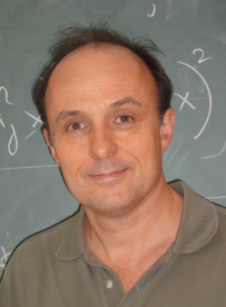 Patrick Gerard合作论文数Department of Mathematics, Faculte des Sciences d’Orsay, Universite Paris-Sud1
 Stefan Le Coz合作论文数LM-Besançon1Fabrice Planchon合作论文数Institut Galilée, Université Paris 13,1
 Gadi Fibich合作论文数Department of Applied Mathematics, School of Mathematical Sciences, Tel Aviv University1
 Oana Pocovnicu合作论文数Universite Paris1Cergy-Pontoise Cedex France合作论文数1Matthieu Hillairet合作论文数1




