The validity of the Jarzynski equation for a very simple, exactly solvable quantum system is analyzed. The implications of two different definitions of work proposed in the literature are investigated. The first one derives from measurements of the system energy at the beginning and at the end of the process under consideration making the work a classical stochastic variable with transition probabilities derived from quantum mechanics. In the second definition an operator of work is introduced and the average in the Jarzynski equation is a quantum expectation value. For the first definition a general quantum mechanical version of the Jarzynski equation is known to hold. For the second one the Jarzynski equation fails to yield the free energy difference at low temperature.
The Canadian high-energy neutron spectrometry system (CHENSS) has been constructed in order to accurately characterize the fluence and energy distribution of high-energy neutrons encountered on space missions in low-Earth orbit.The CHENSS is a proton-recoil spectrometer based on a cylindrical gelled scintillator, with pulse-shape discrimination properties comparable to those of a liquid scintillator, completely surrounded by thin plastic panels which can be used to veto coincident events due to charged particles.The CHENSS has been irradiated by monoenergetic neutron beams, with energies up to 19 MeV, at the Physikalisch-Technische Bundesanstalt.Comparison of the data with fluence determinations performed in parallel to the CHENSS measurements shows good consistency and demonstrates the efficacy of the spectrometer for measurements in space.
The Canadian high-energy neutron spectrometry system (CHE NSS) has been constructed in order to accurately characterize the fluence and energy distribut ion of high-energy neutrons encountered on space missions in low-Earth orbit. The CHENSS is a protonrecoil spectrometer based on a cylindrical gelled scintillator, with pulse-shape discri mination properties comparable to those of a liquid scintillator, completely surrounded by thin plasti c panels which can be used to veto coincident events due to charged particles. The CHENSS has been irr adiated by monoenergetic neutron beams, with energies up to 19 MeV, at the Physikalisch-Techn is e Bundesanstalt. Comparison of the data with fluence determinations performed in para llel to the CHENSS measurements shows good consistency and demonstrates the efficacy of the s pectrometer for measurements in space.
The energy distribution and yield of electrons and hard x-ray photons were investigated by irradiating tungsten and tantalum targets with ~ 30 fs pulses in the intensity range 1018 — 1019 W cm-2 by using the Laboratoire d'Optique Appliquee (LOA) as well as the Max Born Institut (MBI) multiterawatt Ti:sapphire lasers. For the measurement of the hard x-ray emission in the energy range from 15 keV to 700 keV at the LOA a 9-channel spectrometer of calibrated thermoluminescence detectors (TLD) was used. The scaling of the hard x-rays was studied by varying the incident laser energy within one order of magnitude and the pulsewidth by a factor of 5. The hot electron output was investigated in the range 300 keV — 1 MeV with the new MBI Ti:sapphire laser by using a time-of-flight spectrometer. The results indicate a sensitive interplay between the temporal laser shape and laser intensity.
A two-phase system utilizing a rhodium(II1) bipyridine complex and a manganese(II1) porphyrin in the presence of sodium formate for the reductive activation of molecular oxygen and the subsequent epoxidation of alkenes is described. In this system, the reducing equivalents for the conversion of Mn”’ to Mn” are obtained from the rhodium-catalyzed oxidation of formate to carbon dioxide.
Calibrated thermoluminescence dosimeters have been used to measure the angular and spectral dependence of hard x-ray emission produced from intense subpicosecond laser irradiation of solid targets. A dosimeter detector set with nine filter channels (13.5–400 keV) has been tested successfully. Total bremsstrahlung conversion up to 0.23% and conversion of 8×10⁻⁵ from laser energy to Ta Kα line emission (photon energy ≊57 keV) was determined. The scaling of the hard x-ray yield with laser intensities ranging from 3×10¹⁶ to 3×10¹⁸ W/cm2 was investigated.
Temperature profiles in the bulk and at the front facet of a 20 emitter GaAs/AlGaAs double‐quantum‐well laser array are studied by spatially resolved luminescence and micro‐Raman spectroscopy. For optical output powers of about 1 W, the facet temperature of the individual emitters differs by up to 90 K. In contrast, the temperature distribution inside the resonator is highly uniform with temperature differences of less than 2 K. The facet temperature distribution correlates with the near‐field intensity pattern of the laser array. Reabsorption of laser emission close to the facet and subsequent surface recombination of the photogenerated carriers represent the main heating mechanism.
Hard x-ray emission in the range of 100 keV has been measured from plasmas produced by irradiation of solid targets with ps laser pulses up to 7×10¹⁷ W/cm2. The experimental data obtained for oblique incidence of p-polarized laser light at different illumination angles are compared to computer calculations, which include the processes of resonance absorption and vacuum heating. The scaling of hard x-ray emission with varying laser flux is consistent with the theoretical model of bremsstrahlung emission of hot electrons. From this, together with an absolute radiation dose measured with calibrated detectors, a transfer of up to 50% of the incident laser energy to suprathermal (∼10...100 keV) electrons is estimated.
Photodecomposition of the herbicide bromofenoxim was studied in aqueous solution, solid state and in aerosol form. Zn all cases, bromoxynil and 2,4-dinitrophenol are the degradation products. Photodecomposition rate in solution is strongly dependent on the pH with a minimum at pH 8-10 and increasing at lower and higher pH values. Hydrolysis at pH 12 in darkness also yields 2,4-dinitrophenol and bromoxynil as products, while hydrolysis in acidic medium has not been observed to occur in absence of light. Photodecomposition of solid bromofenoxim deposited on an inert surface is also studied and linked to the irradiation time. A system for generation of test aerosols is described. Dry and droplet aerosols are collected, extracted and analyzed after different times of irradiation in order to study the possible photolytical behaviour of bromofenoxim in the atmosphere.
Sulfonated poly(arylene ether sulfones) with various sulfonation levels have been prepared and evaluated as solid polymer electrolytes in electrolysers and fuel cells. Solution and slurry sulfonation of poly(arylene ether sulfones) such as Udel® P-1700 (PSU) and Victrex® PES 5200P (PES) yield polyelectrolytes which have been characterized using FTIR and 1H-NMR spectroscopy, titration, thermal analysis, and electrochemical characterization such as resistivity, selectivity of ion permeation, current/voltage plot and life time test in an electrolysis cell. In contrast to the sulfonated PSU, the PES sulfonated in a slurry process was water insoluble, even at high sulfonation levels of 90 mol%, and gave significantly improved electrochemical properties similar to those of fluorine-containing polyelectrolytes used in commercial membrane systems. A versatile in-situ crosslinking technique has been developed to crosslink the sulfonated poly (arylene ether sulfone) electrolytes during membrane processing in order to substantially reduce water swelling without impairing other membrane properties such as proton conductivity.
Massively parallel systems are based on distributed memory concepts and consist of several hundreds to thousands of nodes interconnected by a very high bandwidth network. Making these systems work requires a very careful operating system design. A distributed operating system is required that takes the form of a functionally dedicated server system. This approach reduces system overhead on the nodes and enables a problem-oriented mapping of system services onto the distributed hardware architecture. The program family concept for operating system construction, combined with a novel virtually shared memory approach, then provides a powerful basis for parallel and distributed computing.
 Gerd Fußmann合作论文数8
 Sandner Wolfgang合作论文数5O. Gehre合作论文数5O. Gruber合作论文数5K.-H. Steuer合作论文数5Matthias Schnürer合作论文数5H.-U. Fahrbach合作论文数5Peter V. Nickles合作论文数5Dr. A. Eberhagen合作论文数5e simmet合作论文数4r lang合作论文数4
 Karl Krieger合作论文数max planck society4Wilhelm Sandmann合作论文数4A. Carlson合作论文数4V. Mertens合作论文数4G. Becker合作论文数4H. Bruhns合作论文数4Brad Bomba合作论文数4Louis Giannone合作论文数4M. P. Kalachnikov合作论文数4Guenter Janeschitz合作论文数4E. Glock合作论文数4G VONGIERKE合作论文数3S KAESDORF合作论文数3h wurz合作论文数3u schneider合作论文数3k hubner合作论文数3f mast合作论文数3Er Muller合作论文数3p ambrosi合作论文数3h rohr合作论文数3J Neuhauser合作论文数3Y. Miura合作论文数3Helmut Niedermeyer合作论文数3H. Rapp合作论文数3
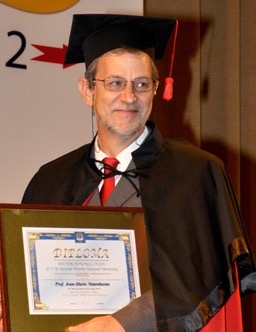 Jean-Marie Noterdaeme合作论文数vakgroep Elektrische Energie, Systemen en Automatisering, faculteit Ingenieurswetenschappen en Architectuur, Ghent University;vakgroep Toegepaste Fysica, faculteit Ingenieurswetenschappen en Architectuur, Ghent University3Eckehart Speth合作论文数3
 Dan Meisel合作论文数Department of Chemistry and Biochemistry, College of Science, University of Notre Dame3H.M. Mayer合作论文数3H. Murmann合作论文数3Frank Soldner合作论文数3Axel Stabler合作论文数3Kathleen a Mccormick合作论文数3D. Roberts合作论文数3
 Karl Lackner合作论文数3F. Schneider合作论文数3
 Ulrich Stroth合作论文数3J. Hofmann合作论文数3G Dodel合作论文数3




