Ultra wideband (UWB) technology is a highly developed wireless radio communication technology used, among others, in location systems. The article focused on using UWB technology to construct a guide location system for an unmanned ground vehicle (UGV). In order to carry out the research, the parameters of the measurement noise occurring in real UWB modules were determined. The mentioned noise simulated disturbed distance measurement indications, modelling real measurements. The paper presented the results of simulation research of selected location algorithms for a guide location system based on UWB technology. The work compareed the total location errors of the guide of selected algorithms based on geometric methods, trilateration and optimisation methods. Simulation studies allow for quick testing of algorithms, taking into account real disturbances and constitute the first stage of work on implementing various algorithms in a real positioning system. The most accurate in the context of guide location among the analysed algorithms was the Levenberg-Marquardt algorithm (lowest value of the average quality index). The geometric method, due to the least complex mathematical model and high susceptibility to interference, was in turn the least accurate location algorithm among the analysed ones.
This paper presents a method for designing manipulators for man-portable UGVs (Unmanned Ground Vehicles), intended for military and counter-terrorism applications. The approach involves selecting manipulator parameters based on requirements for capabilities and a database of available components. The authors identified a gap in the existing literature regarding load definition, particularly for small robot manipulators used in Explosive Ordnance Disposal (EOD) tasks. To address this, a method is proposed consisting of three main stages: In the first stage, manipulator drives and geometric parameters are selected. In the second stage, a detailed load analysis is performed. A distinctive feature of the proposed method is the use of optimization techniques to determine the maximum possible loads during load case definition. In the final stage, topological optimization of the components is carried out. The method was validated using a selected manipulator joint of a portable robot designed for EOD tasks.
Maintaining the road requires regular mowing of ditches and roadside areas. This is mainly done using mowers mounted on agricultural tractors. The trend is to introduce autonomous mowing systems, but so far a number of autonomous solutions for mowing short grass (home lawns, golf courses), and there are few autonomous mower solutions for mowing tall grass on the market. The first part of the article describes the conditions determining work on the development of lawn mowers. Then, a proposal for a semi-autonomous control system for tandem mowers for mowing roadside areas was presented. As part of its construction, a fully functional set was designed and built, consisting of two mowers: wheeled and tracked, a remote control system for the first mower, and a high-level computer with implemented software ensuring autonomous mowing with the second mower under active operator supervision. A series of field tests conducted allowed us to assess the effectiveness and practicality of the proposed solution. Mowing efficiency was assessed by the consistency of subsequent mowing paths. The obtained results indicate that the development of the developed system will significantly improve mowing efficiency and increase employee safety.
The introduction of Unmanned Ground Vehicles (UGVs) into the field of rescue operations is an ongoing process. New tools, such as UGV platforms and dedicated manipulators, provide new opportunities but also come with a steep learning curve. The best way to familiarize operators with new solutions are hands-on courses but their deployment is limited, mostly due to high costs and limited equipment numbers. An alternative way is to use simulators, which from the software side, resemble video games. With the recent expansion of the video game engine industry, currently developed software becomes easier to produce and maintain. This paper tries to answer the question of whether it is possible to develop a highly accurate simulator of a rescue and IED manipulator using a commercially available game engine solution. Firstly, the paper describes different types of simulators for robots currently available. Next, it provides an in-depth description of a plug-in simulator concept. Afterward, an example of a hydrostatic manipulator arm and its virtual representation is described alongside validation and evaluation methodologies. Additionally, the paper provides a set of metrics for an example rescue scenario. Finally, the paper describes research conducted in order to validate the representation accuracy of the developed simulator.
The efficient operation of hydraulic manipulators with expansive working areas is crucial in various applications such as the construction industry, the rescue service, and the military. These machines are characterized by having more capabilities than humans, and they perform tasks that are not repeated in the same environment. For this reason, they are most often controlled by a human in a teleoperation system. This research investigates the influence of the operator’s perception on the energy demand of such manipulators. Specifically, the research focused on assessing how the intuitive control systems, such as primary–secondary solutions, impact the energy consumption. Understanding the relation between the operator’s perception and the energy demand is essential for optimizing manipulator design and operation. Experimental research was conducted to analyze the velocity and acceleration of the manipulator’s effector, which is controlled by human operators under different movement ranges and size ratios. The obtained test results allow for the assessment of the dynamic loads, velocity, and energy consumption of the movement of a manipulator with a large working area due to the limitations resulting from the operator’s perception.
In the following article, the results of a study on the impact of the suspension system used in Unmanned Ground Vehicles (UGVs) on the kinematic excitation of cameras in teleoperation systems are presented. As indicated by preliminary reconnaissance studies, these excitations significantly affect the operator’s ability to perceive the environment and recognize images while driving. Currently, there is a lack of publications and guidelines in the literature regarding the design of UGV suspensions and their evaluation in terms of improving operator perception in teleoperation systems. The studies were conducted in a simulated environment using multibody systems, where various suspension structure variants were developed. The tests were carried out on the ISO 5008 rough test track. The evaluation of the tested suspension structures was carried out using a proprietary method, enabling parametric analysis and the selection of favorable solutions for improving image recognition by the UGV operator. Future research can focus on adjustment of the UGV suspension characteristics which could have significant influence on situational awareness and the operator’s ability to act effectively, especially during dynamic missions.
More and more commonly, manipulators and robots equipped with effectors are used to replace humans in the implementation of tasks that require significant working abilities or are used in dangerous zones. These constructions have considerable ranges and are capable of carrying heavy loads. The specificity of the tasks performed with the use of mentioned devices requires their control by a human. Intuitive tracking systems are used to control them. Problems in their use result from the kinematic amplification between the effector and the operator's hand. Proper design of the drive and control systems for these manipulators requires knowledge of the maximum velocities of the manipulator's effectors, which significantly depend on the scale ratio. The article presents the results of the effector's velocity movements while performing a specific task by the operator's hand with different velocities and scale ratios.
The transition of automated machine systems towards autonomous operation is progressing fast in various industrial sectors. The following paper presents the current situation in the regulations that normalize and support the development of working machines for construction purposes. A review of the existing ISO and IEC standards alongside own work focusing on autonomous machines, as well as a review of different activities in international industry groups regarding automation and autonomy of machines have been presented. Three different approaches to the concept of safety have been identified for different working conditions. The paper also tackles issues of on-board machine communication. By analysing different systems and their basic requirements, several optimization possibilities have been identified in relation to combining different data sources. It has been shown that the combination of different systems at the machine level as well as the connection between different machines can have a major impact on the performance of both the entire system as well as on the machine itself.
Unmanned ground vehicles (UGVs) are technically complex machines to operate in difficult or dangerous environmental conditions. In recent years, there has been an increase in research on so called “following vehicles”. The said concept introduces a guide—an object that sets the route the platform should follow. Afterwards, the role of the UGV is to reproduce the mentioned path. The article is based on the field test results of an outdoor localization subsystem using ultra-wideband technology. It focuses on determining the guide’s route using a smoothing spline for constructing a UGV’s path planning subsystem, which is one of the stages for implementing a “follow-me” system. It has been shown that the use of a smoothing spline, due to the implemented mathematical model, allows for recreating the guide’s path in the event of data decay lasting up to a several seconds. The innovation of this article originates from influencing studies on the smoothing parameter of the estimation errors of the guide’s location.
Unmanned Ground Vehicles (UGV) are devices capable of performing basic working movements without the operator being in their immediate working environment. Their capabilities include but are not limited to the perception of the environment with the use of sensors, determining the platform’s position, and planning and executing its movement. Ultra Wideband (UWB) is one of the wireless communication technologies which is increasingly used in location systems. This article presents the use of UWB technology in developing a guide localization system for a UGV (one of the stages of implementing a follow-me system). The article describes tests carried out on the developed testbed. Their aim was to determine the hardware configuration of the anchor arrangement characterized by the minimum number of lost data packets during operation. In order to determine the influence of the analysed variables on the output values, the method of global sensitivity analysis for neural networks was used.
Ultra-wideband (UWB) technology is one of the most promising wireless communication technologies. Examples of UWB applications include, among others, radiocommunication devices and location systems, due to their operating range, ability to work in outdoor environments, and resistance to multipath effects. This article focuses on the use of UWB technology in constructing a guide localization system for an unmanned ground vehicle (UGV), which is one of the stages of implementing a “follow me” system. This article describes the complete process of UWB signal processing from its acquisition, methods of filtering, and obtained results, to determining the location of the guide. This article examines the possibility of using modified versions of localization algorithms for determining the guide’s location, including trilateration, methods of nonlinear programming, and a geometric algorithm proposed by us. The innovation of this study consists in the implementation of an algorithm that changes the selection of equations (mathematical model) for determining location based on the number of available measurements from UWB sensors.
The use and capabilities of umnanned ground vehicles (UGVs) have increased significantly in recent years. This applies to both the national economy and the army. More and more commercial vehicles are being used to perform tasks that are considered dangerous for personnel, such as chemical and biological monitoring of military installations, firefighting. probing unidentified areas and disposal of explosive devices. The application of the UGVs also allows to minimize requirements regarding soldiers' presence in such tasks as border patrolling and supply transports in military active areas. Although the benefits and uses of UGVs are very desirable, the use of Unmanned Transport Vehicles (UTV) introduces new concerns about the safety of soldiers and manned vehicles. These fears are all the greater because in UTV service the role of the operator is significantly reduced. The following paper presents the areas of application and discusses concerns related to the safety of UTVs and the analysis of requirements aimed at ensuring their safe use.
The article describes the possibility of using Ultra Wideband (UWB) technology for the purpose of trajectory tracking of a moving object equipped with a UWB transmitter (so-called tag). The discussed system consists of four receivers (so-called anchors) placed on an omnidirectional mobile robot with mecanum wheels and one tag attached to the moving object. UWB signals are used to determine the position of the tag, while the implemented control system realizes an estimated trajectory of the characteristic point of a wheeled mobile robot.
UWB (Ultra Wideband) is one of the wireless data transmission techniques in which signal is emitted in a very wide frequency band opposed to narrowband radio-communication systems The location detection using the UWB can ensure high location accuracy. The most commonly used methods for determining position in wireless systems: RSS (Received Signal Strength), AOA (Angle of Arrival), TOA (Time of Arrival), TDOA (Time Difference of Arrival). The paper presents a theoretical analysis of determining the location of an static object based on geometric multilateration and modified geometric trilateration techniques.
The increase in functionality of unmanned land platforms is accompanied by the development of new manipulation equipment. In many cases, this development complicates their cinematic structure, increasing their degrees of freedom (DOF) to 6 and beyond. Based on extensive research carried out at the Institute of Machine Building of the Military University of Technology, using such hydraulically powered structures creates a need to operate two different actuators simultaneously. In such scenarios, the total volumetric flow of the hydraulic fluid within the power system reaches op to several liters per minute, which allows for use of small diameter hydraulic hoses. Based on the above-mentioned assumptions, a new power system has been developed for these types of manipulators, which uses a spool valve bank and thermoplastic hydraulic hoses. Since these types of manipulators are dedicated to handling high loads, there's a problem of vibrations being transferred to the work tool from the mechanical structure of the unit. Because of this, the following paper focuses on assessing the possibilities of the newly developed power system regarding limiting the vibrations of the work tool during precise control. (c) 2018
The article discusses the requirements for the hydrostatic system of turning unmanned mobile robots in the context of using the system to follow the guide. The requirements set in this regard by the army were analyzed. Exchange car monitoring systems for cars. The control system of the unmanned ground platform and the results of tests on the intensity of the platform's turn compared to a typical construction machine are discussed.
The article compares anthropomorphic and industrial manipulators. The basic differences between these constructions are indicated, resulting both from the control method as well as the kinematic structure. Presented the method of developing the kinematic structure of the anthropomorphic manipulator as a construction similar to the human upper limb. An anthropomorphic manipulator model was developed based on accepted assemblies concerning a significant increase in human working capacity in the context of reloading and transport work. Simulation studies were carried out on the manipulator model developed in the aspect of determining selected hydro-static drive system parameters.
Remote controlled working machines became popular in recent years among both big and small construction companies as well as with military contractors. This type of control offers flexibility when creating the mechanical structure of a new machine, may improve operator's insight into the work process and can save human lives when dealing with highly dangerous materials. It`s possible to distinguish two major groups within the remote controlled working machine family: close range remote control and long range remote control (teleoperated). Close range remote control machines are mostly being used in scenarios where human life is not at risk and the machine is operating within a humanpopulated environment. Long range remote control machinery however operates in areas which are either inaccessible to humans or may prove hazardous to human life. Such applications may include (but are not limited to): dangerous material disposal, construction areas, mines etc. Because of the importance of said tasks its crucial to have a beforehand knowledge of how a certain machine will behave in certain conditions. This is especially important now since today`s market is filled with solutions offering,the best" performance possible. While certainly true in some aspects, it's impossible for the consumer to actually differentiate between these machines as there are no universal criteria by which to measure said performance. This article proposes a solution which could be used to assess the level of functionality and performance of teleoperated working machines based on a series of objective and subjective factors which are all processed in a way which presents the potential consumer with an unequivocal, value based indicator which can then be used to compare different solutions. The article also presents a first version of test scenarios for two aspects of a teleoperated machine: the work tool and the base platform.
 A. Typiak合作论文数14Miroslaw Przybysz合作论文数10Andrzej Typiak合作论文数10
 Łukasz Rykała合作论文数Fac Mech Engn, Mil Univ Technol10Piotr Krogul合作论文数10Karol Cieslik合作论文数9Lopatka, M.J.合作论文数6
 Arkadiusz Rubiec合作论文数6Stanisław Konopka合作论文数Department of Heavy Duty Machines and Research Methodology, University of Warmia and Mazury in Olsztyn5s konopka合作论文数3Kacper Spadlo合作论文数2Muszynski, T.合作论文数2
 Magdalena Rykała合作论文数1a dąbrowska合作论文数1
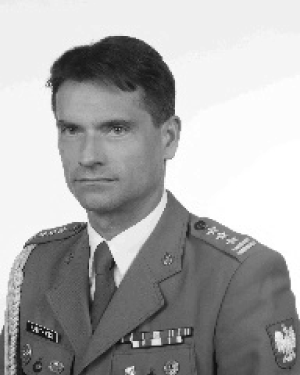 Bartnicki, A.合作论文数1




